
Test 3 of 10 · 20 questions · Free 2026
WI Permit Practice Test 3
Jump to the test ↓A fixed 20 question set from the Wisconsin bank with answers and plain English explanations. The real WI exam has a 15 question road sign section with 12 correct to pass, plus 50 knowledge questions with 40 correct to pass; take the full length version on the main practice page.
Question 1 of 20 · 0 right so far
All 20 questions in test 3
Every question below comes from the Wisconsin question bank on this page. Open a question to see the correct answer and the explanation. Nothing here is hidden behind a signup.
1. If a Wisconsin driver refuses a requested PAC test, what minimum driving privilege consequence does the handbook describe?
- Loss of driving privileges for at least one year
- A warning with no license consequence
- A three-month suspension only
- A requirement to retake the signs test
Show answer
Loss of driving privileges for at least one year. Wisconsin's implied consent rule requires a driver to agree to a prohibited alcohol concentration test when an officer asks. Refusal leads to arrest for violating the Implied Consent Law and loss of driving privileges for at least one year, along with other consequences. A warning or a short three-month suspension understates the stated minimum. Retaking a signs test does not address the refusal consequence. The practical cue is that consent is tied to the privilege to drive, not merely to the outcome of an alcohol measurement.
Study this in the handbook: Alcohol, drugs and implied consent
2. When may a driver cross a dashed yellow centerline to pass?
- When the vehicle ahead is farm equipment
- Whenever the driver wants to save time
- Only after sounding the horn twice
- When passing is safe and the way is clear
Show answer
When passing is safe and the way is clear. A dashed yellow line indicates that passing may be permitted, but the maneuver still depends on safety. Check for adequate view, oncoming traffic, and room to return before crossing. Treating the marking as permission at any moment ignores the handbook’s warning to watch for other traffic. A horn does not make an unsafe pass lawful, and the type of vehicle ahead, such as farm equipment, is not what makes the pass allowed. The key cue is a dashed line plus a clear, safe path, never the marking by itself.
Study this in the handbook: Lane lines, crosswalks and special lanes
3. How should you approach an intersection when trees, buildings, or parked vehicles block your view?
- Rely on the vehicle ahead without looking
- Accelerate so you clear the obstruction quickly
- Stop in the middle of the cross street
- Approach at a slow pace
Show answer
Approach at a slow pace. A blocked intersection requires a slow approach because the obstruction can hide a vehicle, cyclist, or pedestrian. Moving slowly gives you time to search left and right, keep control, and brake if someone appears. Accelerating reduces the time available to react, and following another vehicle without looking leaves you dependent on its driver. The handbook does not call for stopping in the cross street. Reduce speed before the blocked area and enter only after the path is visible and clear.
Study this in the handbook: Right of way
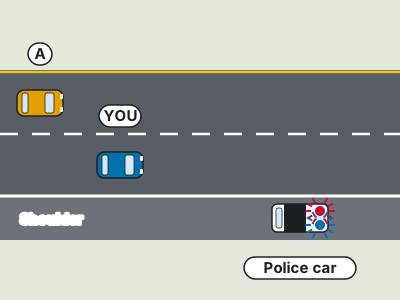
4. What must a driver do when a police car is stopped on the roadside with lights and sirens on?
- Move over or slow down to give it room
- Stop directly behind the police car
- Pass without changing speed if the lane is open
- Turn around before reaching the stopped vehicle
Show answer
Move over or slow down to give it room. Wisconsin’s roadside rule protects officers and other emergency personnel working near traffic. When a police car is stopped with lights and sirens active, move over when possible or slow down to provide space. Stopping directly behind it can obstruct the scene, and passing at unchanged speed leaves the roadside worker exposed. A turnaround is not the required response. Scan ahead for stopped emergency vehicles, choose a safe adjacent lane if available, and reduce speed when a lane change cannot be made safely.
Study this in the handbook: Pedestrians, emergency vehicles and school buses
5. On a two lane road, what does a solid yellow line beside a dashed yellow line indicate?
- The road is changing to one way traffic
- Passing is forbidden for vehicles on both sides
- Passing is allowed from the solid side only
- Passing is allowed from the dashed side but not the solid side
Show answer
Passing is allowed from the dashed side but not the solid side. A mixed yellow centerline assigns different passing permissions to the two directions. The driver beside the dashed line may pass when conditions make the maneuver safe. The driver beside the solid line may not pass. Treating both sides as prohibited loses the permission on the dashed side, while using the solid side reverses the marking’s meaning. Before crossing, check sight distance, opposing traffic, and the surrounding roadway. The line nearest your vehicle is the one that governs your passing decision.
Study this in the handbook: Lane lines, crosswalks and special lanes
6. How much room must you give a bicyclist when passing in Wisconsin?
- At least one foot
- At least three feet
- At least ten feet
- Half a lane width
Show answer
At least three feet. Wisconsin tells drivers to give bicyclists at least three feet of room when passing, and to wait for oncoming traffic to clear before passing. Bicyclists can use the whole traffic lane, and drivers should not share a lane with them because they can move into your path quickly. One foot is far too close. Ten feet is the handbook's stopping distance for a pedestrian with a white cane or guide dog. Half a lane is not a measure the handbook uses.
Study this in the handbook: Motorcycles, bicycles and truck no zones
7. How much room should you give a snowplow in Wisconsin when its lights are flashing?
- At least 200 feet
- At least 20 feet
- At least 50 feet
- At least 1,000 feet
Show answer
At least 200 feet. Wisconsin's winter driving tips tell drivers to give snowplows at least 200 feet of room when their lights are flashing red, amber or green. Twenty feet is the school bus stopping distance and far too close to a working plow. Fifty feet is still too close. A thousand feet is not the handbook's figure. The same winter list also advises driving slowly, leaving extra room in front of your vehicle, and skipping cruise control on slippery roads.
Study this in the handbook: Bad weather, skids, winter and rural roads
8. A Wisconsin probationary driver under 18 is in the first nine months of GDL restrictions. When may the teen drive alone between midnight and 5 a.m.?
- Only when driving between home, school and/or work
- Never, under any circumstances
- Anytime, as long as no passengers ride along
- Only on weekends
Show answer
Only when driving between home, school and/or work. From 12 a.m. to 5 a.m., a Wisconsin GDL driver may drive alone only if driving between home, school and/or work. Otherwise the teen needs a qualified adult: a qualified instructor or spouse 19 or older, or a person 21 or older, with a valid regular license and two years of experience. Never is too strict, because the home, school and work trips are allowed. Driving alone anywhere overnight ignores the purpose limit, and the handbook sets no weekend rule.
Study this in the handbook: The probationary license and GDL restrictions
9. A 16 year old Wisconsin permit holder is driving with a qualified adult in front. Who else may ride along, in a seat other than the front seat?
- Any number of friends from school
- One other licensed person 25 or older with at least two years of experience
- One unlicensed passenger 18 or older
- No one else
Show answer
One other licensed person 25 or older with at least two years of experience. Once the permit holder is at least 16, the handbook allows one other licensed person 25 years of age or more with at least two years of driving experience to ride in a seat other than the front seat, in addition to the accompanying driver. When the front seat supervisor is a parent, guardian or spouse, immediate family members may also ride in the back. A group of school friends or an unlicensed adult is not on the list. Saying no one else may ride is wrong, because this extra licensed adult is allowed.
Study this in the handbook: Sponsors and the instruction permit
10. A Wisconsin instruction permit holder wants to practice with a licensed adult. Which license may that adult NOT be holding?
- A regular license held for five years
- A regular license held for exactly two years
- A probationary or occupational license
- A regular license held for ten years with no violations
Show answer
A probationary or occupational license. The person riding with a permit holder must have at least two years of licensed driving experience and a valid regular license. The handbook states that this license cannot be a probationary or occupational license. A regular license held two, five or ten years meets the experience rule. The person must also sit in the front passenger seat and be a qualified instructor or parent, guardian or spouse 19 or older, or a person 21 or older.
Study this in the handbook: Sponsors and the instruction permit
11. What should you expect at a Sharp Turn warning?

- A long gradual bend that never changes direction sharply
- A left or right turn requiring readiness to slow
- A lane merge controlled by a traffic signal
- A railroad crossing with a Yield sign below it
Show answer
A left or right turn requiring readiness to slow. The Sharp Turn warning may show a left or right arrow and tells drivers to be ready to slow down while turning on that road. The gradual-bend choice describes a curved road, which is a different warning. A signal-controlled merge and a railroad crossing with a Yield sign belong to separate topics in the handbook. Focus on the arrow's direction, reduce speed before the turn, and keep enough control to follow the road without drifting across the lane or needing abrupt braking.
Study this in the handbook: Warning and construction signs
12. How should you apply ABS during an emergency stop?
- Press firmly and continuously until stopped or danger passes
- Pump the brake pedal rapidly from the first moment
- Release the brake whenever the wheels begin to slow
- Use the parking brake instead of the foot brake
Show answer
Press firmly and continuously until stopped or danger passes. With ABS, use firm, continuous pressure on the brake pedal and keep applying it until the vehicle stops or the danger has passed. The pumping choice describes a technique for a vehicle without ABS, not the handbook's emergency ABS method. The system is designed to help prevent wheel lock and reduce skidding while you maintain braking force. Keep watching for traffic behind you, because a sudden stop can create a second hazard.
Study this in the handbook: Avoiding crashes, crash duties and roadside emergencies
13. What action does a Wisconsin Road Workers Ahead sign encourage?
- Stop in the travel lane until construction ends
- Maintain speed because workers must leave the lane
- Slow down or move over for workers ahead
- Use the shoulder to pass the work area quickly
Show answer
Slow down or move over for workers ahead. A Road Workers Ahead sign warns that people are working near the roadway. Slow down and move over when that can be done safely, giving workers more time and space. Maintaining speed leaves less margin around the work zone, while stopping in the travel lane can create a separate collision hazard. The shoulder is not automatically an open passing lane. Scan for cones, flaggers, and changing lane paths, then follow the posted directions as you approach the workers.
Study this in the handbook: Warning and construction signs
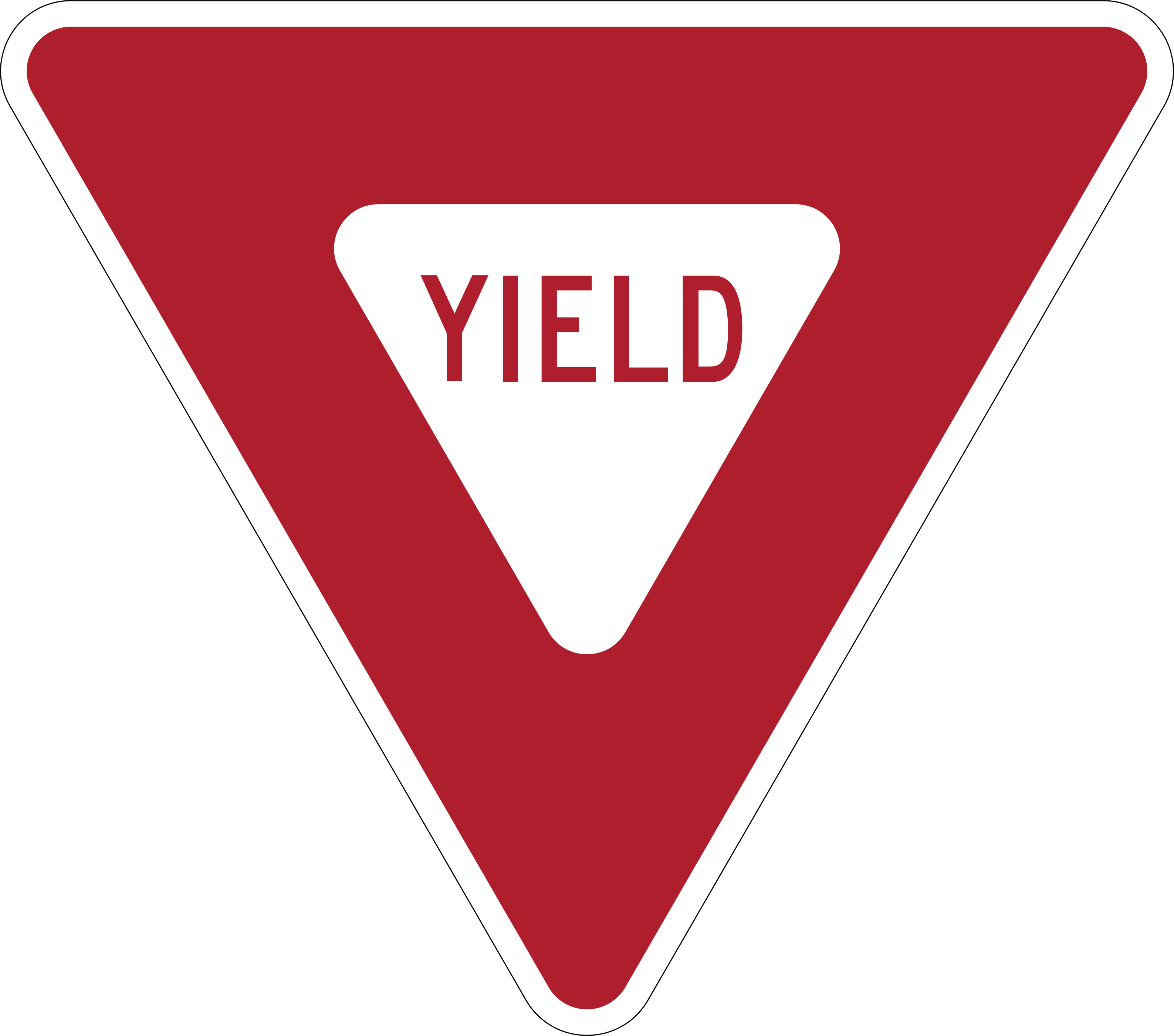
14. At a railroad crossing, what does the handbook require when a Yield sign is posted below the crossbuck?
- Cross quickly before a train reaches the nearest track
- Yield to trains that are crossing
- Stop only when the crossing lights are dark
- Continue because a crossbuck gives your vehicle priority
Show answer
Yield to trains that are crossing. A Yield sign beneath the railroad crossbuck means an approaching train has priority at the crossing. The choice “Yield to trains that are crossing” captures the handbook rule directly. The choice “Cross quickly before a train reaches the nearest track” is dangerous because the handbook warns drivers never to try to beat a train. The choice “Stop only when the crossing lights are dark” reverses the safety condition: a dark signal does not remove the duty to look both ways. The choice “Continue because a crossbuck gives your vehicle priority” treats the crossbuck as permission to proceed, when its purpose is to identify the crossing and, with the posted Yield sign, require yielding. Scan both directions before entering the tracks.
Study this in the handbook: Railroad crossing signs and rules
15. What does a dashed yellow line beside a solid yellow line allow?
- Passing only from the solid-line side
- Passing in both directions at any time
- Passing only from the dashed-line side
- No passing for either direction
Show answer
Passing only from the dashed-line side. A dashed and solid yellow pair assigns a different passing rule to each side. A driver next to the dashed side may pass when it is safe, while a driver next to the solid side may not pass. The marking does not allow passing in both directions, and the solid side is the restricted side rather than the permitted one. Before moving around another vehicle, identify which line is beside your lane, check the traffic and sight distance, and make sure the maneuver is safe. The paint pattern must be read from the driver's side, not from the other lane.
Study this in the handbook: Lane lines, crosswalks and special lanes
16. What should you do when this pedestrian crossing warning appears?

- Use the shoulder instead of the marked crossing
- Accelerate so pedestrians clear the lane sooner
- Stop only if a school bus is present
- Yield to crossing pedestrians
Show answer
Yield to crossing pedestrians. The pedestrian crossing warning marks a location where people may cross, and Wisconsin specifically directs drivers to yield to crossing pedestrians. Accelerating is the opposite of the cautious response needed near a crossing. The school bus condition is too narrow because this warning is for pedestrians generally. Driving on the shoulder does not create a safe substitute and can endanger people outside the lane. Watch the arrow for the crossing location, check both sides, and be ready to stop before a person enters your path.
Study this in the handbook: Warning and construction signs
17. Why should Wisconsin drivers give motorcycles extra room when following them?
- Motorcycles cannot use regular traffic lanes
- Motorcycles are required to travel below 25 mph
- Motorcycles always have two riders
- Motorcycles can stop faster than most vehicles
Show answer
Motorcycles can stop faster than most vehicles. Wisconsin notes that motorcycles are lightweight and can stop faster than most vehicles, so drivers following them need extra space. That quicker stop means the gap behind a motorcycle can close fast. The 25 mph statement is not the handbook rule, and the number of riders does not explain following distance. Motorcycles use traffic lanes like other road users. Leave a larger cushion, check blind spots carefully, and wait until passing can be done safely.
Study this in the handbook: Motorcycles, bicycles and truck no zones
18. When may a driver make a U-turn on a rural two-lane highway in Wisconsin?
- Whenever the driver activates hazard lights
- Only at a signalized intersection
- When it is done safely and does not interfere with traffic
- Never, because rural highways prohibit U-turns
Show answer
When it is done safely and does not interfere with traffic. A U-turn on a rural two-lane highway is allowed when the maneuver is safe and does not interfere with traffic. The handbook also tells drivers to check mirrors, surrounding traffic, and signs that prohibit the turn. A signalized intersection is not the only possible location, hazard lights do not create permission, and rural roads are not subject to a blanket ban. Before turning, scan carefully and look for a posted restriction. The deciding conditions are safe completion and no interference with other road users.
Study this in the handbook: Turns, passing, backing and parking
19. Unless a sign sets a different limit, what speed applies in a Wisconsin residential area?
- 15 miles per hour
- 25 miles per hour
- 30 miles per hour
- 35 miles per hour
Show answer
25 miles per hour. Wisconsin sets the residential default at 25 miles per hour when no other sign changes the limit. The 15 mile choice belongs to a school zone when children are present, while 30 and 35 miles per hour are not the handbook’s residential default. Posted signs still control when they show another number. On a practice question, first identify the land use, then check whether the wording says unless otherwise posted. That pairing points to 25 miles per hour rather than the nearby school zone and outlying-area figures.
Study this in the handbook: Speed limits and the sight distance rule
20. A vehicle is passing your vehicle in the same direction. What responsibility does the Wisconsin handbook assign you?
- Move left to occupy the passing vehicle’s lane
- Accelerate so the other driver cannot complete the pass
- Yield to the passing vehicle
- Maintain speed and force the other vehicle to brake
Show answer
Yield to the passing vehicle. A driver being passed must yield to the vehicle passing on the left or right in the same direction. Accelerating, moving into the passing lane, or forcing the other driver to brake creates conflict and contradicts the handbook’s right-of-way instruction. Ease off as needed and allow the maneuver to finish safely, while keeping control of your lane. The cue is that the other vehicle is already passing and traveling the same direction. That situation calls for cooperation, not competition over lane position or speed.
Study this in the handbook: Right of way
QualitySpace is expanding to Wisconsin
We are a California-based independent insurance brokerage working on licensing in more states. We cannot help with Wisconsin insurance yet. Leave your email and we will let you know when we can.
Every question is written from the official Wisconsin Motorists' Handbook. Need paper? Printable WI practice test with answer key.
Last verified 2026-10-05. How we check every question · Study all 200 as flashcards
Frequently asked questions
How many questions are on this Wisconsin practice test?
This fixed set has 20 questions. It is test 3 of 10 from the 200 question Wisconsin bank. The real WI exam has a 15 question road sign section with 12 correct to pass, plus 50 knowledge questions with 40 correct to pass.
What is the passing score for the real Wisconsin test?
40 questions (80%) correctly to pass That figure comes from the official Wisconsin source cited on the DMV facts page.
How does this fixed test relate to the full Wisconsin bank?
Each numbered test is a fixed set of questions in a fixed order, so you can retake the same test later and compare. Every test mixes road signs and the other topics in about the same proportion as the full bank. Tests 1 to 10 together cover every question in the Wisconsin bank once. The full practice page mixes the whole bank at random.
Last verified 2026-10-05. See the Wisconsin DMV facts page for sourced state details.
Return to the full Wisconsin practice test · Study road signs