
Test 14 of 25 · 20 questions · Free 2026
WI Permit Practice Test 14
Jump to the test ↓A fixed 20 question set from the Wisconsin bank with answers and plain English explanations. The real WI exam has a 15 question road sign section with 12 correct to pass, plus 50 knowledge questions with 40 correct to pass; take the full length version on the main practice page.
Question 1 of 20 · 0 right so far
All 20 questions in test 14
Every question below comes from the Wisconsin question bank on this page. Open a question to see the correct answer and the explanation. Nothing here is hidden behind a signup.
1. In Wisconsin, after a train passes on double tracks, when should a driver cross?
- As soon as the caboose passes the crossing sign
- While the first train still blocks your view of the far track completely
- Immediately when the warning lights stop flashing
- After waiting until the train is far away and the tracks look clear
Show answer
After waiting until the train is far away and the tracks look clear. On double tracks, a passing train can hide a second train on the far track. Wait until the first train is far away so you can actually see that the tracks are clear before crossing. Moving as soon as the end passes, or while your view is blocked, risks driving into that second train. Even after lights stop, your own view of both tracks is the final check.
Study this in the handbook: Railroad crossing signs and rules
2. In Wisconsin, roads have turned icy before a planned trip. What is the best choice?
- Drive, but only in the left lane
- Drive, but tailgate a truck for guidance
- Try to avoid driving on the icy roads
- Drive, because ice matters only on bridges
Show answer
Try to avoid driving on the icy roads. When roads are icy, try to avoid driving at all, because ice can remove nearly all grip without warning. Lane choice, following a truck closely, or trusting that ice lives only on bridges does not make an icy trip safe. Postpone the drive, or if you are already out, slow drastically and increase space. The safest icy-road crash is the trip that never starts.
Study this in the handbook: Right of way
3. In Wisconsin, a police officer is directing traffic at an intersection where lights also work. Whose directions must a driver follow?
- The traffic light, because lights always outrank people
- The driver who arrived first at the corner
- The police officer directing traffic
- The directions painted on the pavement only
Show answer
The police officer directing traffic. When an officer directs traffic, follow the officer, even where a working light or sign says something different. Human direction handles the exact blockage, crash or backup in front of you, while the light follows its normal cycle. Arrival order and pavement paint do not outrank the officer. Watch the officer, move only as directed, and keep scanning for pedestrians while you proceed.
Study this in the handbook: Traffic lights and arrows
4. In Wisconsin, at an intersection with no signals or signs, what matters most for safety?
- Keep control of your vehicle and be able to brake if needed
- Reach the center first so others must yield
- Sound the horn all the way through
- Roll through slowly without braking readiness
Show answer
Keep control of your vehicle and be able to brake if needed. Where there are no control signals or signs, keep control of your vehicle and be ready to brake, because no light will sort the crossing for you. Racing to the center, leaning on the horn, or rolling without brake readiness invites a crash with a driver doing the same. Approach slowly, scan each approach, and be set to yield even if you believe the right-of-way is yours.
Study this in the handbook: Right of way
5. In Wisconsin, how does a prohibited alcohol concentration test measure alcohol?
- A vision test given at the roadside stop
- A breathalyzer or blood test that measures alcohol amount
- A balance test given on the road shoulder
- A written test given at the police station
Show answer
A breathalyzer or blood test that measures alcohol amount. A prohibited alcohol concentration test finds whether you have a measurable amount of alcohol by a breathalyzer or blood test. Vision checks, balance exercises, and written quizzes do not measure concentration. If an officer asks you to take this test, you must agree; refusing brings arrest and loss of driving privileges for at least one year under implied consent. Breath and blood are the two measuring methods officers can use.
Study this in the handbook: Alcohol, drugs and implied consent
6. In Wisconsin, preparing to turn quickly to avoid a crash, what steering preparation is required?
- Grip with both hands, and stay ready to control the recovery
- Use one hand so the other can give signals
- Let go briefly after the turn to relax a bit
- Turn first, then decide recovery afterward
Show answer
Grip with both hands, and stay ready to control the recovery. To turn away from a crash, grip the steering wheel with both hands, then stay ready to keep the vehicle under control after the turn or lane change. One-handed signaling, letting go, or postponing recovery planning invites a second collision after dodging the first. Many drivers steer away from one crash only to end in another. Choose a path, turn firmly, and immediately manage where the car settles.
Study this in the handbook: Avoiding crashes, crash duties and roadside emergencies
7. In Wisconsin, vehicles arrive at a four-way stop at different times during busy traffic. Who has priority to go?
- The driver or bicyclist that arrived first at the stop
- The largest vehicle, because it needs the most room
- The driver who honks first to claim the intersection
- The driver on the right goes first, no matter who arrived first
Show answer
The driver or bicyclist that arrived first at the stop. At a four-way stop, when vehicles arrive at different times, the driver or bicyclist that arrived first has priority. Size, honking, and the right-side tie rule do not reorder that queue when arrival times differ. Complete your stop, note who arrived before you, and yield to each earlier arrival in turn. When arrival is truly simultaneous instead, the separate tie rule gives priority to the driver on the right.
Study this in the handbook: Right of way
8. In Wisconsin, what does the merge sign at a flex lane tell a driver?
- A new flex lane begins on the other shoulder
- Drivers may choose either shoulder to continue
- The flex lane ends there, so merge to the normal lanes
- Trucks must move into the flex lane there
Show answer
The flex lane ends there, so merge to the normal lanes. The merge sign marks the end of the flex lane, telling drivers to merge back to the general-purpose lanes. It does not start a flex lane on the other side, open both shoulders, or send trucks into the shoulder lane. Plan the merge before the sign, match the speed of the normal lanes, and slide into a gap without braking hard at the lane end.
Study this in the handbook: Lane lines, crosswalks and special lanes
9. In Wisconsin, what shape helps a driver recognize a state road sign?
- A badge shape in grey or white
- A shield shape with red on the top and blue below
- A rectangle with rounded edges
- A milk jug shape, white with black lettering
Show answer
A milk jug shape, white with black lettering. A Wisconsin state road sign looks like a milk jug with a spout at the bottom, in white with black lettering. The badge shape belongs to U.S. routes, the red and blue shield to interstates, and the rounded rectangle to county roads. Learning that jug outline helps you confirm at a glance that you are looking at a Wisconsin state road sign.
10. In Wisconsin, why do metered ramp signals help freeway traffic flow better?
- They let ramp cars enter in large groups at once
- They raise the freeway speed limit at rush hour
- They evenly space merging vehicles and reduce congestion
- They close entrance ramps for the whole evening
Show answer
They evenly space merging vehicles and reduce congestion. Metered ramps evenly space the vehicles merging onto the freeway, which reduces congestion both on the freeway and back at the entrance ramp. Releasing cars in large groups would recreate the jam metering prevents, and the signals neither raise speed limits nor close ramps all evening. One car per green, spaced steadily, lets freeway drivers keep a smooth speed instead of braking for clusters.
Study this in the handbook: Roundabouts, metered ramps and funeral processions
11. In Wisconsin, you see a fluorescent yellow-green sign with five sides ahead near a crossing. What does it identify?
- A railroad crossing where a train might be close ahead
- A school zone or a school crossing area
- A construction area where fines are doubled for speeding
- A divided highway beginning with separated opposing traffic
Show answer
A school zone or a school crossing area. The fluorescent pentagonal sign, with five sides, identifies a school zone or school crossing. Its shape and color separate it from the round railroad warning, orange construction warnings, and diamond shaped divided highway warnings. Children may be crossing near that sign, so slow down, watch the crosswalks, and be ready to stop. Shape recognition matters here because the five-sided outline carries the school meaning before any words can be read.
Study this in the handbook: Warning and construction signs
12. In Wisconsin, children are visible near a school speed limit sign. What does the sign require?
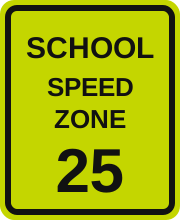
- Drive up to 25 mph because schools sit in residential areas
- Do not drive faster than the speed shown on the sign
- Match the speed of adult traffic passing the school
- Use the listed speed only when a crossing guard is present
Show answer
Do not drive faster than the speed shown on the sign. When children are visible, the speed printed on the school zone sign becomes the maximum you may drive. The rule turns on whether children can be seen, not on whether a guard is present. A residential limit does not replace the school sign, and adult traffic does not set your speed. Read the number on the sign, stay at or below it, and watch for children who may step out.
Study this in the handbook: Regulatory, destination and service signs
13. In Wisconsin, making a left turn with oncoming traffic coming, where should the driver wait?
- About halfway into the intersection while approaching slowly
- Fully across the oncoming lanes before waiting
- At the curb before entering any part of the corner
- In the crosswalk until traffic clears
Show answer
About halfway into the intersection while approaching slowly. For a left turn, slowly approach and wait about halfway in the intersection, close to the center, while oncoming traffic passes. That position shows your intent and shortens the final turn. Waiting fully across the lanes blocks traffic, waiting at the curb causes hesitation later, and waiting in the crosswalk endangers pedestrians. Keep wheels straight while you wait, then turn when the gap is truly safe.
Study this in the handbook: Turns, passing, backing and parking
14. In Wisconsin, a driver is moving to the right lane. Which shoulder check is required?
- Check over the left shoulder for every lane change
- Look only in the center mirror before moving
- Look down at the lane lines while moving over
- Check over the right shoulder, in the direction of the move
Show answer
Check over the right shoulder, in the direction of the move. Check over the shoulder in the direction you are changing lanes: left shoulder for a left move, right shoulder for a right move. That glance covers the blind spot your mirrors miss on that exact side. The center mirror alone, the opposite shoulder, or the pavement at your wheels cannot show the car pacing beside your rear door. Turn your head, confirm the space, then move.
15. In Wisconsin, how much farther do high beams let a driver see compared with low beams?
- Twice as far as low beams let you see
- The same distance, but with warmer color
- Half as far, to protect other drivers
- Ten times as far on any road
Show answer
Twice as far as low beams let you see. High beams let you see twice as far as low beams, which is why they help on empty, dark roads. They do not merely change color, shrink your view, or multiply it tenfold. That extra reach reveals deer, stalled cars, and curves earlier. Switch back to low beams the moment a vehicle approaches, so your wider view does not steal the other driver sight.
Study this in the handbook: The horn, headlights and turn signals
16. In Wisconsin, on a cold wet morning you cross several bridges before the sun warms the road. Why do those bridges need extra care?
- Bridges stay warmer than the road and dry first in winter
- Bridges and overpasses freeze before the rest of the roadway
- Only shaded curves freeze early in the morning; bridges freeze last of all
- Bridge ice forms only after the whole road is already icy
Show answer
Bridges and overpasses freeze before the rest of the roadway. In severe weather, bridges and overpasses freeze before the rest of the roadway. Cold air surrounds the raised surface, so a bridge deck can carry ice while the approach road is only wet. Treating bridges as warmer, drier, or last to freeze reverses that warning. Slow down before the deck, avoid hard braking or sharp steering on it, and expect the grip to return only after you are back on solid ground.
Study this in the handbook: Bad weather, skids, winter and rural roads
17. In Wisconsin, a driver turns from the middle of three turn lanes. Which lane should the driver end in?
- The left-most lane, because it is widest
- The middle lane of the street being turned onto
- The right-most lane, to exit sooner
- Any lane, as long as the signal stays on
Show answer
The middle lane of the street being turned onto. With multiple turn lanes, end in the lane that matches the one you started from: left-most to left-most, middle to middle. Swinging to the widest or fastest-exit lane crosses the path of drivers turning beside you in formation. A signal does not license a lane change mid-turn. Choose the correct starting lane before the corner, hold it through the turn, and change lanes only after straightening out.
Study this in the handbook: Turns, passing, backing and parking
18. In Wisconsin, which three documents should a driver make sure to have before driving?
- Driver license, fuel receipts and parking permits
- Insurance card, radio license and inspection sticker
- Valid driver license, proof of insurance and vehicle registration
- Registration, toll pass and emission report only
Show answer
Valid driver license, proof of insurance and vehicle registration. Before driving, make sure you have your valid driver license, proof of insurance and vehicle registration with you. Fuel receipts, parking permits, radio paperwork, toll passes and emission reports do not substitute for that trio at a traffic stop. An officer may ask for all three, and insurance proof must be presented on request. Keep current copies where you can reach them without digging while stopped.
Study this in the handbook: Right of way
19. In Wisconsin, finishing a parallel park, what wheel action brings the car parallel with the curb?
- Keep the wheel locked the first way until parked
- Turn the wheel straight and roll forward first
- Turn toward the same side a second full time
- When your bumper clears the front car, turn sharply opposite
Show answer
When your bumper clears the front car, turn sharply opposite. When your front bumper is clear of the vehicle in front, turn your wheel sharply in the opposite direction and back slowly until you are parallel with the curb. Holding the first lock drives you into the curb, rolling forward wastes the entry, and repeating the same turn over-rotates the car. Finish about a foot from the curb, at least two feet from cars before and behind you.
Study this in the handbook: The horn, headlights and turn signals
20. In Wisconsin, approaching a two-lane roundabout, what must a driver do before entering?
- Yield only to traffic in the nearest lane
- Enter beside circulating traffic and merge inside
- Choose a lane after entering the circle
- Choose the correct lane and yield to all traffic in both lanes
Show answer
Choose the correct lane and yield to all traffic in both lanes. At a two-lane roundabout, choose your lane and yield to all traffic in both lanes before entering, because vehicles inside may exit across your entry path. Yielding to only the nearest lane, merging inside the circle, or picking a lane after entry all invite sideswipes. Decide by your exit: right lane for right and through moves as signed, left lane for left and U-turn moves as signed.
Study this in the handbook: Roundabouts, metered ramps and funeral processions
Every question is written from the official Wisconsin Motorists' Handbook. Need paper? Printable WI practice test with answer key.
Last verified 2026-10-05. How we check every question · Study all 500 as flashcards
Frequently asked questions
How many questions are on this Wisconsin practice test?
This fixed set has 20 questions. It is test 14 of 25 from the 500 question Wisconsin bank. The real WI exam has a 15 question road sign section with 12 correct to pass, plus 50 knowledge questions with 40 correct to pass.
What is the passing score for the real Wisconsin test?
40 questions (80%) correctly to pass That figure comes from the official Wisconsin source cited on the DMV facts page.
How does this fixed test relate to the full Wisconsin bank?
Each numbered test is a fixed set of questions in a fixed order, so you can retake the same test later and compare. Every test mixes road signs and the other topics in about the same proportion as the full bank. Tests 1 to 25 together cover every question in the Wisconsin bank once. The full practice page mixes the whole bank at random.
Last verified 2026-10-05. See the Wisconsin DMV facts page for sourced state details.
Return to the full Wisconsin practice test · Study road signs