
Test 1 of 10 · 20 questions · Free 2026
WI Permit Practice Test 1
Jump to the test ↓A fixed 20 question set from the Wisconsin bank with answers and plain English explanations. The real WI exam has a 15 question road sign section with 12 correct to pass, plus 50 knowledge questions with 40 correct to pass; take the full length version on the main practice page.
Question 1 of 20 · 0 right so far
All 20 questions in test 1
Every question below comes from the Wisconsin question bank on this page. Open a question to see the correct answer and the explanation. Nothing here is hidden behind a signup.
1. When should a driver return from high beams to low beams?
- Only after entering a construction area
- Whenever the road has a center line
- When a vehicle comes toward you
- When following a vehicle at any distance
Show answer
When a vehicle comes toward you. Wisconsin directs drivers to return to low beams when a vehicle is coming toward them. High beams can make it difficult for the approaching driver to see, increasing glare and reducing safety. A center line by itself does not determine the setting, and construction areas are only one situation where high beams may be used if no vehicles are approaching. When another vehicle appears ahead, dim the lights promptly and keep your attention on the right side of the roadway.
Study this in the handbook: The horn, headlights and turn signals
2. A school bus displays flashing red lights on the opposite side of an undivided road. What must you do?
- Stop only if the bus driver gestures
- Continue if you are traveling in the opposite direction
- Pass slowly after checking for children
- Stop at least 20 feet from the bus
Show answer
Stop at least 20 feet from the bus. A school bus with flashing red lights requires a stop at least 20 feet away. Wisconsin applies that duty whether the bus is on your side of the road or the opposite side, which covers an undivided roadway. Continuing because the bus faces another direction is unsafe. A slow pass or a driver gesture cannot replace the required stop. Remain stopped while the red lights flash, watch for children, and move only after the lights stop flashing. The key visual cue is the combination of red lights and a bus stopped to load or unload students.
Study this in the handbook: Pedestrians, emergency vehicles and school buses
3. Which action is prohibited when crossing railroad tracks?
- Waiting for a clear path on the other side
- Looking both ways before crossing
- Stopping on the tracks
- Checking for a train even when warning signs are dark
Show answer
Stopping on the tracks. Never stop on railroad tracks. A stopped vehicle can be trapped in the path of a train, and the handbook also warns drivers not to enter unless there is room on the other side. Looking both ways remains necessary even when the warning signs are not flashing. Waiting for a clear exit is a safety step, not a delay to skip. Before crossing, make sure the vehicle can clear the tracks completely and avoid shifting gears while on them.
Study this in the handbook: Railroad crossing signs and rules
4. What must Wisconsin drivers always do to avoid hitting pedestrians, bicyclists, or other vehicles?
- Yield when needed
- Assume pedestrians will stop
- Proceed first after sounding the horn
- Yield only when a police officer is present
Show answer
Yield when needed. Wisconsin's right-of-way section puts safety ahead of claiming priority: drivers must yield when needed to avoid hitting pedestrians, bicyclists, or other vehicles. Assuming a pedestrian will stop shifts responsibility to the most vulnerable road user. A horn can warn someone, but it does not replace yielding. The rule is not limited to police-directed scenes. The cue is conflict with another road user, especially someone already in or near your path: slow, wait, and let the hazard clear.
Study this in the handbook: Right of way
5. What headphone use does Wisconsin warn drivers not to do?
- Drive with headsets or headphones covering or in both ears
- Use one earbud for a navigation prompt
- Keep the vehicle radio at low volume
- Listen for emergency vehicles while driving
Show answer
Drive with headsets or headphones covering or in both ears. Wisconsin tells drivers not to drive with headsets or headphones that cover or go in both ears. Covering both ears can block sirens, horns, and other sounds needed for traffic decisions. A single earbud is not what this specific handbook sentence describes, and a low radio volume supports hearing emergency vehicles. Listening for emergency traffic is a safety practice, not a violation. The cue is isolation from outside sound: if both ears are blocked, remove the device before driving.
Study this in the handbook: Distracted and drowsy driving
6. What should a driver do when the tires begin sliding on top of water?
- Press the brake pedal firmly and turn toward the shoulder
- Ease off the gas, keep the wheel straight, and wait for grip
- Accelerate until the tires cut through the water
- Turn sharply before the vehicle reaches the road edge
Show answer
Ease off the gas, keep the wheel straight, and wait for grip. When a vehicle hydroplanes, the tires are riding on water instead of gripping the pavement. Ease your foot off the gas, keep the wheel straight, and avoid stopping or turning until the tires grip the road again. Firm braking can disturb the vehicle while traction is missing, and a sharp steering movement can send it toward another lane or the shoulder. Acceleration does not restore control. The practical cue is patience: make no sudden correction while the tires are sliding. Bald tires can hydroplane even at low speeds, so tire condition and careful speed also reduce the risk.
Study this in the handbook: Bad weather, skids, winter and rural roads
7. What roadway change does this Merge warning describe?

- A stop sign replaces every traffic signal ahead
- A right or left lane merges into the next lane
- The road becomes a one-way street with no opposing traffic
- A railroad track divides the roadway into three paths
Show answer
A right or left lane merges into the next lane. The Merge warning can show either a right or left lane merging. Wisconsin tells drivers to move over to the next lane when it is safe to do so. The stop-sign choice describes a different warning, and the one-way and railroad options do not explain a lane joining another lane. Begin looking for a safe opening rather than waiting until the lane line disappears. Check mirrors and blind spots, signal your intended movement, and make the merge only when the adjacent lane can accommodate you.
Study this in the handbook: Warning and construction signs
8. What restriction is shown by a yellow pennant marked NO PASSING ZONE?
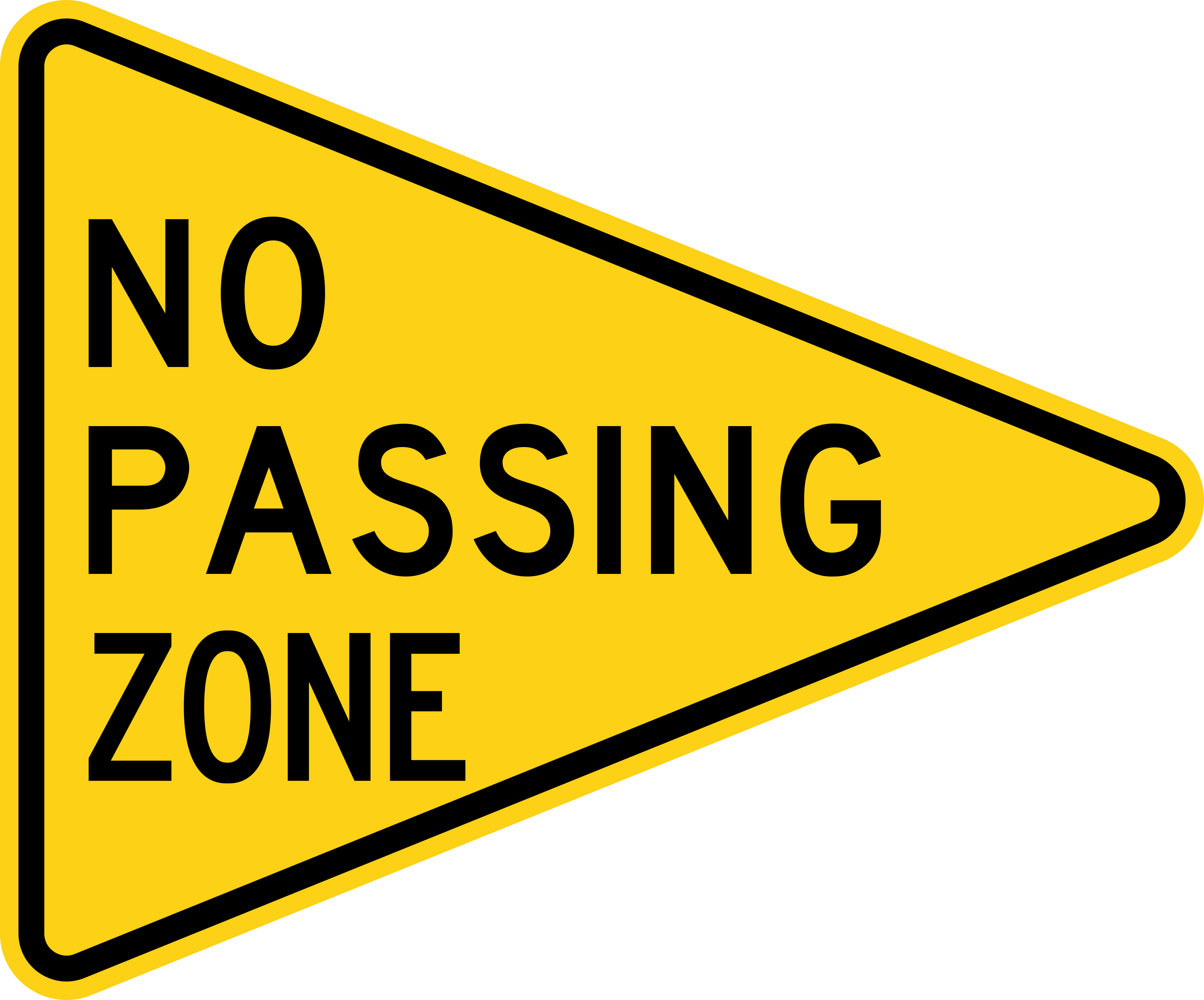
- Passing any vehicle is not allowed in that zone
- Only trucks may pass other vehicles there
- Passing is allowed if the road appears empty
- The zone permits passing only after sunset
Show answer
Passing any vehicle is not allowed in that zone. Wisconsin describes the yellow pennant as a no-passing-zone sign. Drivers may not pass another vehicle within that marked area, even if the roadway looks clear. The truck-only option invents an exception, and an empty road does not cancel the posted restriction. Darkness is unrelated to the sign's meaning. Treat the pennant as an advance decision point: remain behind the vehicle ahead, keep a safe following gap, and wait until the restriction ends and a legal, visible opportunity exists before considering a pass.
Study this in the handbook: Regulatory, destination and service signs
9. How fast should you back up when backing is necessary?
- At the same speed as nearby traffic
- At the posted speed limit for the road
- Fast enough to clear the area immediately
- No faster than a slow walking pace
Show answer
No faster than a slow walking pace. Backing has limited visibility, so Wisconsin advises moving no faster than a slow walk. The speed-limit and traffic-flow choices are far too fast for a maneuver where people, objects, and cross traffic can be hidden. Turn your body, look through the rear window, and use a helper outside when possible instead of relying only on mirrors or a camera. Slow movement gives you time to stop when the view changes.
Study this in the handbook: Turns, passing, backing and parking
10. What response does Wisconsin recommend for a Slippery When Wet warning?

- Slow down when you see the sign
- Increase speed to reduce time on the wet pavement
- Brake hard while entering the slick section
- Use the shoulder to avoid all opposing traffic
Show answer
Slow down when you see the sign. The Slippery When Wet warning means the road ahead might be slippery, and Wisconsin tells drivers to slow down when they see it. Increasing speed reduces the time available to respond and does not address loss of traction. Hard braking can upset a vehicle on a slick surface, so it is not the handbook's cue. The shoulder is not a substitute for controlled travel in the lane. Reduce speed early, leave extra room, and use smooth steering and braking as the surface changes.
Study this in the handbook: Warning and construction signs
11. Who must wear a seat belt under Wisconsin law?
- Only the driver
- Only passengers under 18
- Only front seat occupants when there are no air bags
- You and your passengers, at any age
Show answer
You and your passengers, at any age. Wisconsin law requires you and your passengers to wear seat belts at any age. Belts keep the driver in position to control the vehicle, prevent injuries, and keep people from being thrown out in a crash. Limiting the rule to the driver or to minors leaves out people the law covers. Air bags do not replace belts; the handbook says you still need to wear your seat belt even if your vehicle has air bags.
Study this in the handbook: Points, seat belts, child seats and insurance
12. What is the minimum age for a Wisconsin probationary license?
- 15
- 17
- 16
- 18
Show answer
16. The first license issued after passing the skills test at the DMV is a probationary license, and the applicant must be at least 16 years old. An applicant under 18 must also have held the instruction permit at least six months and finished driver education. Fifteen is the minimum age for the instruction permit. Seventeen is not a Wisconsin threshold for this license, and 18 is when the GDL hour and passenger restrictions stop applying.
Study this in the handbook: Sponsors and the instruction permit
13. A Wisconsin permit holder wants to practice after dark. Who must sit in the seat beside the learner?
- Any licensed person 19 or older
- Any passenger who is 18
- A licensed person 21 or older with one year of experience
- A qualified instructor, or a licensed person 25 or older with at least two years of experience
Show answer
A qualified instructor, or a licensed person 25 or older with at least two years of experience. Night practice has a stricter supervision rule. During hours of darkness the permit holder must be accompanied by a qualified instructor or by a licensed person 25 years of age with at least two years of licensed driving experience in the seat beside the learner. A 19 year old parent or a 21 year old adult who can supervise in daylight does not meet the night rule unless 25 or an instructor. An unlicensed 18 year old never qualifies, and one year of experience is too little.
Study this in the handbook: Sponsors and the instruction permit
14. What does a steady red arrow require at a Wisconsin traffic signal?
- Turn after slowing without stopping
- Come to a full stop and wait for the light to turn green
- Proceed straight if no one is crossing
- Treat it as a flashing yellow arrow
Show answer
Come to a full stop and wait for the light to turn green. A steady red arrow requires a full stop and waiting for the light to turn green. It is stronger than a yield or caution indication. Slowing without stopping ignores the red arrow command, and going straight because the crosswalk looks empty is not the signal's instruction. A flashing yellow arrow permits a cautious turn after yielding, which is a different display. The cue is the steady red arrow shape: stop completely, hold position, and wait for a green indication.
Study this in the handbook: Traffic lights and arrows
15. During a Wisconsin traffic stop, where should the driver place their hands?
- Inside a bag to find documents immediately
- On top of the steering wheel in plain sight
- Below the seat until the officer arrives
- On the radio controls
Show answer
On top of the steering wheel in plain sight. Wisconsin's traffic stop guidance tells drivers to keep their hands on top of the steering wheel in plain sight. Reaching into a bag, under a seat, or toward controls can look sudden and unsafe during the stop. Documents can wait until the officer gives directions. The handbook also says to park, turn off the car and radio, stay in the vehicle, and avoid sudden movements. The cue is emergency lights behind you: pull right, stop, then make your hands visible.
Study this in the handbook: Traffic stops, deer and emergency vehicles in roundabouts
16. What is the proper way to approach a funeral procession traveling in a line?
- Do not cut into the line or interfere with it
- Enter the line whenever a gap appears
- Pass through the procession to save time
- Honk until the procession leaves the road
Show answer
Do not cut into the line or interfere with it. A funeral procession travels together from a funeral home or place of worship to a cemetery or crematorium. Drivers should not cut into the line or interfere with it. Entering a gap can divide vehicles that are meant to remain together, and passing through creates a serious conflict with the procession. Honking does not give a driver priority. Slow down, wait patiently, and let the group continue. Remember that the first vehicle follows traffic signals, while vehicles in the line use their headlights.
Study this in the handbook: Roundabouts, metered ramps and funeral processions
17. What minimum supervised driving practice must a Wisconsin permit holder complete before a probationary license?
- 40 hours, all during daylight
- 50 hours, including 10 hours in darkness
- 60 hours, including 20 hours in darkness
- 25 hours, including 5 hours in darkness
Show answer
50 hours, including 10 hours in darkness. The supervised program requires 50 total hours, divided into at least 40 hours during daylight and 10 hours during darkness. The 40-hour option omits the required nighttime practice, while 60 and 25 hours do not match the handbook's minimum. The handbook says the sponsor will verify driving hours at the probationary license phase, so keeping a driving log is useful. Think of the requirement as 40 plus 10, not simply a single total with no time-of-day condition. More practice may still be needed to demonstrate safe driving ability.
Study this in the handbook: The probationary license and GDL restrictions
18. What do blue service signs identify?
- A no-passing zone ahead
- The maximum speed for the roadway
- Nearby services such as camping or a hospital
- The route number of an interstate
Show answer
Nearby services such as camping or a hospital. Blue service signs direct drivers to nearby facilities, including camping areas and hospitals. They do not set speed, prohibit passing, or identify an interstate route. Color and shape can help classify the sign, but confirm the symbol and direction before turning. If the sign points to a service, maintain safe control while looking for the access road rather than stopping suddenly in the travel lane.
Study this in the handbook: Regulatory, destination and service signs
19. Before turning at a flashing yellow arrow, what does the signal require?
- Stop and wait for a green arrow
- Turn immediately because the arrow gives priority
- Yield first, then turn with caution
- Continue straight without checking traffic
Show answer
Yield first, then turn with caution. A flashing yellow arrow allows a turn only after yielding first and then proceeding cautiously. Yielding means checking for oncoming traffic, pedestrians, and other road users who have priority. Turning immediately treats the arrow as a protected movement, which it is not. A full stop until a green arrow appears is more restrictive than the handbook's instruction, and continuing straight does not address the turn indication. The useful cue is yellow arrow equals yield before turning, followed by a careful path check.
Study this in the handbook: Traffic lights and arrows
20. When should you use a turn signal before making a turn?
- Only on roads with two or more lanes
- Only when another vehicle is visible
- After the turn is complete
- Before moving, then check around you and make the move
Show answer
Before moving, then check around you and make the move. A turn signal communicates your plan before other road users must react. Wisconsin directs drivers to activate it before moving, check around the vehicle, and then make the turn. Signaling only when another vehicle is visible leaves pedestrians or unseen traffic without warning. Signaling afterward provides no useful advance notice, and a narrow road still has people who need to understand the maneuver. Make the signal part of the routine: indicate, search mirrors and blind spots, then move when clear.
Study this in the handbook: The horn, headlights and turn signals
QualitySpace is expanding to Wisconsin
We are a California-based independent insurance brokerage working on licensing in more states. We cannot help with Wisconsin insurance yet. Leave your email and we will let you know when we can.
Every question is written from the official Wisconsin Motorists' Handbook. Need paper? Printable WI practice test with answer key.
Last verified 2026-10-05. How we check every question · Study all 200 as flashcards
Frequently asked questions
How many questions are on this Wisconsin practice test?
This fixed set has 20 questions. It is test 1 of 10 from the 200 question Wisconsin bank. The real WI exam has a 15 question road sign section with 12 correct to pass, plus 50 knowledge questions with 40 correct to pass.
What is the passing score for the real Wisconsin test?
40 questions (80%) correctly to pass That figure comes from the official Wisconsin source cited on the DMV facts page.
How does this fixed test relate to the full Wisconsin bank?
Each numbered test is a fixed set of questions in a fixed order, so you can retake the same test later and compare. Every test mixes road signs and the other topics in about the same proportion as the full bank. Tests 1 to 10 together cover every question in the Wisconsin bank once. The full practice page mixes the whole bank at random.
Last verified 2026-10-05. See the Wisconsin DMV facts page for sourced state details.
Return to the full Wisconsin practice test · Study road signs