
Test 13 of 25 · 20 questions · Free 2026
WI Permit Practice Test 13
Jump to the test ↓A fixed 20 question set from the Wisconsin bank with answers and plain English explanations. The real WI exam has a 15 question road sign section with 12 correct to pass, plus 50 knowledge questions with 40 correct to pass; take the full length version on the main practice page.
Question 1 of 20 · 0 right so far
All 20 questions in test 13
Every question below comes from the Wisconsin question bank on this page. Open a question to see the correct answer and the explanation. Nothing here is hidden behind a signup.
1. In Wisconsin, during brake failure after pumping the pedal, what should the driver look for?
- A downhill slope to gain speed for steering
- A line of parked cars to rub against
- A railroad crossing to use its gate as a stop
- A safe place to slow to a stop
Show answer
A safe place to slow to a stop. During brake failure, after pumping the pedal, look for a safe place to slow to a stop. Gaining speed on a downhill slope works against slowing, and rubbing a line of parked cars trades one collision for another. A railroad crossing gate is never a stopping device. Keep searching for open, safe space where the vehicle can lose speed and stop without striking people or property.
Study this in the handbook: Avoiding crashes, crash duties and roadside emergencies
2. In Wisconsin, in a crash where someone is injured or killed, what two actions come first?
- Move vehicles first, then decide about calling
- Drive the injured person yourself at once
- Call 911 and stay on the scene without moving the vehicles
- Exchange insurance cards and both drive away
Show answer
Call 911 and stay on the scene without moving the vehicles. If someone is injured or killed, call 911, stay on the scene, and do not move the vehicles, preserving positions that investigators need to read. Moving cars first, self-transporting the seriously injured without direction, or driving away after swapping cards all break that order. Stay in your vehicle if it is safe, turn on flashers, and let responders direct medical and traffic decisions.
Study this in the handbook: Avoiding crashes, crash duties and roadside emergencies
3. In Wisconsin, when is it proper to push hard on the horn?
- When a friend waves from a front porch nearby
- When traffic ahead moves too slowly for you
- When you enter a quiet neighborhood street
- Warn when your car is about to hit or be hit by another
Show answer
Warn when your car is about to hit or be hit by another. Push hard on the horn only to warn someone when you are about to hit them or they are about to hit you. That hard blast is an emergency shout, not a greeting, a hurry-up, or a neighborhood announcement. Used sparingly, it keeps its power to freeze a driver mid-mistake. Pair it with braking or steering away, because sound alone cannot stop either car.
Study this in the handbook: The horn, headlights and turn signals
4. In Wisconsin, how should a driver position their body while backing up?
- Face forward and steer by the front mirrors only
- Turn and look over the right shoulder through the rear window
- Twist left and look through the left window only
- Stand up slightly to see over the roof panel
Show answer
Turn and look over the right shoulder through the rear window. While backing, turn your body and look behind you out of your windows, especially over your right shoulder through the rear window. Facing forward leaves the danger zone unseen, a left-only view misses the right rear corner, and standing breaks your pedal control. A direct rear view shows children, bikes and low obstacles where they actually are. Keep speed at a crawl while you look.
Study this in the handbook: Turns, passing, backing and parking
5. In Wisconsin, what preparation best prevents drowsy driving before a trip?
- Get a good night sleep before you drive
- Drink extra coffee during the drive itself
- Open windows hourly while already tired
- Plan to nap only after arriving tired
Show answer
Get a good night sleep before you drive. The best prevention for drowsy driving is a good night sleep before you drive, because rest restores the attention driving consumes. Coffee during the drive, open windows, and a nap planned after arrival all manage a problem that sleep should have prevented. Teen and young adult drivers face greater drowsy crash risk, so families should guard sleep before morning drives and late returns.
Study this in the handbook: Distracted and drowsy driving
6. In Wisconsin, how should a driver change lanes on a multi-lane road?
- Cross two lanes in one motion to finish sooner
- Change lanes first, then signal to explain
- Signal first, then move one lane at a time
- Move without signaling if the road looks empty
Show answer
Signal first, then move one lane at a time. Signal before changing lanes and move one lane at a time, settling into each lane before considering the next. Crossing two lanes at once, signaling afterward, or skipping the signal on an empty-looking road all hide your intent from the one driver you missed. One lane at a time gives everyone, including you, a fresh chance to check mirrors and blind spots.
7. In Wisconsin, what shape helps a driver recognize a U.S. route sign?
- A rectangle with rounded edges and black lettering
- A jug shape with a spout at the bottom
- A badge shape, normally grey or white with black lettering
- A shield with red on top and blue on the bottom
Show answer
A badge shape, normally grey or white with black lettering. A U.S. route sign looks like a police badge and is normally grey or white with black lettering. The rounded rectangle belongs to county roads, the jug shape to state roads, and the red and blue shield to interstates. Spotting the badge outline tells you that you are on the national network of U.S. highways, which helps when you follow directions across state lines.
8. In Wisconsin, who may park in a space marked Reserved Parking Only for disabled drivers?
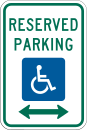
- Any driver who will return within five minutes or less today
- A driver holding a valid disabled permit or disabled plate
- A driver carrying a passenger who feels unwell today
- Any licensed driver parking after business hours end
Show answer
A driver holding a valid disabled permit or disabled plate. A reserved disabled parking space may be used only by a driver who holds a valid disabled parking identification permit or a valid disabled license plate. A short stay does not create an exception, and neither does the time of day. Feeling unwell does not replace the permit or plate. If you do not hold one of those credentials, choose a regular space and leave the reserved space open for a driver who does.
Study this in the handbook: Regulatory, destination and service signs
9. In Wisconsin, a medicine label says do not operate heavy machinery. What does that warning include?
- Only farm tractors are included in that warning
- Only factory forklifts are included in that warning
- Passenger cars are excluded from that warning
- Motor vehicles are included in that warning
Show answer
Motor vehicles are included in that warning. If a drug label says do not operate heavy machinery, that warning includes motor vehicles, so driving your car counts as operating the warned machinery. It is not limited to tractors or forklifts, and passenger cars are not excluded. Check every prescription and over-the-counter label for side effects before driving, and skip the drive if drowsiness or slowed reactions are listed.
Study this in the handbook: Alcohol, drugs and implied consent
10. In Wisconsin, you begin a U-turn on a quiet street as a vehicle approaches from ahead. Which vehicles must you yield to?
- Only vehicles approaching from behind your car
- All approaching vehicles before completing the turn
- Only vehicles larger than yours on the same street
- No vehicles, if you signaled before starting the turn
Show answer
All approaching vehicles before completing the turn. When making a left turn or U-turn, yield to approaching vehicles. That duty covers the traffic your turn crosses, whatever its size, and a turn signal announces intent without creating priority. Vehicles behind you are managed by your position and signal, but they are not the approaching traffic named here. Wait for a gap that lets every approaching vehicle pass or turn safely, then complete the maneuver.
Study this in the handbook: Right of way
11. In Wisconsin, you choose a space for parallel parking between two vehicles. How long should the space be compared with your vehicle?
- Exactly the same length as your vehicle, bumper to bumper
- About 10 to 12 feet longer than your vehicle length
- One foot longer, if you turn the wheel sharply inward
- About 3 to 6 feet longer than your vehicle
Show answer
About 3 to 6 feet longer than your vehicle. For parallel parking, choose a space about 3 to 6 feet longer than your vehicle. That allowance gives room to angle in, straighten, and center the car without striking either neighbor. A bumper to bumper fit cannot be entered cleanly, one extra foot is too tight, and ten extra feet is more than the described allowance. Judge the gap before signaling, and pass up spaces that fall short.
Study this in the handbook: Turns, passing, backing and parking
12. In Wisconsin, you are making a left turn while an oncoming vehicle is also turning. What must you leave room for?
- Oncoming traffic to turn in front of you
- Oncoming traffic to pass behind you inside your lane
- Following traffic to overtake you on the left side
- Parked traffic to pull out from the curb beside you
Show answer
Oncoming traffic to turn in front of you. When making a left turn, leave room for oncoming traffic to turn in front of you. Creeping into the center can block that opposing turn and lock both vehicles in the intersection. The rule concerns the oncoming turning movement, not followers overtaking or parked cars leaving the curb. Hold a position that lets the oncoming driver complete the turn, then finish your own turn when the path is clear.
Study this in the handbook: Turns, passing, backing and parking
13. In Wisconsin, why should a driver give extra space to large vehicles nearby?
- So the large vehicle will change lanes sooner
- So the driver can see around them and they can see the car
- So the car can hide in the truck blind spot
- So following traffic will slow down behind
Show answer
So the driver can see around them and they can see the car. Give extra space to large vehicles so you can see around them and their drivers can see you. A truck blocks your view of signals and brake lights ahead, and its mirrors leave large blind spots. Hiding in those spots, expecting the truck to move over, or slowing followers does not help. Drop back until you can see the road ahead and the truck mirrors show your car.
Study this in the handbook: Speed limits and the sight distance rule
14. In Wisconsin, a car without ABS starts to slide on a slippery road while braking. What should the driver do?
- Gently pump the brakes to keep the car from skidding
- Press the brake pedal once as hard as possible and hold it
- Release the brakes fully and coast to a stop
- Turn the wheel sharply while braking hard
Show answer
Gently pump the brakes to keep the car from skidding. Without anti-lock brakes, gently pump the brakes on slippery roads to keep wheels rolling and prevent a skid or slide. One hard held press locks wheels into a slide, full release gives up slowing, and sharp steering while braking overloads tire grip. The pumping rhythm lets tires regain bite between presses. Cars with ABS need the opposite: firm, steady pressure while the system pulses.
Study this in the handbook: Bad weather, skids, winter and rural roads
15. In Wisconsin, what look must a driver make before entering any intersection?
- Look only straight across at the far signal
- Look only in the rearview mirror
- Look to the left and right before entering
- Look only toward the side with shops
Show answer
Look to the left and right before entering. Look to your left and right before you enter an intersection, because crossing traffic approaches from the sides. Staring only across, checking only behind, or favoring the shopping side misses the car running a late light beside you. A left-right scan takes a second and confirms the crossing is clear. Make it automatic at signals, stop signs, and plain driveways alike.
Study this in the handbook: Right of way
16. In Wisconsin, as a car goes faster, what happens to the distance it needs to turn, slow or stop?
- It takes less distance because tires grip harder
- The distance stays the same at any speed
- Only stopping distance grows, turning does not
- It takes more distance to turn, slow or stop
Show answer
It takes more distance to turn, slow or stop. Change your speed for road and traffic conditions, remembering that the faster your car goes, the more distance it takes to turn, slow or stop. Speed does not improve grip into shorter distances, the distance does not stay fixed, and turning space grows along with stopping space. That is why a speed that feels fine on a straight can be far too fast for a curve or a stop sign ahead.
Study this in the handbook: Right of way
17. In Wisconsin, what does a roundabout exit sign tell a driver before entering the circle?
- Which lane has the shortest line of waiting cars
- The speed limit that applies inside the roundabout
- Which road the driver will be on after exiting
- Which exit charges a fee for large vehicles
Show answer
Which road the driver will be on after exiting. A roundabout exit sign helps you plan before you enter by showing which road you will be on when you exit the roundabout. It does not rank waiting lines, state the speed limit inside the circle, or list exit fees. Read the sign on approach, pick the exit that matches your road, and choose the correct lane. Planning early keeps you from circling again or changing lanes inside the roundabout.
Study this in the handbook: Regulatory, destination and service signs
18. In Wisconsin, you are driving in a reversible lane when a yellow X appears above your lane. What must you do?
- Move out of the lane, because it is changing
- Stay in the lane, because yellow means it stays open
- Stop in the lane until a green arrow appears above it
- Speed up to finish using the lane before it changes
Show answer
Move out of the lane, because it is changing. A yellow X over a reversible lane means the lane is changing, so move to a green arrow lane. Staying because yellow seems permissive, stopping inside the lane, or speeding to finish using it all leave you where opposing or closing traffic will be sent. Read the signal over your exact lane, check the neighboring green arrow lane, and move over smoothly before the lane changeover completes.
Study this in the handbook: Lane lines, crosswalks and special lanes
19. In Wisconsin, a driver whose turn signals fail needs to signal a left turn by hand. How is that signal made?
- Point the hand straight out the driver side window
- Bend the elbow and point the hand up
- Point the hand down toward the ground
- Wave the hand in a circle twice
Show answer
Point the hand straight out the driver side window. For a left turn by hand, point your hand straight out the driver side window. An elbow bent with the hand up means a right turn, a hand pointed down means stopping or slowing, and waving in circles has no standard meaning. Use the straight arm early enough for drivers behind you to react, and keep your other hand controlling the wheel through the turn.
Study this in the handbook: The horn, headlights and turn signals
20. In Wisconsin, on a road with reversible lanes, how does a driver know which lanes are usable now?
- Flags on the curb change color each hour
- Special lights above the lanes tell which lanes can be used
- By following whichever lane most other cars are already using at that hour
- By checking which lane the city buses are using today
Show answer
Special lights above the lanes tell which lanes can be used. Special lights over reversible lanes tell you which lanes you can use at that moment, because pavement direction changes during the day. Curb flags, the flow of other cars, and bus movements do not control the lanes. A red X closes the lane to you, a green arrow opens it, and a yellow X means it is changing. Read the signal over your exact lane before entering.
Study this in the handbook: Lane lines, crosswalks and special lanes
Every question is written from the official Wisconsin Motorists' Handbook. Need paper? Printable WI practice test with answer key.
Last verified 2026-10-05. How we check every question · Study all 500 as flashcards
Frequently asked questions
How many questions are on this Wisconsin practice test?
This fixed set has 20 questions. It is test 13 of 25 from the 500 question Wisconsin bank. The real WI exam has a 15 question road sign section with 12 correct to pass, plus 50 knowledge questions with 40 correct to pass.
What is the passing score for the real Wisconsin test?
40 questions (80%) correctly to pass That figure comes from the official Wisconsin source cited on the DMV facts page.
How does this fixed test relate to the full Wisconsin bank?
Each numbered test is a fixed set of questions in a fixed order, so you can retake the same test later and compare. Every test mixes road signs and the other topics in about the same proportion as the full bank. Tests 1 to 25 together cover every question in the Wisconsin bank once. The full practice page mixes the whole bank at random.
Last verified 2026-10-05. See the Wisconsin DMV facts page for sourced state details.
Return to the full Wisconsin practice test · Study road signs