
Test 8 of 10 · 20 questions · Free 2026
WI Permit Practice Test 8
Jump to the test ↓A fixed 20 question set from the Wisconsin bank with answers and plain English explanations. The real WI exam has a 15 question road sign section with 12 correct to pass, plus 50 knowledge questions with 40 correct to pass; take the full length version on the main practice page.
Question 1 of 20 · 0 right so far
All 20 questions in test 8
Every question below comes from the Wisconsin question bank on this page. Open a question to see the correct answer and the explanation. Nothing here is hidden behind a signup.
1. What following gap does Wisconsin recommend as a normal starting point?
- Ten feet behind the vehicle ahead
- One car length at every speed
- Two seconds only when roads are icy
- Four seconds from a stationary reference point
Show answer
Four seconds from a stationary reference point. Wisconsin teaches the Four Second Following Distance Rule. Choose a fixed object ahead and count through one thousand four; reaching it before the count ends means the gap is too short. A car length or ten feet is a fixed distance that does not grow with speed, so neither is a reliable general measure. Adverse conditions call for an additional second for each concern such as rain, snow, ice, or heavy traffic. Use the rule as a timing check, then expand space when the roadway conditions demand it.
Study this in the handbook: Speed limits and the sight distance rule
2. What score is required to pass Wisconsin's separate Highway Signs test?
- 10 correct out of 15
- 12 correct out of 15
- 13 correct out of 20
- 8 correct out of 10
Show answer
12 correct out of 15. The separate Highway Signs test contains 15 questions, and an applicant must answer 12 correctly. That is an 80 percent passing score. The 10-of-15 option is below the handbook's threshold, while 13-of-20 and 8-of-10 describe different test sizes. The important cue is the paired numbers 15 and 12. Do not substitute the Knowledge test's 50-question format, even though both tests use an 80 percent passing standard.
Study this in the handbook: The vision, signs, knowledge and skills tests
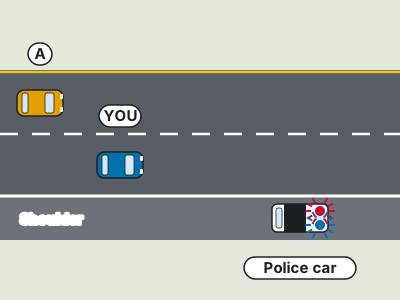
3. On a road with more than one lane in your direction, how should you pass a stopped emergency vehicle with flashing lights?
- Drive on the shoulder beside it
- Stop in the lane nearest the vehicle
- Move into the lane farthest from the stopped vehicle
- Turn around before reaching it
Show answer
Move into the lane farthest from the stopped vehicle. Approaching a stopped emergency vehicle with its lights flashing requires moving into the lane not nearest the stopped vehicle, then staying in that far lane until you are past it. This creates a buffer for responders working at the roadside. Stopping beside the vehicle leaves no protective space. Using the shoulder is not a substitute for a normal travel lane and can endanger people outside the cruiser. Turning around is unnecessary. Look early, change lanes only when safe, and keep the separation through the pass.
Study this in the handbook: Pedestrians, emergency vehicles and school buses
4. When may a driver travel briefly in a Wisconsin reserved lane that is marked for special vehicles?
- Whenever traffic in regular lanes is slow
- When turning across it in the next half of a block
- Only to pass a bicyclist at full speed
- Anytime the lane has a white diamond
Show answer
When turning across it in the next half of a block. Reserved lanes are for special vehicles, but Wisconsin allows a driver to travel in one when a turn across that lane is needed in the next half of a block. Slow traffic does not open the lane for convenience. Passing a bicyclist at full speed is unsafe and misses the narrow turning exception. A white diamond marks the reserved lane, not general permission. The cue is an upcoming turn across the lane: enter only for that short movement and yield as needed.
Study this in the handbook: Lane lines, crosswalks and special lanes
5. What does a slow moving vehicle sign identify in Wisconsin?

- A vehicle carrying hazardous cargo only
- A vehicle that must travel at least 55 mph
- A road closed to farm equipment
- A vehicle that could travel at 25 mph or less
Show answer
A vehicle that could travel at 25 mph or less. Wisconsin describes the slow moving vehicle sign as a triangle with reflective orange markings and says the vehicle could travel at 25 mph or less. It is not a minimum-speed sign, a road closure for farm equipment, or a hazardous cargo placard. The low speed warning gives following drivers time to reduce speed and avoid a rear-end crash. When you see the orange triangle, expect a much slower vehicle ahead, often farm equipment or another slow machine.
Study this in the handbook: Regulatory, destination and service signs
6. Where should your front wheels stop when approaching a crosswalk?
- Just before the solid white line
- On top of the crosswalk
- Past the crosswalk near the opposite curb
- At least one car length beyond the intersection
Show answer
Just before the solid white line. At a crosswalk, stop with the front wheels just before the solid white line. This leaves the marked pedestrian space open and gives people room to cross safely. Stopping on the crosswalk blocks that protected area, while stopping beyond it places the vehicle too far into the crossing path. The handbook notes that crosswalks are common at intersections but may also appear midblock, so do not rely only on traffic lights. See the line, stop before it, and keep scanning for pedestrians.
Study this in the handbook: Lane lines, crosswalks and special lanes
7. Which Wisconsin drivers have their demerit points doubled on the second conviction and after?
- Only drivers over 65
- Only commercial drivers
- Every licensed driver in the state
- Holders of a probationary license, an ID card, or no license
Show answer
Holders of a probationary license, an ID card, or no license. The point system starts every record at zero. Points are doubled on the second conviction and any later one for a person who holds a probationary license, an ID card, or no type of license. Age over 65 and commercial status do not trigger doubling in this rule. Regular license holders are not included, so doubling is not a rule for every driver. Twelve or more points in any 12-month period leads to suspension or revocation.
Study this in the handbook: Points, seat belts, child seats and insurance
8. A Wisconsin teen does not live with a parent or legal guardian. Which of these people may sign as the teen's sponsor?
- A 17 year old sibling
- A grandparent
- A family friend who is 25
- The driving school instructor
Show answer
A grandparent. When a teen applicant is not living with a parent or legal guardian, Wisconsin lets a grandparent, an aunt or uncle, a sibling 18 or older, a spouse 18 or older, or a foster parent sign as sponsor and accept liability. A 17 year old sibling is too young, because siblings must be at least 18. A family friend and a driving instructor are not on the list. The sponsor becomes legally and financially responsible for incidents caused by the minor driving.
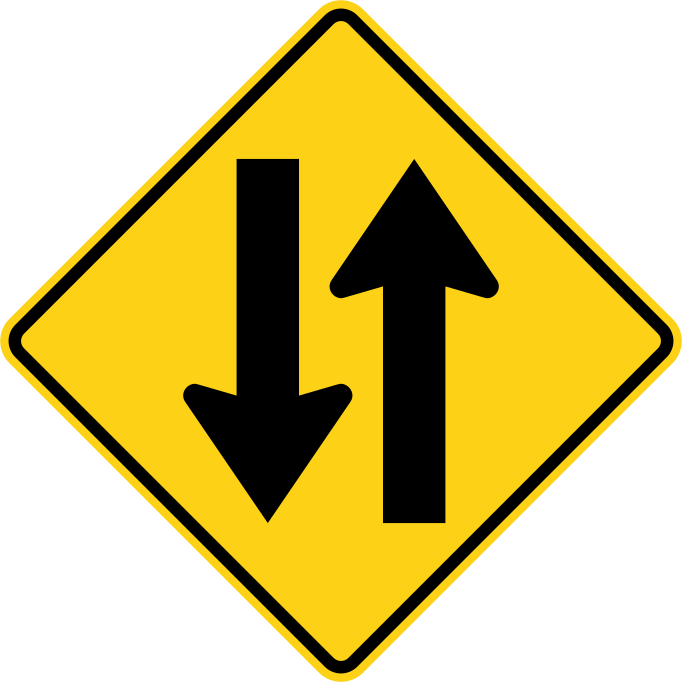
9. When does Wisconsin say a driver is entering a roadway with opposing traffic?
- When approaching a roundabout from the right
- When passing through a school zone
- When leaving a one-way roadway
- When driving onto a divided highway
Show answer
When leaving a one-way roadway. The handbook says opposing traffic begins when a driver leaves a one-way roadway and enters the next roadway. The choice “When leaving a one-way roadway” states that transition. A school zone concerns children and crossing pedestrians, not traffic direction. A roundabout has its own lane and yielding rules, while a divided highway separates opposing flows with a physical barrier. Use the two-way warning as a visual prompt to expect vehicles coming toward you and to position yourself for the new traffic pattern before continuing.
Study this in the handbook: Warning and construction signs
10. What action is associated with a Lane Ends warning?

- Pass on the shoulder before the lane disappears
- Stop in the ending lane and wait for traffic to clear
- Move to the other lane when it is safe
- Keep the ending lane by crossing the center barrier
Show answer
Move to the other lane when it is safe. A Lane Ends sign means the displayed right or left lane will end. The handbook directs drivers to move to the other lane when it is safe to do so. Stopping in the ending lane can create a new hazard, and passing on the shoulder is not the instructed response. Crossing a center barrier is plainly outside the roadway guidance. Read which side is ending, check the adjacent traffic, and make one controlled lane change with a signal before the available lane narrows further.
Study this in the handbook: Warning and construction signs
11. How does Wisconsin classify driving after a measurable amount of a controlled substance has been used?
- As operating while impaired
- As a nonmoving equipment violation
- As legal unless alcohol is also present
- As a warning-only offense for a first occurrence
Show answer
As operating while impaired. The handbook places any amount of a controlled substance in the same category as operating while impaired. That rule does not require alcohol to be present, so the combined-substances choice adds a condition Wisconsin does not state. Calling it an equipment matter or a warning-only event also misses the safety and legal treatment described in the alcohol and drugs section. A useful recall cue is the word any: even a measurable amount of a controlled substance is enough for the handbook to connect the conduct with impaired operation.
Study this in the handbook: Alcohol, drugs and implied consent
12. What visibility condition requires low beams or headlights?
- Only when driving on an interstate
- When a vehicle or person cannot be seen 500 feet away
- Whenever the road has a posted speed limit
- Only after midnight
Show answer
When a vehicle or person cannot be seen 500 feet away. Wisconsin requires low beams or headlights when a driver cannot see a vehicle or person 500 feet away. The handbook also requires them from a half hour after sunset until a half hour before sunrise. A posted speed limit and an interstate roadway do not determine this requirement, and midnight is not the controlling time. Use visibility and the daily light cycle as the cues. In rain, snow, fog, or when using windshield wipers, the handbook recommends low beams as an added safety measure.
Study this in the handbook: The horn, headlights and turn signals
13. What information do destination signs provide?
- The location of emergency vehicles only
- Warnings about slippery pavement only
- Rules for parking in the next block
- Directions and distances to different places
Show answer
Directions and distances to different places. Destination signs guide drivers by showing directions and distances to places such as cities, states, airports, parks, and museums. They are not hazard warnings, parking regulations, or emergency-vehicle notices. Green or brown backgrounds with white lettering are useful visual clues, but read the route and direction information before choosing a lane. Plan early so a needed exit or turn does not become a last-second maneuver.
Study this in the handbook: Regulatory, destination and service signs
14. At an uncontrolled Wisconsin intersection, which vehicles should you yield to when there are no signals or traffic lights?
- Vehicles coming from the right
- Vehicles parked along the curb
- Only vehicles sounding a horn
- Only vehicles turning into driveways
Show answer
Vehicles coming from the right. Wisconsin includes vehicles coming from the right among the road users to yield to at uncontrolled intersections. The rule applies when there are no signals or traffic lights to assign turns. Parked vehicles are not entering the intersection, and a horn is not the condition that creates priority. Driveway turns are too narrow and miss the broader cross-traffic risk. At a quiet intersection with no control devices, slow enough to scan right and left before entering.
Study this in the handbook: Right of way
15. What insurance must a vehicle have before it is driven in Wisconsin?
- Collision coverage only
- Valid liability car insurance
- A vehicle warranty instead of insurance
- Insurance only when traveling outside Wisconsin
Show answer
Valid liability car insurance. Wisconsin requires valid liability car insurance for driving in the state. Liability coverage addresses responsibility for harm caused to others, while collision coverage alone is not the requirement stated in this handbook. A warranty is not an insurance policy, and the duty applies to Wisconsin driving rather than only out-of-state trips. Carry proof and be prepared to present it if an officer requests it. If borrowing a vehicle, confirm that the car has the required coverage before driving away.
Study this in the handbook: Points, seat belts, child seats and insurance
16. What should drivers remember about right-of-way situations?
- Traffic signals never affect priority
- The vehicle on the right always goes first
- Each situation can be different
- Pedestrians must always wait for cars
Show answer
Each situation can be different. Wisconsin warns that every right-of-way situation can be different. A vehicle on the right does not automatically go first in every setting, because the surrounding intersection, signs, signals, pedestrians, and other traffic affect the decision. Traffic controls still matter, and drivers must yield when needed to avoid a collision. Use the scene rather than a single shortcut: scan left and right, identify the applicable rule, and be ready to wait when another road user has priority.
Study this in the handbook: Right of way
17. What does a solid white line between lanes generally mean?
- You cannot cross it except for a hazard or an imminent turn within the next block
- You may cross it at any time to pass
- It separates traffic traveling in opposite directions
- It marks a lane that must be used for parking
Show answer
You cannot cross it except for a hazard or an imminent turn within the next block. A solid white line between lanes means you should not cross it in ordinary lane changes. The handbook allows crossing when there is a hazard or when you are turning within the next block. It is not a passing invitation, and it does not divide opposing traffic because yellow lines serve that purpose. Parking is not the meaning of the marking. Treat the line as a restriction, then identify one of the handbook’s limited reasons before crossing.
Study this in the handbook: Lane lines, crosswalks and special lanes
18. How should a Wisconsin driver handle a bicyclist's lane position?
- Tap the bumper lightly to signal passing
- Crowd the bicyclist only when oncoming traffic appears
- Do not share the lane with the bicyclist
- Assume the bicyclist must stay on the shoulder
Show answer
Do not share the lane with the bicyclist. Wisconsin says bicyclists can use the whole traffic lane and drivers should not share that lane with them. Crowding a bicycle because oncoming traffic appears is exactly when waiting becomes more important. Contacting a bicycle or assuming shoulder use can create a crash. The safe cue is lane width: if you cannot pass with a separate, clear path, remain behind the bicyclist until oncoming traffic clears and the maneuver can be completed with room.
Study this in the handbook: Motorcycles, bicycles and truck no zones
19. During the daytime GDL period, how many immediate family members may ride with a Wisconsin probationary driver?
- Exactly two immediate family members
- Only one immediate family member
- No immediate family members
- Any number of immediate family members
Show answer
Any number of immediate family members. From 5 a.m. to midnight, a Wisconsin probationary driver may carry any number of immediate family members. The rule also lists limits for a qualifying licensed person and one other person, but those are separate passenger categories. “Only one” and “exactly two” impose numbers the handbook does not use, while a complete ban contradicts the stated family allowance. When checking a daytime passenger question, separate immediate family from the licensed adult and the additional passenger. The family category is the one with no numerical cap during this period, provided the driver still follows all other safety and licensing requirements.
Study this in the handbook: The probationary license and GDL restrictions
20. When passing another vehicle in Wisconsin, what does the handbook say about the number of vehicles to pass at one time?
- Pass only one vehicle at a time on the left
- Pass two vehicles together if the lane is clear
- Pass as many vehicles as fit before the next curve
- Pass only on the right side
Show answer
Pass only one vehicle at a time on the left. Wisconsin's passing guidance limits a driver to one vehicle at a time and places that pass on the left side. Passing a group increases the distance and time exposed to opposing traffic, so a clear view is not enough to justify overtaking several vehicles. The right-side option conflicts with the handbook's stated method, and the number of vehicles cannot be expanded because a curve is still distant. After passing, return safely to the driving lane rather than lingering in the passing lane.
Study this in the handbook: Turns, passing, backing and parking
QualitySpace is expanding to Wisconsin
We are a California-based independent insurance brokerage working on licensing in more states. We cannot help with Wisconsin insurance yet. Leave your email and we will let you know when we can.
Every question is written from the official Wisconsin Motorists' Handbook. Need paper? Printable WI practice test with answer key.
Last verified 2026-10-05. How we check every question · Study all 200 as flashcards
Frequently asked questions
How many questions are on this Wisconsin practice test?
This fixed set has 20 questions. It is test 8 of 10 from the 200 question Wisconsin bank. The real WI exam has a 15 question road sign section with 12 correct to pass, plus 50 knowledge questions with 40 correct to pass.
What is the passing score for the real Wisconsin test?
40 questions (80%) correctly to pass That figure comes from the official Wisconsin source cited on the DMV facts page.
How does this fixed test relate to the full Wisconsin bank?
Each numbered test is a fixed set of questions in a fixed order, so you can retake the same test later and compare. Every test mixes road signs and the other topics in about the same proportion as the full bank. Tests 1 to 10 together cover every question in the Wisconsin bank once. The full practice page mixes the whole bank at random.
Last verified 2026-10-05. See the Wisconsin DMV facts page for sourced state details.
Return to the full Wisconsin practice test · Study road signs