Every question below comes from the Louisiana question bank on this page. Open a question to see the correct answer and the explanation. Nothing here is hidden behind a signup.
1. What does a steady yellow traffic light mean when you are already in the intersection?
- You may continue safely through the intersection
- You must reverse out of the intersection
- You must stop immediately in the crossing path
- You may turn in any direction without yielding
Show answer
You may continue safely through the intersection. Yellow normally warns that the signal is about to turn red, so a driver approaching the stop bar should slow and stop when that can be done Full explanation in Test 1
2. What driver education must a Louisiana teen complete for a learner's permit?
- 6 hours of classroom only
- 30 hours of classroom instruction and 8 hours of behind-the-wheel instruction
- 38 hours of behind-the-wheel only
- 50 hours of classroom instruction
Show answer
30 hours of classroom instruction and 8 hours of behind-the-wheel instruction. Stage 1 of Louisiana's graduated licensing program requires a learner's permit applicant to be at least 15, complete thirty hours of classro Full explanation in Test 2
3. Which BAC does the Louisiana guide identify as the legal limit for drivers age 20 and younger?
- 0.04%
- 0.02%
- 0.08%
- 0.10%
Show answer
0.02%. Louisiana lists 0.02% as the legal BAC limit for a driver who is 20 or younger. The 0.08% figure belongs to drivers 21 or older, and 0. Full explanation in Test 3
4. In Louisiana, how close to a crosswalk at an intersection may you park?
- No closer than 5 feet
- No closer than 50 feet
- No closer than 20 feet
- Right up to the crosswalk line
Show answer
No closer than 20 feet. Louisiana law makes it illegal to park within 20 feet of a crosswalk at an intersection. Full explanation in Test 4
5. What kind of information does a yellow diamond-shaped roadway sign provide?
- A regulatory command such as a posted speed limit
- A warning about an upcoming condition or hazard
- A guide to lodging, food, or fuel
- A route number for an interstate highway
Show answer
A warning about an upcoming condition or hazard. The yellow diamond category warns about conditions ahead, including curves, side roads, traffic flow, or another hazard. Full explanation in Test 5
6. What BAC does the guide list for operation of a commercial motor vehicle in Louisiana?
- 0.04%
- 0.02%
- 0.08%
- 0.15%
Show answer
0.04%. The guide lists 0.04% as the legal BAC limit for operating a commercial motor vehicle. The 0. Full explanation in Test 6
7. A 16 year old moves to Louisiana with a license or permit held for at least 180 days. What may happen?
- The teen must start over with a new learner's permit
- The teen gets a full license right away
- The teen must wait until 17 to drive
- The teen may bypass the learner's permit stage and get an intermediate license
Show answer
The teen may bypass the learner's permit stage and get an intermediate license. Louisiana allows an out-of-state applicant who is sixteen and has had a license or permit for at least one hundred eighty days to be eligibl Full explanation in Test 7
8. How many reckless driving convictions within 12 months can cost a Louisiana driver the license?
- Two
- Five
- One
- Three
Show answer
Three. Three convictions of reckless driving committed within a 12-month period are on Louisiana's list of grounds for losing the driving privilege Full explanation in Test 8
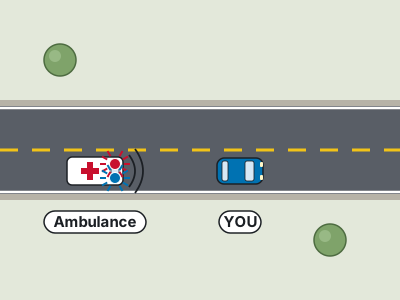
9. When an emergency vehicle is approaching, where should you wait?
- In the nearest intersection
- On the left shoulder facing traffic
- At the right edge of the roadway, clear of intersections
- Immediately beside the emergency vehicle
Show answer
At the right edge of the roadway, clear of intersections. The roadside position matters as much as stopping. Full explanation in Test 9
10. What must a driver do at a steady red traffic light before making a permitted right turn?
- Wait for a green arrow in every case
- Slow down and turn without stopping if traffic is light
- Turn first, then stop beyond the intersection
- Stop behind the stop bar or crosswalk and yield before turning
Show answer
Stop behind the stop bar or crosswalk and yield before turning. A steady red signal requires a stop behind the stop bar, crosswalk, or intersection. Full explanation in Test 10
11. Why should a driver avoid passing a vehicle stopped at a crosswalk?
- The stopped vehicle may be hiding a pedestrian
- The stopped vehicle always has a mechanical failure
- Passing is allowed only when the crosswalk has a traffic signal
- A driver must pass before the pedestrian reaches the curb
Show answer
The stopped vehicle may be hiding a pedestrian. The guide warns that a vehicle stopped at a crosswalk can block the next driver's view of a pedestrian. Full explanation in Test 1
12. Under Louisiana law, what fine and jail range applies to a first DWI conviction?
- A fine of $300 to $1,000 and 10 days to 6 months in jail
- A fine of $750 to $1,000 and 30 days to 6 months in jail
- A $2,000 fine and 1 to 5 years in prison
- A $5,000 fine and 10 to 30 years in prison
Show answer
A fine of $300 to $1,000 and 10 days to 6 months in jail. Louisiana Revised Statute 14:98.1 sets the penalty for a first offense of operating while impaired: a fine of not less than $300 nor more th Full explanation in Test 2
13. On a first offense, a Louisiana driver age 21 or older submits to the test and shows a BAC of 0.10%. How long are driving privileges suspended?
- 365 days
- 730 days
- 90 days
- 180 days
Show answer
180 days. If you submit to the test and are 21 or older, a BAC of 0.08% to 0.149% brings a 180 day suspension, so 0.10% falls in that band. Full explanation in Test 3
14. What happens to traffic fines in Louisiana construction zones?
- They are doubled
- They are waived
- They are cut in half
- They stay the same
Show answer
They are doubled. In Louisiana, traffic fines are double for construction zones. Full explanation in Test 4
15. What do double solid yellow lines mark on a roadway with four or more lanes?
- A shared lane reserved for travel in either direction
- A lane where passing is required before the next intersection
- The edge of a one-way roadway where vehicles may park
- The center of the roadway, where crossing to pass is prohibited
Show answer
The center of the roadway, where crossing to pass is prohibited. Double solid yellow lines mark the center of a roadway with four or more lanes. Full explanation in Test 5
16. What color is used for temporary traffic control signs in Louisiana’s guide?
- Brown
- Blue
- Orange
- Green
Show answer
Orange. Orange identifies temporary traffic control signs and signals a construction or maintenance setting. Full explanation in Test 6
17. What information is commonly provided by a blue service sign?
- A prohibition against passing
- The location of services such as gas stations or hospitals
- A warning about a curve or slippery pavement
- The maximum speed allowed on the road
Show answer
The location of services such as gas stations or hospitals. Blue service signs direct travelers to useful facilities, including rest areas, gas stations, hotels, and hospitals. Full explanation in Test 7
18. A Louisiana student who is 16 withdraws from school before graduating. What can happen?
- Nothing, because school is unrelated to driving
- The driving privilege can be lost
- Only a fine is charged
- The license is upgraded
Show answer
The driving privilege can be lost. The guide lists withdrawing from school before graduation, if you are 15 but less than 18, or being found habitually absent or tardy, as a w Full explanation in Test 8
19. What does a single solid yellow line on a two-lane road identify?
- A boundary between lanes moving the same direction
- A lane where passing is required
- A no-passing zone
- A place where a U-turn is always required
Show answer
A no-passing zone. A single solid yellow line on a two-lane road marks a zone where passing is prohibited. Full explanation in Test 9
20. How long does texting take a driver's eyes off the road, according to the Louisiana guide?
- 4.6 seconds
- 30 seconds
- Half a second
- 10 seconds
Show answer
4.6 seconds. Texting causes a driver to look away from the road for 4.6 seconds, long enough to cover a football field at highway speed. Full explanation in Test 10
21. How often did a crash, serious injury and fatality occur in Louisiana in 2018, according to the guide?
- A crash every hour
- A crash every 3 minutes, a serious injury every 7 minutes, and a fatality every 11 hours and 22 minutes
- A crash every day
- A fatality every week
Show answer
A crash every 3 minutes, a serious injury every 7 minutes, and a fatality every 11 hours and 22 minutes. In 2018 a crash in Louisiana occurred every 3 minutes, a serious injury every 7 minutes, and a fatality every 11 hours and 22 minutes. Full explanation in Test 1
22. How many supervised driving hours must be documented before a Louisiana Class E intermediate license is issued?
- 50 hours, including at least 15 at night
- 30 hours, including at least 5 at night
- 40 hours, all during daylight
- 60 hours, including at least 20 at night
Show answer
50 hours, including at least 15 at night. The intermediate license upgrade requires a documented total of at least 50 practice hours, and the manual adds a separate nighttime minimum Full explanation in Test 2
23. What mandatory jail time does Louisiana list for a second DWI conviction?
- 48 hours
- 30 days
- None
- One year
Show answer
48 hours. Louisiana Revised Statute 14:98.2 sets a second DWI conviction at a fine of $750 to $1,000 and 30 days to six months in jail, and at least 4 Full explanation in Test 3
24. After a property damage crash, what should you do to reduce the risk of another collision?
- Park across a lane so approaching traffic must stop
- Leave both vehicles in the travel lanes until every report is finished
- Drive away if the vehicles can still move under their own power
- Remove the vehicles from the roadway to the nearest soft shoulder when possible
Show answer
Remove the vehicles from the roadway to the nearest soft shoulder when possible. Louisiana's Move It campaign emphasizes clearing damaged vehicles from the roadway when it can be done safely. Full explanation in Test 4
25. How should a driver use a roundabout after entering it?

- Do not stop inside; traffic already in the roundabout has the right-of-way
- Stop inside whenever another vehicle approaches from the right
- Drive clockwise against the circulating traffic to reach the exit
- Change lanes repeatedly until the desired exit appears
Show answer
Do not stop inside; traffic already in the roundabout has the right-of-way. Once inside a roundabout, do not stop, and remember that the vehicle circulating there has the right-of-way. Full explanation in Test 5
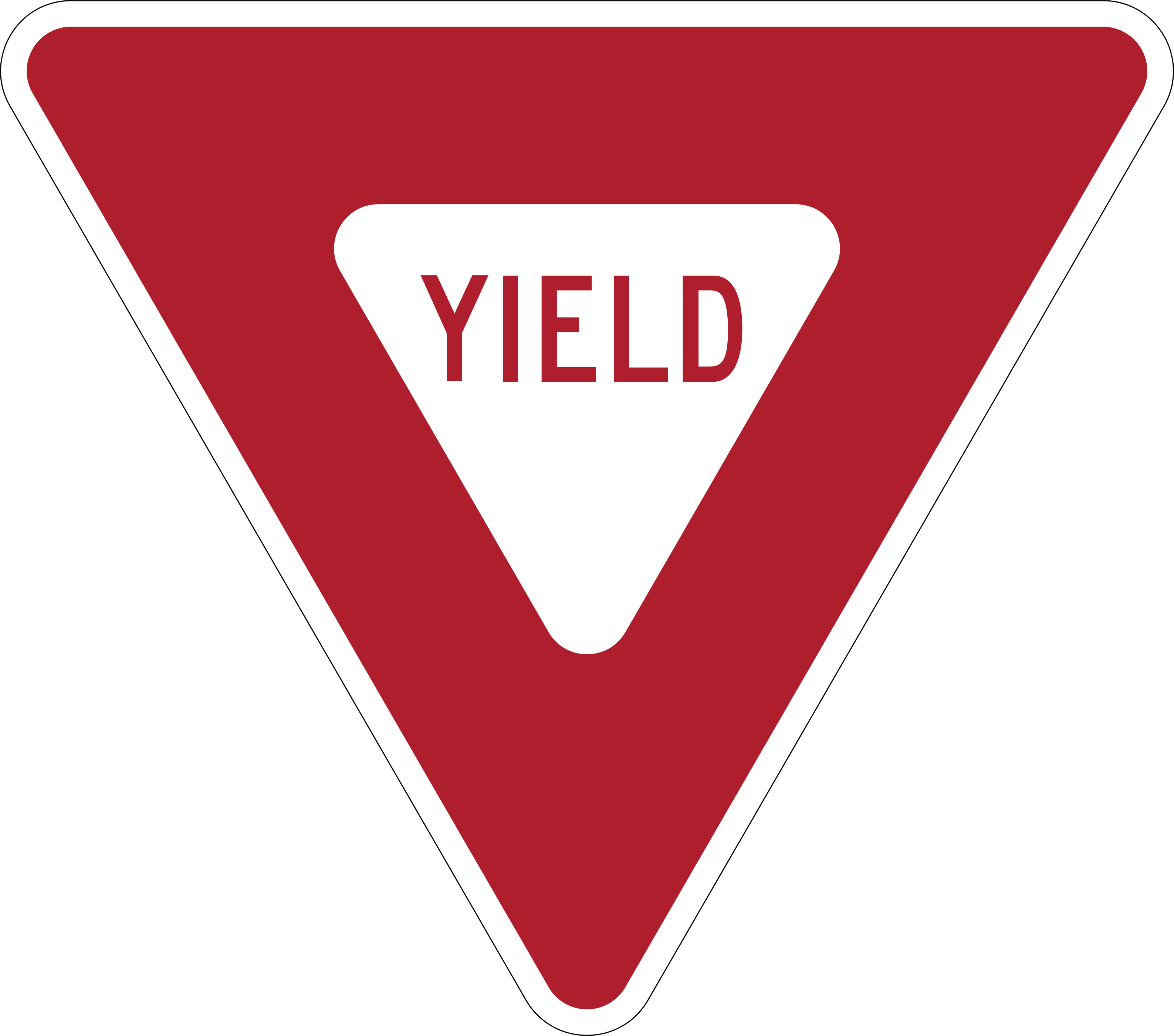
26. What does a downward-pointing red and white triangle require?
- Enter only after sounding the horn twice
- Stop permanently until the signal turns green
- Continue without checking because the triangle gives priority
- Slow down and allow right-of-way traffic to cross before entering
Show answer
Slow down and allow right-of-way traffic to cross before entering. A yield sign tells the driver to slow down and let traffic with the right-of-way cross before entering. Full explanation in Test 6
27. What does Louisiana law prohibit a driver from doing on railroad tracks?
- Stopping before a lowered crossing gate
- Looking both ways before crossing
- Stopping a vehicle on the tracks
- Waiting until the gates are raised
Show answer
Stopping a vehicle on the tracks. Louisiana law prohibits stopping a vehicle on railroad tracks. Full explanation in Test 7
28. Which sign color means stop or do not?
- Fluorescent pink
- Amber
- Orange
- Red
Show answer
Red. Red carries a stop or prohibition message in the guide. It is used for stop and yield signs, along with DO NOT ENTER and WRONG WAY signs. Full explanation in Test 8
29. A pedestrian is crossing outside a marked crosswalk. What does the Louisiana guide require a driver to do?
- Continue because pedestrians only have priority in marked crosswalks
- Yield and stop for the pedestrian
- Pass a stopped vehicle that is waiting for the pedestrian
- Sound the horn and keep the same speed
Show answer
Yield and stop for the pedestrian. The guide says drivers must yield to pedestrians at all times, even when a person is crossing where crossing is illegal. Full explanation in Test 9
30. What does a steady DON'T WALK pedestrian signal tell a person at the curb?
- Cross if no vehicle is immediately visible
- Do not enter the roadway toward the signal
- Cross normally because the signal is not flashing
- Wait only for a vehicle to wave the pedestrian through
Show answer
Do not enter the roadway toward the signal. The steady DON'T WALK indication means pedestrians must not enter the roadway toward that signal. Full explanation in Test 10
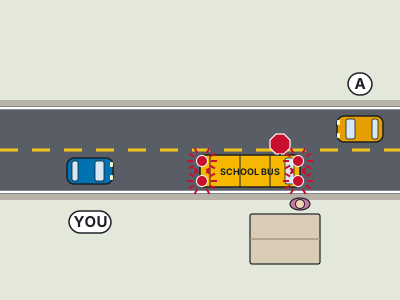
31. When required to stop for a school bus that is loading or unloading children, what minimum distance must you leave?
- At least 10 feet
- At least 5 feet
- At least 30 feet
- At least 100 feet
Show answer
At least 30 feet. A stopped school bus loading or unloading children requires a stop at least thirty feet away. Full explanation in Test 1
32. What should a driver do at a steady green traffic light if crossing traffic is still clearing the intersection?
- Enter immediately because green traffic always has priority
- Allow the crossing traffic to clear before going ahead
- Wait for the light to turn red, then drive through
- Use the shoulder to bypass the crossing traffic
Show answer
Allow the crossing traffic to clear before going ahead. A steady green allows movement only when the intersection is clear. Full explanation in Test 2
33. Which of these can cost a Louisiana driver the driving privilege?
- Failure to pay state income taxes
- Buying a new car
- Moving within the same parish
- Driving an older vehicle
Show answer
Failure to pay state income taxes. Louisiana's list of ways to lose the driving privilege includes failure to pay child support and failure to pay state income taxes, along wi Full explanation in Test 3
34. About how long does it take for the effects of one marijuana cigarette to wear off, according to the Louisiana guide?
- About one hour
- About 15 minutes
- Five to six hours
- Two days
Show answer
Five to six hours. The guide contrasts marijuana with alcohol: the effects of a single drink diminish over about an hour, but it takes five to six hours for th Full explanation in Test 4
35. What kind of roadway information is conveyed by the yellow diamond sign shown?

- A command to enter a reserved bus lane
- A warning about a possible hazard ahead
- A guide to a recreational destination
- A notice that the vehicle registration is due
Show answer
A warning about a possible hazard ahead. The skidding car image is a warning sign, and its yellow diamond shape tells the driver to prepare for a possible roadway hazard. Full explanation in Test 5
36. What do red raised pavement markings or reflectors indicate?
- Passing is permitted if the roadway is dry
- The lane is reserved for buses traveling in either direction
- Travel is against the direction of traffic and the roadway must not be entered
- A parking area begins at the next intersection
Show answer
Travel is against the direction of traffic and the roadway must not be entered. Red raised markings or reflectors warn that a driver is facing the wrong direction of travel. Full explanation in Test 6
37. A school bus is stopped on a two-lane road with red lights flashing. What must traffic do?
- Drivers may continue once the bus door opens
- Only traffic behind the bus must stop
- Oncoming drivers may pass if they slow below 15 mph
- Drivers in both directions must stop at least 30 feet away
Show answer
Drivers in both directions must stop at least 30 feet away. A bus loading or unloading children requires a stop at least thirty feet away, and the rule applies whether a driver is meeting the bus or f Full explanation in Test 7
38. A driver is leaving a driveway to enter a public road. To whom must the driver yield?
- Only vehicles approaching from the driver's left
- Vehicles already on the main road
- No one if the driveway has a paved surface
- Only pedestrians standing on the sidewalk
Show answer
Vehicles already on the main road. A driver entering a road from a driveway, alley, or roadside must yield to vehicles already on the main road. Full explanation in Test 8
39. How should a Louisiana driver treat a flashing red signal before entering an intersection?
- As a signal to wait until it becomes steady red
- As a yield sign without making a full stop
- As a green light if no vehicle is visible
- As a stop sign, stopping completely before proceeding when safe
Show answer
As a stop sign, stopping completely before proceeding when safe. A flashing red light requires the driver to stop behind the stop bar, crosswalk, or intersection before entering. Full explanation in Test 9
40. What hand positions does the Louisiana guide recommend on the steering wheel?
- 10 and 2 at all times
- 12 and 6
- 9 and 3 or 8 and 4, with 12 o'clock only while backing
- One hand at 12
Show answer
9 and 3 or 8 and 4, with 12 o'clock only while backing. The recommended positions are 9 and 3 or 8 and 4, which keep the arms clear of a deploying air bag and give balanced control. Full explanation in Test 10
