
Test 12 of 25 · 20 questions · Free 2026
LA Permit Practice Test 12
Jump to the test ↓A fixed 20 question set from the Louisiana bank with answers and plain English explanations. The real LA exam is 40 questions, 80 percent to pass; take the full length version on the main practice page.
Question 1 of 20 · 0 right so far
All 20 questions in test 12
Every question below comes from the Louisiana question bank on this page. Open a question to see the correct answer and the explanation. Nothing here is hidden behind a signup.
1. On dry pavement with good brakes, about how far does it take to react and stop from 30 mph?
- About 40 feet
- About 123 feet
- About 268 feet
- About 359 feet
Show answer
About 123 feet. Stopping takes longer than most drivers expect. At 30 mph, reacting to a problem and bringing the car to a stop takes about two to three seconds, or about 123 feet, even with good tires, good brakes and dry pavement. The 268 foot figure is the minimum total at 50 mph, and 359 feet is the guide figure for 60 mph. Forty feet leaves out the distance you travel before your foot even reaches the brake.
Study this in the handbook: Scanning ahead, stopping distance and following distance
2. You are following a big truck and cannot see its side mirrors. What does that tell you?
- The truck driver has a clear view of you
- You are at a safe following distance
- You are too close and should back off
- The truck is about to make a right turn
Show answer
You are too close and should back off. If you cannot see a truck's side mirrors while following it, you are driving too close, and the driver cannot see you. Back off. Big trucks have large blind spots, called No-Zones, around the front, back and sides. The guide also says that if you cannot see the truck driver's face in one of the mirrors, the driver cannot see you. Following farther back also improves your view of the road and gives you more room to stop if the truck brakes suddenly.
Study this in the handbook: Bicycles, motorcycles and big trucks
3. A bicyclist has the right of way in an intersection you are approaching. How must you treat the rider?
- Go first, since motor vehicles have priority
- Yield just as you would to other vehicles
- Yield only if the rider gives a hand signal
- Pass the rider before reaching the crosswalk
Show answer
Yield just as you would to other vehicles. Bicycles have the same rights to use public roads as automobiles and must follow the same traffic laws. In intersections, you must yield to bicyclists just as you would to pedestrians and other vehicles. Cars do not get priority because they are bigger, and the duty does not depend on a hand signal. The guide adds that drivers turning left must wait until oncoming bicyclists pass, and that you should not swing in front of a bicyclist to make a right turn.
Study this in the handbook: Bicycles, motorcycles and big trucks
4. You are driving at night on a road you have never used before. How much should you add to your following distance?
- At least two extra seconds
- Nothing, if your high beams are on
- At least half of one extra second
- At least ten extra seconds
Show answer
At least two extra seconds. Darkness cuts how far you can see, so night driving calls for at least one extra second of following distance. On an unfamiliar road at night, add at least two extra seconds, because you do not know where curves, driveways or hazards are. High beams do not remove the need, since headlights still limit what you can see. Ten seconds is not the guide figure. Also slow down so you can stop within your headlight range.
Study this in the handbook: Night driving, pedestrians and phones
5. How should you steer and brake on slippery curves to keep from skidding?
- With a light touch on the wheel and brake
- Firmly, locking the wheels briefly
- With quick, hard steering corrections
- Hard braking in the middle of the curve
Show answer
With a light touch on the wheel and brake. Most skids happen when drivers try to turn or stop suddenly on slippery pavement. The guide says you can prevent skids by driving slowly and carefully, especially on curves, and by steering and braking with a light touch. When you need to slow or stop, do not brake hard or lock the wheels; keep mild pressure on the brake pedal instead. Sudden, hard inputs in a curve are what start a skid in the first place.
Study this in the handbook: Skids, blowouts and hydroplaning
6. On an interstate with three lanes in your direction, what is the far left lane mainly for?
- Entering and exiting the interstate
- Steady travel at the speed limit
- Slow trucks and trailers
- Passing other vehicles
Show answer
Passing other vehicles. Normally you should stay in the right hand lane unless you are passing, exiting to the left or letting another vehicle enter. On an interstate with three or more lanes in one direction, though, you may drive in any lane, because each has a job: the right lane is used for entering and exiting, the middle is often the travel lane, and the far left lane is for passing. Avoid unnecessary lane changing.
Study this in the handbook: Interstate and rural road driving
7. In a parking lot with perpendicular spaces, what does the guide say is the safer way to park when possible?
- Back in, or pull through to the next space
- Park across two spaces for more room
- Pull in nose first and back out later
- Park at an angle across the painted lines
Show answer
Back in, or pull through to the next space. When it is possible, backing into a perpendicular space or pulling through to the space ahead is preferred. The guide calls it a safer method that helps prevent crashes with other vehicles and with pedestrians, because you avoid backing out between parked cars when you leave. Taking two spaces or parking crooked across the lines is not the answer. Park correctly within the lines so others have room to get in and out.
Study this in the handbook: Parking rules and painted curbs
8. You see this yellow warning sign ahead. What will change on the road?

- A median will separate the two directions
- Two lanes will merge into one
- A two-way left turn lane begins
- The road ends at a T intersection
Show answer
A median will separate the two directions. This yellow diamond warns that a divided highway begins ahead. Louisiana's guide defines divided highways as roads where lanes going in opposite directions are separated by a median or some sort of barrier. After this point, oncoming traffic will be on the far side of that median, and you stay to the right of it. A merge, a center turn lane and a T intersection are each shown by different signs or markings.
9. While parking, you scrape a parked car whose owner is not around. What must you do?
- Leave, since no one saw it happen
- Tell police, seek the owner and leave a note
- Leave a note only if the damage is serious
- Call your insurance company later and leave
Show answer
Tell police, seek the owner and leave a note. If you damage an unattended vehicle or other property, you must notify the police and try to locate the owner. Leave your name, address and telephone number on a note where the owner will be sure to see it. Leaving without identifying yourself is not allowed, and the duty does not depend on how serious the damage looks. You should also notify your insurance company as soon as practical with complete information.
Study this in the handbook: Stuck pedals, fires, floods and crashes
10. Louisiana says not to turn around on a hill or curve where drivers from either direction cannot see you within what distance?
- 100 feet
- 200 feet
- 500 feet
- 1,000 feet
Show answer
500 feet. On a hill or in a curve, approaching drivers may not see your vehicle in time, so the guide says not to turn around where drivers from either direction cannot see your vehicle within 500 feet. One hundred or 200 feet is far less sight distance than the rule requires. If you are on a hill or curve without that view, continue until you reach a place where turning is safe.
Study this in the handbook: School buses, turns and signals
11. On a wet curve, the rear of your car starts sliding to the right. Which way should you turn the front wheels?
- To the left, against the slide
- Hold them straight and brake hard
- To the right, the way the rear slides
- Sharply left, then sharply right
Show answer
To the right, the way the rear slides. When the rear of the car slides, steer in the direction the rear end is skidding. Take your foot off the gas, and if the rear is skidding to the right, turn the front wheels to the right, only enough to keep them going straight down the road. Do not use your brakes. Be careful not to oversteer, because the car may start to skid the other way; when you feel control return, straighten the wheels.
Study this in the handbook: Skids, blowouts and hydroplaning
12. At night on a highway, a large flashing arrow panel ahead points to the left. What is it telling you?
- Slow down but stay in your lane
- Take the next exit on the left
- A sharp left curve is just ahead
- Move left; the lane ahead is closed
Show answer
Move left; the lane ahead is closed. Large flashing or sequential arrow panels are used in work zones both day and night. Louisiana's guide says they guide drivers into certain traffic lanes and tell them that part of the road ahead is closed. An arrow pointing left means the lane you are in is closing and traffic should move to the left. It is not a curve warning and not an exit sign. Merge early and smoothly rather than waiting until you reach the closure.
13. At a flashing red traffic light, you should follow the same steps as at which traffic control?
- A yield sign
- A flashing yellow light
- A stop sign
- A green arrow
Show answer
A stop sign. Louisiana's guide says a flashing red light means you must stop behind the stop bar, crosswalk or intersection before entering, and then use the same procedure as at a stop sign: come to a complete stop, look both ways and yield the right of way. A yield sign only requires stopping when traffic makes it necessary, and a flashing yellow light means slow down and proceed with caution. Treat every flashing red signal as a stop sign.
Study this in the handbook: Traffic lights and arrows
14. An ambulance with its siren on passes you on the way to a call. You follow 300 feet behind it to get through traffic. Is that allowed?
- Yes, as long as you stay 100 feet back
- Yes, if your hazard lights are flashing
- No, closer than 500 feet is unlawful
- No, you must stay a full mile back
Show answer
No, closer than 500 feet is unlawful. Louisiana law makes it unlawful to follow an emergency vehicle responding to a call closer than 500 feet. Three hundred feet is too close, and hazard lights do not change that. You also may not follow the vehicle into the block where it stops and park there. When an emergency vehicle approaches with siren and lights, pull to the right edge of the road clear of intersections, stop until it passes and watch for others.
Study this in the handbook: Bicycles, motorcycles and big trucks
15. You pull over to the right curb for an ambulance using its siren. How long should you stay stopped?
- Until the siren can no longer be heard
- Until the ambulance has passed you
- Only until the ambulance is alongside you
- For about ten seconds, then go
Show answer
Until the ambulance has passed you. When an authorized emergency vehicle such as an ambulance, police car or fire truck approaches using audible or visual signals, you must yield the right-of-way. Immediately drive to a position parallel to the right-hand edge or curb and remain stopped until that vehicle has passed. Starting again as soon as it reaches you, or after a set count, ignores that rule. Once moving again, do not follow an emergency vehicle closer than 500 feet.
Study this in the handbook: Stuck pedals, fires, floods and crashes
16. You are on a country highway and see this yellow diamond sign. What is ahead?
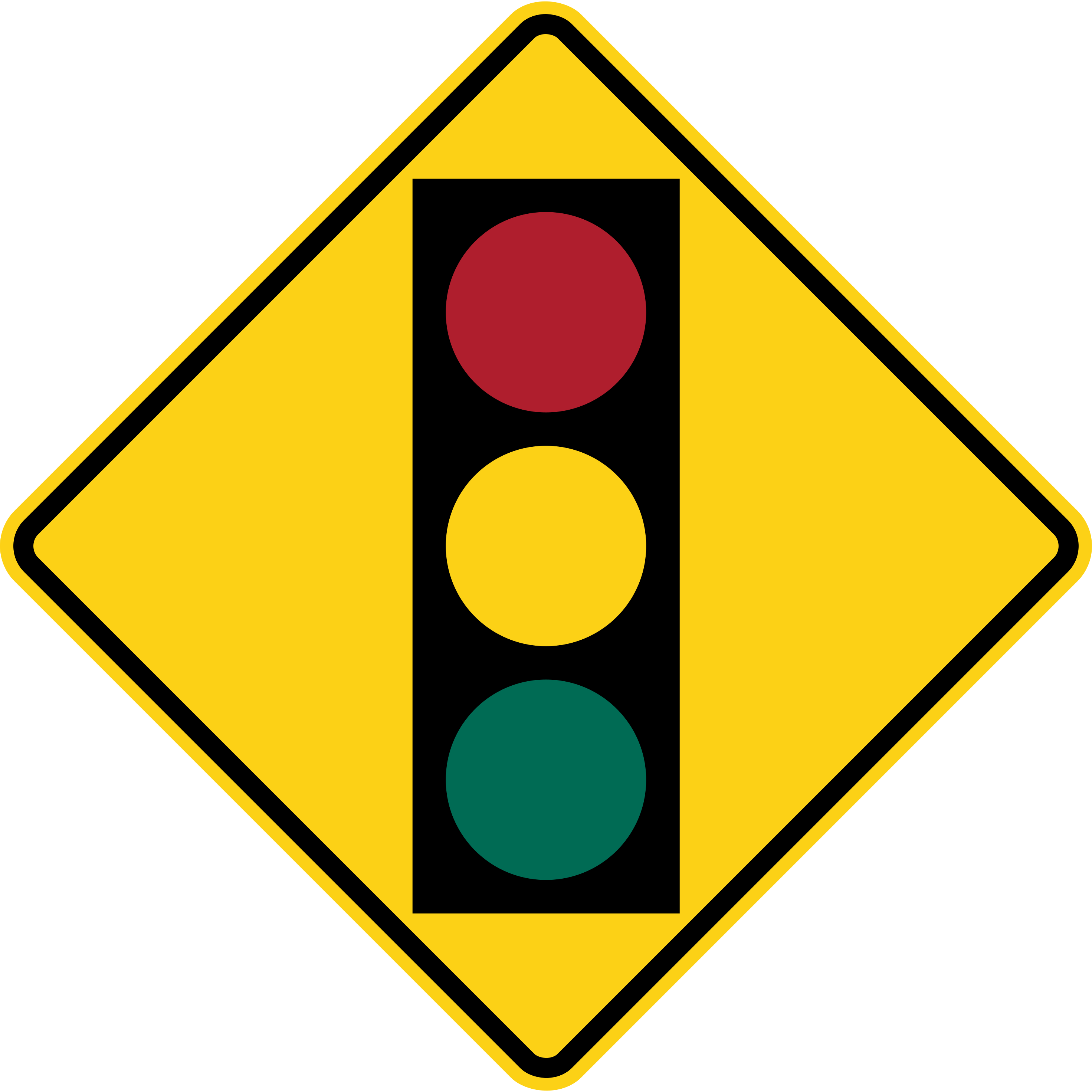
- A railroad crossing
- A traffic signal
- A school crossing
- A stop sign
Show answer
A traffic signal. This is the Traffic Signal Ahead sign from the guide's set of common warning signs. Warning signs are usually yellow diamonds that tell you about possible danger ahead, such as a place where you may need to slow down and be prepared to stop. Here the symbol shows a traffic light, so expect a signal that may be red when you reach it. A railroad warning is round, and a stop sign ahead is shown with a red octagon symbol instead.
Study this in the handbook: Warning, regulatory, guide and work zone signs
17. You crest a hill on a rural highway and see a hay wagon ahead showing an orange and red triangle on its rear. What speed should you expect it to be going?
- Less than 25 mph
- About 35 to 45 mph
- The posted speed limit
- Less than 55 mph
Show answer
Less than 25 mph. An orange and red triangle on the rear of a vehicle drawn by animals, farm equipment or construction equipment means the vehicle is traveling less than 25 mph. Coming over a hill at highway speed, you will close on it very quickly, so slow down early. The guide says to use caution when approaching a slow moving vehicle and to be sure it is safe before passing. Farm machinery may be wide enough to take up more than one lane.
Study this in the handbook: Interstate and rural road driving
18. A horizontal traffic signal has only its leftmost light lit, but sun glare makes the color hard to judge. What should you do?
- Go, since you cannot tell the color
- Slow down and proceed with caution
- Turn left, since the left light is lit
- Stop, as you would for a red light
Show answer
Stop, as you would for a red light. On a horizontal signal the position of the light tells you its color. Louisiana's guide says that in some metropolitan areas signals are horizontal, with red on the left, yellow in the middle and green on the right. When glare washes out the color, a lit left light is still the red, so you stop as you would for any red signal. It is not a caution light and it does not signal a left turn.
Study this in the handbook: Traffic lights and arrows
19. What do most warning signs, such as those for curves and side roads, look like?
- Red and white triangles
- White rectangles
- Green squares
- Yellow diamonds
Show answer
Yellow diamonds. Warning signs alert you to possible danger ahead, such as curves, side roads or a special situation on the road. Louisiana's guide says they are usually yellow with black lettering or symbols and diamond shaped. Some warning signs, such as school zone and pedestrian crossing signs, may be fluorescent yellow. A red and white downward triangle is the yield sign, white rectangles are regulatory signs such as speed limits, and green signs are guide signs.
Study this in the handbook: Warning, regulatory, guide and work zone signs
20. How does Louisiana penalize driving under the influence of over-the-counter or prescribed medication?
- The same as driving under the influence of alcohol
- It is never an offense if the drug is legal
- A lesser penalty than driving under the influence of alcohol
- A warning letter from the Office of Motor Vehicles
Show answer
The same as driving under the influence of alcohol. Louisiana law provides the same penalty for driving under the influence of drugs as for alcohol, and the guide says this includes over-the-counter and prescribed medication. A legal drug is not a defense if it impairs you. The penalty is not reduced to a lesser sanction or a warning letter, and no crash is needed. Read medication labels, because they may warn that the drug can interfere with driving, and ask a doctor or pharmacist if you are unsure.
Study this in the handbook: Implied consent and DWI penalties
Every question is written from the official Louisiana Class D and E Driver's Guide. Need paper? Printable LA practice test with answer key.
Last verified 2026-10-05. How we check every question · Study all 500 as flashcards
Frequently asked questions
How many questions are on this Louisiana practice test?
This fixed set has 20 questions. It is test 12 of 25 from the 500 question Louisiana bank. The real LA exam asks 40 questions and you need 32 correct.
What is the passing score for the real Louisiana test?
80% minimum score is required That figure comes from the official Louisiana source cited on the DMV facts page.
How does this fixed test relate to the full Louisiana bank?
Each numbered test is a fixed set of questions in a fixed order, so you can retake the same test later and compare. Every test mixes road signs and the other topics in about the same proportion as the full bank. Tests 1 to 25 together cover every question in the Louisiana bank once. The full practice page mixes the whole bank at random.
Last verified 2026-10-05. See the Louisiana DMV facts page for sourced state details.
Return to the full Louisiana practice test · Study road signs