
Test 1 of 10 · 20 questions · Free 2026
LA Permit Practice Test 1
Jump to the test ↓A fixed 20 question set from the Louisiana bank with answers and plain English explanations. The real LA exam is 40 questions, 80 percent to pass; take the full length version on the main practice page.
Question 1 of 20 · 0 right so far
All 20 questions in test 1
Every question below comes from the Louisiana question bank on this page. Open a question to see the correct answer and the explanation. Nothing here is hidden behind a signup.
1. What does a steady yellow traffic light mean when you are already in the intersection?
- You may continue safely through the intersection
- You must reverse out of the intersection
- You must stop immediately in the crossing path
- You may turn in any direction without yielding
Show answer
You may continue safely through the intersection. Yellow normally warns that the signal is about to turn red, so a driver approaching the stop bar should slow and stop when that can be done safely. The situation changes once the vehicle is already in the intersection. The guide allows that driver to continue safely through rather than stopping in the middle of the crossing. Reversing is unpredictable, and the signal does not remove the duty to yield during a turn. Clear the intersection smoothly, watching for people and vehicles, then wait for the next legal movement.
Study this in the handbook: Traffic lights and arrows
2. Why should a driver avoid passing a vehicle stopped at a crosswalk?
- The stopped vehicle may be hiding a pedestrian
- The stopped vehicle always has a mechanical failure
- Passing is allowed only when the crosswalk has a traffic signal
- A driver must pass before the pedestrian reaches the curb
Show answer
The stopped vehicle may be hiding a pedestrian. The guide warns that a vehicle stopped at a crosswalk can block the next driver's view of a pedestrian. Passing it may put the passing driver directly into the pedestrian's path without enough sight distance to stop. The stopped vehicle does not need to have a mechanical problem, and a signal does not make a blind pass safe. Approach cautiously, prepare to stop, and wait until the crossing area is visible and clear. The practical cue is an occupied lane beside a crosswalk, especially when the stopped vehicle hides what is ahead.
Study this in the handbook: Lane changes, passing and wet roads
3. How often did a crash, serious injury and fatality occur in Louisiana in 2018, according to the guide?
- A crash every hour
- A crash every 3 minutes, a serious injury every 7 minutes, and a fatality every 11 hours and 22 minutes
- A crash every day
- A fatality every week
Show answer
A crash every 3 minutes, a serious injury every 7 minutes, and a fatality every 11 hours and 22 minutes. In 2018 a crash in Louisiana occurred every 3 minutes, a serious injury every 7 minutes, and a fatality every 11 hours and 22 minutes. Fatalities, injuries and property damage from crashes cost the average licensed Louisiana driver $2,899.77 that year. The Louisiana Highway Safety Research Group identified the four leading causes of motor vehicle fatalities in the state as alcohol, distraction, aggressive driving or behavior, and lack of seat belt usage. The slower rates in the other choices badly understate the problem.
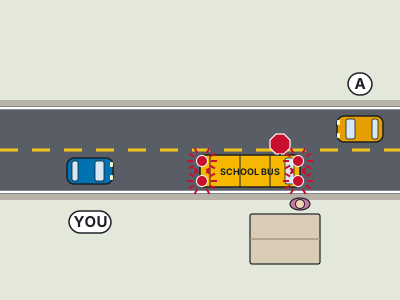
4. When required to stop for a school bus that is loading or unloading children, what minimum distance must you leave?
- At least 10 feet
- At least 5 feet
- At least 30 feet
- At least 100 feet
Show answer
At least 30 feet. A stopped school bus loading or unloading children requires a stop at least thirty feet away. The distance gives children and the bus a protected area and prevents a moving vehicle from passing too close. Five or ten feet leaves very little room for a child who steps into the roadway, while one hundred feet is not the stated stopping distance. Watch for the bus's flashing red lights and stop signs, remain stopped, and wait until the bus moves and the area has been checked before continuing.
Study this in the handbook: School buses, turns and signals
5. If a car begins to skid, which response follows the driver's guide?
- Turn the wheel as far as possible in the opposite direction
- Lock the brakes and hold the steering wheel straight
- Accelerate sharply toward the shoulder
- Ease off the gas and steer carefully where you want the front of the car to go
Show answer
Ease off the gas and steer carefully where you want the front of the car to go. A skid calls for calm, gradual control rather than a sudden correction. Release pressure on the accelerator and guide the front wheels toward the intended path, making only enough steering input to regain alignment. Locking the brakes can worsen the loss of traction, and acceleration toward the shoulder adds another unpredictable force. A full opposite turn may overcorrect and start a skid in the other direction. Think of the cue as tires first: reduce power, look where you want to travel, and steer smoothly.
Study this in the handbook: Skids, blowouts and hydroplaning
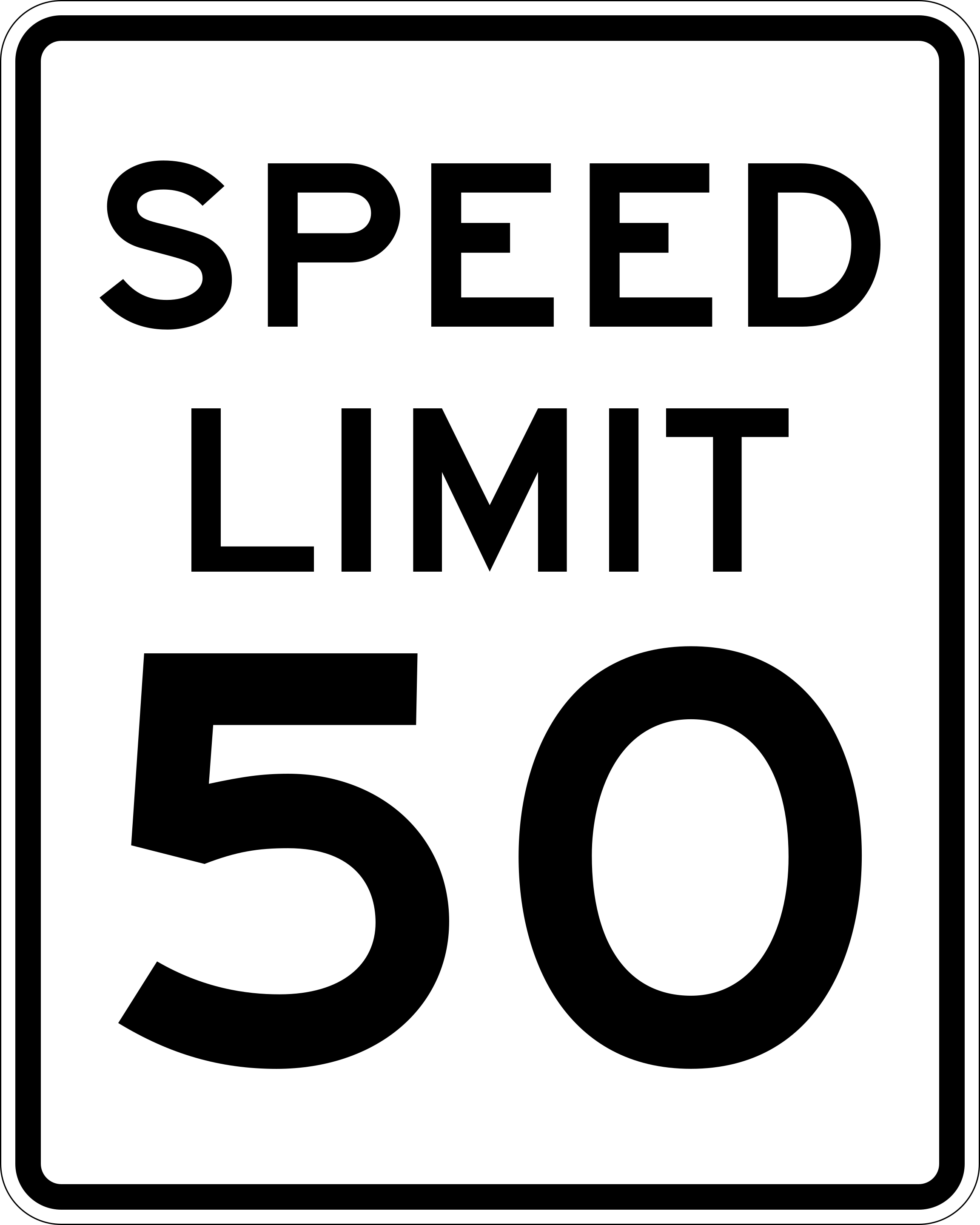
6. What does a black and white speed limit sign show?
- The speed required in every weather condition
- A recommended speed that may always be exceeded
- The maximum legal speed or, where posted, the minimum legal speed
- The speed permitted only when no other vehicles are present
Show answer
The maximum legal speed or, where posted, the minimum legal speed. Black and white speed signs can show a maximum legal speed or a minimum legal speed. A maximum is meant for ideal conditions, so rain, fog, ice, traffic, or poor visibility can require slowing further. The recommendation choice wrongly treats the number as optional, while the all-weather choice ignores the need to adapt. A minimum on a high-speed road is different: traveling below it can create a hazard. Read the sign’s wording and assess conditions together.
Study this in the handbook: Warning, regulatory, guide and work zone signs
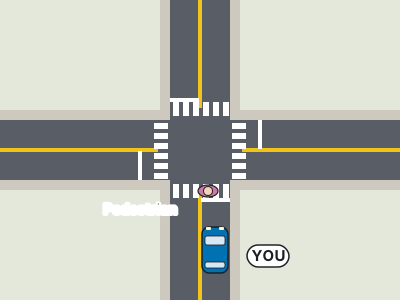
7. What must a driver do when pedestrians are in a crosswalk?
- Sound the horn and pass in front of them
- Continue if the pedestrians are walking slowly
- Yield only at a traffic signal
- Stop and yield to the pedestrians
Show answer
Stop and yield to the pedestrians. Pedestrians in crosswalks have the right of way over motor vehicles, and the guide says drivers must stop for them. The rule applies to crosswalks even when they are located in the middle of a block, so a traffic signal is not required. Walking speed does not remove the pedestrian's priority, and a horn does not authorize passing in front. The cue is the crosswalk itself: scan it early, stop, and wait until the path is clear.
Study this in the handbook: Center lines, lane lines and crosswalks
8. What instruction is conveyed exclusively by an octagonal sign?
- Yield
- Stop
- Do not enter
- Keep right
Show answer
Stop. An octagon is reserved for stop signs, making the shape itself an immediate recognition cue. Come to a complete stop at the required stopping point, then check both directions and yield before entering. Yield signs are downward triangles, while do-not-enter and keep-right instructions use other designs. Do not roll through because the road appears empty; the complete stop is required before deciding whether the movement is safe.
Study this in the handbook: Sign shapes and colors
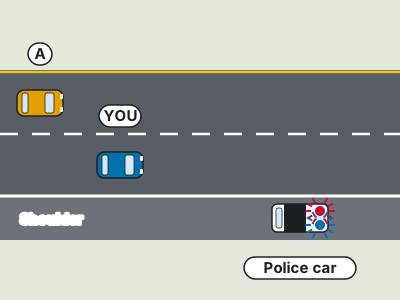
9. If a lane change away from a stopped emergency vehicle is unsafe, what should you do?
- Slow to a reasonably safe speed and pass carefully
- Stop beside the emergency vehicle in the adjacent lane
- Speed up to reduce time beside the vehicle
- Ignore the vehicle if its lights are flashing
Show answer
Slow to a reasonably safe speed and pass carefully. The emergency response rule allows a driver to slow to a reasonably safe speed when moving into a nonadjacent lane is not possible or safe. A sudden lane change can create a side collision, so safety and traffic conditions come first. Speeding up reduces reaction time and increases exposure to workers or responders. Check mirrors, reduce speed early, give the scene room, and move over later when a safe opening exists.
Study this in the handbook: Emergency vehicles and the move over rule
10. What do fluorescent pink incident signs tell Louisiana drivers to expect?
- A permanent hospital service is available ahead
- A roadside incident may require slowing and changing lanes
- A school speed limit applies only during flashing hours
- A recreational route begins at the next exit
Show answer
A roadside incident may require slowing and changing lanes. Fluorescent pink incident signs are temporary. They tell drivers when to be prepared to stop or when roadways are closed or detoured because of a road user incident, natural disaster, hazardous material spill, or another unplanned incident. The guide pairs them with Louisiana's move over law, which requires slowing down and changing lanes when approaching a roadside incident. Do not treat the sign as a permanent service, school zone, or destination marker. Scan for stopped vehicles and workers, and check mirrors before the lane change.
Study this in the handbook: Warning, regulatory, guide and work zone signs
11. What information does a typical yellow diamond-shaped warning sign provide?
- The location of a fuel or lodging service
- A maximum legal speed that applies in all weather
- A possible danger or special roadway condition ahead
- A command to enter only in the arrow's direction
Show answer
A possible danger or special roadway condition ahead. Warning signs alert drivers to possible danger, a hazard, or a special situation ahead. They are usually yellow with black lettering or symbols and diamond shaped. Their message calls for an adjustment in speed or attention before the driver reaches the condition. A speed limit is a regulatory message, services use guide signs, and directional commands belong to lane-use or other regulatory signs. When a yellow diamond appears, look beyond the sign, identify the developing condition, and prepare to slow or stop if the roadway requires it.
Study this in the handbook: Warning, regulatory, guide and work zone signs
12. What does a downward-pointing triangle sign tell a Louisiana driver to do?
- Stop every time before reaching the sign
- Slow down and yield to traffic with the right-of-way
- Enter a no-passing zone
- Continue without checking because the lane is protected
Show answer
Slow down and yield to traffic with the right-of-way. Louisiana reserves the downward-pointing triangle for yield signs. The driver should reduce speed, watch for oncoming traffic, and be ready to stop when traffic flow requires it. A stop is not automatic in every approach, so the stop-every-time choice adds a condition the sign does not state. The shape does not identify a no-passing zone, which uses a sideways-pointing triangle. Use the triangle as an early visual cue to assess traffic before entering and give priority to roadway users already entitled to proceed.
Study this in the handbook: Sign shapes and colors
13. What is the Louisiana speed limit for a school bus that frequently stops to load or unload children?
- 35 mph
- 25 mph
- 45 mph
- 70 mph
Show answer
35 mph. The guide limits school buses to 35 mph when they frequently stop to load or unload children. That special number is not 25 or 45, and the general 70 mph maximum is inappropriate for this bus operation. The condition matters as much as the number: the guide ties the limit to frequent child loading or unloading stops. The cue is school bus plus repeated stops, which signals the 35 mph exception.
14. A Louisiana 15 year old has held a learner's permit for 200 days. When can the teen move to the intermediate license?
- Right away, since 180 days have passed
- At 15 and a half
- Not until the 16th birthday
- At 17
Show answer
Not until the 16th birthday. A learner's license must be held at least one hundred eighty days, and the holder cannot advance to the intermediate stage until the sixteenth birthday. Both conditions apply, so meeting the 180 days alone is not enough for a 15 year old. Fifteen and a half is not a Louisiana threshold. Seventeen is when the intermediate license stage ends and a full license becomes possible.
Study this in the handbook: The graduated licensing program
15. When the broken yellow line is on your side beside a solid yellow line, what may you do?
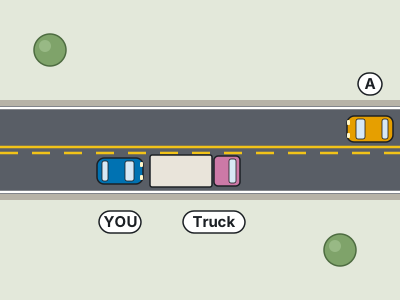
- Never cross for any reason
- Cross only to park on the opposite shoulder
- Cross to pass when it is safe
- Use the line as a travel lane
Show answer
Cross to pass when it is safe. A broken yellow line on your side indicates that passing may be permitted when the roadway is clear and the maneuver is safe. The solid line on the other side restricts that opposing direction, so drivers must read which marking is beside their lane. Never-cross wording is too broad, and the line is not a lane for ordinary travel or a special parking guide. Check sight distance, traffic, and other restrictions before crossing, then return to the proper side promptly.
Study this in the handbook: Traffic lights and arrows
16. How many people may ride in the front seat of a moving vehicle in Louisiana?
- No more than two
- No more than three
- No more than four
- Any number with seat belts
Show answer
No more than three. It is against Louisiana law for more than three persons to occupy the front seat of a moving vehicle. Two is stricter than the rule and four exceeds it. Seat belts do not create an exception to this limit. The guide also warns against overloading a vehicle with passengers or anything that blocks the driver's view or interferes with control.
Study this in the handbook: Right of way and other laws you should know
17. A Louisiana driver under 21 submits to the test and shows 0.03% BAC. How long are driving privileges suspended?
- 30 days
- 730 days
- No suspension below 0.08%
- 180 days
Show answer
180 days. For a driver under 21 who submits to the test, a BAC of 0.02% or more brings a 180 day suspension, and 0.03% is over that line. Drivers 20 and younger have a legal limit of 0.02%, so the 0.08% adult limit does not protect them. Thirty days is not in the rule. Seven hundred thirty days is for adults at 0.15% or more, or a second refusal.
Study this in the handbook: Implied consent and DWI penalties
18. Under Louisiana R.S. 32:61, what maximum applies on an interstate or controlled-access highway unless a different speed zone has been established?
- 70 mph
- 45 mph
- 35 mph
- 55 mph
Show answer
70 mph. Louisiana's statutory maximum is 70 mph on interstate and controlled-access highways, subject to established speed zones. The ordinary highway baseline is 55 mph, while a multilane divided highway with partial or no access control has a 65 mph maximum. The road classification matters: 70 mph is not the default for every road in the state. Follow the applicable signs and reduce speed whenever traffic, weather, or visibility makes the maximum unsafe.
Study this in the handbook: Speed laws
19. What does Louisiana's open-container law prohibit inside a vehicle?
- Carrying a nonalcoholic drink in a cup holder
- Transporting any sealed bottle in a trunk
- Drinking water while a passenger is present
- Possessing an open alcoholic beverage container and consuming alcohol
Show answer
Possessing an open alcoholic beverage container and consuming alcohol. Louisiana's rule prohibits both possession of an open alcoholic beverage container and consumption of any alcoholic beverage in a vehicle. The choice “Possessing an open alcoholic beverage container and consuming alcohol” includes both parts. A sealed bottle transported in a trunk, water, and a nonalcoholic drink are not the conduct described by this open-container passage. The guide warns that the driver can face fines and penalties even when someone else is consuming the alcohol. A practical cue is to distinguish an open alcoholic container from an ordinary beverage and to keep alcohol out of the passenger area.
Study this in the handbook: Alcohol and Louisiana's BAC limits
20. How should a driver interpret the yellow diamond shape of this crossroad sign?

- It prohibits all turns at the intersection
- It establishes a four way stop at the sign
- It gives the distance to the next airport
- It warns of an approaching roadway condition
Show answer
It warns of an approaching roadway condition. The crossroad picture is a yellow diamond warning sign. The manual says that yellow diamond signs advise drivers of approaching conditions, including approaching side roads and changes in traffic flow. The driver should slow as needed, scan both directions, and be ready for crossing traffic. The sign itself does not establish a four way stop, provide airport distance, or prohibit every turn. Look for separate stop, yield, or signal controls at the intersection and use the warning sign as advance notice to prepare.
Study this in the handbook: Warning, regulatory, guide and work zone signs
QualitySpace is expanding to Louisiana
We are a California-based independent insurance brokerage working on licensing in more states. We cannot help with Louisiana insurance yet. Leave your email and we will let you know when we can.
Every question is written from the official Louisiana Class D and E Driver's Guide. Need paper? Printable LA practice test with answer key.
Last verified 2026-10-05. How we check every question · Study all 218 as flashcards
Frequently asked questions
How many questions are on this Louisiana practice test?
This fixed set has 20 questions. It is test 1 of 10 from the 218 question Louisiana bank. The real LA exam asks 40 questions and you need 32 correct.
What is the passing score for the real Louisiana test?
80% minimum score is required That figure comes from the official Louisiana source cited on the DMV facts page.
How does this fixed test relate to the full Louisiana bank?
Each numbered test is a fixed set of questions in a fixed order, so you can retake the same test later and compare. Every test mixes road signs and the other topics in about the same proportion as the full bank. Tests 1 to 10 together cover 200 of the 218 questions in the Louisiana bank, each once. The full practice page mixes the whole bank at random.
Last verified 2026-10-05. See the Louisiana DMV facts page for sourced state details.
Return to the full Louisiana practice test · Study road signs