
Test 5 of 10 · 20 questions · Free 2026
LA Permit Practice Test 5
Jump to the test ↓A fixed 20 question set from the Louisiana bank with answers and plain English explanations. The real LA exam is 40 questions, 80 percent to pass; take the full length version on the main practice page.
Question 1 of 20 · 0 right so far
All 20 questions in test 5
Every question below comes from the Louisiana question bank on this page. Open a question to see the correct answer and the explanation. Nothing here is hidden behind a signup.
1. What kind of information does a yellow diamond-shaped roadway sign provide?
- A regulatory command such as a posted speed limit
- A warning about an upcoming condition or hazard
- A guide to lodging, food, or fuel
- A route number for an interstate highway
Show answer
A warning about an upcoming condition or hazard. The yellow diamond category warns about conditions ahead, including curves, side roads, traffic flow, or another hazard. It gives the driver time to prepare, but it is not itself a speed-limit command. Service signs identify places such as fuel or lodging, and route shields identify road systems. Use the warning as a prompt to scan, reduce speed when needed, and follow any later regulatory sign or pavement marking.
Study this in the handbook: Sign shapes and colors
2. What do double solid yellow lines mark on a roadway with four or more lanes?
- A shared lane reserved for travel in either direction
- A lane where passing is required before the next intersection
- The edge of a one-way roadway where vehicles may park
- The center of the roadway, where crossing to pass is prohibited
Show answer
The center of the roadway, where crossing to pass is prohibited. Double solid yellow lines mark the center of a roadway with four or more lanes. A driver may cross them to make a turn, but may not cross them to pass. The choice describing a shared lane confuses these markings with the special center turn lane, which uses a different solid-and-dashed pattern. Treat the double solid lines as a barrier to overtaking, then look for a legal opening or turn location before crossing them.
Study this in the handbook: Traffic lights and arrows
3. How should a driver use a roundabout after entering it?

- Do not stop inside; traffic already in the roundabout has the right-of-way
- Stop inside whenever another vehicle approaches from the right
- Drive clockwise against the circulating traffic to reach the exit
- Change lanes repeatedly until the desired exit appears
Show answer
Do not stop inside; traffic already in the roundabout has the right-of-way. Once inside a roundabout, do not stop, and remember that the vehicle circulating there has the right-of-way. Drivers yield to the left before entering, then follow signs and prepare for the chosen exit. Stopping inside disrupts the circle, and traveling against the circulation direction creates a head-on conflict. Repeated lane changes add unnecessary risk. Enter slowly, maintain a steady path, check the mirror before exiting, and use the turn signal as you leave.
Study this in the handbook: Roundabouts and traffic circles
4. What kind of roadway information is conveyed by the yellow diamond sign shown?

- A command to enter a reserved bus lane
- A warning about a possible hazard ahead
- A guide to a recreational destination
- A notice that the vehicle registration is due
Show answer
A warning about a possible hazard ahead. The skidding car image is a warning sign, and its yellow diamond shape tells the driver to prepare for a possible roadway hazard. The manual describes yellow diamond signs as notices of approaching conditions, including curves, side roads, and traffic flow. Reduce speed when conditions require it, use smooth steering and braking, and leave room to respond if the pavement becomes slick. A bus lane command, recreational guide sign, or registration notice belongs to a different sign category. Use the shape and symbol together as an early risk cue.
Study this in the handbook: Warning, regulatory, guide and work zone signs
5. How close may a driver follow an emergency vehicle responding to a call in Louisiana?
- Within 100 feet if traveling slowly
- Not closer than 500 feet
- Within 50 feet when the road is clear
- Any distance if the driver uses hazard lights
Show answer
Not closer than 500 feet. Louisiana makes it unlawful to follow an emergency vehicle responding to a call closer than 500 feet. The smaller distances in the choices “Within 100 feet if traveling slowly” and “Within 50 feet when the road is clear” are still too close, and hazard lights do not create an exception. This rule addresses following the responding vehicle, while a separate rule covers parking within the block where the emergency vehicle has stopped. The cue is the large spacing requirement: leave at least 500 feet and do not use the emergency vehicle's path as a way to move through traffic more quickly.
Study this in the handbook: Bicycles, motorcycles and big trucks
6. An impaired Louisiana driver injures someone, but not seriously. What is the penalty for vehicle negligent injury?
- A fine of not more than $1,000 or not more than six months in prison, or both
- 5 to 30 years in prison
- A fine up to $2,000 or up to five years
- No penalty if the injury is minor
Show answer
A fine of not more than $1,000 or not more than six months in prison, or both. Vehicle negligent injury, under R.S. 14:39.1, is injuring someone while under the influence of alcohol or drugs or with a BAC of 0.08% or more. Penalties include a fine of not more than $1,000 or imprisonment for not more than six months, or both. Up to $2,000 or five years is not this offense's penalty, and serious bodily injury is charged as a separate, more serious crime. Five to 30 years is for vehicular homicide. A minor injury is still a crime.
Study this in the handbook: Implied consent and DWI penalties
7. When parallel parked in Louisiana, how close must the right wheels be to the curb?
- Within 18 inches
- Within 3 feet
- Within 6 inches
- Touching the curb
Show answer
Within 18 inches. When parallel parked, the vehicle's right wheels must be within 18 inches of the right-hand curb. The list of illegal parking spots also includes being more than 2 feet from the curb. Three feet is too far out and would also break the 2 foot limit. Six inches and touching the curb are closer than required but are not the rule, which sets a maximum distance, not an exact one. When leaving the car, stop the motor, remove the key, lock the ignition and set the brake.
Study this in the handbook: Parking rules and painted curbs
8. How far does a 100 car freight train at 55 mph need to stop?
- About 290 feet
- About 500 feet
- About a quarter mile
- More than a mile
Show answer
More than a mile. The guide says a 100 car freight train traveling at 55 miles per hour requires more than a mile to stop, the length of 18 football fields. Two hundred ninety feet is the guide's minimum stopping distance for a loaded tractor trailer at 55 mph. Five hundred feet and a quarter mile badly understate a train's stopping distance. Trains have the right of way over everyone 100% of the time.
Study this in the handbook: Right of way and other laws you should know
9. When turning right at a roundabout, when should the driver use the right signal?
- Never, because roundabouts do not use signals
- Only after passing the intended exit
- Only while traveling straight through
- While approaching and until exiting the roundabout
Show answer
While approaching and until exiting the roundabout. For a right turn through a roundabout, the guide directs the driver to signal right while approaching and continue signaling until the exit is completed. Signaling communicates the intended movement to drivers and pedestrians near the circle. Waiting until after the exit gives other road users information too late, while the straight-through option belongs to a different maneuver. A roundabout still requires communication even though traffic flows around an island. Slow first, yield to circulating traffic, then keep the right signal active through the selected exit.
Study this in the handbook: Roundabouts and traffic circles
10. By how much can proper tire inflation improve gas mileage, according to the Louisiana guide?
- Not at all
- About 25 percent
- As much as 3.3 percent
- About 50 percent
Show answer
As much as 3.3 percent. Keeping your tires properly inflated can improve gas mileage by as much as 3.3 percent, and properly inflated tires are also safer and last longer. The correct pressure for your vehicle is usually found on a sticker on the driver side door jamb or in the owner's manual. The guide suggests checking tire pressure weekly, for example during a fill up, and making sure each tire has at least 1/16 of an inch of tread depth. Claims of 25 or 50 percent overstate the benefit.
11. What must a driver do when an emergency vehicle sounds a siren and flashes warning lights?
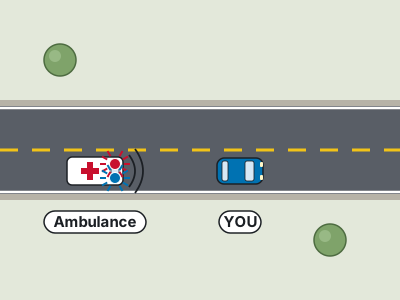
- Pull to the right edge clear of intersections and stop
- Continue driving if the emergency vehicle is in another lane
- Stop in the middle of the nearest intersection
- Follow closely so other traffic moves aside
Show answer
Pull to the right edge clear of intersections and stop. The Louisiana rule requires drivers to yield to an emergency vehicle using both a siren and flashing warning lights. Pull to the right edge of the roadway, clear of intersections, and remain stopped until the vehicle passes. Stopping in an intersection can obstruct the emergency response, while following closely is unlawful and dangerous. The rule applies to traffic in both directions, so an approaching vehicle does not become someone else's problem merely because it is not directly behind you. Look for additional emergency vehicles before moving again.
Study this in the handbook: Emergency vehicles and the move over rule
12. What causes hydroplaning as speed rises on a wet roadway?
- The brakes lock because the road is too dry
- The engine becomes flooded by rainwater
- The tires ride up on a layer of water and lose pavement contact
- The steering wheel automatically turns toward the shoulder
Show answer
The tires ride up on a layer of water and lose pavement contact. Hydroplaning begins when water cannot be removed from the roadway quickly enough by the tires. The tires then ride up on the water like skis, reducing or eliminating contact with the pavement. That loss of contact means the driver cannot rely on normal braking, acceleration, or steering. The explanation involving a flooded engine confuses a roadway traction problem with a mechanical problem. Reduce speed on wet roads, maintain recommended tire pressure, and keep usable tread so water can escape through the grooves.
Study this in the handbook: Skids, blowouts and hydroplaning
13. Using Louisiana's following-distance method, what gap should a driver maintain in ordinary conditions?
- At least ten car lengths at every speed
- Exactly one second behind the vehicle ahead
- At least three seconds behind the vehicle ahead
- No gap is needed when traffic is moving
Show answer
At least three seconds behind the vehicle ahead. The manual's ordinary benchmark is the three-second rule, which works at any speed. Pick a fixed object beyond the vehicle ahead, begin counting when that vehicle passes it, and make sure your vehicle takes at least three seconds to reach the same point. A one-second gap leaves little time for a sudden stop, while a car-length measurement changes meaning as speed changes. Ten car lengths is not the handbook's test. If you reach the checkpoint too soon, ease off and repeat the count at another object until the full time cushion is present.
Study this in the handbook: Scanning ahead, stopping distance and following distance
14. What is a two way left turn lane intended for?
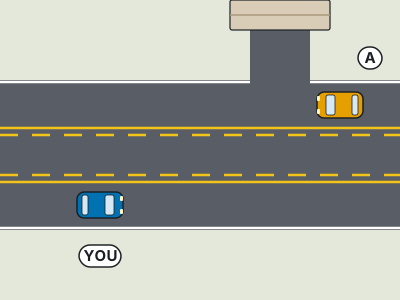
- Parking while waiting for a gap
- Passing slower traffic in either direction
- Traveling straight through an intersection
- Left turn maneuvers only
Show answer
Left turn maneuvers only. The center lane marked with solid and dashed yellow lines is shared by traffic from both directions, but its use is limited to left turns. It is not a travel lane, passing lane, or parking area. Enter it only when preparing for a left turn, check for opposing users, and leave it promptly. Using the lane to continue straight can place two vehicles on a collision path because both directions may enter it. Read the marking as a narrow turning space, not an extra lane for through movement.
Study this in the handbook: Center lines, lane lines and crosswalks
15. For a second or subsequent refusal of Louisiana's alcohol analysis test, how long are driving privileges suspended?
- 180 days
- 365 days
- 730 days
- Three years
Show answer
730 days. Louisiana increases the implied-consent suspension to 730 days for a second or subsequent refusal of the alcohol analysis test. The 365-day choice is the first-offense period. A 180-day suspension is connected to certain BAC results after submitting to the test, not to a later refusal. Three years is the required maintenance period for SR-22 proof in the described case, not the refusal suspension itself. Separate the duration of the license suspension from the length of any financial-responsibility requirement when reading the fact pattern.
Study this in the handbook: Implied consent and DWI penalties
16. Which Louisiana applicants must supply a Social Security number for Selective Service purposes?
- All male U.S. citizens or immigrants age 15 to 26 applying for a license or ID
- All applicants over 18
- Only commercial applicants
- No one
Show answer
All male U.S. citizens or immigrants age 15 to 26 applying for a license or ID. To comply with the Military Selective Service Act, Louisiana requires the Social Security number from all male U.S. citizens or immigrants age 15 to 26 who apply for a driver's license or ID card. Failure to provide the number results in denial of issuance. The rule is tied to sex and age, so it does not reach every applicant over 18, it is not limited to commercial applicants, and it plainly does apply to someone.
Study this in the handbook: Insurance, renewal, your record and losing your license
17. How fast should a driver generally travel inside a Louisiana roundabout?
- The posted highway speed
- 35 mph or less
- 15 mph or less
- At least 25 mph
Show answer
15 mph or less. The guide says speeds of 15 mph or less are adequate inside a roundabout. The 35 mph option is associated with a different speed rule in the manual, not the circular intersection. Using the ordinary highway limit would ignore the tight geometry and conflict points of the roundabout, while a minimum speed is not required. The cue is the word inside: reduce speed before entering and maintain a slow pace through the circle.
Study this in the handbook: Roundabouts and traffic circles
18. What is a driver required to do when a high-speed road has a posted minimum speed?
- Ignore the minimum when traffic is light
- Stay below the minimum to conserve fuel
- Use the shoulder whenever traveling at the minimum
- Travel at least the posted minimum unless conditions require otherwise
Show answer
Travel at least the posted minimum unless conditions require otherwise. Some high-speed roads post a minimum speed, and drivers are legally required to travel at least that fast so they do not become a hazard to other drivers. Light traffic does not erase the sign, and using the shoulder is not the stated solution. Conservation of fuel is not a reason to obstruct normal traffic. The cue is the word minimum: it marks the slowest lawful pace for ordinary conditions, subject to any need to slow for safety.
Study this in the handbook: Warning, regulatory, guide and work zone signs
19. A Louisiana driver has a BAC of 0.20% at 2:00 a.m. About what will it still be at noon?
- 0.00%
- About 0.05%
- 0.15%
- About 0.10%
Show answer
About 0.05%. The guide says the body processes about 0.015% of alcohol per hour. Its own example: a BAC of 0.20% at 2:00 a.m. will be more than 0.10% at 8:00 a.m. and still 0.05% at noon the next day. So the driver is not sober by noon, and 0.00% is wrong. About 0.10% is the 8:00 a.m. figure, and 0.15% would mean almost no alcohol was processed. Only time lowers BAC.
Study this in the handbook: Alcohol and Louisiana's BAC limits
20. How long does the Louisiana Office of Motor Vehicles keep a public record of your traffic convictions and collisions?
- Two years
- Five years
- Ten years
- Permanently
Show answer
Five years. The Office of Motor Vehicles keeps a public record of all your traffic convictions and collisions for five years. Convictions for DWI are maintained for 10 years, and the guide adds that this includes traffic convictions received in other states, which is why ten years is a tempting choice. Two years is too short, and ordinary convictions are not kept permanently under the guide. Keep the two periods separate: five years for the general record, ten for DWI.
Study this in the handbook: Insurance, renewal, your record and losing your license
QualitySpace is expanding to Louisiana
We are a California-based independent insurance brokerage working on licensing in more states. We cannot help with Louisiana insurance yet. Leave your email and we will let you know when we can.
Every question is written from the official Louisiana Class D and E Driver's Guide. Need paper? Printable LA practice test with answer key.
Last verified 2026-10-05. How we check every question · Study all 218 as flashcards
Frequently asked questions
How many questions are on this Louisiana practice test?
This fixed set has 20 questions. It is test 5 of 10 from the 218 question Louisiana bank. The real LA exam asks 40 questions and you need 32 correct.
What is the passing score for the real Louisiana test?
80% minimum score is required That figure comes from the official Louisiana source cited on the DMV facts page.
How does this fixed test relate to the full Louisiana bank?
Each numbered test is a fixed set of questions in a fixed order, so you can retake the same test later and compare. Every test mixes road signs and the other topics in about the same proportion as the full bank. Tests 1 to 10 together cover 200 of the 218 questions in the Louisiana bank, each once. The full practice page mixes the whole bank at random.
Last verified 2026-10-05. See the Louisiana DMV facts page for sourced state details.
Return to the full Louisiana practice test · Study road signs