
Test 25 of 25 · 20 questions · Free 2026
LA Permit Practice Test 25
Jump to the test ↓A fixed 20 question set from the Louisiana bank with answers and plain English explanations. The real LA exam is 40 questions, 80 percent to pass; take the full length version on the main practice page.
Question 1 of 20 · 0 right so far
All 20 questions in test 25
Every question below comes from the Louisiana question bank on this page. Open a question to see the correct answer and the explanation. Nothing here is hidden behind a signup.
1. What does a flashing WALK pedestrian signal sometimes indicate?
- Pedestrians must not start crossing now
- A possible conflict with turning vehicles
- The signal is broken and should be ignored
- Only bicycles may use the crosswalk
Show answer
A possible conflict with turning vehicles. Pedestrian signals control only people on foot. A steady WALK signal means pedestrians may cross the roadway toward the signal. A flashing WALK signal is sometimes used to show that there is a possible conflict between pedestrians and vehicles. The signal that tells pedestrians not to start is DON'T WALK, steady or flashing. Drivers must yield to pedestrians lawfully crossing.
Study this in the handbook: Lane changes, passing and wet roads
2. A Louisiana child fits two child restraint categories because of age and weight. Which one must be used?
- The category for the child's age only
- Whichever seat the parent already owns
- The less restrictive of the two categories
- The more protective of the two categories
Show answer
The more protective of the two categories. Louisiana's child restraint law sorts children by age and weight, from rear facing seats to boosters to seat belts. When a child falls into more than one category, the more protective category must be used. Age alone does not decide it, and owning a particular seat is not a reason to move a child to a less protective stage. Never hold a child on your lap or share one belt with a child.
Study this in the handbook: Safety belts, child restraints and air bags
3. Your car runs off the road into a lake. About how long will it float on the surface?
- About 30 to 60 seconds
- About 5 to 10 minutes
- About 2 to 3 minutes
- Until water fills the cabin
Show answer
About 30 to 60 seconds. A car that enters water stays afloat only 30 to 60 seconds, so the guide says to try to get out immediately rather than waiting for the car to fill. Unbuckle your seat belt right away and roll the window down; electric windows may keep working for a few seconds if the engine is still running. Once the window is open, climb on top of the vehicle if it is not fully under, and check the current before you swim. The guide sums it up as POGO: pop the belt, open the windows, get out.
Study this in the handbook: Stuck pedals, fires, floods and crashes
4. You see an orange diamond-shaped sign ahead. What should you expect?
- Workers, machinery or barricades just ahead
- A school zone with children crossing
- A sharp curve with a lower advisory speed
- A railroad crossing a short distance ahead
Show answer
Workers, machinery or barricades just ahead. Orange is the color of work zones. Louisiana's guide says orange warning signs tell you that workers, machinery and barricades are just ahead, and that you may need to slow down, stop or change lanes. Curves and other road conditions are shown on yellow diamonds, school zones are marked with fluorescent yellow-green signs, and the railroad advance warning sign is round and yellow. When orange appears, reduce speed and watch for lane changes, equipment and people working near traffic.
Study this in the handbook: Warning, regulatory, guide and work zone signs
5. After leaving a divided road, you see this sign. What is it reminding you?
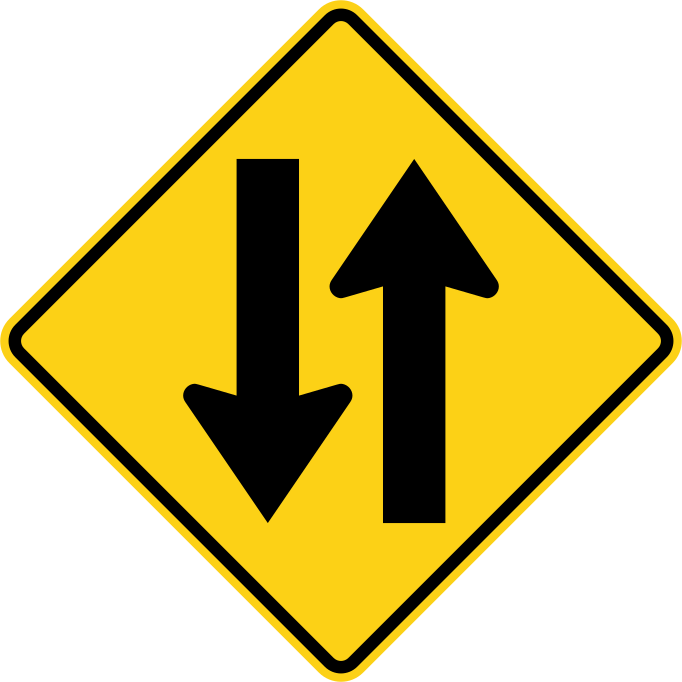
- Two lanes now go your way
- Traffic moves in both directions
- You are on a one-way street
- A divided highway begins
Show answer
Traffic moves in both directions. This warning sign is the 2-way traffic reminder shown in the guide. The two arrows pointing opposite ways tell you that the road now carries traffic in both directions, so oncoming vehicles will be close to you on the other side of the center line. The guide also tells drivers to be aware of two-way traffic ahead after leaving the interstate. Stay to the right of the center line and pass only where markings and sight distance allow it.
Study this in the handbook: Warning, regulatory, guide and work zone signs
6. Your tires suddenly roll over rumble strips at the edge of your lane. What are they telling you?
- The road surface ahead is under repair
- You are going faster than the speed limit
- You are drifting off the road or out of your lane
- A railroad crossing is just ahead
Show answer
You are drifting off the road or out of your lane. Rumble strips are one of the safety features added to highways to reduce collisions. Louisiana's guide says they alert the driver that the vehicle is veering off the road or heading into a different lane. They are not a speed warning, and they do not mark railroad crossings or road repairs. If you hit them, steer gently back into the center of your lane, since jerking the wheel after leaving your path can cause you to lose control.
7. You are driving on a Louisiana interstate where no other speed zone has been set. Traffic around you is doing 75. How fast may you legally go?
- Up to 65 mph
- Up to 70 mph
- Up to 75 mph
- Up to 80 mph
Show answer
Up to 70 mph. The guide says the maximum speed allowed on the interstate is 70 miles per hour unless otherwise posted. Other drivers going 75 do not raise that limit for you. The guide also says to enter the interstate at or near the speed of traffic, to drive slower than the posted minimum only when weather or road conditions demand it, and to always try to drive at a steady speed.
Study this in the handbook: Speed laws
8. A driver holds the left arm out the window and bends it downward. What does this hand signal mean?
- Turning right
- Turning left
- Slowing or stopping
- Pulling over to park
Show answer
Slowing or stopping. The guide says you may signal with your vehicle's signal lights or with your left arm. With the arm bent downward, the signal means you are slowing or stopping. An arm held straight out signals a left turn, and an arm bent upward signals a right turn. You must signal other drivers when you plan to turn, change lanes, slow down or stop, so the downward arm warns drivers behind you that you are reducing speed.
Study this in the handbook: Right of way and other laws you should know
9. At night you are following another car from about 150 feet behind. Which headlights must you use?
- High beams, since the car is going your way
- Parking lights only, to avoid any glare
- High beams until you are 50 feet behind
- Low beams, since you are within 200 feet
Show answer
Low beams, since you are within 200 feet. When you follow another vehicle within 200 feet, the law requires low beams. At 150 feet behind, your high beams would shine into the other driver's mirrors and could blind them. The 200 foot rule applies to traffic going your way. For oncoming vehicles, dim within 500 feet. Parking lights alone are not legal while driving at night, because headlights must be on from sunset to sunrise.
Study this in the handbook: Night driving, pedestrians and phones
10. Your exit is coming up, and the word EXIT is printed on the right side of the overhead exit sign. Which way should you move to take it?
- Toward the left lanes
- Toward the right lanes
- Into the center lane
- Into whichever lane is empty
Show answer
Toward the right lanes. Destination signs tell you which side an exit is on. Louisiana's guide says that if the word Exit is written on the right side of an exit sign, the exit lane or ramp is to the right, and if it is written on the left side, the exit is to the left. Seeing Exit on the right tells you to work toward the right lanes in good time, signaling and checking mirrors, instead of cutting across at the last moment.
11. You plan to pass and can clearly see an oncoming car getting closer. What does that suggest?
- It is probably closer than 25 seconds away
- It is probably more than a full minute away
- It is moving slower than you are
- It is far enough away to pass safely
Show answer
It is probably closer than 25 seconds away. Judging the speed of oncoming cars is hard, even for experienced drivers. A vehicle more than 25 seconds away usually seems to be standing still. If you can actually see it coming closer, it is probably less than 25 seconds away. Oncoming vehicles do not seem to be coming as fast as they really are, so a visible approach is a reason to wait. The guide says that if you can see an oncoming vehicle, do not try to pass.
12. You are passing a slower bicyclist on a Louisiana road. How much space must be between your car and the rider?
- At least 1 foot
- At least 2 feet
- At least 3 feet
- At least 10 feet
Show answer
At least 3 feet. Louisiana law, R.S. 32:76.1, requires at least three feet between a passing automobile and a slower bicyclist. The guide also warns that the air current from a passing vehicle can cause a bicyclist to crash, so slow down before you pass. On a two way road, do not pass between a bicyclist and an oncoming vehicle; let the oncoming vehicle go by first and then move left to give plenty of room. If you are pulling a trailer, allow even more passing room.
Study this in the handbook: Bicycles, motorcycles and big trucks
13. You overtake a bicyclist just before the corner where you plan to turn right. What does the guide say to do?
- Speed up so you can turn in front of the rider
- Turn from the left lane to give the rider room
- Sound your horn so the rider stops for you
- Slow down and stay behind the bicyclist
Show answer
Slow down and stay behind the bicyclist. The guide warns against swinging in front of a bicyclist to make a right turn, and says turning right just after overtaking a rider is a common cause of collisions. Instead, slow down and stay behind the bicyclist, or look once and then again, so you know where the bicycle is and how fast it is going before you turn. Bicycle speeds are hard to judge. Honking or turning from the wrong lane creates new dangers.
Study this in the handbook: Bicycles, motorcycles and big trucks
14. Why does the guide say to set the parking brake while your foot is still on the brake, before shifting into park?
- It keeps the brake lights from staying on
- It keeps the steering wheel from locking
- It lets the engine cool down more quickly
- It reduces strain on the transmission's parking pawl
Show answer
It reduces strain on the transmission's parking pawl. In park, the car is held by a small device inside the transmission called a parking pawl, which can break or come loose. If you set the parking brake first, with your foot still on the brake pedal, the brake takes the car's weight before you shift into park. That reduces the strain on the parking pawl. You still need to put the car in park. The parking brake also protects other drive parts and gives a stronger hold.
15. You are driving 50 mph when a stalled car appears about 200 feet ahead in your lane. Can you count on stopping before it?
- Yes, 200 feet is plenty at 50 mph
- Yes, if you brake as hard as you can
- No, a stop from 50 mph takes at least 268 feet
- No, a stop from 50 mph takes at least 500 feet
Show answer
No, a stop from 50 mph takes at least 268 feet. Total stopping distance includes perception, reaction and braking. At 50 mph, even in ideal conditions, your car travels at least 268 feet before it stops. About 55 feet pass during reaction and about 158 feet while braking, plus the time it takes to see and recognize the hazard. A car 200 feet ahead is inside that distance, so you would need to steer around it. Five hundred feet is not the guide figure for 50 mph.
Study this in the handbook: Scanning ahead, stopping distance and following distance
16. You are driving a slow farm vehicle on a two-lane road, and a line of cars has formed behind you. What should you do?
- Keep going; slow vehicles have the right of way
- Pull to the side when safe and let them pass
- Speed up beyond what the vehicle safely allows
- Wave drivers to pass wherever they like
Show answer
Pull to the side when safe and let them pass. When you drive so slowly that vehicles behind you must reduce speed, the guide says to pull to the side of the roadway when it is safe and let them pass. Some two-way, single lane roads have turnout areas that must be used when you are slowing traffic significantly, and others have selective passing lanes to reduce congestion behind slower vehicles. Use those turnouts and passing lanes where they exist.
Study this in the handbook: Interstate and rural road driving
17. On which kind of road may oncoming drivers keep going when a school bus stops with red lights flashing on the other side?
- A road divided by a ditch, median or barrier
- Any road that has four or more lanes
- A road with one lane each way and a center turn lane
- Any road with a speed limit of 45 mph or more
Show answer
A road divided by a ditch, median or barrier. Oncoming drivers do not have to stop for a school bus on the other side when the roadway is separated by a ditch, grassy median, concrete barrier or other obstacle that keeps traffic from driving across. Lane count alone is not enough: a four lane road without a barrier requires a stop. A road with one lane each way and a two way left turn lane is not a divided highway, so drivers must stop there too. Speed limits do not create an exception.
Study this in the handbook: School buses, turns and signals
18. A cow has wandered onto the rural road ahead of you. What does the guide say to do?
- Swerve around it at your current speed
- Flash your high beams and keep going
- Sound your horn and brake in a controlled way
- Stay silent and pass as close as you can
Show answer
Sound your horn and brake in a controlled way. For a domestic animal such as a horse or cow that wanders into the road, the guide says to sound your horn and brake in a controlled manner. Usually the horn is enough for the animal's instincts to take over. Do not scare it into the path of another vehicle, and do not swerve around it, which can make it panic. Once it is safe, notify the local authorities. Wild animals are handled differently: there, the guide says not to use the horn.
Study this in the handbook: Interstate and rural road driving
19. Pink incident signs warn of a crash on the right shoulder ahead, where responders are working. You are in the right lane of a four-lane highway. What does the move over law require?
- Slow down and change lanes away from it
- Keep your speed and stay in your lane
- Stop in your lane until the scene clears
- Pull onto the shoulder behind responders
Show answer
Slow down and change lanes away from it. Louisiana's move over law requires you to slow down and change lanes when approaching a roadside incident. Fluorescent pink incident signs warn you early so you have time to do both. In the right lane next to a shoulder crash, move to the lane away from the scene when it is safe, and reduce speed as you pass. Holding your speed and lane ignores the law, and stopping in a travel lane or pulling onto the shoulder creates new hazards.
Study this in the handbook: Warning, regulatory, guide and work zone signs
20. Your turn signal lights stop working. Which hand signal shows you are turning left?
- Left arm bent upward
- Right arm waved forward
- Left arm bent downward
- Left arm held straight out
Show answer
Left arm held straight out. You may signal with your vehicle's signal lights or with your left arm. An arm held straight out means a left turn, an arm bent up means a right turn and an arm bent downward means you are slowing or stopping. A turn signal, by light or by arm, must be given for at least 100 feet before you turn. Waving the right arm is not one of the signals in the guide.
Study this in the handbook: Right of way and other laws you should know
Every question is written from the official Louisiana Class D and E Driver's Guide. Need paper? Printable LA practice test with answer key.
Last verified 2026-10-05. How we check every question · Study all 500 as flashcards
Frequently asked questions
How many questions are on this Louisiana practice test?
This fixed set has 20 questions. It is test 25 of 25 from the 500 question Louisiana bank. The real LA exam asks 40 questions and you need 32 correct.
What is the passing score for the real Louisiana test?
80% minimum score is required That figure comes from the official Louisiana source cited on the DMV facts page.
How does this fixed test relate to the full Louisiana bank?
Each numbered test is a fixed set of questions in a fixed order, so you can retake the same test later and compare. Every test mixes road signs and the other topics in about the same proportion as the full bank. Tests 1 to 25 together cover every question in the Louisiana bank once. The full practice page mixes the whole bank at random.
Last verified 2026-10-05. See the Louisiana DMV facts page for sourced state details.
Return to the full Louisiana practice test · Study road signs