
Test 4 of 10 · 20 questions · Free 2026
LA Permit Practice Test 4
Jump to the test ↓A fixed 20 question set from the Louisiana bank with answers and plain English explanations. The real LA exam is 40 questions, 80 percent to pass; take the full length version on the main practice page.
Question 1 of 20 · 0 right so far
All 20 questions in test 4
Every question below comes from the Louisiana question bank on this page. Open a question to see the correct answer and the explanation. Nothing here is hidden behind a signup.
1. In Louisiana, how close to a crosswalk at an intersection may you park?
- No closer than 5 feet
- No closer than 50 feet
- No closer than 20 feet
- Right up to the crosswalk line
Show answer
No closer than 20 feet. Louisiana law makes it illegal to park within 20 feet of a crosswalk at an intersection. The same 20 foot distance applies to a traffic signal, flashing beacon, stop sign or yield sign at the roadside. Five feet is too close. Fifty feet is the distance from a railroad crossing, and parking right at the crosswalk blocks pedestrians and hides them from drivers. The hydrant distance is 15 feet, so the numbers differ by the object being protected.
Study this in the handbook: Parking rules and painted curbs
2. What happens to traffic fines in Louisiana construction zones?
- They are doubled
- They are waived
- They are cut in half
- They stay the same
Show answer
They are doubled. In Louisiana, traffic fines are double for construction zones. Reduced speed limits there are set to protect drivers and workers, so obey them even if no workers are visible. Fines are not waived, halved or left unchanged. Orange signs mark temporary traffic control areas where the higher fines apply. Slow down, watch for flaggers and equipment, and expect lanes to shift or narrow.
Study this in the handbook: Warning, regulatory, guide and work zone signs
3. After a property damage crash, what should you do to reduce the risk of another collision?
- Park across a lane so approaching traffic must stop
- Leave both vehicles in the travel lanes until every report is finished
- Drive away if the vehicles can still move under their own power
- Remove the vehicles from the roadway to the nearest soft shoulder when possible
Show answer
Remove the vehicles from the roadway to the nearest soft shoulder when possible. Louisiana's Move It campaign emphasizes clearing damaged vehicles from the roadway when it can be done safely. Moving them toward the nearest soft shoulder reduces congestion and lowers the chance of a secondary crash. Leaving vehicles in active lanes may expose everyone to another impact, while driving away abandons collision responsibilities. Do not create a new hazard while moving a disabled vehicle, and handle the required exchange of information after the scene is made safer. The practical cue is simple: protect people first, then deal with paperwork away from moving traffic whenever possible.
Study this in the handbook: Stuck pedals, fires, floods and crashes
4. About how long does it take for the effects of one marijuana cigarette to wear off, according to the Louisiana guide?
- About one hour
- About 15 minutes
- Five to six hours
- Two days
Show answer
Five to six hours. The guide contrasts marijuana with alcohol: the effects of a single drink diminish over about an hour, but it takes five to six hours for the effects of smoking one marijuana cigarette to wear off. That is why combining the two is especially dangerous. One hour is the alcohol figure, and 15 minutes is far too short. Two days is not the guide's estimate for the driving effects.
Study this in the handbook: Implied consent and DWI penalties
5. At a flashing red signal, what sequence must a driver follow before entering?
- Come to a complete stop, look both ways, and yield before entering
- Slow without stopping if the intersection appears clear
- Continue as if the signal were green
- Stop only when another vehicle is approaching
Show answer
Come to a complete stop, look both ways, and yield before entering. At a flashing red signal, stop behind the stop bar, crosswalk, or intersection before entering. The stop must be complete, followed by looking both ways and yielding right of way. Merely slowing is not enough even when the intersection appears empty, and continuing as if the light were green removes the required safety check. Use the pause to identify vehicles, pedestrians, and cyclists from every approach. Enter only after the intersection is clear and the movement can be made without interfering with traffic that has priority.
Study this in the handbook: Traffic lights and arrows
6. How long must a Louisiana learner's license be maintained before advancing to the intermediate stage?
- At least one year
- At least 30 days
- At least 90 days
- At least 180 days
Show answer
At least 180 days. The learner's license must be maintained for a minimum of 180 days before the driver can advance to the intermediate stage, and the driver must also reach the sixteenth birthday. Thirty and 90 days are shorter periods than the guide specifies. One year is longer than the stated minimum and is not the program's threshold. Read the condition as two requirements joined together: the time minimum alone is insufficient if the applicant has not reached age 16. A calendar reminder for both the 180-day mark and the birthday helps avoid confusing this stage change with a full license.
Study this in the handbook: The graduated licensing program
7. When must Louisiana applicants complete driver education in relation to applying for a driver's license?
- Before making application for the driver's license
- Only after receiving the full license
- After the road skills test but before the vision exam
- Within 30 days after the first license renewal
Show answer
Before making application for the driver's license. The guide requires the driver education course to be completed before the applicant makes an application for the driver's license. The course is not a post-license task, and the stated order does not place it between a road test and a vision exam. The renewal deadline in the choice “Within 30 days after the first license renewal” is unrelated. Applicants should also note that a Temporary Instruction Permit must be obtained before the knowledge test, skill test, or behind-the-wheel instruction. The practical sequence is education first, then the application and required testing steps with the permit in place.
Study this in the handbook: Who needs a license, license classes and the tests
8. What BAC is the Louisiana legal limit for a driver age 21 or older?
- 0.15%
- 0.02%
- 0.04%
- 0.08%
Show answer
0.08%. For a driver who is 21 or older, Louisiana lists 0.08% as the legal BAC limit. The 0.02% figure applies to drivers 20 and younger, while 0.04% applies when operating a commercial motor vehicle. The 0.15% choice is not the ordinary adult threshold; it is a higher BAC level tied to a more severe administrative suspension after testing. The practical cue is to identify the driver's age and vehicle category before choosing a number. Alcohol can impair driving before the listed limit, so the safest plan is not to drive after drinking.
Study this in the handbook: Alcohol and Louisiana's BAC limits
9. When should a driver increase the normal three second following gap to four seconds?
- Only when traveling below 15 mph
- During bad weather or when driving on wet pavement
- Whenever the road is dry and empty
- Only after the vehicle ahead changes lanes
Show answer
During bad weather or when driving on wet pavement. Wet pavement and bad weather increase the distance needed to stop, so the manual directs drivers to expand the ordinary three second rule to four seconds. The added time creates room for reduced traction, limited visibility, and a slower response from the vehicle ahead. It is not reserved for low speed travel, and dry pavement does not create the same specific need. Begin with a fixed roadside object, count after the lead vehicle passes, and drop farther back whenever conditions make stopping harder.
Study this in the handbook: Scanning ahead, stopping distance and following distance
10. What action is required at a flashing yellow traffic light?
- Continue at the posted speed without scanning
- Stop and remain until the light becomes green
- Slow down, watch for entering traffic, and proceed cautiously
- Treat it as a flashing red signal
Show answer
Slow down, watch for entering traffic, and proceed cautiously. A flashing yellow signal is a caution control, not a command to stop automatically. Reduce speed, look for traffic entering the intersection, and proceed only when the path is clear. The flashing-red choice applies a complete-stop procedure that belongs to a different signal. The strongest cue is the blinking amber light: expect conflict, yield when necessary, and be prepared to stop if another road user is already in the intersection.
Study this in the handbook: Traffic lights and arrows
11. At a Louisiana yield-sign intersection, when may a driver proceed?
- Only after slowing and confirming the movement will not interfere with approaching traffic
- Immediately, because a yield sign grants priority to entering traffic
- Only after stopping for a fixed five seconds
- By accelerating before approaching traffic reaches the intersection
Show answer
Only after slowing and confirming the movement will not interfere with approaching traffic. At a yield sign intersection, the driver must slow to a reasonable speed and stop if required. Proceed only when the movement will not interfere with approaching traffic. The sign does not give entering traffic priority, does not require a fixed five-second stop in every case, and does not call for acceleration to beat another road user. The visual cue is the downward-pointing triangle, but the action depends on traffic conditions. Scan for vehicles, cyclists, and pedestrians, then stop when necessary before entering the intersection safely.
Study this in the handbook: Right of way and other laws you should know
12. What action is prohibited once a driver is inside a roundabout?
- Stop in the circle to choose an exit
- Continue without stopping until taking the exit
- Follow destination signs to the chosen exit
- Signal before leaving the roundabout
Show answer
Stop in the circle to choose an exit. The guide says to never stop once inside the roundabout, because the vehicle already in the roundabout has the right of way. Stopping in the circle can block circulating traffic and create a conflict behind you. Continuing without stopping, following destination signs, and signaling as you exit are all steps the guide tells drivers to take, so none of them is prohibited. Choose your destination before entering, then keep a slow, steady pace of 15 mph or less until your exit.
Study this in the handbook: Roundabouts and traffic circles
13. What may make material on a Louisiana vehicle's front windshield or front side windows lawful?
- A driver's preference for darker glass
- A physician's prescription
- A passenger's written permission
- A vehicle's age over ten years
Show answer
A physician's prescription. Louisiana prohibits non-transparent material affixed to the front windshield or front side windows unless it is prescribed by a physician. A driver's preference, a passenger's permission, or the vehicle's age does not create the stated exception. The rule concerns both the material's lack of transparency and where it is attached, so a fact pattern should be checked against both details. The quick cue is medical authorization: without a physician's prescription, non-transparent material in those front viewing areas is illegal under the guide.
Study this in the handbook: Right of way and other laws you should know
14. How long can a Louisiana driver lose the license for a second DWI conviction?
- One year (365 days)
- Three years (1095 days)
- Two years (730 days)
- 90 days
Show answer
Two years (730 days). The maximum license loss for a second DWI conviction is two years, or 730 days. One year is the first conviction maximum. Three years, or 1095 days, applies to third and fourth convictions. Ninety days is not in Louisiana's DWI list. The second conviction also carries at least 48 hours of jail that must be served without parole, probation or suspension.
15. What does the yellow diamond shape tell a driver about this roadway sign?

- It gives the legal minimum speed for the lane
- It warns of an approaching condition or hazard
- It identifies a traveler service such as lodging
- It marks a route used only by commercial trucks
Show answer
It warns of an approaching condition or hazard. The pictured Lane Ends sign uses the yellow diamond warning format. The manual explains that diamond shaped signs warn about approaching hazards and conditions, while yellow diamond signs can alert drivers to curves, side roads, and traffic flow changes. The sign therefore gives advance notice that the roadway situation will change, allowing time to check mirrors, signal, and merge safely. It is not a speed limit, traveler service, or truck only designation. Treat the yellow diamond as an early warning and prepare before the lane markings end.
Study this in the handbook: Sign shapes and colors
16. What does a one-way street sign with an arrow tell drivers?
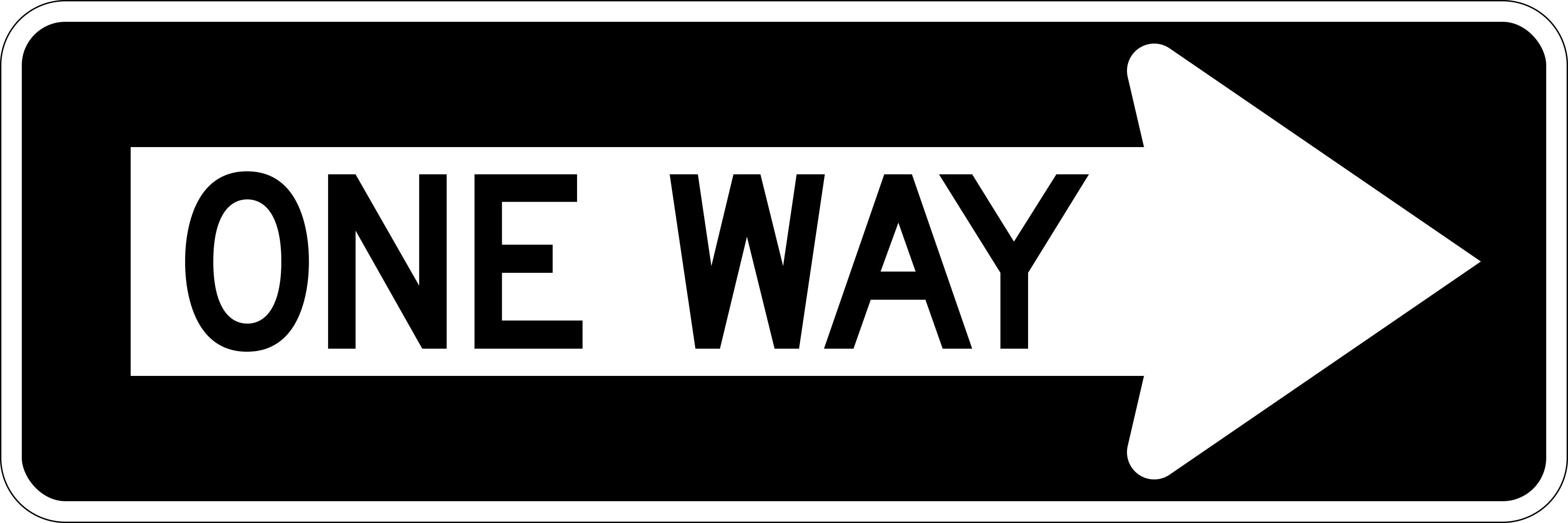
- Traffic may travel either way after yielding
- Traffic flows only in the arrow’s direction
- The arrow marks a lane reserved for turning around
- The street is closed to all motor vehicles
Show answer
Traffic flows only in the arrow’s direction. A one-way sign establishes the permitted direction of traffic. The driver must not turn opposite the arrow and must never drive the wrong way on that street. Yielding does not make reverse travel legal, and the arrow does not designate a turnaround lane or a complete closure. Use the sign together with lane arrows and nearby signals. If you miss a turn, continue legally and find another route instead of reversing direction.
Study this in the handbook: Warning, regulatory, guide and work zone signs
17. What do double solid yellow lines in the center of a roadway allow?
- Crossing only to change into a lane moving the same direction
- Crossing freely to pass whenever traffic is light
- Driving on top of the lines as a normal travel lane
- Crossing to make a turn, but not crossing to pass
Show answer
Crossing to make a turn, but not crossing to pass. Double solid yellow lines separate opposing traffic and may be crossed for a turn, but not to pass another vehicle. The light-traffic option still violates the stated passing restriction. These markings are not a normal travel lane and they do not separate same-direction lanes, which use white markings. Plan the turn carefully, signal, check for oncoming road users, and cross only for that turning movement.
Study this in the handbook: Traffic lights and arrows
18. What total stopping distance does the Louisiana guide give at 50 mph?
- About 100 feet
- A minimum of 268 feet, including perception, reaction and braking
- About 50 feet
- About 1,000 feet
Show answer
A minimum of 268 feet, including perception, reaction and braking. Total stopping distance is the minimum distance traveled in ideal conditions including perception distance, reaction distance and braking distance, and at 50 mph your vehicle will travel a minimum of 268 feet before it stops; braking alone takes about 158 feet on dry pavement with good brakes. It takes much longer and farther to stop than most drivers realize, which is why following distance matters.
Study this in the handbook: Scanning ahead, stopping distance and following distance
19. What should you do when an authorized emergency vehicle approaches on a two lane road using audible or visual signals?
- Stop in the center of the intersection
- Pull left and continue at the same speed
- Move parallel to the right edge or curb and remain stopped until it passes
- Follow closely behind it to clear traffic
Show answer
Move parallel to the right edge or curb and remain stopped until it passes. An approaching police car, ambulance, or fire truck using audible or visual signals must be given the right of way. Move to a position parallel to the right edge or curb and stay stopped until the vehicle has passed. Continuing forward can block its path, and Louisiana makes it unlawful to follow an emergency vehicle responding to a call closer than 500 feet. You also must not follow it into, and park within, the block where it has stopped. The cue is lights or siren: yield, move right, and stop.
Study this in the handbook: Stuck pedals, fires, floods and crashes
20. What adjustment does the guide recommend when driving on a road covered with oil and water?
- Keep normal speed but shorten the gap to the vehicle ahead
- Reduce speed, use extra caution, and allow twice the normal following distance
- Brake hard throughout the trip to test traction
- Turn off the headlights so reflections do not distract you
Show answer
Reduce speed, use extra caution, and allow twice the normal following distance. Oil and water can make a roadway behave much like ice, so the guide calls for reduced speed, extra caution, and twice the normal following distance. Shortening the gap would remove the extra time needed if the vehicle ahead stops or skids. Repeated hard braking can itself cause a loss of control and does not create traction. The first rain is especially hazardous because oil and grease may still be on the pavement. Slow before the slick area, keep steering smooth, and leave room to respond.
Study this in the handbook: Lane changes, passing and wet roads
QualitySpace is expanding to Louisiana
We are a California-based independent insurance brokerage working on licensing in more states. We cannot help with Louisiana insurance yet. Leave your email and we will let you know when we can.
Every question is written from the official Louisiana Class D and E Driver's Guide. Need paper? Printable LA practice test with answer key.
Last verified 2026-10-05. How we check every question · Study all 218 as flashcards
Frequently asked questions
How many questions are on this Louisiana practice test?
This fixed set has 20 questions. It is test 4 of 10 from the 218 question Louisiana bank. The real LA exam asks 40 questions and you need 32 correct.
What is the passing score for the real Louisiana test?
80% minimum score is required That figure comes from the official Louisiana source cited on the DMV facts page.
How does this fixed test relate to the full Louisiana bank?
Each numbered test is a fixed set of questions in a fixed order, so you can retake the same test later and compare. Every test mixes road signs and the other topics in about the same proportion as the full bank. Tests 1 to 10 together cover 200 of the 218 questions in the Louisiana bank, each once. The full practice page mixes the whole bank at random.
Last verified 2026-10-05. See the Louisiana DMV facts page for sourced state details.
Return to the full Louisiana practice test · Study road signs