
Test 16 of 25 · 20 questions · Free 2026
LA Permit Practice Test 16
Jump to the test ↓A fixed 20 question set from the Louisiana bank with answers and plain English explanations. The real LA exam is 40 questions, 80 percent to pass; take the full length version on the main practice page.
Question 1 of 20 · 0 right so far
All 20 questions in test 16
Every question below comes from the Louisiana question bank on this page. Open a question to see the correct answer and the explanation. Nothing here is hidden behind a signup.
1. How long does the Louisiana Office of Motor Vehicles maintain convictions for DWI?
- For the driver's lifetime only
- 5 years
- 1 year
- 10 years
Show answer
10 years. The Office of Motor Vehicles maintains DWI convictions for 10 years. The guide separately says the public record of all traffic convictions and collisions is kept for five years, so choosing five confuses the general record period with the DWI rule. One year is also unrelated, and the guide does not state lifetime retention for this item. The memory cue is the special treatment: DWI lasts twice the ordinary five-year period.
Study this in the handbook: Insurance, renewal, your record and losing your license
2. Heavy traffic forces you to stop at the end of a short interstate acceleration lane. About how much distance will you need to get up to the speed of traffic?
- About two car lengths
- About a full block
- About half a mile
- About one mile
Show answer
About a full block. Some interstate entrances have only a short acceleration lane, and in heavy traffic drivers may end up stopped there waiting for a big enough gap. The guide calls this dangerous because of the risk of rear end collisions and the need to accelerate quickly. Starting from a full stop, you need about a full block to reach the speed of the vehicles on the interstate. That is why you should begin checking traffic while still on the ramp instead of rolling to the end and stopping.
Study this in the handbook: Interstate and rural road driving
3. A blind pedestrian with a white cane waits to cross at a crosswalk. How far from the crosswalk should you stop?
- At least 20 feet back
- In the middle of the crosswalk
- At least 10 feet back
- No more than five feet away
Show answer
No more than five feet away. People using guide dogs or white canes must be given the right of way at all times. The guide says to stop no more than five feet from the crosswalk, because the pedestrian uses the sound of your engine as a guide. Do not stop in the middle of the crosswalk, since that forces the person to walk around your car and into traffic. Do not honk or give verbal directions; the person listens to all traffic sounds before deciding to cross.
Study this in the handbook: Night driving, pedestrians and phones
4. Far ahead, you see a traffic light that has been green for a long time. What should you do?
- Speed up to get through before it changes
- Keep your speed, since green means go
- Change lanes so you can turn right on red
- Start slowing down and be ready to stop
Show answer
Start slowing down and be ready to stop. Looking well ahead lets you see changes early. A light that has been green for a long time may turn red before you reach it, so begin slowing and be ready to stop. Speeding up to beat the change is the kind of risky move defensive drivers avoid. Acting early also helps the drivers behind you, because they get more time to react to your slowing instead of a sudden stop at the line.
Study this in the handbook: Scanning ahead, stopping distance and following distance
5. The car ahead passes a road sign, and your car reaches the same sign after counting only two seconds. What does that tell you?
- Your gap is right for dry roads
- You are following too closely
- You should speed up to keep pace
- Your gap is right only at night
Show answer
You are following too closely. The three second rule works at any speed. When the vehicle ahead passes a fixed object such as a sign or pole, start counting. If your car reaches the object in less than three seconds, you are following too closely. Drop back, then count again at another spot until you are no closer than three seconds. Bad weather and wet roads call for four seconds, and night driving needs at least one more second.
Study this in the handbook: Scanning ahead, stopping distance and following distance
6. A car is coming toward you in your lane. You sound the horn and brake, but it keeps coming. Where should you steer?
- Into the left lane to go around it
- Straight ahead while braking until stopped
- Off the road to the right shoulder or ditch
- Onto the far left shoulder past the other car
Show answer
Off the road to the right shoulder or ditch. If a car comes toward you in your lane, first blow your horn and flash your lights if there is time, then brake fast without locking the wheels. If the other driver keeps coming and a crash is probable, steer off the road to the right shoulder or ditch. Do not drive into the left lane. Elsewhere the guide explains why: the other driver may swerve back into his own lane at the last moment.
7. You are driving past a row of parked cars and see a person sitting in one of them. What should you expect?
- That they will stay put until you pass
- That they will honk before getting out
- That they will wave you on before moving
- That they may open the door in your path
Show answer
That they may open the door in your path. When you drive past parked cars, watch for doors opening in front of you. The guide says that if anyone is sitting in a car, expect them to open the door. Also look for signs that a car may pull out, such as exhaust smoke, brake or backup lights, a turn signal, or front wheels turning out. Watch for pedestrians and bicycles crossing between parked cars, and be especially watchful for children.
Study this in the handbook: Parking rules and painted curbs
8. You stop at a red light with no sign against turning right. A pedestrian is crossing the street you want to turn onto. What should you do?
- Wait for the pedestrian to cross, then turn
- Turn now, since you have already stopped
- Turn right only after the light turns green
- Turn while the walker is in the far lane
Show answer
Wait for the pedestrian to cross, then turn. Louisiana allows a right turn on red when no sign prohibits it, but only after you stop and yield to traffic, including pedestrians. Stopping alone is not enough. A person crossing the street you plan to enter has the right of way, so wait until they are clear and then turn if no vehicles are coming. You do not have to wait for green, and turning while the person is still crossing, even in a far lane, fails to yield.
Study this in the handbook: Traffic lights and arrows
9. You stop at a stop sign with a 4-WAY plate below it. A car arrives on the cross street. What should you expect that driver to do?
- Stop at a stop sign, as you did
- Drive through; it has the right of way
- Slow down and yield only if needed
- Stop only if you entered first
Show answer
Stop at a stop sign, as you did. Louisiana's guide says a 4-WAY sign may be added below a stop sign at intersections where all approaching traffic has a stop sign. The plate tells you that cross traffic must also stop, so the cross street is not a through road. Every driver stops first, then looks for vehicles and pedestrians and yields as required before entering. You may also see 3-WAY, 5-WAY or ALL-WAY plates, which tell you the same kind of thing about the other approaches.
Study this in the handbook: Warning, regulatory, guide and work zone signs
10. You want to pass a slow truck on a two lane road. Where should you wait while you look for a chance?
- Right behind it, ready to pull out
- Beside it on the right shoulder
- Half in the oncoming lane
- Back at a safe following distance
Show answer
Back at a safe following distance. Do not pull up close behind a vehicle you plan to pass, especially a large truck or bus, because it blocks your view of the road ahead. Follow at a safe distance until you can see far enough ahead to pass safely. Waiting half in the oncoming lane exposes you to head on traffic, and the shoulder is never a passing lane. If you can see an oncoming vehicle, do not try to pass.
11. Far ahead you see a sign with a red background, but you cannot read it yet. What kind of message should you expect?
- A command to stop or not to do something
- Information about services ahead
- A warning about a curve ahead
- Directions to a nearby city
Show answer
A command to stop or not to do something. Colors give clues before you can read a sign. Louisiana's guide says red is used for stop and yield signs and for DO NOT ENTER and WRONG WAY signs, and that red means stop or do not whenever you see it. Services are shown on blue signs, curve warnings on yellow ones and directions to cities on green ones. A red sign ahead calls for you to be ready to stop or to avoid a prohibited move.
Study this in the handbook: Sign shapes and colors
12. A truck ahead signals a right turn and swings wide to the left first. You also want to turn right. What should you do?
- Stay back and do not turn until the truck finishes
- Turn right through the gap between the truck and curb
- Pass the truck on the left while it swings wide
- Honk so the driver knows you are turning too
Show answer
Stay back and do not turn until the truck finishes. A truck or bus making a right turn sometimes swings wide to the left to clear the corner, and may use space from other lanes. If you pull into the gap between the truck and the curb, you can be squeezed between them in a serious crash. The guide says to watch large vehicles' turn signals, give them plenty of room and not turn until the truck has completed its turn. Passing it on the left or honking does not protect you from its turning path.
13. When a railroad crossing signal is flashing and a train is approaching, where must a Louisiana driver stop?
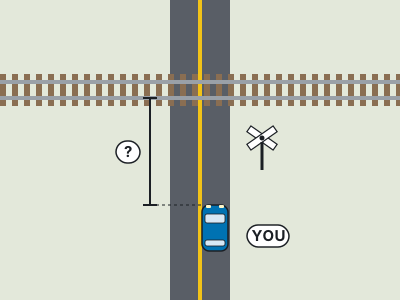
- Exactly 5 feet from the nearest rail
- Within 50 feet but no less than 15 feet from the nearest rail
- At least 100 feet from the nearest rail
- Only after the vehicle reaches the crossing
Show answer
Within 50 feet but no less than 15 feet from the nearest rail. A flashing crossing signal combined with an approaching train requires a full stop. Louisiana specifies a stopping zone from 15 feet to 50 feet from the nearest rail. Five feet leaves too little clearance, while 100 feet is farther away than the stated zone. Reaching the crossing before stopping defeats the warning and creates a serious collision risk. Use the nearest rail as the reference point, stop within the stated range, and wait until the signal and train hazard have cleared before crossing.
Study this in the handbook: Railroad crossings
14. A friend has had several drinks and wants to drink black coffee before driving home. What does the guide say?
- Only time lowers the alcohol in his blood
- Coffee will sober him up within an hour
- A cold shower works better than coffee
- Exercise will burn the alcohol off quickly
Show answer
Only time lowers the alcohol in his blood. Once alcohol is in the blood, nothing you do will lessen its effect. Black coffee, exercise and cold showers do not sober a person up. Alcohol is broken down by the liver and removed through the kidneys and lungs, and that process simply takes time. The guide's advice is direct: if you know someone has been drinking, do not allow them to drive, because a person who has been drinking is in no condition to drive.
Study this in the handbook: Alcohol and Louisiana's BAC limits
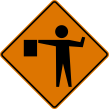
15. You see this orange sign as you approach a work zone. What should you do?
- Keep your speed; workers are off the road
- Change lanes to the left right away
- Slow down and be prepared to stop
- Stop at the sign and wait for it to change
Show answer
Slow down and be prepared to stop. This orange diamond is the Flagger Ahead sign. Louisiana's guide says it means a flag person is ahead to control traffic, so you should slow down and be prepared to stop. Flag persons wear orange vests, shirts or jackets and use red flags or stop and slow paddles to direct traffic through the work zone. The sign itself does not tell you to change lanes or to stop where it stands; follow the flag person's directions when you reach them.
Study this in the handbook: Warning, regulatory, guide and work zone signs
16. Children are riding bicycles near the road ahead of you. What does the guide tell you to expect?
- That they will stay on the sidewalk
- Sudden moves or changes in direction
- That they know and follow traffic laws
- That they will stop when you honk
Show answer
Sudden moves or changes in direction. The guide says children on bicycles may not be aware of their surroundings and may make sudden movements or change direction. Do not expect them to know traffic laws. Slow down, give them as much room as you safely can and be ready to stop. The guide also reminds drivers that bicyclists need extra following distance in bad weather, and that your horn should only get a light tap if a rider moves unsafely into your lane.
Study this in the handbook: Bicycles, motorcycles and big trucks
17. You are about to turn right on green when a person with a guide dog starts across the street you are entering. What must you do?
- Turn first, since your light is green
- Honk so the person knows you are there
- Give the person the right of way and wait
- Ease forward slowly behind the guide dog
Show answer
Give the person the right of way and wait. A pedestrian using a guide dog, or a white cane with or without a red tip, must be given the right of way at all times. A green light lets you turn only after you yield to people crossing, so wait until the person has finished crossing. Do not honk; a person who is blind listens to traffic sounds to decide when it is safe. Creeping toward the crosswalk can confuse the person about what your car is doing.
Study this in the handbook: Night driving, pedestrians and phones
18. On an interstate, you realize your exit lane is on the other side of double solid white lines. What should you do?
- Cross the lines quickly to make the exit
- Stop and wait for a gap to cross
- Stay in your lane and use the next exit
- Cross the lines after signaling first
Show answer
Stay in your lane and use the next exit. Double solid white lines separate two lanes going the same direction, and Louisiana's guide says crossing them is prohibited. They are most often seen on interstates. If the lines stand between you and your exit, the legal choice is to stay in your lane and continue to the next exit. Signaling does not make crossing legal, and stopping in a travel lane on an interstate to wait for a gap creates a serious hazard for the traffic behind you.
Study this in the handbook: Center lines, lane lines and crosswalks
19. A driver in a car with an air bag steers with hands at 10 and 2 o'clock. What risk does the guide describe?
- The air bag will fail to inflate in a crash
- The hands can be thrown into the head
- The wheel will lock during a turn
- The horn will sound by accident
Show answer
The hands can be thrown into the head. An air bag comes out at 150 to 200 miles per hour. If your hands are high on the wheel at 10 and 2, the bag can throw them into your head and cause a serious head injury, or break a wrist or forearm. That is why the 10 and 2 position was dropped when air bags came in. The guide recommends 9 and 3 or 8 and 4, and sitting at least 10 inches from the wheel.
Study this in the handbook: Safety belts, child restraints and air bags
20. Your 11 year old wants to ride up front in a car with a front passenger air bag. What does the guide advise?
- The child may ride up front if belted
- The child may ride up front after age 10
- The child should sit in the back seat
- The child may ride up front on short trips
Show answer
The child should sit in the back seat. Children 12 and under should sit in the back seat. Front seat air bags have killed children and older people, because the bag comes out with great force. A belt does not remove that danger, and short trips are no exception. The middle of the back seat is safer than the front. In a vehicle with no usable back seat, a passenger air bag on and off switch may be provided to carry a child 12 or under.
Study this in the handbook: Safety belts, child restraints and air bags
Every question is written from the official Louisiana Class D and E Driver's Guide. Need paper? Printable LA practice test with answer key.
Last verified 2026-10-05. How we check every question · Study all 500 as flashcards
Frequently asked questions
How many questions are on this Louisiana practice test?
This fixed set has 20 questions. It is test 16 of 25 from the 500 question Louisiana bank. The real LA exam asks 40 questions and you need 32 correct.
What is the passing score for the real Louisiana test?
80% minimum score is required That figure comes from the official Louisiana source cited on the DMV facts page.
How does this fixed test relate to the full Louisiana bank?
Each numbered test is a fixed set of questions in a fixed order, so you can retake the same test later and compare. Every test mixes road signs and the other topics in about the same proportion as the full bank. Tests 1 to 25 together cover every question in the Louisiana bank once. The full practice page mixes the whole bank at random.
Last verified 2026-10-05. See the Louisiana DMV facts page for sourced state details.
Return to the full Louisiana practice test · Study road signs