
Key points
Stop within 50 feet but no less than 15 feet from the nearest rail when a signal flashes and a train is coming.
Source: Handbook p. 94
“the driver of any motor vehicle must stop within 50 feet but no less than 15 feet from the nearest rail of a railroad crossing when: A signal device is flashing and a train is approaching.”
Louisiana Class D and E Driver's Guide, Handbook p. 94You must also stop when a crossing gate is lowered.
Source: Handbook p. 94
“A signal device is flashing and a train is approaching. A crossing gate is lowered.”
Louisiana Class D and E Driver's Guide, Handbook p. 94Louisiana law prohibits stopping a vehicle on railroad tracks.
Source: Handbook p. 94
“prohibits any driver from stopping a vehicle on railroad tracks. Never get trapped on a crossing.”
Louisiana Class D and E Driver's Guide, Handbook p. 94If you stall with a train coming, get out and move toward the approaching train, away from the tracks.
Source: Handbook p. 94
“get out and move in the direction toward the approaching train away from the tracks.”
Louisiana Class D and E Driver's Guide, Handbook p. 94Drivers of vehicles carrying passengers for hire, school buses or trucks, and of any vehicle carrying explosives or flammable liquids must stop at railroad crossings.
Source: Handbook p. 94
“Drivers of vehicles carrying passengers for hire, school buses or trucks, or any vehicle carrying explosives or flammable liquids must stop at railroad crossings.”
Louisiana Class D and E Driver's Guide, Handbook p. 94Never drive around crossing gates. It is against the law.
Source: Handbook p. 95
“Never drive around the gates. It's against the law to drive through or around any crossing gate at a railroad crossing.”
Louisiana Class D and E Driver's Guide, Handbook p. 95Trains have the right of way 100% of the time.
Source: Handbook p. 96
“Trains have the right of way 100% of the time over emergency vehicles, cars, the police and pedestrians.”
Louisiana Class D and E Driver's Guide, Handbook p. 96A 100 car freight train at 55 mph needs more than a mile to stop.
Source: Handbook p. 96
“A 100 car freight train traveling at 55 miles per hour requires more than a mile to stop.”
Louisiana Class D and E Driver's Guide, Handbook p. 96
Numbers to know
| Number | What it means | Manual |
|---|---|---|
| 15 to 50 feet | where to stop from the nearest rail | Handbook p. 94 |
| 100% | trains always have the right of way | Handbook p. 96 |
| 100 cars at 55 mph | a train this size needs more than a mile to stop | Handbook p. 96 |
Recognize these signs
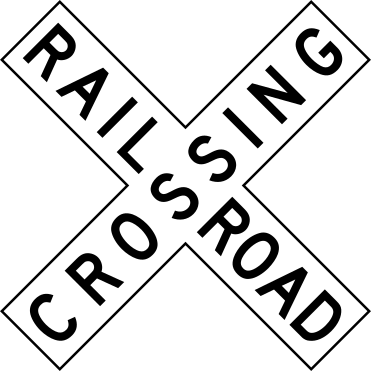
Railroad crossbuck
3 questions from the Louisiana practice test
1. When a railroad crossing signal is flashing and a train is approaching, where must a Louisiana driver stop?
- Exactly 5 feet from the nearest rail
- Within 50 feet but no less than 15 feet from the nearest rail
- At least 100 feet from the nearest rail
- Only after the vehicle reaches the crossing
Show answer
Within 50 feet but no less than 15 feet from the nearest rail. A flashing crossing signal combined with an approaching train requires a full stop. Louisiana specifies a stopping zone from 15 feet to 50 feet from the nearest rail. Five feet leaves too little clearance, while 100 feet is farther away than the stated zone. Reaching the crossing before stopping defeats the warning and creates a serious collision risk. Use the nearest rail as the reference point, stop within the stated range, and wait until the signal and train hazard have cleared before crossing.
2. What does Louisiana law prohibit a driver from doing on railroad tracks?
- Stopping before a lowered crossing gate
- Looking both ways before crossing
- Stopping a vehicle on the tracks
- Waiting until the gates are raised
Show answer
Stopping a vehicle on the tracks. Louisiana law prohibits stopping a vehicle on railroad tracks. Looking both ways, stopping before a lowered gate, and remaining stopped until the gate rises are safety actions required by the crossing guidance. The danger is not limited to a vehicle that is intentionally parked: a driver should avoid entering a crossing unless there is room to clear the tracks. If a vehicle stalls or becomes trapped, occupants should leave and move toward the approaching train, away from the tracks. Never treat the rails as a temporary stopping place.
3. Which condition requires a Louisiana driver to stop at a railroad crossing?
- A lowered crossing gate
- A clear track with no warning device active
- A green traffic light on a nearby street
- A vehicle parked more than 100 feet away
Show answer
A lowered crossing gate. A lowered crossing gate is one of the conditions that requires a stop at a Louisiana railroad crossing. The guide also identifies a flashing signal with an approaching train and several train-warning conditions. A clear track does not cancel an active gate, and a nearby green light or a distant parked vehicle does not determine whether the rail crossing is safe. Stop before the gate, remain stopped until it is raised, and never drive around it. The key cue is the crossing control itself: an active gate means stop and wait.
Practice this topic
Lock it in with emergencies questions from the free Louisiana practice test. Every answer comes with a plain English explanation.
Source: the Louisiana Class D and E Driver's Guide, Chapter 6: Traffic Laws and Regulations. This lesson is a plain English summary, not the law itself; where it differs, the manual and the statute govern. Last checked 2026-09-27.