
Key points
When parallel parked, your right wheels must be within 18 inches of the curb.
Source: Handbook p. 70
“When parallel parked, the vehicle's right wheels must be within 18 inches of the right-hand curb of the street.”
Louisiana Class D and E Driver's Guide, Handbook p. 70When leaving your vehicle unattended, stop the motor, remove the key, lock the ignition and set the brake.
Source: Handbook p. 70
“When parking and leaving a vehicle unattended, stop the motor, remove the key, lock the ignition, and set the brake.”
Louisiana Class D and E Driver's Guide, Handbook p. 70Never park on a sidewalk, in front of a driveway, in an intersection or in a bike lane.
Source: Handbook p. 70
“it is against the law to park: On a sidewalk In front of a driveway In an intersection In a biking lane”
Louisiana Class D and E Driver's Guide, Handbook p. 70No parking within 15 feet of a fire hydrant or 50 feet of a railroad crossing.
Source: Handbook p. 70
“Within 15 feet of a fire hydrant or within 50 feet of a railroad crossing”
Louisiana Class D and E Driver's Guide, Handbook p. 70No parking within 20 feet of a crosswalk at an intersection.
Source: Handbook p. 70
“Within 20 feet of a crosswalk at an intersection”
Louisiana Class D and E Driver's Guide, Handbook p. 70No parking within 20 feet of a traffic signal, flashing beacon, stop sign or yield sign at the side of the road.
Source: Handbook p. 70
“Within 20 feet of a traffic signal, flashing beacon, stop sign, yield sign or traffic control signal located at the side of a roadway”
Louisiana Class D and E Driver's Guide, Handbook p. 70No parking within 20 feet of a fire station driveway on the same side, or 75 feet on the other side.
Source: Handbook p. 70
“Within 20 feet of a fire station driveway on the same side of the street, or within 75 feet of the driveway on the other side of the street”
Louisiana Class D and E Driver's Guide, Handbook p. 70No double parking, and no parking on a bridge, overpass or in a tunnel.
Source: Handbook p. 70
“Beside a parallel parked vehicle (double parking) On a bridge, overpass or in any tunnel”
Louisiana Class D and E Driver's Guide, Handbook p. 70Painted curbs: white allows only short stops, yellow marks a loading zone or other restriction, red is a fire zone, blue is accessible parking.
Source: Handbook p. 70
“White - indicates that only short stops are permitted Yellow - indicates a loading zone or some other restriction Red - indicates fire zone restrictions Blue- indicates an accessibility restriction”
Louisiana Class D and E Driver's Guide, Handbook p. 70When parallel parking, stop beside the front car about 18 inches from it, with rear bumpers even.
Source: Handbook p. 69
“Signal, stop parallel to the front car (about 18 inches from it), with rear bumpers even.”
Louisiana Class D and E Driver's Guide, Handbook p. 69
Numbers to know
| Number | What it means | Manual |
|---|---|---|
| 18 inches | maximum distance from the curb when parallel parked | Handbook p. 70 |
| 15 feet; 50 feet | no parking near a hydrant; near a railroad crossing | Handbook p. 70 |
| 20 feet | no parking this close to a traffic signal, stop sign or yield sign | Handbook p. 70 |
| 20 feet; 75 feet | no parking near a fire station driveway on the same side; on the other side | Handbook p. 70 |
Recognize these signs
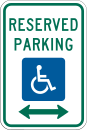
Accessible parking
3 questions from the Louisiana practice test
1. When parallel parked in Louisiana, how close must the right wheels be to the curb?
- Within 18 inches
- Within 3 feet
- Within 6 inches
- Touching the curb
Show answer
Within 18 inches. When parallel parked, the vehicle's right wheels must be within 18 inches of the right-hand curb. The list of illegal parking spots also includes being more than 2 feet from the curb. Three feet is too far out and would also break the 2 foot limit. Six inches and touching the curb are closer than required but are not the rule, which sets a maximum distance, not an exact one. When leaving the car, stop the motor, remove the key, lock the ignition and set the brake.
2. In Louisiana, how close to a crosswalk at an intersection may you park?
- No closer than 5 feet
- No closer than 50 feet
- No closer than 20 feet
- Right up to the crosswalk line
Show answer
No closer than 20 feet. Louisiana law makes it illegal to park within 20 feet of a crosswalk at an intersection. The same 20 foot distance applies to a traffic signal, flashing beacon, stop sign or yield sign at the roadside. Five feet is too close. Fifty feet is the distance from a railroad crossing, and parking right at the crosswalk blocks pedestrians and hides them from drivers. The hydrant distance is 15 feet, so the numbers differ by the object being protected.
3. In Louisiana, how close may you park to a fire station driveway on the other side of the street?
- No closer than 20 feet
- No closer than 15 feet
- No closer than 500 feet
- No closer than 75 feet
Show answer
No closer than 75 feet. Louisiana prohibits parking within 20 feet of a fire station driveway on the same side of the street, or within 75 feet of the driveway on the other side of the street. So 20 feet is the same side rule. Fifteen feet is the fire hydrant distance. Five hundred feet is how close you may not follow an emergency vehicle answering a call.
Practice this topic
Lock it in with parking questions from the free Louisiana practice test. Every answer comes with a plain English explanation.
Source: the Louisiana Class D and E Driver's Guide, Chapter 5: Safe Driving Habits. This lesson is a plain English summary, not the law itself; where it differs, the manual and the statute govern. Last checked 2026-09-27.