
Test 18 of 25 · 20 questions · Free 2026
LA Permit Practice Test 18
Jump to the test ↓A fixed 20 question set from the Louisiana bank with answers and plain English explanations. The real LA exam is 40 questions, 80 percent to pass; take the full length version on the main practice page.
Question 1 of 20 · 0 right so far
All 20 questions in test 18
Every question below comes from the Louisiana question bank on this page. Open a question to see the correct answer and the explanation. Nothing here is hidden behind a signup.
1. On a four-lane road with double solid yellow center lines, you want to turn left into a driveway. May you cross the lines?
- Yes, crossing to make a turn is allowed
- No, double yellow lines may not be crossed
- Only while passing a slow vehicle
- Only after driving in the opposite lane
Show answer
Yes, crossing to make a turn is allowed. Double solid yellow lines mark the center of a road with four or more lanes. Louisiana's guide says you may not cross them to pass, but you may cross them to make a turn. Turning left into a driveway is a turn, so you may cross after yielding to oncoming traffic. Many drivers believe double yellow lines can never be crossed, but the ban is on passing. Driving along in the opposite lanes is never part of the turn.
Study this in the handbook: Traffic lights and arrows
2. You miss your exit on a controlled-access interstate. May you back up on the shoulder to reach it?
- No, not on the shoulder or the roadway
- Yes, if your hazard lights are flashing
- Yes, if you stay entirely on the shoulder
- Only when there is no traffic coming up behind you
Show answer
No, not on the shoulder or the roadway. Louisiana does not permit backing up on the shoulder or the roadway of any controlled-access highway. On other roads, backing is allowed only when it can be done safely without interfering with traffic. If you miss an exit, the guide's advice is to keep going, take the next exit and turn around. Hazard lights, staying on the shoulder or waiting for a gap in traffic behind you does not make backing legal on an interstate.
Study this in the handbook: Right of way and other laws you should know
3. Firefighters are working a fire and an unprotected hose lies across the street. When may you drive over it?
- When you drive over it slowly and straight
- Only when a fire department official consents
- When the fire trucks turn off their lights
- When no water appears to be flowing through it
Show answer
Only when a fire department official consents. Louisiana law says not to cross an unprotected fire department hose unless an official of the fire department gives consent. Driving slowly, waiting until the trucks shut off their lights or guessing that the hose is empty does not replace that permission. The same section of the guide says it is unlawful to follow an emergency vehicle responding to a call closer than 500 feet, or to follow it into the block where it has stopped and park there.
Study this in the handbook: Bicycles, motorcycles and big trucks
4. You park an automatic car on flat ground in Louisiana. Should you set the parking brake?
- No, it is only needed on hills
- No, it is only for manual cars
- Only if you leave for over an hour
- Yes, set it every time you park
Show answer
Yes, set it every time you park. Many people think the parking brake is only for hills or for cars with a manual transmission. The guide says that is wrong. Use it every time you park, on flat or hilly ground, with any transmission. Park is held by a small part inside the transmission that can break or slip, and the parking brake gives a stronger hold. It also adds stability if another car hits yours while it is parked. Release it fully before driving again.
5. In good road and weather conditions, how much following time should you leave behind a big truck?
- At least four to five seconds
- About two seconds behind it
- One second per 10 mph of speed
- At least eight to ten seconds
Show answer
At least four to five seconds. Behind a truck, the guide asks for a gap of at least four to five seconds in good conditions, and longer when conditions are poor. Hanging back keeps road spray from the truck's wheels off your windshield, widens your view of the road the truck is blocking, and gives you more room to stop if the truck brakes for a hazard you cannot see. Two seconds is too close behind a truck. When following at night, keep your headlights on low beam.
Study this in the handbook: Bicycles, motorcycles and big trucks
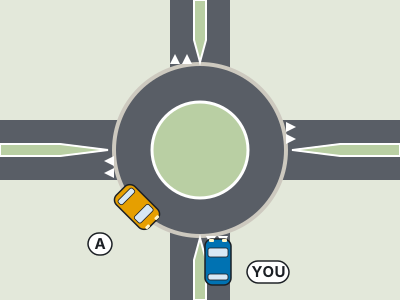
6. Before entering a Louisiana roundabout, to which direction must a vehicle yield?
- To no direction if signaling
- To the right
- Only to vehicles behind it
- To the left
Show answer
To the left. Vehicles entering a roundabout must yield to the left, where circulating traffic approaches. A driver does not gain priority by signaling, and traffic behind the entering vehicle is not the conflict described by this rule. Yielding to the right reverses the guide's instruction and can put the entering vehicle across the path of circulating traffic. Remember the sequence: slow down, look left, yield, and enter only when the circulation lane is clear.
Study this in the handbook: Roundabouts and traffic circles
7. On a cold morning, which parts of the road are likely to freeze first and stay icy longest?
- Sunny, straight stretches of road
- Bridges, overpasses and shaded areas
- Freshly paved city streets
- The lanes closest to the curb
Show answer
Bridges, overpasses and shaded areas. Bridges, overpasses and shaded areas can freeze first and stay icy longer than the rest of the road. Take extra care there, slow down and avoid sudden braking or steering. In bad winter conditions, leave more distance behind the car ahead, because it takes longer to stop on ice. Remember that a road with melting ice is more slippery than one where the ice is completely frozen.
8. The driver is sober, but a passenger is holding an open can of beer in the car. Is this allowed under Louisiana's open container law?
- Yes, because the driver is not drinking
- Yes, if the can stays below the windows
- No, possessing an open container is banned
- No, but only when the passenger is under 21
Show answer
No, possessing an open container is banned. Louisiana's open container law prohibits both possessing any open alcoholic beverage container and consuming any alcoholic beverage in a vehicle. The guide points out that even if you are not drinking, the presence of the open container puts you, the driver, at risk for fines and penalties. The rule is not limited by the passenger's age, and keeping the container out of sight does not change it.
Study this in the handbook: Alcohol and Louisiana's BAC limits
9. Your manual transmission car is rolling toward a railroad crossing in a gear that feels too high. When should you change gears?
- While the car is on the tracks
- Once you are halfway across the crossing
- Just after the front wheels pass a rail
- Before you reach the tracks
Show answer
Before you reach the tracks. With a manual transmission, shift before you reach the tracks and do not change gears while crossing. Never shift gears on the crossing itself. The guide also says never to stop a vehicle on railroad tracks. If your vehicle ever stalls in the path of a train, get out and move toward the approaching train, away from the tracks. Always look both ways as you approach, even if the lights are not flashing.
Study this in the handbook: Railroad crossings
10. You approach a railroad crossing and its warning lights are not flashing. What should you still do?
- Cross at normal speed, since no train is near
- Sound your horn before crossing the tracks
- Stop fully even when the tracks are clearly empty
- Look both ways, because the lights may not work
Show answer
Look both ways, because the lights may not work. The guide says to always look both ways as you approach a railroad crossing, even when the warning lights are not flashing, because they may not be working. When the lights are flashing, always stop. Expect a train on any track at any time, since freight trains do not run on fixed schedules, and be especially careful when trees, hills or buildings hide the tracks. Avoid phones or headphones that could keep you from hearing a train.
Study this in the handbook: Railroad crossings
11. A motorcycle is riding in your lane ahead of you. May you drive beside it in the same lane?
- Yes, if the rider stays on the left side
- Yes, if you keep three feet of space
- No, a motorcycle gets the full lane width
- Only where lanes are wider than usual
Show answer
No, a motorcycle gets the full lane width. A motorcycle is allowed the full width of a lane to maneuver, and the guide says not to share a lane with one, because it limits the rider's ability to avoid hazards. Riders often use the left part of the lane to see and be seen, and may shift position suddenly to avoid potholes or wind. That lane position is not an invitation to pull alongside. Because a motorcycle has the right to a full lane, pass it just as you would another vehicle.
Study this in the handbook: Bicycles, motorcycles and big trucks
12. At a cross street, a ONE WAY sign has its arrow pointing to your right. Which way may you turn onto that street?
- Left only, against the arrow
- Right only, the way the arrow points
- Either way, if no traffic is coming
- Left, as long as you stay close to the curb
Show answer
Right only, the way the arrow points. A one-way street sign tells you traffic flows only in the direction of the arrow. Louisiana's guide adds that you must not turn in the opposite direction of the arrow and must never drive the wrong way on a one-way street. When the arrow points right, a right turn is the only legal way onto that street. Turning left would put you head-on with traffic, no matter how empty the street looks or how close to the curb you stay.
Study this in the handbook: Warning, regulatory, guide and work zone signs
13. A large white X with the letters RR is painted in your lane. What does it warn you about?
- A reversible lane ahead
- A rest area exit ahead
- A railroad crossing ahead
- A road work zone just ahead
Show answer
A railroad crossing ahead. Railroad crossing markings are painted in the traffic lane before railroad crossings. Louisiana's guide describes a large X and two R letters on the pavement, along with a solid yellow center line that runs the whole distance to prevent passing and a white stop line painted across the lane. Seeing the X and RR tells you tracks are ahead, so slow down and be ready to stop behind the white stop line if a train is coming.
Study this in the handbook: Center lines, lane lines and crosswalks
14. You are waiting to turn left when your green arrow changes to a steady yellow arrow. What does it mean?
- A protected turn is about to begin
- The green arrow is ending; be ready to stop
- Oncoming traffic must now stop for you
- You may turn without yielding to anyone
Show answer
The green arrow is ending; be ready to stop. A steady yellow arrow warns that the green arrow for your turn is ending. Louisiana's guide says to prepare to stop and to yield the right of way to oncoming traffic or pedestrians. It does not start a protected turn, and it does not hold oncoming traffic for you. The protection the green arrow gave is going away, so any turn you make from here must give way to oncoming vehicles and to people crossing.
Study this in the handbook: Traffic lights and arrows
15. Why should you keep your headlights on low beam when following a truck at night?
- The truck's side mirrors reflect high beams at the driver
- High beams make the truck's tail lights much harder to see
- Low beams light the road under the trailer better
- High beams are banned on every interstate highway
Show answer
The truck's side mirrors reflect high beams at the driver. When following a truck at night, keep your headlights on low beam. A truck has many side mirrors, and high beams reflect off them right into the driver's eyes. In good conditions, follow at least four to five seconds behind a truck, and farther when conditions are poor. Hanging back also keeps road spray off your windshield and gives you more room to stop if the truck brakes suddenly.
Study this in the handbook: Bicycles, motorcycles and big trucks
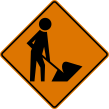
16. Driving through a work zone, you pass this sign. What does Louisiana's guide advise?
- Sound your horn to warn the workers
- Reduce speed and move away from the workers
- Keep your speed to clear the zone sooner
- Drive on the shoulder around the work
Show answer
Reduce speed and move away from the workers. This orange diamond is the Workers Ahead sign. It means people are performing maintenance on the roadway. Louisiana's guide says to reduce speed and adjust your lane position away from the workers. The guide also says that in work zones you should reduce your speed and be prepared to stop. Honking does not protect anyone, and moving onto the shoulder can put you closer to the crew. Give them as much room as your lane allows.
Study this in the handbook: Warning, regulatory, guide and work zone signs
17. You have been keeping a three second gap on the highway when heavy rain starts. How should you change your gap?
- Keep three seconds, since it works at any speed
- Cut it to two seconds so you can see the taillights
- Increase it to at least four seconds
- Increase it to ten seconds in every lane
Show answer
Increase it to at least four seconds. Three seconds is the normal minimum, but bad weather and wet pavement call for four seconds. A wet road needs more distance to stop, so if the vehicle ahead stops suddenly you need the extra room. Moving closer to see taillights cuts your reaction time. The guide does not set a fixed ten second rule. If another vehicle cuts into the space you left, drop back again to a safe distance.
Study this in the handbook: Scanning ahead, stopping distance and following distance
18. When another vehicle is following too closely, what response does the guide recommend?
- Move into the opposing lane to create a gap
- Brake sharply to punish the following driver
- Accelerate and race until the other vehicle falls behind
- Pull to the right and allow the following vehicle to pass
Show answer
Pull to the right and allow the following vehicle to pass. When a driver is following too closely, move to the right and allow that vehicle to pass. This reduces the pressure behind you and avoids turning the situation into a contest. Sharp braking can cause a rear-end collision, accelerating prolongs the unsafe interaction, and entering opposing traffic creates a head-on risk. Keep control of your lane, check that the roadside is safe, and give the other driver room to go by. The useful cue is to create separation by yielding space, not by speeding up or confronting the tailgater.
Study this in the handbook: Defensive driving, fatigue and aggressive drivers
19. A sign on a multilane highway tells certain drivers to stay in the right lane. Which drivers is it meant for?
- Drivers going slower than the normal speed of traffic
- Drivers planning to turn right at the next exit
- Drivers who just finished passing another vehicle
- Drivers of trucks and buses, whatever their speed
Show answer
Drivers going slower than the normal speed of traffic. Louisiana's guide says this sign is posted on a multilane highway for drivers going slower than the normal speed of traffic. It tells the slow driver to stay in the right lane. That leaves the other lanes open for faster traffic. The sign is about your speed compared with traffic around you, not about your vehicle type, your next exit or whether you have just passed someone.
20. You are on a four-lane highway in light traffic, not passing anyone and not planning a turn. Which lane should you be in?
- The left lane, since traffic is light
- Either lane, if you match the limit
- The right lane, since you are not passing
- The left lane, so others can merge
Show answer
The right lane, since you are not passing. Louisiana law says all vehicles should travel in the right-hand lane unless preparing for a left turn, passing another vehicle, or when the right-hand lanes are congested. Light traffic with no pass or turn planned fits none of those exceptions, so the right lane is where you belong. Light traffic does not turn the left lane into a cruising lane, and keeping to the speed limit does not change the rule. Use the left lane to pass, then move back.
Study this in the handbook: Center lines, lane lines and crosswalks
Every question is written from the official Louisiana Class D and E Driver's Guide. Need paper? Printable LA practice test with answer key.
Last verified 2026-10-05. How we check every question · Study all 500 as flashcards
Frequently asked questions
How many questions are on this Louisiana practice test?
This fixed set has 20 questions. It is test 18 of 25 from the 500 question Louisiana bank. The real LA exam asks 40 questions and you need 32 correct.
What is the passing score for the real Louisiana test?
80% minimum score is required That figure comes from the official Louisiana source cited on the DMV facts page.
How does this fixed test relate to the full Louisiana bank?
Each numbered test is a fixed set of questions in a fixed order, so you can retake the same test later and compare. Every test mixes road signs and the other topics in about the same proportion as the full bank. Tests 1 to 25 together cover every question in the Louisiana bank once. The full practice page mixes the whole bank at random.
Last verified 2026-10-05. See the Louisiana DMV facts page for sourced state details.
Return to the full Louisiana practice test · Study road signs