
Test 13 of 25 · 20 questions · Free 2026
LA Permit Practice Test 13
Jump to the test ↓A fixed 20 question set from the Louisiana bank with answers and plain English explanations. The real LA exam is 40 questions, 80 percent to pass; take the full length version on the main practice page.
Question 1 of 20 · 0 right so far
All 20 questions in test 13
Every question below comes from the Louisiana question bank on this page. Open a question to see the correct answer and the explanation. Nothing here is hidden behind a signup.
1. A six year old is riding in your car in Louisiana. Which restraint does the guide call for at that age?
- A rear facing car seat
- A booster seat with restraints
- A lap and shoulder belt by itself
- No restraint in the back seat
Show answer
A booster seat with restraints. Children ages 4 through 9 ride in a booster seat with restraints, so a six year old belongs in a booster. At about 9, a child can ride with a lap and shoulder belt fitted correctly on the vehicle seat. Rear facing seats are for children from birth to at least 2. The back seat is the safer place for children, but it never replaces a proper restraint.
Study this in the handbook: Safety belts, child restraints and air bags
2. A solid yellow line runs on your side of the center, next to a broken yellow line on the oncoming side. May you pass the slow car ahead?
- No, the dashed line is not on your side
- Yes, if the oncoming lane looks clear
- Yes, but only during daylight
- Yes, the broken line lets both sides pass
Show answer
No, the dashed line is not on your side. When a solid and a broken yellow line run side by side, the line nearest you decides what you may do. Louisiana's guide says you may cross the no-passing line to make a turn, or if the dashed line is on your side of travel. With the solid line on your side, passing is prohibited even if the oncoming lane looks clear. Drivers coming the other way, who have the dashed line, may pass when it is safe. You may still cross to turn into a driveway or side road.
Study this in the handbook: Traffic lights and arrows
3. You stop at a crash where a driver is hurt and lying on the ground. When should you move the injured person?
- Right away, to make them comfortable
- When they ask to be moved to a car
- After giving them something to drink
- Only when there is immediate danger to life
Show answer
Only when there is immediate danger to life. Do not move an injured person unless there is immediate life threatening danger, because movement could cause more injury. Call the police and ask for an ambulance; if in doubt, assume one is needed. Keep the injured warm, place a clean cloth over a wound to stop bleeding, and do not give fluids. Do not try to take an injured person to the hospital yourself unless there is no other way to get help.
Study this in the handbook: Stuck pedals, fires, floods and crashes
4. You missed your street and want to turn around at the next intersection, where this sign is posted. What does it mean for you?
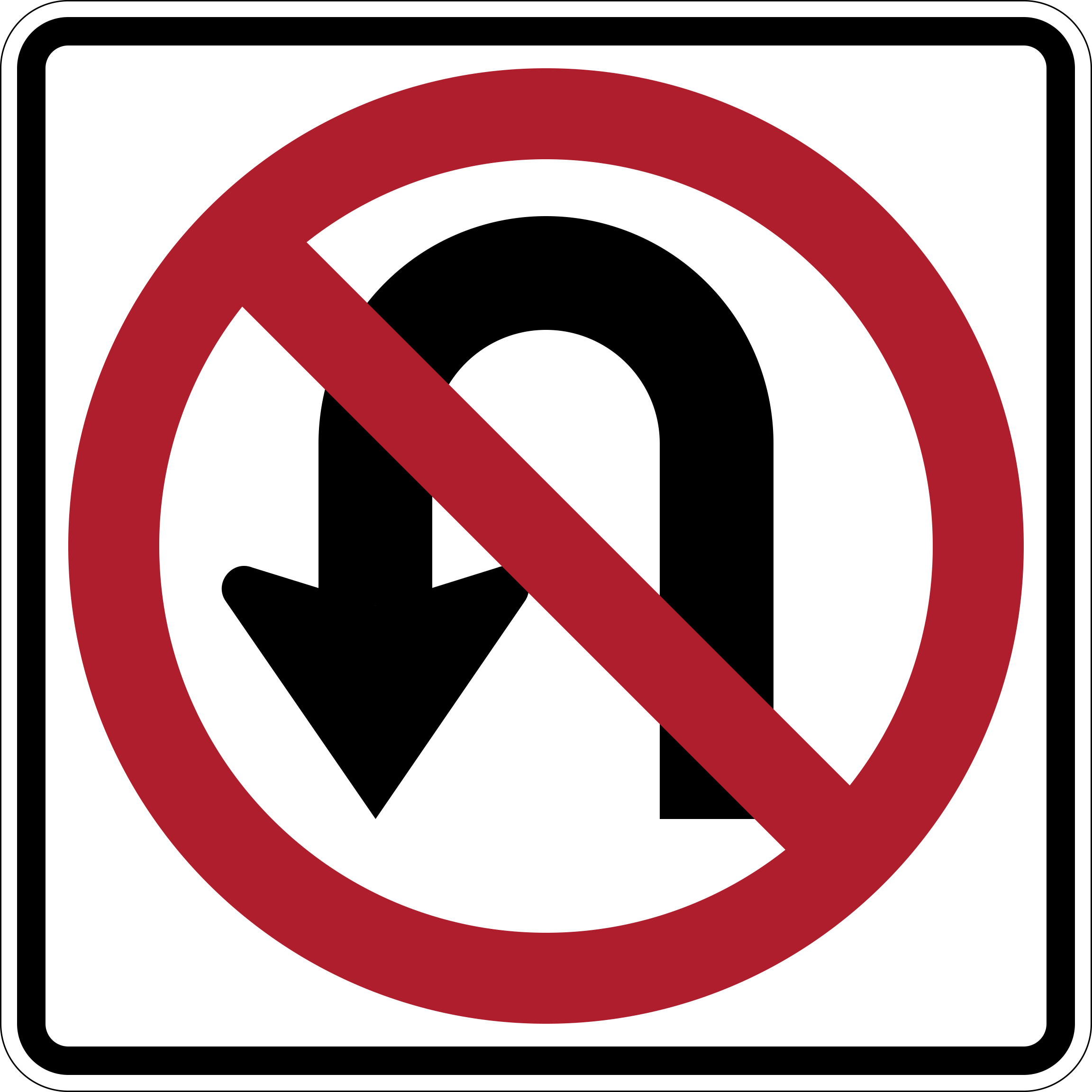
- You may U-turn after a full stop
- U-turns are allowed from the right lane
- You may not make a U-turn here
- Only plain left turns are banned here
Show answer
You may not make a U-turn here. Some regulatory signs show a symbol inside a red circle with a red slash, and Louisiana's guide says those signs prohibit the action shown. A U-shaped arrow under the slash means U-turns are not allowed at that location. Stopping first does not make the turn legal, and the sign does not ban ordinary left turns. To turn around, keep going until you reach a place where turning is permitted, such as by driving around the block.
Study this in the handbook: Warning, regulatory, guide and work zone signs
5. On a multilane road in Louisiana, which lane should you normally drive in?
- The left lane, away from merging traffic
- The right lane, except to pass or turn left
- The center lane, when there are three
- Any lane, as long as you stay within the limit
Show answer
The right lane, except to pass or turn left. Louisiana law says all vehicles should travel in the right-hand lane unless they are preparing for a left turn, passing another vehicle, or the right-hand lanes are congested. Using the left lane for steady cruising, or picking any lane as long as you stay under the limit, does not follow that rule. The guide also says a vehicle in the left lane may not be driven slower than vehicles to its right. Move back to the right after you finish passing.
Study this in the handbook: Center lines, lane lines and crosswalks
6. You are driving slower than the normal speed of traffic on a multilane highway. Which lane must you use?
- The right lane only
- The left lane
- Any lane, if you signal
- The center lane
Show answer
The right lane only. Louisiana's guide states that any vehicle traveling slower than the normal speed of traffic shall travel in the right lane only. It also says no vehicle in the left-hand lane may be driven slower than vehicles to its right. Staying left, or in a middle lane at a lower speed, forces faster drivers to weave around you. Keep right while you are slower than the flow, and move left only when you need to pass or turn left.
Study this in the handbook: Center lines, lane lines and crosswalks
7. A fire truck stops at a house fire on your street. What does Louisiana law say about parking near it?
- Park at least 20 feet from the fire truck
- Park anywhere once its siren is turned off
- Park on the opposite side of the street only
- Do not follow it and park within that block
Show answer
Do not follow it and park within that block. Louisiana law says you must not follow an emergency vehicle into the block where it has stopped and park there. A distance from the truck or the side of the street does not make it allowed, and a siren turning off does not end the rule. The same section says following an emergency vehicle that is responding to a call closer than 500 feet is unlawful, and that you may not cross an unprotected fire hose without a fire official's consent.
Study this in the handbook: Bicycles, motorcycles and big trucks
8. To prevent drowsy driving, during which hours does the guide suggest limiting your driving?
- Between noon and 3 p.m.
- Between 6 a.m. and 9 a.m.
- Between midnight and 6 a.m.
- Between 6 p.m. and 9 p.m.
Show answer
Between midnight and 6 a.m.. The guide suggests limiting driving between midnight and 6 a.m. to help prevent drowsy driving. It also suggests starting your trip well rested, setting realistic travel goals, avoiding alcohol and drugs, and keeping the inside of your vehicle at a cool temperature. To stay alert on a longer trip, switch drivers every two hours and stop every two hours to stretch.
Study this in the handbook: Defensive driving, fatigue and aggressive drivers
9. You are backing out of an angle parking space and turning the wheel. What happens to the front of your car?
- It stays pointed straight until the car is in the lane
- It swings in the same direction as the turn
- It lifts slightly and then follows the rear
- It swings opposite to the direction of the turn
Show answer
It swings opposite to the direction of the turn. When you back while turning, the front of the car swings the opposite way from your turn. That swing can clip the car parked beside you, so back slowly and watch the front corners as well as the path behind. The guide says to back while turning until your left front wheel passes the rear bumper of the car on your left, then straighten the wheels as you come into the lane.
Study this in the handbook: Parking rules and painted curbs
10. You are stopped, waiting to turn left across oncoming traffic. How should your front wheels point?
- Turned left so you are ready to go
- Straight ahead until you start the turn
- Turned right, toward the edge of the road
- Whichever way gives you the best view of traffic
Show answer
Straight ahead until you start the turn. Keep your wheels straight while you wait to make a left turn. If another car hits you from behind, straight wheels keep your car from being pushed into the oncoming lane. Turning the wheels left early is exactly what would steer you into that traffic. The guide's left turn steps also say to signal at least 100 feet before the turn, brake before you begin it, use the proper lane and avoid cutting the corner too sharply.
Study this in the handbook: School buses, turns and signals
11. A small fire starts under your hood from a fuel leak after you pull off the road. Which of these should you NOT use on it?
- A chemical fire extinguisher
- Sand or dirt from the roadside
- Water from a bottle or cooler
- A coat or other heavy clothing
Show answer
Water from a bottle or cooler. Most vehicle fires come from an overheated engine, an electrical short, or a fuel or oil leak. After driving clear of traffic, turning off the engine and switches, and getting everyone away from the car, a small fire can be smothered with a chemical extinguisher, dirt, mud, sand or clothing. Water must not be used on a gasoline, oil or electrical fire. If a large gasoline or oil fire develops, do not try to fight it; seek assistance.
Study this in the handbook: Skids, blowouts and hydroplaning
12. A friend says a couple of drinks will make him a more alert driver. How does the guide classify alcohol?
- As a stimulant that speeds up reflexes
- As a mild stimulant in small amounts
- As a depressant with anesthetic effects
- As neither, since effects depend on the drink
Show answer
As a depressant with anesthetic effects. Alcohol is a depressant, not a stimulant. It has anesthetic effects on the brain, slows normal reflexes, interferes with judgment, reduces alertness and impairs vision. A person who feels stimulated after drinking is really feeling lowered inhibitions, which cause a loss of caution and self control. The type of drink does not change this, because it is the amount of alcohol entering the blood that causes the problem.
Study this in the handbook: Alcohol and Louisiana's BAC limits
13. Above about what speed does the guide recommend push/pull (hand to hand) steering while driving forward?
- Above 3 to 5 mph
- Above 10 to 15 mph
- Above 30 to 35 mph
- Above 50 to 55 mph
Show answer
Above 10 to 15 mph. Push/pull steering, also called hand to hand steering, is for normal forward driving above about 10 to 15 mph. One hand pushes the wheel up while the other slides up and pulls down, so your arms never cross the wheel. That lowers the chance of face, hand and arm injury if the driver air bag goes off in a frontal crash. At low speeds, such as at an intersection or when parking, the guide uses hand over hand steering instead.
14. Why should a driver reduce speed before a curve or hill on a rural road?
- Rural hills and curves may be steeper and sharper than those on highways
- The posted limit becomes automatically invalid on every rural road
- Rural roads have wider shoulders that make slowing unnecessary
- Headlights must be turned off before entering a rural curve
Show answer
Rural hills and curves may be steeper and sharper than those on highways. The manual warns that rural hills and curves can be steeper and sharper than those on highways. Lowering speed before reaching the crest or entering the bend gives the driver more time to see and react to hidden traffic, animals, or roadway changes. The posted limit does not become meaningless, but it is not a command to maintain that speed when the road demands less. Wider shoulders do not make slowing unnecessary, and headlight use is unrelated to the hazard. Slow before the sightline disappears, not after an obstacle appears.
Study this in the handbook: Interstate and rural road driving
15. When is it illegal to flash the turn signal on just one side of your vehicle?
- When parked or disabled, or to wave a driver past
- When changing lanes on an interstate highway
- When pulling out of a parallel parking space
- When turning less than 100 feet from a corner
Show answer
When parked or disabled, or to wave a driver past. Louisiana law makes it illegal to flash the turn signal on only one side of a parked or disabled vehicle, or to use it to tell another vehicle to pass you. The guide notes that crashes often happen when one driver does something another driver does not expect. Signaling for lane changes is required, and the left signal should be used when pulling out of a curbside parking space. A turn signal must run for at least 100 feet before the turn.
Study this in the handbook: Roundabouts and traffic circles
16. How should you make a right turn at an intersection with one right-hand lane?
- Swing left first to make the turn wider
- Turn from the center lane if it happens to be empty
- From the right-most lane, not swinging left
- Start the turn from the road's shoulder
Show answer
From the right-most lane, not swinging left. For a right turn, the guide says to avoid swinging left before turning and to turn from the right-most lane, unless lane markings show that more than one lane may turn right. Signal and get into the proper lane at least 100 feet before the turn, slow down before turning, and finish in the proper lane. Swinging left or turning from a center lane surprises drivers beside you, and the shoulder is not a turning lane.
Study this in the handbook: School buses, turns and signals
17. A green sign with white letters gives the name of a city and how many miles away it is. What type of sign is this?
- A warning sign about road conditions
- A regulatory sign you must obey
- A service sign for fuel and food
- A destination guide sign
Show answer
A destination guide sign. Destination signs are guide signs. In Louisiana they are green or brown, square or rectangular, with white lettering, and they show the direction and distance to places such as cities, airports and parish lines. Warning signs are usually yellow diamonds, regulatory signs are mostly white with black, red or green letters, and services such as fuel and food appear on blue signs. A green panel giving a place name and mileage is helping you find your way. It is not ordering you to do something or warning you of a hazard.
18. What does a flashing red traffic light require before entering an intersection?
- A slow roll through without stopping when no signal is visible
- A complete stop, a look in both directions, and yielding right-of-way
- A stop only if another vehicle is approaching from the left
- Immediate passage because flashing red means the signal is inactive
Show answer
A complete stop, a look in both directions, and yielding right-of-way. A flashing red light is an active stop control, not a signal that can be ignored when the road looks empty. Stop behind the stop bar, crosswalk, or intersection, then look both ways and yield before entering. A slow roll fails to provide the required complete stop, and checking only the left side can miss traffic or pedestrians approaching from another direction. Use the same deliberate sequence as a stop sign: stop, scan, yield, and proceed only when the path is safe.
Study this in the handbook: Traffic lights and arrows
19. You see a PASS WITH CARE sign on a two-lane road. What does it tell you?
- The no-passing zone has ended
- A no-passing zone is about to begin
- Passing is allowed only on the right
- The speed limit is about to drop
Show answer
The no-passing zone has ended. The Pass With Care sign marks the end of a no-passing zone. Louisiana's guide says that from that point you may pass, but only when it is safe to do so. The sign does not order you to pass, and it does not open passing on the right. A no-passing zone that is starting is shown by the yellow pennant-shaped sign instead. Before pulling out, make sure the road ahead is clear and the pass can be completed safely.
Study this in the handbook: Warning, regulatory, guide and work zone signs
20. Driving fast through heavy rain, your steering suddenly feels light and loose. What is most likely happening?
- Your tires are riding up on a layer of water
- Your brakes have overheated from the rain
- Your power steering fluid has leaked out
- Your tires have gained extra grip from the water
Show answer
Your tires are riding up on a layer of water. At higher speeds on a wet road, the tread cannot clear water fast enough, so the tires ride up on a layer of water like water skis. This is hydroplaning, and it can make the steering feel light because the tires are losing contact with the road. Do not panic. Ease off the gas, keep looking and steering where you want to go, and avoid using the brakes until the tires touch the road again.
Study this in the handbook: Lane changes, passing and wet roads
Every question is written from the official Louisiana Class D and E Driver's Guide. Need paper? Printable LA practice test with answer key.
Last verified 2026-10-05. How we check every question · Study all 500 as flashcards
Frequently asked questions
How many questions are on this Louisiana practice test?
This fixed set has 20 questions. It is test 13 of 25 from the 500 question Louisiana bank. The real LA exam asks 40 questions and you need 32 correct.
What is the passing score for the real Louisiana test?
80% minimum score is required That figure comes from the official Louisiana source cited on the DMV facts page.
How does this fixed test relate to the full Louisiana bank?
Each numbered test is a fixed set of questions in a fixed order, so you can retake the same test later and compare. Every test mixes road signs and the other topics in about the same proportion as the full bank. Tests 1 to 25 together cover every question in the Louisiana bank once. The full practice page mixes the whole bank at random.
Last verified 2026-10-05. See the Louisiana DMV facts page for sourced state details.
Return to the full Louisiana practice test · Study road signs