
Test 2 of 10 · 20 questions · Free 2026
LA Permit Practice Test 2
Jump to the test ↓A fixed 20 question set from the Louisiana bank with answers and plain English explanations. The real LA exam is 40 questions, 80 percent to pass; take the full length version on the main practice page.
Question 1 of 20 · 0 right so far
All 20 questions in test 2
Every question below comes from the Louisiana question bank on this page. Open a question to see the correct answer and the explanation. Nothing here is hidden behind a signup.
1. What driver education must a Louisiana teen complete for a learner's permit?
- 6 hours of classroom only
- 30 hours of classroom instruction and 8 hours of behind-the-wheel instruction
- 38 hours of behind-the-wheel only
- 50 hours of classroom instruction
Show answer
30 hours of classroom instruction and 8 hours of behind-the-wheel instruction. Stage 1 of Louisiana's graduated licensing program requires a learner's permit applicant to be at least 15, complete thirty hours of classroom instruction and eight hours of behind-the-wheel instruction, and pass the vision and knowledge exams. Six hours is the pre-licensing course option for adults 18 and older who skipped the teen program. Thirty-eight hours is the adult driver's education course. Fifty hours is the supervised practice total needed later for the intermediate license.
Study this in the handbook: The graduated licensing program
2. Under Louisiana law, what fine and jail range applies to a first DWI conviction?
- A fine of $300 to $1,000 and 10 days to 6 months in jail
- A fine of $750 to $1,000 and 30 days to 6 months in jail
- A $2,000 fine and 1 to 5 years in prison
- A $5,000 fine and 10 to 30 years in prison
Show answer
A fine of $300 to $1,000 and 10 days to 6 months in jail. Louisiana Revised Statute 14:98.1 sets the penalty for a first offense of operating while impaired: a fine of not less than $300 nor more than $1,000, and imprisonment for not less than ten days nor more than six months. The court can suspend the sentence only with probation conditions such as 48 hours in jail or community service, a substance abuse program and a driver improvement program. The $750 to $1,000 fine with 30 days to 6 months is the second offense range. The $2,000 fine with 1 to 5 years is the third offense penalty, and $5,000 with 10 to 30 years is the fourth.
3. How many supervised driving hours must be documented before a Louisiana Class E intermediate license is issued?
- 50 hours, including at least 15 at night
- 30 hours, including at least 5 at night
- 40 hours, all during daylight
- 60 hours, including at least 20 at night
Show answer
50 hours, including at least 15 at night. The intermediate license upgrade requires a documented total of at least 50 practice hours, and the manual adds a separate nighttime minimum of 15 hours. A log that reaches 50 hours without 15 nighttime hours is incomplete. The 30, 40, and 60 hour options change the stated requirement rather than applying the Louisiana rule. Record the time of each session and verify both categories independently. The key memory cue is that nighttime practice is a required portion of the total, not an optional extra or a replacement for daytime driving.
Study this in the handbook: The graduated licensing program
4. What should a driver do at a steady green traffic light if crossing traffic is still clearing the intersection?
- Enter immediately because green traffic always has priority
- Allow the crossing traffic to clear before going ahead
- Wait for the light to turn red, then drive through
- Use the shoulder to bypass the crossing traffic
Show answer
Allow the crossing traffic to clear before going ahead. A steady green allows movement only when the intersection is clear. If crossing traffic remains, the driver must allow it to clear before proceeding. Entering immediately can block the intersection and create a collision, while waiting for red is unnecessary once the path becomes safe. The shoulder is not a lawful bypass. Look through the intersection before moving, and keep the vehicle behind the stop line when there is not enough room to clear it.
Study this in the handbook: Traffic lights and arrows
5. What share of crashes occur within 25 miles of home, and at what speed have unbelted fatalities been recorded, according to the Louisiana guide?
- 75 percent within 25 miles, with unbelted deaths at speeds as low as 12 mph
- 10 percent, at speeds over 60 mph
- 50 percent, at 30 mph
- 90 percent, at 5 mph
Show answer
75 percent within 25 miles, with unbelted deaths at speeds as low as 12 mph. Seventy five percent of crashes occur within 25 miles of home, and non belted fatalities have been recorded at speeds as low as 12 mph, so the belt matters on the shortest trips. A marble stops more easily than a bowling ball, and an unbelted body keeps moving at the car's speed until something stops it. Pregnant drivers are safer belted as well.
Study this in the handbook: Safety belts, child restraints and air bags
6. How should you treat an intersection when its traffic control signal is not functioning?
- Treat it as a flashing yellow signal
- Proceed without stopping because no light is showing
- Give priority only to the wider roadway
- Treat it as an all way or four way stop
Show answer
Treat it as an all way or four way stop. A dark or otherwise nonfunctioning traffic signal does not erase the intersection's controls. Louisiana directs the intersection to revert to an all way or four way stop. Each driver must stop, assess cross traffic and pedestrians, and then apply the normal right of way rules. Proceeding without stopping risks a collision with another driver who is following the same rule. The wider road does not automatically receive priority, and a dark signal is not the same as flashing yellow. Treat the outage as a stop controlled intersection from every approach.
Study this in the handbook: Speed laws
7. What hazard can a truck's windblast create for a bicyclist on an open highway or bridge?
- Windblasts can move a bicyclist out of the path of travel
- Windblasts eliminate the need to leave space when passing a bicycle
- Windblasts make a bridge's lane markings change direction
- Windblasts require the truck to stop before crossing a bridge
Show answer
Windblasts can move a bicyclist out of the path of travel. Air pushed by a passing truck can move a bicyclist out of the bicyclist's path on a long open highway or bridge. That sudden lateral movement is why a driver should avoid crowding the bicycle, keep a safe buffer, and be prepared for the rider to drift. Wind does not remove the need for passing space, change lane markings, or require the truck to stop at a bridge. Watch the bicycle as well as the truck, reduce speed when needed, and allow the rider room to recover from the gust.
Study this in the handbook: Bicycles, motorcycles and big trucks
8. A truck carrying hazardous materials is stopped at a Louisiana railroad crossing. What should the driver behind it do?
- Honk until the truck leaves the tracks
- Pass immediately if no train is visible
- Drive onto the shoulder and pass on the right
- Wait behind it because vehicles carrying hazardous materials must stop at railroad crossings
Show answer
Wait behind it because vehicles carrying hazardous materials must stop at railroad crossings. Louisiana lists vehicles carrying hazardous materials among those required to stop at railroad crossings. The following driver should leave room and wait rather than treating the absence of a visible train as permission to pass. The choice about passing on the shoulder is especially risky because it adds an unplanned movement near tracks and a stopped truck. A useful cue is to recognize that the truck is making a legally required stop, not merely pausing for convenience. Do not pass unless it is legal, conditions are safe, and the tracks can be seen clearly.
Study this in the handbook: Scanning ahead, stopping distance and following distance
9. A deer runs into the lane and a collision cannot be avoided. Which response does the Louisiana guide recommend?
- Leave the roadway onto the shoulder at full speed
- Turn sharply into oncoming traffic
- Keep the vehicle under control on the roadway instead of swerving
- Close your eyes and release the steering wheel
Show answer
Keep the vehicle under control on the roadway instead of swerving. When an animal collision is inevitable, the guide warns against swerving because leaving the roadway or entering opposing traffic can create a more serious crash. The driver should concentrate on keeping control and remaining on the roadway. The choice to turn sharply into oncoming traffic creates a second hazard that may injure other road users. Slow down when possible, keep your eyes on the intended path, and use controlled braking. The key cue is preserving vehicle control, even when avoiding the animal is no longer possible.
Study this in the handbook: Interstate and rural road driving
10. After a refusal of Louisiana's alcohol analysis test, how long must SR-22 proof be maintained from the date of conviction?
- Three years
- One year
- Five years
- Until the next license renewal
Show answer
Three years. The guide says SR-22 high-risk insurance must be maintained for three years from the date of conviction when that proof is required after an alcohol-test refusal. The one-year choice confuses the first-refusal suspension with the insurance period. Five years is not the stated duration, and a license-renewal date does not replace the conviction-based measurement. Look for the anchor date in the rule: the clock starts at conviction, and the obligation lasts three years. This requirement is separate from the number of days the driving privilege remains suspended.
Study this in the handbook: Implied consent and DWI penalties
11. When does Louisiana law require low beam headlights during the day?
- Only in tunnels
- Whenever your windshield wipers are required
- Only on interstates
- Never during daylight
Show answer
Whenever your windshield wipers are required. Louisiana law requires you to have your headlights on, on low beam, when your windshield wipers are required. That means rain or other conditions heavy enough for wipers also call for headlights, even in daylight. Tunnels and interstates are not the rule's trigger. Saying never during daylight ignores the wiper rule. Headlights in rain help other drivers see you, which matters as much as your own view of the road.
Study this in the handbook: Bicycles, motorcycles and big trucks
12. What does a single solid white lane line indicate?
- The two lanes carry opposing traffic
- Moving from one lane to another is hazardous
- A lane change is required immediately
- The roadway edge is always on the left
Show answer
Moving from one lane to another is hazardous. A single solid white line separates lanes moving in the same direction and warns that changing lanes is hazardous. It does not indicate opposing traffic, which is separated by yellow center lines. It also does not command an immediate lane change. A white edge line is usually along the right edge, so the left-edge statement is not a general definition of this marking. If a lane change is necessary, wait for a safe opening and cross the solid line only with great care.
Study this in the handbook: Center lines, lane lines and crosswalks
13. Which locations may be identified by fluorescent yellow warning signs?

- Recreational areas and cultural attractions
- Truck inspection stations and weigh scales
- School zones, school crossings, and pedestrian crossings
- Temporary construction detours and lane closures
Show answer
School zones, school crossings, and pedestrian crossings. The guide says some warning signs may be fluorescent yellow, including signs for school zones, school crossings, and pedestrian crossings. These signs call for heightened attention because children and pedestrians may be near the roadway. Construction warnings use orange, recreational and cultural information uses brown, and truck controls use other regulatory treatments. When the bright warning color appears, reduce speed as needed, scan both sides of the road, and be prepared to stop for people entering the crossing area. The color is a warning cue, not a destination marker.
Study this in the handbook: Warning, regulatory, guide and work zone signs
14. What does a two-way left turn lane permit?
- Right turns from whichever direction has more space
- Travel and passing in either direction
- Parking until opposing traffic clears
- Left-turn maneuvers from either direction only
Show answer
Left-turn maneuvers from either direction only. The center two-way left turn lane is shared by vehicles from either direction, but only for left-turn maneuvers. It is not a through lane and must never be used for passing. Parking there also creates a conflict, and the lane is not intended for right turns. Enter it only near the turn, watch carefully for an opposing vehicle using the same space, and complete the turn without treating the lane as a shortcut.
Study this in the handbook: Center lines, lane lines and crosswalks
15. What does a white railroad crossbuck mean?
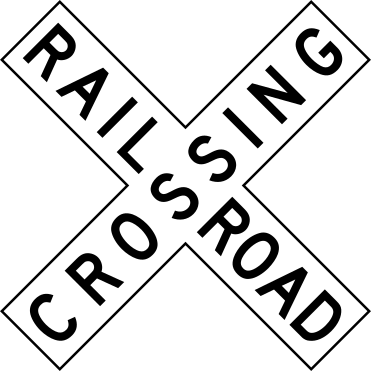
- It permits passing across the tracks without looking
- It guarantees that no train can be approaching
- It marks a school crossing where vehicles have priority
- It is a regulatory sign with the same meaning as a yield sign
Show answer
It is a regulatory sign with the same meaning as a yield sign. The white crossbuck is a railroad regulatory sign and has the same meaning as a yield sign. The driver must approach prepared to give way, never assume the tracks are clear, and follow any additional signals or gates. It does not guarantee an empty crossing, grant vehicle priority, or make passing safe. Reduce speed, look and listen, and proceed only when the crossing can be cleared safely.
Study this in the handbook: Sign shapes and colors
16. What is the maximum speed on a Louisiana road when the vehicle is towing another motor vehicle?
- 35 miles per hour
- 70 miles per hour
- 45 miles per hour
- 15 miles per hour
Show answer
45 miles per hour. Towing another motor vehicle triggers Louisiana's 45 mph maximum. The ordinary 70 mph figure is the general rule, but it does not survive this listed exception. The 35 mph option belongs to certain school-bus operations, and 15 mph is a roundabout speed reference rather than a towing limit. The cue is the verb towing: when the question describes one motor vehicle pulling another, select the special 45 mph number before considering the general limit.
17. What does Louisiana's implied consent law mean for a person driving on state highways?
- Consent applies only after a conviction
- The driver can never be asked for a sobriety test
- Only a blood test may be requested
- The driver is deemed to have consented to testing for alcohol and certain drugs
Show answer
The driver is deemed to have consented to testing for alcohol and certain drugs. Louisiana's implied consent rule attaches to driving a motor vehicle on the state's highways. By driving, the person is deemed to have consented to testing for alcohol content and the presence of abused or illegal controlled dangerous substances. The guide also says testing may involve blood, urine, or breath, so a blood only choice is too narrow. The rule exists before any conviction and does not mean an officer is barred from requesting a test. The cue is the act of driving on Louisiana highways.
Study this in the handbook: Implied consent and DWI penalties
18. A school bus stops across a raised median with red lights flashing. Must your traffic stop?
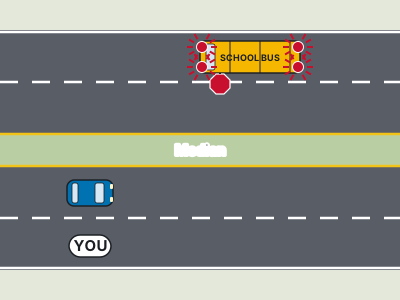
- Only if the bus is within 100 feet
- Yes, every roadway must stop for every bus
- No, a median or barrier prevents traffic from driving across to the bus
- Only after an officer directs you to stop
Show answer
No, a median or barrier prevents traffic from driving across to the bus. Traffic on the opposite side does not have to stop when a ditch, grassy median, elevated concrete barrier, or another obstacle prevents vehicles from driving across to the bus. The physical separation is the key condition, not the distance to the bus. This exception does not permit passing a bus in your own roadway. Slow, watch carefully for children, and obey the stop requirement whenever your side is not separated.
Study this in the handbook: School buses, turns and signals
19. What is Louisiana's maximum speed for a vehicle pulling or towing another motor vehicle?
- 70 mph
- 55 mph
- 45 mph
- 35 mph
Show answer
45 mph. Louisiana sets a 45 mph maximum when a vehicle is pulling or towing another motor vehicle. The general maximum of 70 mph does not control this exception, and 55 mph is not the towing figure in the guide. The 35 mph number applies to certain school buses that frequently stop for children. The practical cue is the trailer or tow connection: once another motor vehicle is being pulled, use the special 45 mph limit.
20. Where must a driver stop when approaching a stop sign and a stop line is present?
- Past the crosswalk
- Behind the stop line
- Beside the nearest parked vehicle
- At the center of the intersection
Show answer
Behind the stop line. The stop sign rule places the vehicle behind the stop line when one is present. If there is no stop line, the crosswalk is the next named stopping reference. Moving beyond the line before stopping can place the vehicle in the path of crossing traffic or pedestrians. The visual cue is to scan the pavement immediately before the intersection and stop at the marked boundary, then look in every direction and yield before proceeding.
Study this in the handbook: Warning, regulatory, guide and work zone signs
QualitySpace is expanding to Louisiana
We are a California-based independent insurance brokerage working on licensing in more states. We cannot help with Louisiana insurance yet. Leave your email and we will let you know when we can.
Every question is written from the official Louisiana Class D and E Driver's Guide. Need paper? Printable LA practice test with answer key.
Last verified 2026-10-05. How we check every question · Study all 218 as flashcards
Frequently asked questions
How many questions are on this Louisiana practice test?
This fixed set has 20 questions. It is test 2 of 10 from the 218 question Louisiana bank. The real LA exam asks 40 questions and you need 32 correct.
What is the passing score for the real Louisiana test?
80% minimum score is required That figure comes from the official Louisiana source cited on the DMV facts page.
How does this fixed test relate to the full Louisiana bank?
Each numbered test is a fixed set of questions in a fixed order, so you can retake the same test later and compare. Every test mixes road signs and the other topics in about the same proportion as the full bank. Tests 1 to 10 together cover 200 of the 218 questions in the Louisiana bank, each once. The full practice page mixes the whole bank at random.
Last verified 2026-10-05. See the Louisiana DMV facts page for sourced state details.
Return to the full Louisiana practice test · Study road signs