
Test 7 of 10 · 20 questions · Free 2026
LA Permit Practice Test 7
Jump to the test ↓A fixed 20 question set from the Louisiana bank with answers and plain English explanations. The real LA exam is 40 questions, 80 percent to pass; take the full length version on the main practice page.
Question 1 of 20 · 0 right so far
All 20 questions in test 7
Every question below comes from the Louisiana question bank on this page. Open a question to see the correct answer and the explanation. Nothing here is hidden behind a signup.
1. A 16 year old moves to Louisiana with a license or permit held for at least 180 days. What may happen?
- The teen must start over with a new learner's permit
- The teen gets a full license right away
- The teen must wait until 17 to drive
- The teen may bypass the learner's permit stage and get an intermediate license
Show answer
The teen may bypass the learner's permit stage and get an intermediate license. Louisiana allows an out-of-state applicant who is sixteen and has had a license or permit for at least one hundred eighty days to be eligible to bypass the learner's permit stage and be issued an intermediate license. Starting over ignores that rule. A full license is not available until the intermediate stage ends at 17. Waiting until 17 to drive at all is not required.
Study this in the handbook: The graduated licensing program
2. What information is commonly provided by a blue service sign?
- A prohibition against passing
- The location of services such as gas stations or hospitals
- A warning about a curve or slippery pavement
- The maximum speed allowed on the road
Show answer
The location of services such as gas stations or hospitals. Blue service signs direct travelers to useful facilities, including rest areas, gas stations, hotels, and hospitals. They are informational rather than warnings, prohibitions, or speed commands. No-passing rules belong to regulatory or warning signs, curves and slippery pavement are hazard messages, and maximum speed is posted on a regulatory sign. A simple roadside cue is color plus purpose: blue helps locate a service. Follow the symbol or wording and make any exit or turn safely.
Study this in the handbook: Warning, regulatory, guide and work zone signs
3. What does Louisiana law prohibit a driver from doing on railroad tracks?
- Stopping before a lowered crossing gate
- Looking both ways before crossing
- Stopping a vehicle on the tracks
- Waiting until the gates are raised
Show answer
Stopping a vehicle on the tracks. Louisiana law prohibits stopping a vehicle on railroad tracks. Looking both ways, stopping before a lowered gate, and remaining stopped until the gate rises are safety actions required by the crossing guidance. The danger is not limited to a vehicle that is intentionally parked: a driver should avoid entering a crossing unless there is room to clear the tracks. If a vehicle stalls or becomes trapped, occupants should leave and move toward the approaching train, away from the tracks. Never treat the rails as a temporary stopping place.
Study this in the handbook: Railroad crossings
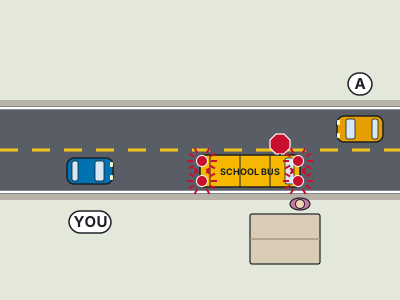
4. A school bus is stopped on a two-lane road with red lights flashing. What must traffic do?
- Drivers may continue once the bus door opens
- Only traffic behind the bus must stop
- Oncoming drivers may pass if they slow below 15 mph
- Drivers in both directions must stop at least 30 feet away
Show answer
Drivers in both directions must stop at least 30 feet away. A bus loading or unloading children requires a stop at least thirty feet away, and the rule applies whether a driver is meeting the bus or following it. The following-only choice overlooks the danger to children crossing the roadway. Do not resume simply because the bus door changes position. Wait for the bus to move, then scan before driving, and remain alert whenever the red lights and stop sign are active.
Study this in the handbook: School buses, turns and signals
5. How should a driver pass an animal-drawn vehicle on a rural road?
- Rev the engine loudly and pass as quickly as possible
- Sound the horn continuously so the animal moves away
- Pass cautiously without using the horn or revving the engine
- Drive onto the shoulder without checking the roadway
Show answer
Pass cautiously without using the horn or revving the engine. Animal-drawn vehicles have the same right to use the road as motor vehicles, but a horse can be frightened by sudden noise. The guide says to pass with caution and not use the horn or rev the engine, because startling the horse may cause a crash. These vehicles normally travel between 5 and 8 miles per hour, and a driver pulling a large load may not see vehicles behind, so be extra cautious when passing. The shoulder is not a substitute for checking traffic or maintaining a controlled, lawful position.
Study this in the handbook: Interstate and rural road driving
6. How many deer vehicle collisions happen in the U.S. each year, according to the Louisiana guide?
- About 100
- About 10,000
- An estimated 1.5 million, causing over 200 deaths and $4 billion in damage
- About 50 million
Show answer
An estimated 1.5 million, causing over 200 deaths and $4 billion in damage. There are an estimated 1.5 million deer vehicle collisions annually in the United States, causing more than 200 fatalities and $4 billion in property and vehicle damage. On rural roads expect animals at dawn and dusk, slow down when you see one, brake firmly and stay in your lane rather than swerving. Animal drawn vehicles bring restricted vision for their drivers too.
Study this in the handbook: Interstate and rural road driving
7. How many bicyclists were killed in U.S. traffic crashes in 2017, according to NHTSA figures in the Louisiana guide?
- 783, out of about 90 million cyclists
- About 10,000
- About 50
- About 5
Show answer
783, out of about 90 million cyclists. There are currently 90 million cyclists in the United States, and according to NHTSA 783 bicyclists were killed in traffic crashes in 2017. Louisiana law, R.S. 32:76.1, requires a three foot distance between a passing automobile and a slower bicyclist, and the guide says to give bicyclists the entire lane when they are passing parked cars so they can avoid opening doors. If a rider is unsafely moving into your lane, give the horn only a light tap.
Study this in the handbook: Bicycles, motorcycles and big trucks
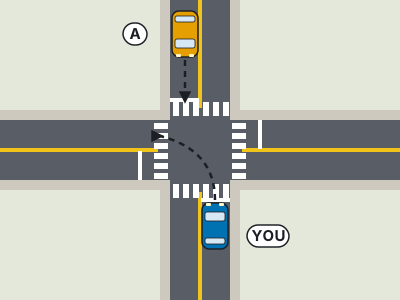
8. When making a left turn, to whom must the driver yield in Louisiana?
- Only vehicles approaching from behind
- Oncoming traffic, including bicyclists
- Only pedestrians on the far sidewalk
- No one if the turn signal is activated
Show answer
Oncoming traffic, including bicyclists. The driver making a left turn must yield right of way to oncoming traffic, including bicyclists. A turn signal communicates intent but does not give the turning vehicle priority. Checking only behind misses the road users who may conflict with the turn, and limiting the rule to pedestrians ignores the manual's explicit reference to oncoming traffic and bicyclists. Wait for a safe gap, scan for people and bicycles, and complete the turn only when the path is clear. The central cue is that a left turn crosses opposing movement.
Study this in the handbook: Right of way and other laws you should know
9. What activity does Louisiana law prohibit on a public street or road?
- Reducing speed before a school crossing
- Driving at the posted limit on a divided highway
- Passing a slower vehicle on a clear, legal stretch
- Participating in a race, speed contest, or speed exhibition
Show answer
Participating in a race, speed contest, or speed exhibition. Louisiana treats drag racing as an unlawful race, speed contest, or speed exhibition on a public street or road. The choice “Participating in a race, speed contest, or speed exhibition” describes the prohibited conduct. Ordinary passing is allowed when visibility, markings, and traffic conditions make it lawful. Driving at a posted limit is not automatically racing, and slowing near a school crossing is a safety measure rather than an offense. A useful cue is competition: two or more vehicles accelerating to outdo one another is the behavior the rule targets, not merely traveling quickly or passing another vehicle.
Study this in the handbook: Speed laws
10. How many non-family passengers under 21 may an intermediate licensee transport between 6:00 p.m. and 5:00 a.m.?
- No more than two
- No more than one
- No more than three
- Any number if all wear seat belts
Show answer
No more than one. During the 6:00 p.m. to 5:00 a.m. period, an intermediate licensee may not transport more than one passenger under 21 who is not an immediate-family member. The rule is a passenger cap, not a permission to carry two or three young non-family passengers after buckling them in. Immediate family is treated differently by the wording, so classify the passenger before counting. Also remember that this evening restriction is distinct from the 11:00 p.m. to 5:00 a.m. driving curfew, which concerns whether the licensee may drive at all without an accompanying qualified person.
Study this in the handbook: The graduated licensing program
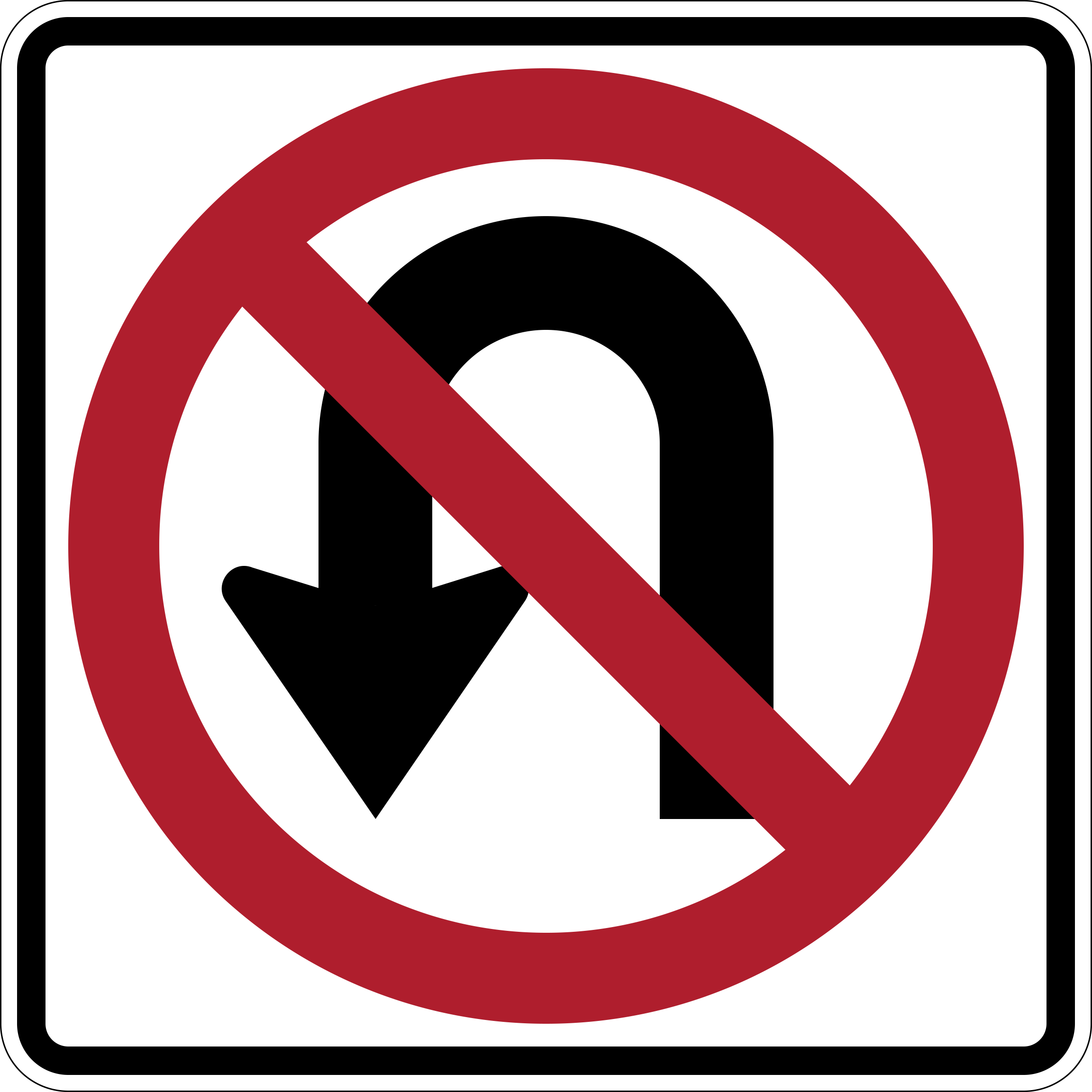
11. What action is prohibited by a red slash over a U-shaped arrow?
- Turning right at the next intersection
- Making a U-turn
- Passing a slower vehicle on a straight road
- Entering a one-way street in the arrow's direction
Show answer
Making a U-turn. A red circle with a red slash identifies a regulatory sign that prohibits the action represented by the symbol. On the pictured sign, the symbol shows a U turn, so the barred maneuver is turning around. The slash does not automatically prohibit a right turn, ordinary passing, or travel in the permitted direction on a one way street. Read the symbol first, then obey any other signs or markings governing the lane. The visual cue is the red slash crossing the maneuver that drivers must not make.
Study this in the handbook: Warning, regulatory, guide and work zone signs
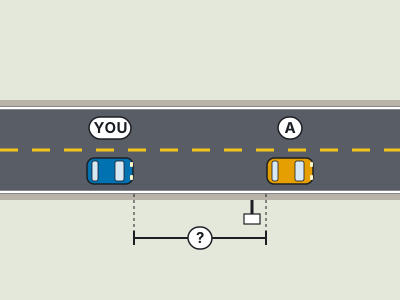
12. How does the three-second rule help a driver judge following distance?
- It replaces the need to watch the road ahead
- It measures three car lengths at every speed
- It permits a two-second gap in rain
- It checks whether the vehicle takes at least three seconds to reach a reference point
Show answer
It checks whether the vehicle takes at least three seconds to reach a reference point. To use the three-second rule, choose a fixed object ahead, begin counting when the vehicle in front passes it, and compare that count with your own arrival at the object. Reaching it in less than three seconds means the gap is too short, so drop back and count again. The method works at any speed because it measures time rather than a fixed number of car lengths. It does not replace scanning ahead, and poor weather calls for increasing the interval beyond three seconds.
Study this in the handbook: Scanning ahead, stopping distance and following distance
13. On a first offense, a Louisiana driver age 21 or older tests at 0.16% BAC. How long are driving privileges suspended?
- 180 days
- Two years (730 days)
- 365 days
- 90 days
Show answer
Two years (730 days). For a driver 21 or older who submits to the test, a BAC of 0.15% or greater brings a suspension of two years, or 730 days. The 180 day suspension is for 0.08% to 0.149%, which 0.16% exceeds. Three hundred sixty-five days is the first refusal suspension. Ninety days is not part of the rule. Refusing on a second or later offense also brings 730 days.
Study this in the handbook: Implied consent and DWI penalties
14. At approximately what speed should a driver negotiate the sharp curve when entering a roundabout?
- The posted interstate speed
- About 35 to 40 mph
- About 15 to 20 mph
- Any speed that keeps the engine above idle
Show answer
About 15 to 20 mph. The guide tells drivers to slow to about fifteen to twenty miles per hour when entering a roundabout because the entry requires negotiating a sharp curve. The interstate-speed choice ignores the geometry and gives too little time to yield or select the proper lane. A driver should also follow signs and pavement markings after entering, and should not change lanes or pass inside when multiple lanes travel the same direction. The roundabout warning sign and the curved entry are cues to reduce speed before crossing into circulating traffic.
Study this in the handbook: Roundabouts and traffic circles
15. Who has priority when a driver approaches a roundabout entrance?
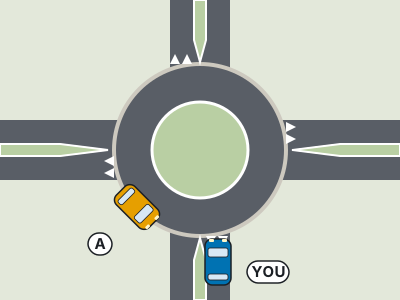
- Traffic entering from the left regardless of position
- The vehicle entering from the widest approach
- The first vehicle to sound its horn
- Traffic already circulating in the roundabout
Show answer
Traffic already circulating in the roundabout. At a roundabout, entering traffic yields the right of way to vehicles already circulating. The entering driver should slow, identify a safe gap, and merge only after yielding. Road width, horn use, and an automatic preference for traffic from the left do not replace that rule. The circular design changes the normal approach to an intersection, but it does not remove the duty to yield. Watch the circulating lane before crossing its path, then maintain the lane selected for the intended exit.
Study this in the handbook: Roundabouts and traffic circles
16. How fast does an air bag deploy, according to the Louisiana guide?
- 150 to 200 miles per hour
- 10 miles per hour
- 50 miles per hour
- 500 miles per hour
Show answer
150 to 200 miles per hour. The Louisiana guide says an air bag, when it deploys, comes out at speeds of 150 to 200 miles per hour. That speed is the reason the old 10 and 2 hand position went out: hands on the upper part of the wheel can be thrown into the head, and wrists, forearms or thumbs can be injured. The guide recommends 9 and 3 or 8 and 4 and sitting at least 10 inches from the wheel. Air bags supplement safety belts and do not replace them.
Study this in the handbook: Safety belts, child restraints and air bags
17. What does an orange diamond-shaped sign indicate?
- A construction zone or approaching work activity
- A hospital or other traveler service
- A permanent route designation
- A recreational or cultural destination
Show answer
A construction zone or approaching work activity. Orange is the visual cue for temporary traffic control and construction activity. An orange diamond tells the driver that workers, machinery, barricades, or a changed traffic pattern may be ahead. The response is to reduce speed, watch the channelizing devices, and be prepared to stop or change lanes. Hospital and service information uses blue guide signs, route designations use route marker shapes, and recreational destinations use brown guide signs. Treat the orange background as a warning that the normal path may be altered for a work zone.
Study this in the handbook: Sign shapes and colors
18. When does a school speed limit sign marked 'flashing' require the reduced speed?
- Only after sunset
- Whenever the school building is occupied
- Only when the sign is flashing
- Only when a crossing guard is present
Show answer
Only when the sign is flashing. A school speed limit when flashing sign indicates that the reduced school-zone speed is required only while the sign is flashing. When the lights are off, the driver follows the roadway's regular speed limit unless another sign says otherwise. Occupancy, darkness, and the presence of a crossing guard are not the conditions stated by this sign. The strongest cue is literal: flashing activates the reduced limit, so check the beacon before applying that lower number.
Study this in the handbook: Warning, regulatory, guide and work zone signs
19. What BAC limit applies to a Louisiana driver who is 21 years of age or older?
- .08 percent
- .02 percent
- .04 percent for every driver
- .10 percent
Show answer
.08 percent. For a driver age 21 or older, Louisiana identifies .08 percent as the legal BAC limit. The .02 figure belongs to drivers age 20 and younger, while .04 applies to a commercial motor vehicle operator. A reading of .10 is above the adult limit and is not the number to memorize for this category. The practical cue is to match the BAC number to the driver's age before choosing a response, because the guide separates adult, underage, and commercial driving rules.
Study this in the handbook: Alcohol and Louisiana's BAC limits
20. How should a driver classify the sharp-turn sign shown in the picture?

- As a warning of an approaching roadway condition
- As a guide sign for airport distances
- As a regulatory sign setting a parking fee
- As a service sign for emergency telephones
Show answer
As a warning of an approaching roadway condition. The sharp right turn symbol appears on a yellow diamond warning sign. In the manual, diamond signs warn of approaching hazards and conditions, and yellow versions can identify curves and changes in traffic flow. That warning gives the driver time to reduce speed and position the vehicle before the turn. It is not a guide sign, parking regulation, or traveler service notice. Scan the lane path, check for traffic beyond the bend, and steer smoothly. The diamond shape signals preparation before the exact turn is reached.
Study this in the handbook: Warning, regulatory, guide and work zone signs
QualitySpace is expanding to Louisiana
We are a California-based independent insurance brokerage working on licensing in more states. We cannot help with Louisiana insurance yet. Leave your email and we will let you know when we can.
Every question is written from the official Louisiana Class D and E Driver's Guide. Need paper? Printable LA practice test with answer key.
Last verified 2026-10-05. How we check every question · Study all 218 as flashcards
Frequently asked questions
How many questions are on this Louisiana practice test?
This fixed set has 20 questions. It is test 7 of 10 from the 218 question Louisiana bank. The real LA exam asks 40 questions and you need 32 correct.
What is the passing score for the real Louisiana test?
80% minimum score is required That figure comes from the official Louisiana source cited on the DMV facts page.
How does this fixed test relate to the full Louisiana bank?
Each numbered test is a fixed set of questions in a fixed order, so you can retake the same test later and compare. Every test mixes road signs and the other topics in about the same proportion as the full bank. Tests 1 to 10 together cover 200 of the 218 questions in the Louisiana bank, each once. The full practice page mixes the whole bank at random.
Last verified 2026-10-05. See the Louisiana DMV facts page for sourced state details.
Return to the full Louisiana practice test · Study road signs