
Test 14 of 25 · 20 questions · Free 2026
LA Permit Practice Test 14
Jump to the test ↓A fixed 20 question set from the Louisiana bank with answers and plain English explanations. The real LA exam is 40 questions, 80 percent to pass; take the full length version on the main practice page.
Question 1 of 20 · 0 right so far
All 20 questions in test 14
Every question below comes from the Louisiana question bank on this page. Open a question to see the correct answer and the explanation. Nothing here is hidden behind a signup.
1. Temporary fluorescent pink signs with black letters appear ahead. What kind of event do they usually warn about?
- A crash, spill or other unplanned incident
- A planned parade or street fair
- Ordinary weekday rush-hour traffic
- A long-term highway construction job
Show answer
A crash, spill or other unplanned incident. Incident signs are temporary signs that tell you to be prepared to stop, or that a road is closed or detoured, because of a road user incident, natural disaster, hazardous material spill or other unplanned incident. Louisiana's guide says they are fluorescent pink with black lettering. Planned construction uses orange signs instead. When pink signs appear, slow down and expect lane changes or a detour, and remember that the move over law requires you to slow down and change lanes near a roadside incident.
Study this in the handbook: Warning, regulatory, guide and work zone signs
2. Why can it be hard to judge an approaching motorcycle before you turn across its path?
- Its small profile makes it look farther away and slower
- Its headlight makes it look closer than it really is
- Motorcycles always travel faster than the speed limit
- Its engine noise hides how fast it is really going
Show answer
Its small profile makes it look farther away and slower. A motorcycle's narrow shape may make it look farther away and slower than it really is. The guide says more than two thirds of car and motorcycle collisions happen when the other driver turns in front of the rider. Motorcycles are also easy to miss in a quick look or a blind spot, so take a second look, and then a third, before turning. A single headlight can blend into other lights, which also makes distance hard to judge.
Study this in the handbook: Bicycles, motorcycles and big trucks
3. An oncoming car seems to be drifting into your lane. What does the guide tell you to do?
- Swerve into the oncoming lane
- Hold your line and speed up
- Brake hard and stop in your lane
- Pull to the roadside, honk and flash lights
Show answer
Pull to the roadside, honk and flash lights. If an oncoming car appears to be crossing into your lane, move out of its path by pulling over to the roadside, and warn the driver by sounding the horn and flashing your lights. Swerving left puts you in the oncoming lane, where the other driver may swerve back. Holding your line or stopping in your lane leaves you in the car's path. Report a driver who is weaving or driving recklessly to the police.
Study this in the handbook: Defensive driving, fatigue and aggressive drivers
4. You take the same curve at twice your usual speed. How much more cornering force acts on the tires?
- About the same force
- About twice the force
- About three times the force
- About four times the force
Show answer
About four times the force. Cornering force depends on speed squared, so doubling your speed through a curve creates four times the force on your tires. Even fifty percent more speed creates well over double the cornering load. Small speed changes make big changes in grip demand, which is why the right speed for a curve is hard to judge and why it is easy to run out of grip. Enter curves a little on the slow side.
5. A steady yellow light appears. In which situation may you continue through the intersection?
- When you are still far back from the stop bar
- When you are already in the intersection
- Whenever no cross traffic is visible
- When you can speed up to beat the red
Show answer
When you are already in the intersection. A steady yellow light warns that the signal is about to turn red. Louisiana's guide says you should slow down and stop if you can do so before the stop bar, but if you are already in the intersection when the yellow appears, you may continue safely through. Being far back means you have room to stop, so you should. An empty cross street and speeding up to beat the red are not reasons the guide gives for continuing.
Study this in the handbook: Traffic lights and arrows
6. Once your foot is on the brake at 50 mph on dry pavement, about how far does the car travel while braking?
- About 55 feet
- About 100 feet
- About 158 feet
- About 268 feet
Show answer
About 158 feet. Braking distance is only the part of the stop that happens while you are braking. At 50 mph on dry pavement with good brakes, it is about 158 feet. Before that, you also travel during perception and reaction. Reaction alone covers about 55 feet at 50 mph, and the total stopping distance is at least 268 feet. Wet roads, worn tires and heavy loads add to these figures, so they are the best you can expect.
Study this in the handbook: Scanning ahead, stopping distance and following distance
7. One person will do all of the driving on a long Louisiana road trip. What daily driving limit does the guide suggest?
- About 4 to 5 hours of driving
- About 6 to 8 hours of driving
- About 10 to 11 hours of driving
- About 12 to 14 hours of driving
Show answer
About 6 to 8 hours of driving. Fatigue builds over a long day behind the wheel. When one person does all the driving, the guide says 6 to 8 hours of driving in any one day should be considered the limit. The 10 to 11 hour figure applies only when two or more people share the driving. The guide also suggests 10 to 15 minute breaks every 2 to 3 hours, a good night's sleep before the trip, and avoiding driving after 11 p.m., when you are more apt to fall asleep.
8. You are driving in the right lane of an interstate and pass a merge sign near an entrance ramp. What does it warn you to be ready to do?
- Stop so ramp traffic can enter
- Speed up so ramp traffic must wait
- Adjust speed or move to the left lane
- Use the shoulder to give ramp traffic room
Show answer
Adjust speed or move to the left lane. Near most interstate entrance points there is a merge sign. It warns drivers already on the interstate to be ready to adjust their speed or, if possible, move into the left lane, so other drivers can enter traffic smoothly and safely. The guide also says to make room for vehicles entering the interstate and to move over a lane if no one is next to you. Stopping in a travel lane or driving on the shoulder would create new hazards.
Study this in the handbook: Interstate and rural road driving
9. Crossing lights flash as a train approaches. You stop with your front bumper 10 feet from the nearest rail. Is that a legal stopping point?
- No, stop at least 15 feet but within 50 feet
- Yes, any spot before the rails is legal
- No, you must stop at least 100 feet from the rail
- Yes, as long as you can see the train
Show answer
No, stop at least 15 feet but within 50 feet. Louisiana law R.S. 32:171 requires a stop within 50 feet but no less than 15 feet from the nearest rail when a signal is flashing and a train is approaching. Ten feet is closer than the law allows. The same stop is required when a crossing gate is lowered or a train is close enough to be an immediate hazard. After stopping, do not cross until you can do so safely. A stop 100 feet back is farther than the 50 foot outer limit.
Study this in the handbook: Railroad crossings
10. You approach a flashing yellow light, and a car is still crossing in the intersection. What should you do?
- Keep going; flashing yellow gives you priority
- Stop, let it pass, then go on with caution
- Honk and continue at the same speed
- Turn right to go around the crossing car
Show answer
Stop, let it pass, then go on with caution. A flashing yellow light is a warning, not a right-of-way signal. Louisiana's guide says to slow down, look for traffic entering the intersection and proceed with caution. It adds that if traffic is in the intersection, you must stop and let it pass before proceeding. A car already crossing therefore goes first. Honking, or steering around it to keep moving, creates the very conflict the rule is meant to prevent.
Study this in the handbook: Traffic lights and arrows
11. Your baby is 14 months old. Which kind of car seat does Louisiana's guide call for?
- A forward facing car seat
- A booster seat with a lap belt
- A rear facing car seat
- An adult lap and shoulder belt
Show answer
A rear facing car seat. Children from birth to at least 2 years old ride in a rear facing, federally approved car seat. A 14 month old is in that stage. Forward facing seats come next, from about 2 to 4 years, followed by booster seats from 4 to 9 and then a lap and shoulder belt. If a child fits more than one category by age or weight, use the more protective one.
Study this in the handbook: Safety belts, child restraints and air bags
12. As you reach this sign, a car on the road you are entering is close and coming toward your path. What should you do?
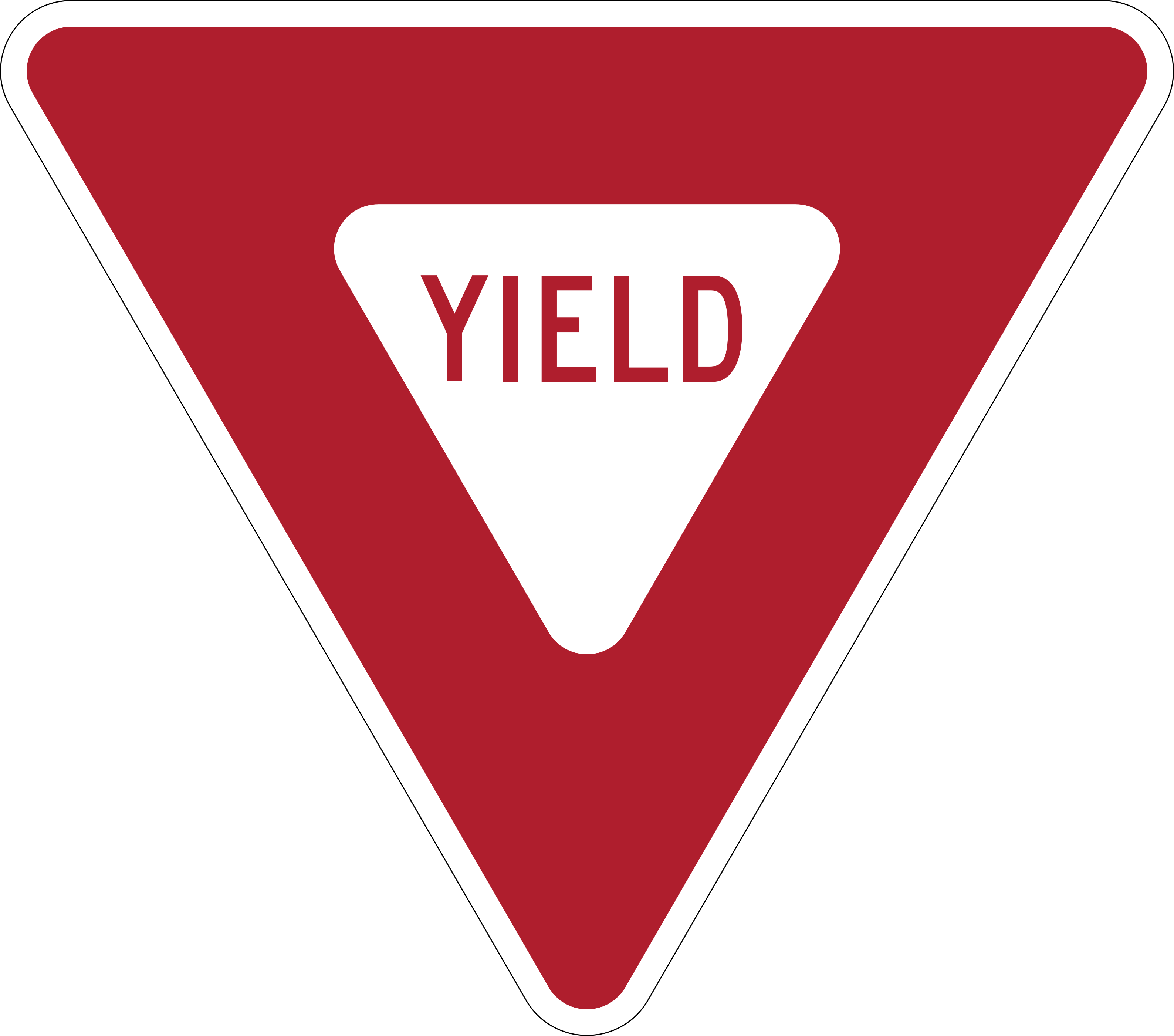
- Keep your speed; that car must make room
- Stop only if a stop line is painted
- Speed up to merge ahead of it
- Slow down and stop if needed to let it pass
Show answer
Slow down and stop if needed to let it pass. The downward-pointing red and white triangle is used only for yield signs. Louisiana's guide says to slow down, watch for traffic and be prepared to stop if the traffic flow requires it. A yield sign means you must allow traffic that has the right of way to cross before you enter. With a car close and heading into your path, that means slowing and stopping if necessary until it passes. Speeding up to get ahead of it is the opposite of yielding.
Study this in the handbook: Sign shapes and colors
13. You are about to slow down to turn into a private driveway. What should you check first?
- Your speedometer only
- Your mirrors for traffic behind
- Your fuel gauge and oil light
- The car directly ahead of you
Show answer
Your mirrors for traffic behind. Check your mirrors whenever you slow down. It is very important when you slow quickly or at places where a following driver would not expect it, such as private driveways or parking spaces. That check tells you if someone is following too closely or coming up fast, which gives you time to adjust. Look to the rear more often in heavy traffic and before changing lanes or going down a long, steep hill.
Study this in the handbook: Scanning ahead, stopping distance and following distance
14. On a standard vertical traffic signal, what is the order of the lights from top to bottom?
- Red, yellow, green
- Green, yellow, red
- Red, green, yellow
- Yellow, red, green
Show answer
Red, yellow, green. Traffic signals are controlled colored lights that tell you what to do. Louisiana's guide says that when red, yellow and green are on the same signal, they are arranged from top to bottom in that order: red, yellow, green. Knowing the position helps when sunlight or glare makes a color hard to see, because on a vertical signal the top light is the red. Some metropolitan areas use horizontal signals instead, with red on the left.
Study this in the handbook: Traffic lights and arrows
15. You are turning left at a Louisiana intersection. Which oncoming vehicles must you yield to?
- Only oncoming vehicles that are also turning left
- Only vehicles that reach the intersection after you
- Oncoming vehicles going straight ahead or turning right
- No one, if you entered the intersection first
Show answer
Oncoming vehicles going straight ahead or turning right. A left turn crosses the path of oncoming traffic, so the turning driver gives way. The guide says to look for a safe gap and to yield to oncoming vehicles that are going straight ahead or turning right. Pulling into the intersection to get ready does not give you the right of way. Before you turn, also check that no vehicle or pedestrian in your path could leave you stranded in front of oncoming cars, and turn into the proper lane.
Study this in the handbook: Scanning ahead, stopping distance and following distance
16. You are driving behind a motorcycle. What following distance does the Louisiana guide call for?
- At least two seconds
- At least three seconds
- At least one car length
- At least four seconds
Show answer
At least four seconds. The guide asks for at least a four second following distance behind a motorcycle, and says this matters even more on wet roads. The extra space gives the rider room to maneuver or stop in an emergency. Drivers have trouble judging a motorcycle's speed and distance, so more space helps you avoid sudden braking. The guide compares tailgating a motorcycle to an 18 wheeler tailgating your car. Two or three seconds, or a single car length, is less than the stated minimum.
Study this in the handbook: Bicycles, motorcycles and big trucks
17. After parallel parking on an unmarked Louisiana street, how much space should you leave at each bumper?
- At least six inches
- At least two feet
- At least one car length
- At least ten feet
Show answer
At least two feet. When you finish parallel parking, center the car in the space so that neither the front nor the rear bumper is closer than two feet to the vehicles around you, unless the street is marked some other way. Six inches leaves the cars ahead and behind almost no room to pull out. A full car length or ten feet is far more than the guide asks and wastes curb space. The last step of the maneuver is pulling forward slowly to center the car.
Study this in the handbook: Parking rules and painted curbs
18. It is raining hard on a Louisiana highway. Which driving choice helps you avoid hydroplaning?
- Driving through puddles to keep momentum
- Using a higher speed so tires cut the water
- Lowering tire pressure for more grip
- Driving in the tire tracks of cars ahead
Show answer
Driving in the tire tracks of cars ahead. Hydroplaning happens when tires ride up on water instead of the road. The guide lists ways to avoid it: keep tires inflated correctly, maintain good tread and replace worn tires. Slow down when roads are wet and stay away from puddles. Driving in the tire tracks left by the cars in front of you also helps. A defensive driver adjusts speed to wet roads early enough that emergency measures are not needed.
Study this in the handbook: Skids, blowouts and hydroplaning
19. Another car is about to strike the side of your car. What does the guide tell you to do with the steering wheel?
- Keep a tight grip and be ready to steer
- Let go so your arms are not hurt
- Turn it hard toward the other car
- Hold it loosely to absorb the hit
Show answer
Keep a tight grip and be ready to steer. If you are about to be hit from the side, keep a tight grip on the steering wheel, which may keep you from being thrown against the side of the car. Then get ready to steer quickly, so that if the car spins around you can try to regain control. Letting go or holding the wheel loosely gives up both protections. A buckled seat belt and shoulder harness remain the best protection in any crash.
20. You notice a car weaving across lanes and suspect the driver is drunk. What should you do?
- Pull alongside and signal the driver to stop
- Follow closely so you can read the plate
- Stay as far away from the car as you can
- Pass quickly and brake ahead to slow it
Show answer
Stay as far away from the car as you can. If you see a drunk driver, stay as far away from that vehicle as possible. Do not signal the driver to pull over, since that may cause a collision. Note the license plate and vehicle details only if you can do it without compromising your safety. Then pull over, call 911 and give a complete description of the vehicle and its exact location, and leave the rest to the police.
Study this in the handbook: Implied consent and DWI penalties
Every question is written from the official Louisiana Class D and E Driver's Guide. Need paper? Printable LA practice test with answer key.
Last verified 2026-10-05. How we check every question · Study all 500 as flashcards
Frequently asked questions
How many questions are on this Louisiana practice test?
This fixed set has 20 questions. It is test 14 of 25 from the 500 question Louisiana bank. The real LA exam asks 40 questions and you need 32 correct.
What is the passing score for the real Louisiana test?
80% minimum score is required That figure comes from the official Louisiana source cited on the DMV facts page.
How does this fixed test relate to the full Louisiana bank?
Each numbered test is a fixed set of questions in a fixed order, so you can retake the same test later and compare. Every test mixes road signs and the other topics in about the same proportion as the full bank. Tests 1 to 25 together cover every question in the Louisiana bank once. The full practice page mixes the whole bank at random.
Last verified 2026-10-05. See the Louisiana DMV facts page for sourced state details.
Return to the full Louisiana practice test · Study road signs