
Test 20 of 25 · 20 questions · Free 2026
LA Permit Practice Test 20
Jump to the test ↓A fixed 20 question set from the Louisiana bank with answers and plain English explanations. The real LA exam is 40 questions, 80 percent to pass; take the full length version on the main practice page.
Question 1 of 20 · 0 right so far
All 20 questions in test 20
Every question below comes from the Louisiana question bank on this page. Open a question to see the correct answer and the explanation. Nothing here is hidden behind a signup.
1. Another driver starts to pass you on a two lane highway. What should you do?
- Slow a little and move right as far as safe
- Speed up so the pass is over sooner
- Move toward the center line to block them
- Brake hard so they can cut in at once
Show answer
Slow a little and move right as far as safe. When someone is passing you, help make the pass safe and easy. Slow your speed a little, and on a two lane highway move to the right as far as you safely can. Speeding up stretches the time the other car spends in the oncoming lane. Drifting toward the center line takes away its space. Hard braking can cause a rear end crash. A small, smooth slowdown is enough to let the passing driver return to the lane sooner.
2. A school bus is loading children in a loading zone completely off the roadway, where pedestrians are not allowed to cross. Must you stop?
- Yes, you must stop at least 30 feet away
- Yes, but only if you are behind the bus
- No, you are not required to stop
- No, but only if you are meeting the bus
Show answer
No, you are not required to stop. The usual rule is to stop at least 30 feet from a school bus that is loading or unloading children, whether you are behind it or meeting it. The guide gives an exception: you do not have to stop when the bus is in a loading zone completely off the roadway and pedestrians are not allowed to cross the road there. The exception is not limited to drivers going one direction. Stay alert anyway, because buses make frequent stops.
Study this in the handbook: School buses, turns and signals
3. You start passing on a two lane road, and an oncoming driver would have to brake for you to finish. What does the law say?
- The pass is legal if you use your signal
- The oncoming driver must make room for you
- You may finish if you speed up quickly
- You must not pass if it makes others slow
Show answer
You must not pass if it makes others slow. A legal pass does not interfere with oncoming traffic or with the vehicle being passed. You must not make another driver slow down or pull over so that you can complete the pass. If finishing would force the oncoming driver to brake, the gap was too short and you should drop back behind the vehicle. Signaling and speeding up do not create space, and oncoming traffic has no duty to clear the lane for you.
Study this in the handbook: Lane changes, passing and wet roads
4. What is the main benefit of anti-lock brakes during a hard stop?
- They always stop the car in a shorter distance
- They let you keep steering while braking hard
- They remove the need to press the pedal firmly
- They prevent skids only on dry pavement
Show answer
They let you keep steering while braking hard. Anti-lock brakes pump the brakes automatically when you press hard, keeping the wheels from locking. That helps you keep control and stop in a straight line instead of spinning. The guide stresses that ABS does not stop the car faster; its benefit is letting you concentrate on steering the car to safety while you brake. Focus on where you want the car to go. You can confirm your car has ABS from the owner's manual or the ABS light at start up.
5. You want to turn right at an intersection where this sign is posted. What does it mean?
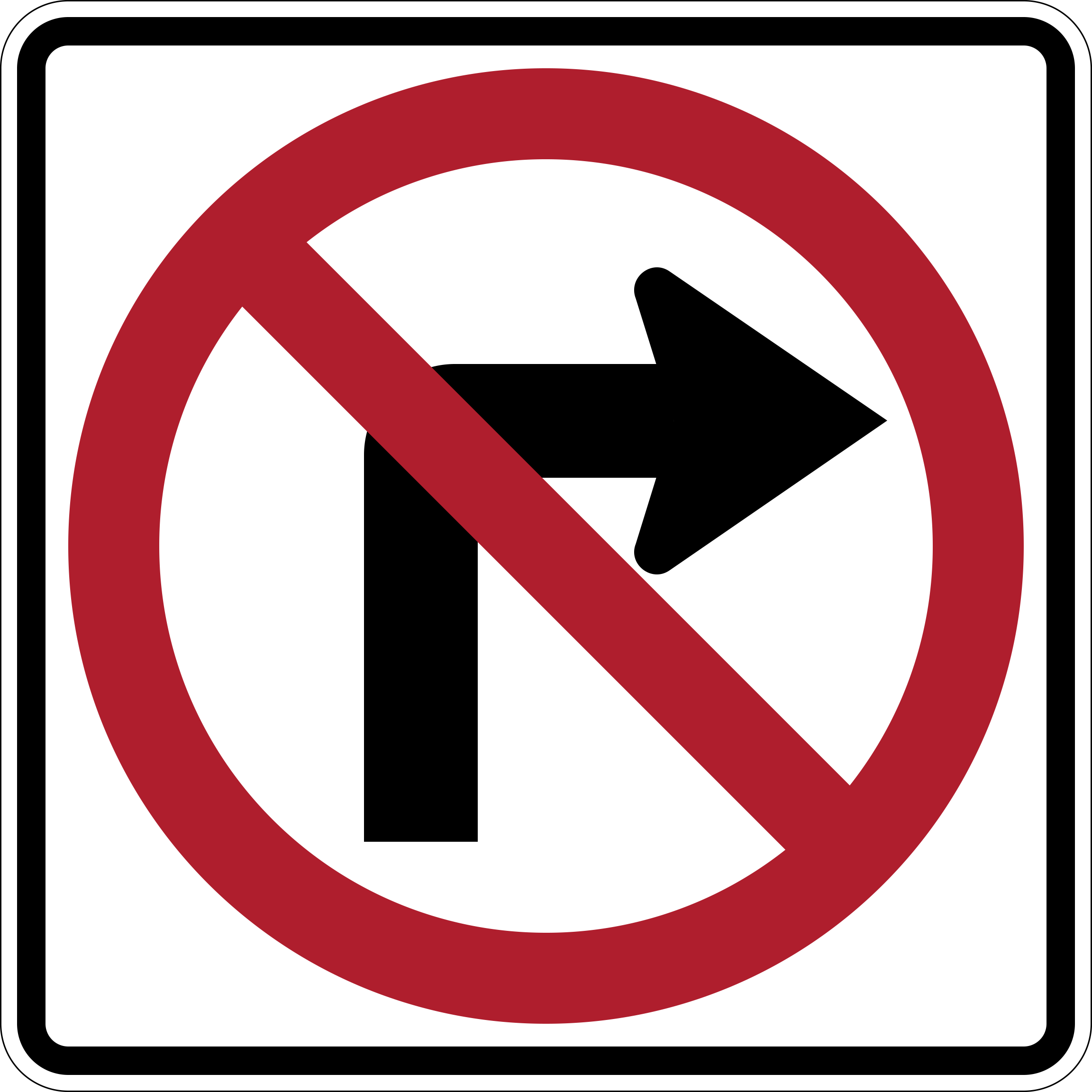
- Right turns are allowed after a full stop
- Right turns are not allowed here
- Only right turns are allowed here
- Right turns are allowed only on green
Show answer
Right turns are not allowed here. Regulatory signs with a red circle and a red slash over a symbol prohibit the action the symbol shows, and Louisiana's guide lists No Right Turn among them. When the slash crosses a right-turn arrow, you may not turn right at that location. That holds whether the light is red or green, and stopping first does not change it. Continue straight or use another route to reach the street you wanted.
Study this in the handbook: Warning, regulatory, guide and work zone signs
6. You are first in line at a red light. It turns green just as a car on the cross street enters the intersection late. What should you do?
- Let the car clear the intersection, then go
- Go at once; the green gives you the right of way
- Honk and pull forward to claim your turn
- Wait for the next green light to be safe
Show answer
Let the car clear the intersection, then go. A green light lets you go only when the intersection is clear. Louisiana's guide says that if you are stopped and the light turns green, you must allow crossing traffic to clear the intersection before you go ahead. A driver who entered late from the cross street may still be in your path. Pulling out the instant your light changes can cause a side-impact crash. Wait for the intersection to clear, then proceed on the same green.
Study this in the handbook: Traffic lights and arrows
7. You reach a roundabout entry. A car already in the circle is approaching from your left. What should you do?
- Enter first, since cars on the right go first
- Yield and enter after it passes
- Enter now if you signal right
- Enter and stop inside the circle for it
Show answer
Yield and enter after it passes. Entering a roundabout works differently from an uncontrolled intersection. Louisiana's guide says vehicles must yield to the left before entering, and the vehicle already in the roundabout has the right of way. A car approaching from your left inside the circle goes first, so wait for a safe gap and then enter. The usual rule of yielding to the driver on the right does not apply here, and signaling does not create a gap for you.
Study this in the handbook: Roundabouts and traffic circles
8. A 19 year old drives friends home after one beer. What blood alcohol limit applies to this driver in Louisiana?
- 0.02 percent
- 0.05 percent
- 0.08 percent
- 0.04 percent
Show answer
0.02 percent. Drivers 20 years of age and younger are held to a 0.02 percent blood alcohol limit in Louisiana, far below the 0.08 percent limit for drivers 21 and older. The 0.04 percent figure belongs to commercial motor vehicle operators. Because even one drink can affect a person's ability to drive, a young driver can reach the limit quickly, and the guide's message is simple: if you have been drinking, you are in no condition to drive.
Study this in the handbook: Alcohol and Louisiana's BAC limits
9. You are passing a truck on a two lane road when a car appears ahead in the oncoming lane. By when must your pass be complete?
- Before you come within 100 feet of the oncoming car
- Before you come within 25 feet of the oncoming car
- Before the oncoming driver has to use the brakes hard
- Before you reach the end of the broken center line
Show answer
Before you come within 100 feet of the oncoming car. A pass must be finished before you come within 100 feet of any vehicle approaching from the opposite direction. That margin is far more than 25 feet, and it applies even if the oncoming driver could brake. In fact, you must never make another driver slow down or pull over so you can finish. If you are not sure you can be back in your lane well before that point, do not start the pass.
Study this in the handbook: Lane changes, passing and wet roads
10. Which steering method does the guide recommend for low speed turns, such as at an intersection or when parking?
- One hand steering
- Push/pull steering
- Hand-over-hand steering
- Palm steering at 12 o'clock
Show answer
Hand-over-hand steering. The guide matches each steering method to a task. Hand over hand steering is for turning the wheel at low speeds, such as at an intersection or when parking. Push/pull steering is for normal forward driving above about 10 to 15 mph. One hand steering is only for backing or briefly reaching a control such as the wipers. The 12 o'clock position is used only when backing and turning in the seat to see.
11. Your side of a two-lane road has a single solid yellow center line. You want to turn left into a parking lot. What does the line allow?
- No left turns until the line ends
- A left turn across it, but not a pass
- Passing, if the oncoming lane is clear
- A left turn only at an intersection
Show answer
A left turn across it, but not a pass. A single solid yellow line on a two-lane road marks a zone where passing is prohibited. Louisiana's guide adds that you may cross this line to make a turn, or if a dashed line is present on your side. A left turn into a parking lot is a turn, so crossing is allowed after yielding to oncoming traffic. Using a clear oncoming lane to pass is not allowed, and the line does not limit your turns to intersections.
Study this in the handbook: Traffic lights and arrows
12. You park facing downhill on a country road with no curb. Which way should you turn your front wheels?
- Toward the center of the road
- Toward the edge of the road
- Straight ahead, not turned
- Away from the edge of the road
Show answer
Toward the edge of the road. Without a curb, the direction is the same uphill or downhill: turn your wheels toward the edge of the road. If the brakes fail, the car rolls off the road instead of into traffic. Straight wheels let it roll down the lane, and wheels turned toward the center send it into traffic. Always set the parking brake as well, and shift into park, reverse or low gear.
13. What does a round yellow warning sign usually identify?
- A temporary construction detour
- A school zone speed limit
- A hospital entrance
- A railroad crossing ahead
Show answer
A railroad crossing ahead. The round yellow advance warning sign is associated with a railroad crossing. It tells the driver to look, listen, and slow down, with a possible stop ahead. A school zone, hospital, or construction detour uses other sign shapes, colors, or wording. Begin searching for crossing devices and tracks early, never stop on the rails, and do not enter unless there is enough room to clear the far side.
Study this in the handbook: Sign shapes and colors
14. Your light turns green, but a pedestrian is still walking in the marked crosswalk in front of your car. What must you do?
- Go, since the green light is yours
- Stay stopped until the pedestrian has crossed
- Drive around behind the pedestrian
- Honk so the pedestrian finishes faster
Show answer
Stay stopped until the pedestrian has crossed. Pedestrians in a marked crosswalk have the right of way over motor vehicles, and Louisiana's guide says you must stop for them. A change to green does not end that duty while someone is still crossing in front of you. Driving around behind a walker or honking to hurry them puts the person at risk and does not satisfy the rule. Wait until the pedestrian is out of your path, then proceed when the intersection is clear.
Study this in the handbook: Center lines, lane lines and crosswalks
15. You move into a shared center left-turn lane to turn into a store ahead. What is the farthest you may drive in that lane?
- 100 feet
- 300 feet
- 200 feet
- 500 feet
Show answer
200 feet. A shared center lane marked for left turns only is reserved for left-turning vehicles from both directions. It is not a lane for through travel or passing. Louisiana's guide also limits how far you may use it: you must not drive more than 200 feet in this lane when making a left turn from it. Enter the lane close to your turn, signal, and wait there for a gap in oncoming traffic. Driving a long stretch in the center lane invites a head-on conflict with a driver turning from the other direction.
Study this in the handbook: Warning, regulatory, guide and work zone signs
16. You are in a line of cars approaching a railroad crossing, and traffic past the tracks is backed up. When should you start across?
- As soon as the car ahead starts across
- Right away, since the lights are not flashing
- When the gates are raised and still
- Only when sure your car can fully clear the tracks
Show answer
Only when sure your car can fully clear the tracks. Louisiana law prohibits stopping a vehicle on railroad tracks, and the guide says never to get trapped on a crossing. In a line of vehicles, do not start across unless you are certain your car can make it all the way to the other side. Following the car ahead or seeing raised gates does not mean there is room beyond the tracks. If your vehicle ever becomes pinned or stalls in a train's path, get out and move toward the approaching train, away from the tracks.
Study this in the handbook: Railroad crossings
17. Fog becomes so thick on a Louisiana highway that you can barely see. What does the guide recommend?
- Creep along at 10 to 20 mph until it lifts
- Turn on high beams and keep normal speed
- Stop in your lane with the flashers on
- Leave the highway at the nearest place to stop
Show answer
Leave the highway at the nearest place to stop. In a heavy downpour or fog, slow down and use low beam headlights. If the fog is so dense that it impairs your vision, the guide says not to drive at all. If you are already driving, slow down and go to the nearest place where you can get off the highway and stop. Creeping along at 10 to 20 miles per hour on the highway risks your life, because vehicles coming up behind you may be driving too fast.
Study this in the handbook: Interstate and rural road driving
18. Your light turns green, but an ambulance with its siren on is approaching the intersection from the side. What should you do?
- Go ahead, since the green light gives you the right of way
- Speed through before the ambulance reaches the intersection
- Yield and let the ambulance pass before you go
- Go on through if the ambulance is still a block away
Show answer
Yield and let the ambulance pass before you go. A steady green light lets you go through the intersection only if it is clear. Louisiana's guide adds that you must still yield to emergency vehicles and other road users as the law requires. An ambulance using its siren keeps that priority even when your signal is green. Rushing through to beat it, or deciding that it is still far enough away, can put you in its path at the moment it arrives. Hold your position, let the emergency vehicle clear the intersection, and then continue when the way is open.
Study this in the handbook: Traffic lights and arrows
19. On a divided highway, you notice a yellow line along the left edge of your roadway. What does it mark?
- A stretch where passing is not allowed
- A lane reserved for left turns
- A lane for traffic coming toward you
- The left edge of the road beside the median
Show answer
The left edge of the road beside the median. Edge lines show where the roadway ends. Louisiana's guide says white edge lines are used along the right edge of the road, and yellow edge lines may run along the left edge on divided streets and highways. On a divided highway, a yellow line on your left therefore marks the median side of your roadway. It does not mean oncoming traffic is in the next lane, since a median separates you from that traffic, and it does not create a passing or turning lane.
Study this in the handbook: Center lines, lane lines and crosswalks
20. Why should you avoid cutting into the open space in front of a big truck?
- The truck needs it to stop safely
- Trucks may use it to pass other cars
- Truck headlights would blind you there
- Trucks speed up when a car moves in
Show answer
The truck needs it to stop safely. The open space ahead of a truck is its safety cushion, because big trucks need much longer to stop than cars, and longer still on wet roads. A loaded tractor trailer at 55 mph needs at least 290 feet. If you cut in and then stop suddenly, the truck may not be able to avoid hitting you. If the truck has a long hood, the driver may not see you at all. Keep as much space as possible around big trucks.
Study this in the handbook: Bicycles, motorcycles and big trucks
Every question is written from the official Louisiana Class D and E Driver's Guide. Need paper? Printable LA practice test with answer key.
Last verified 2026-10-05. How we check every question · Study all 500 as flashcards
Frequently asked questions
How many questions are on this Louisiana practice test?
This fixed set has 20 questions. It is test 20 of 25 from the 500 question Louisiana bank. The real LA exam asks 40 questions and you need 32 correct.
What is the passing score for the real Louisiana test?
80% minimum score is required That figure comes from the official Louisiana source cited on the DMV facts page.
How does this fixed test relate to the full Louisiana bank?
Each numbered test is a fixed set of questions in a fixed order, so you can retake the same test later and compare. Every test mixes road signs and the other topics in about the same proportion as the full bank. Tests 1 to 25 together cover every question in the Louisiana bank once. The full practice page mixes the whole bank at random.
Last verified 2026-10-05. See the Louisiana DMV facts page for sourced state details.
Return to the full Louisiana practice test · Study road signs