
Test 3 of 10 · 20 questions · Free 2026
LA Permit Practice Test 3
Jump to the test ↓A fixed 20 question set from the Louisiana bank with answers and plain English explanations. The real LA exam is 40 questions, 80 percent to pass; take the full length version on the main practice page.
Question 1 of 20 · 0 right so far
All 20 questions in test 3
Every question below comes from the Louisiana question bank on this page. Open a question to see the correct answer and the explanation. Nothing here is hidden behind a signup.
1. Which BAC does the Louisiana guide identify as the legal limit for drivers age 20 and younger?
- 0.04%
- 0.02%
- 0.08%
- 0.10%
Show answer
0.02%. Louisiana lists 0.02% as the legal BAC limit for a driver who is 20 or younger. The 0.08% figure belongs to drivers 21 or older, and 0.04% is the listed limit for a commercial motor vehicle. The 0.10% choice is not one of the guide's three age or vehicle thresholds. This is an age based rule, so do not substitute the adult limit when the driver is under 21. A young driver should treat any alcohol before driving as unsafe, even though the legal table supplies a specific numerical threshold.
Study this in the handbook: Alcohol and Louisiana's BAC limits
2. On a first offense, a Louisiana driver age 21 or older submits to the test and shows a BAC of 0.10%. How long are driving privileges suspended?
- 365 days
- 730 days
- 90 days
- 180 days
Show answer
180 days. If you submit to the test and are 21 or older, a BAC of 0.08% to 0.149% brings a 180 day suspension, so 0.10% falls in that band. A BAC of 0.15% or greater brings two years, or 730 days. Three hundred sixty-five days is the suspension for a first refusal. Ninety days is not in the rule. Penalties increase with each later conviction.
Study this in the handbook: Implied consent and DWI penalties
3. What mandatory jail time does Louisiana list for a second DWI conviction?
- 48 hours
- 30 days
- None
- One year
Show answer
48 hours. Louisiana Revised Statute 14:98.2 sets a second DWI conviction at a fine of $750 to $1,000 and 30 days to six months in jail, and at least 48 hours of that sentence must be served without benefit of parole, probation, or suspension of sentence. That 48 hour minimum is the mandatory jail time. Saying there is none ignores the statute. Thirty days is the bottom of the full jail range, not the part that can never be suspended. One year is the mandatory minimum for a third conviction, not a second.
4. Which of these can cost a Louisiana driver the driving privilege?
- Failure to pay state income taxes
- Buying a new car
- Moving within the same parish
- Driving an older vehicle
Show answer
Failure to pay state income taxes. Louisiana's list of ways to lose the driving privilege includes failure to pay child support and failure to pay state income taxes, along with DWI, refusing an alcohol test, failing to stop for a school bus, three reckless driving convictions in 12 months, and driving with a suspended license. Buying a car, moving within a parish and driving an older vehicle are lawful and are not on the list. The same list covers altering information on the license, unlawful use of a license and making a false statement on an application, so the privilege depends on more than driving behavior.
Study this in the handbook: Insurance, renewal, your record and losing your license
5. Which traffic control devices does the Louisiana guide list as the most commonly used in a work zone?
- Traffic lights, painted crosswalks, and speed bumps
- Signs, barricades, drums, cones, tubes, flashing arrow panels, and flag persons
- Guardrails, rumble strips, and reflectors
- Police cars, tow trucks, and ambulances
Show answer
Signs, barricades, drums, cones, tubes, flashing arrow panels, and flag persons. Work zones are managed with a familiar set of orange devices. The guide lists signs, barricades, drums, cones, tubes, flashing arrow panels, and flag persons as the most commonly used traffic control devices, and orange is the basic color for these devices. Traffic lights and crosswalks are permanent controls, guardrails and reflectors are roadside hardware, and emergency vehicles are not traffic control devices. Flag persons wear orange vests, shirts, or jackets and use red flags or stop and slow paddles to stop, slow, or guide traffic through the area.
Study this in the handbook: Warning, regulatory, guide and work zone signs
6. Why may a driver need to travel below the posted speed limit?
- The general speed law requires a safe speed for road, traffic, light, and weather conditions
- Posted limits apply only when the road is straight
- A lower speed is required only on interstate highways
- The posted number is a target that drivers must never exceed or reduce
Show answer
The general speed law requires a safe speed for road, traffic, light, and weather conditions. A posted maximum is not a guarantee that the same speed is safe in every setting. Louisiana's general speed law calls for a safe, appropriate speed based on the area, roadway, traffic, light, and weather conditions. Rain, ice, fog, congestion, a hill, or a sharp curve can require a reduction below the number on the sign. The limit is not restricted to straight roads, and it is not a target that must be maintained. Choose a speed that lets you stop and steer as needed for what you can actually see.
Study this in the handbook: Speed laws
7. What should you do when a school bus activates its flashing red lights?
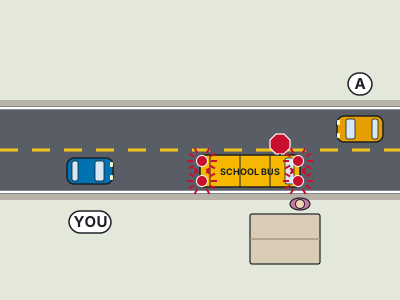
- Stop only when traveling behind the bus
- Pass slowly if no child is visible
- Stop and wait until the bus moves and the roadway is checked
- Use the opposite lane to pass before children exit
Show answer
Stop and wait until the bus moves and the roadway is checked. Flashing red lights and the bus stop sign mean the bus has stopped to load or unload children. Drivers must wait for the vehicle to move and scan before starting again, whether they are approaching from behind or meeting the bus. A child may be hidden from view, and passing on either side defeats the protection created by the stop. Do not decide based on whether you can see a child. Treat the bus signals as the instruction, stop at the required distance, and remain there until the bus is moving.
Study this in the handbook: School buses, turns and signals
8. Which vehicle is specifically listed as one that must stop at a railroad crossing?
- A minivan carrying a family
- A passenger car carrying one adult
- A motorcycle with its headlight on
- A school bus
Show answer
A school bus. The guide identifies school buses as vehicles that must stop at railroad crossings, along with vehicles carrying passengers for hire, trucks, and vehicles carrying explosives or flammable liquids. A family minivan, an ordinary passenger car, and a motorcycle are not in that listed category merely because they are approaching tracks. Drivers should watch for these required stops and never pass unless passing is legal, there are no unsafe conditions, and the tracks can be seen clearly. The cue is the vehicle's special operating or cargo category, not simply its presence near rails.
Study this in the handbook: Railroad crossings
9. What minimum following gap does the three second rule recommend in ordinary conditions?
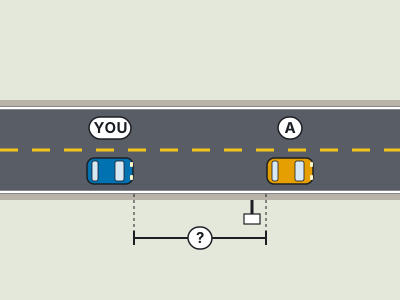
- A fixed distance of ten feet
- One second at every speed
- At least three seconds
- Half a vehicle length
Show answer
At least three seconds. The three second rule creates a time based gap that works at any speed. Choose a fixed object, begin counting when the vehicle ahead passes it, and make sure your own vehicle does not reach that object in less than three seconds. A fixed number of feet changes meaning as speed changes, while one second leaves little room to perceive and react. If your count is short, ease back and count again at another object. Rain, darkness, slippery roads, or other risks call for more space.
Study this in the handbook: Scanning ahead, stopping distance and following distance
10. What does the octagon shape tell a driver about a traffic sign?

- It identifies a no-passing zone
- It marks a railroad advance warning
- It is used exclusively for stop signs
- It marks a guide sign to a service
Show answer
It is used exclusively for stop signs. The octagon is reserved for stop signs, making its shape useful before the lettering can be read. A railroad advance warning uses a round yellow sign or a white crossbuck, and the sideways triangle identifies a no-passing zone. Service information is commonly shown on blue square or rectangular signs. If an octagonal sign comes into view, begin slowing and prepare for a complete stop rather than treating it as a general warning.
Study this in the handbook: Sign shapes and colors
11. When should a driver move over for a roadside incident in Louisiana?
- Only after passing the incident and returning to the original lane
- When approaching a roadside incident, slow down and change lanes
- Speed up so the incident is cleared sooner
- Stop in the travel lane beside the incident
Show answer
When approaching a roadside incident, slow down and change lanes. Louisiana’s move-over instruction applies when approaching a roadside incident. The driver should slow down and change lanes, creating space for people and vehicles at the shoulder. Passing first defeats the protective purpose, and speeding raises the danger near workers or crash victims. Stopping in the travel lane creates a new obstruction unless another rule or emergency requires it. Look well ahead for incident signs, check mirrors, signal, and make the lane change only when it can be completed safely.
Study this in the handbook: Warning, regulatory, guide and work zone signs
12. Under Louisiana's general speed law, which driving choice is prohibited?
- Checking the speedometer often on a clear road
- Driving below the posted limit when traffic is light
- Driving faster than is reasonable for the conditions
- Reducing speed when rain limits visibility
Show answer
Driving faster than is reasonable for the conditions. Louisiana's general speed law requires a reasonable speed that matches the area, roadway, traffic, lighting, and weather. A posted limit is not permission to drive that fast in every circumstance. The choice “Driving faster than is reasonable for the conditions” is prohibited because it ignores conditions and can leave the vehicle unable to stop or steer safely. Driving below the limit may be prudent, checking the speedometer helps the driver judge speed, and slowing for rain is specifically a sound response. Use the posted number as an upper boundary, then reduce speed whenever visibility, traction, or traffic makes that necessary.
Study this in the handbook: Speed laws
13. What does a yellow diamond-shaped sign generally warn a driver about?

- A legal instruction to travel at the minimum speed
- A mandatory service stop at the next exit
- Approaching conditions such as curves, side roads, and traffic flow
- A route number for an interstate highway
Show answer
Approaching conditions such as curves, side roads, and traffic flow. Yellow diamond signs are warnings about conditions ahead, including curves, side roads, and changes in traffic flow. They are not service signs, route markers, or minimum-speed regulations. The shape and color provide an early cue before the wording is readable. When one appears, scan farther ahead, reduce speed if needed, and prepare for the condition shown rather than waiting until the hazard is immediately beside the vehicle.
Study this in the handbook: Sign shapes and colors
14. What minimum stopping distance does the Louisiana guide give for a loaded tractor trailer at 55 mph?
- 100 feet
- 290 feet on a clear, dry road with good tires and brakes
- 1,000 feet
- 50 feet
Show answer
290 feet on a clear, dry road with good tires and brakes. A tractor trailer loaded with freight, with safe rated tires and properly adjusted brakes, traveling at 55 mph on a clear dry roadway requires a minimum of 290 feet to come to a complete stop, and in crashes between large trucks and cars the car occupants sustain 78 percent of the fatalities. Stay out of the no zone, pass on the left, and leave room before cutting back in.
Study this in the handbook: Bicycles, motorcycles and big trucks
15. What is a two-way left turn lane used for?
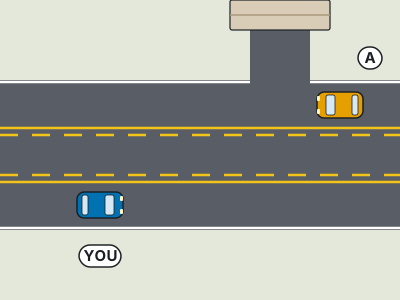
- Waiting for a parking space to open
- Passing slower traffic in either direction
- Continuous travel through the center of the roadway
- Left turns only by vehicles traveling in either direction
Show answer
Left turns only by vehicles traveling in either direction. The shared center lane is designed for left-turn maneuvers from either direction. It is not a passing lane, a through lane, or a place to pause while searching for parking. Enter only when preparing for the turn, check opposing traffic and mirrors, signal, and keep the use brief. The guide also limits travel in this lane to no more than 200 feet. The key visual cue is yellow center markings paired with turn-only use, not a normal travel lane.
Study this in the handbook: School buses, turns and signals
16. In Louisiana, how close may you park to a fire station driveway on the other side of the street?
- No closer than 20 feet
- No closer than 15 feet
- No closer than 500 feet
- No closer than 75 feet
Show answer
No closer than 75 feet. Louisiana prohibits parking within 20 feet of a fire station driveway on the same side of the street, or within 75 feet of the driveway on the other side of the street. So 20 feet is the same side rule. Fifteen feet is the fire hydrant distance. Five hundred feet is how close you may not follow an emergency vehicle answering a call.
Study this in the handbook: Parking rules and painted curbs
17. Where must proof of required liability insurance be kept while a Louisiana vehicle is operational?
- Only at the driver's home
- In the vehicle
- Only at the insurance agent's office
- It need not be kept anywhere
Show answer
In the vehicle. Louisiana requires proof of insurance to be maintained in the vehicle when the vehicle is operational. It must also be presented when a law-enforcement officer requests it. Keeping the document only at home or at an agent's office would not satisfy the guide's in-vehicle requirement, and having no proof available ignores the rule. The concrete cue is operational: before driving, make sure the insurance proof travels with the vehicle.
Study this in the handbook: Insurance, renewal, your record and losing your license
18. With a steady green light, how should you make a left turn?
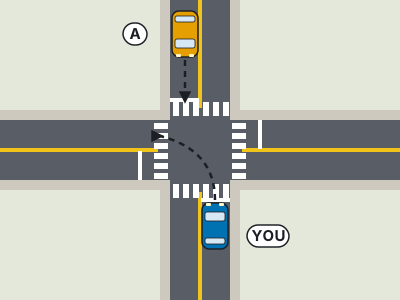
- Enter only when clear and yield to oncoming traffic and pedestrians
- Turn immediately because green always protects the turn
- Wait for the next red light before entering
- Stop across the crosswalk until oncoming traffic moves
Show answer
Enter only when clear and yield to oncoming traffic and pedestrians. A steady green permits movement when the intersection is clear, but a left turn still crosses opposing traffic. Enter carefully, yield to oncoming vehicles and pedestrians, and turn only when the path is safe. The green signal does not provide the same protected movement as a green arrow. Waiting for red is unnecessary and may create confusion, while stopping across a crosswalk blocks people who are crossing. The useful cue is green plus gap: confirm the intersection is open before completing the turn.
Study this in the handbook: Traffic lights and arrows
19. What should a driver do when weather or traffic conditions make the posted maximum speed unsafe?
- Maintain the maximum because the sign overrides weather
- Reduce speed below the posted maximum as conditions require
- Drive at least the posted maximum to avoid blocking traffic
- Use the posted maximum only when following another vehicle
Show answer
Reduce speed below the posted maximum as conditions require. The manual gives slippery pavement, rain, snow, ice, fog, and poor visibility as reasons to reduce speed below the posted maximum. The choice that keeps the maximum because of the sign ignores those conditions and removes the driver's duty to adapt. A minimum pace is also unsafe when sight distance or traction is poor. Use the surface and visibility as cues: ease off before the hazard, increase following space, and preserve enough distance to stop smoothly.
Study this in the handbook: Warning, regulatory, guide and work zone signs
20. After stopping for a school bus, when may a driver begin moving again?
- When the driver can see around the bus from the stopped position
- As soon as the flashing red lights turn off, without checking
- After waiting ten seconds even if the bus remains stopped
- After the bus moves and the driver scans before proceeding
Show answer
After the bus moves and the driver scans before proceeding. After stopping for a school bus, the driver must wait for the vehicle to move and scan before starting to drive again. Turning off the red lights alone is not enough if the bus remains in place or children are still nearby. A fixed ten-second wait has no role in this rule, and seeing around the bus does not confirm that the roadway is clear. Keep the vehicle stopped, watch the bus, and check both sides before proceeding.
Study this in the handbook: School buses, turns and signals
QualitySpace is expanding to Louisiana
We are a California-based independent insurance brokerage working on licensing in more states. We cannot help with Louisiana insurance yet. Leave your email and we will let you know when we can.
Every question is written from the official Louisiana Class D and E Driver's Guide. Need paper? Printable LA practice test with answer key.
Last verified 2026-10-05. How we check every question · Study all 218 as flashcards
Frequently asked questions
How many questions are on this Louisiana practice test?
This fixed set has 20 questions. It is test 3 of 10 from the 218 question Louisiana bank. The real LA exam asks 40 questions and you need 32 correct.
What is the passing score for the real Louisiana test?
80% minimum score is required That figure comes from the official Louisiana source cited on the DMV facts page.
How does this fixed test relate to the full Louisiana bank?
Each numbered test is a fixed set of questions in a fixed order, so you can retake the same test later and compare. Every test mixes road signs and the other topics in about the same proportion as the full bank. Tests 1 to 10 together cover 200 of the 218 questions in the Louisiana bank, each once. The full practice page mixes the whole bank at random.
Last verified 2026-10-05. See the Louisiana DMV facts page for sourced state details.
Return to the full Louisiana practice test · Study road signs