
Test 24 of 25 · 20 questions · Free 2026
LA Permit Practice Test 24
Jump to the test ↓A fixed 20 question set from the Louisiana bank with answers and plain English explanations. The real LA exam is 40 questions, 80 percent to pass; take the full length version on the main practice page.
Question 1 of 20 · 0 right so far
All 20 questions in test 24
Every question below comes from the Louisiana question bank on this page. Open a question to see the correct answer and the explanation. Nothing here is hidden behind a signup.
1. You want to change lanes on a busy road. How large a gap in traffic should you look for?
- About 1 to 2 seconds
- About 2 to 3 seconds
- About 4 to 5 seconds
- About 8 to 10 seconds
Show answer
About 4 to 5 seconds. Before changing lanes, check your mirrors and look over your shoulder at your blind spot. Then pick out a gap of 4 to 5 seconds in traffic, signal, and look again toward the lane you are entering. After that, adjust speed, steer into the lane and cancel the signal. Do not look away for too long, because traffic ahead could stop while you are checking behind you. A one or two second gap is too tight.
Study this in the handbook: Scanning ahead, stopping distance and following distance
2. You are nearing the top of a steep hill on a narrow rural road and cannot see over it. What should you do?
- Slow down, keep right and watch for oncoming cars
- Speed up to get over the top quickly
- Move to the center so you can see better
- Sound your horn and keep your speed
Show answer
Slow down, keep right and watch for oncoming cars. Hills and curves on rural roads are often steeper and sharper than on highways, and the far side of a crest is hidden from view. Before reaching the crest of a hill or entering a curve, the guide says to slow down, move to the right side of the road and watch for oncoming vehicles. Drifting toward the center or keeping your speed leaves no room if a car or farm machine is just over the top.
Study this in the handbook: Interstate and rural road driving
3. You are driving around a roundabout and a car is waiting to enter just ahead of you. Should you stop to let it in?
- Yes, entering cars have the right of way
- Yes, stop and wave the driver in
- Only if the waiting driver signals you
- No, keep moving; you have the right of way
Show answer
No, keep moving; you have the right of way. Louisiana's guide gives two rules for traffic already in a roundabout: never stop once you are inside, and the vehicle in the roundabout has the right of way. Drivers waiting to enter must yield to the left before entering. Stopping to wave someone in breaks that pattern, can lead to a crash behind you, and leaves the waiting driver unsure who should go. Keep moving at a slow, steady speed and let entering drivers find their own gap.
Study this in the handbook: Roundabouts and traffic circles
4. You drive through the same long-term work zone every day on your commute. What should you keep in mind?
- Signs can be ignored once you know the route
- Traffic patterns can change from day to day
- Work zone limits end after the first week
- Lane closures always stay in the same place
Show answer
Traffic patterns can change from day to day. Long-term projects make it easy to stop paying attention. Louisiana's guide warns drivers not to become oblivious to work zone signs when the work is long term or widespread, and to be aware that traffic patterns can change daily, including lane shifts and alternating lane closures. A lane that was open yesterday may be closed today. Read the signs on every trip, keep your speed down and be prepared to stop.
5. An ambulance with its siren on and a train both approach the same railroad crossing. Which one has the right of way?
- The ambulance, in every case
- The ambulance, if police escort it
- Whichever reaches the crossing first
- The train, in every case
Show answer
The train, in every case. The guide's track facts say trains have the right of way 100 percent of the time, over emergency vehicles, cars, police and pedestrians. A train cannot stop quickly; a 100 car freight train at 55 mph needs more than a mile. Sirens, escorts or reaching the crossing first do not change that. You also cannot judge the distance and speed of an oncoming train, so never try to beat one.
Study this in the handbook: Right of way and other laws you should know
6. Driving at night, you turn onto a ramp and see red reflectors on the pavement shining back at you. What do they mean?
- The lane ahead ends and you must merge
- A railroad crossing is just ahead
- A slow vehicle is stopped ahead
- You are going the wrong way and must not go on
Show answer
You are going the wrong way and must not go on. Raised pavement markers and reflectors help you see the lanes at night. Louisiana's guide says red raised markings or reflectors indicate you are going against the direction of travel, and that the roadway must not be entered. Red reflectors facing you on a ramp mean you are headed the wrong way. Stop as soon as it is safe and turn around rather than continuing toward traffic coming the other way.
Study this in the handbook: Center lines, lane lines and crosswalks
7. Your brakes fail while you are driving in the left lane of a busy highway. Where should you steer the car?
- Right lane first, then the shoulder or an exit
- Onto the left shoulder by the median
- Straight ahead in the lane you are in
- Swing across all lanes toward the nearest exit
Show answer
Right lane first, then the shoulder or an exit. If your brakes fail, try not to panic and do not put the parking brake on suddenly, which could make you lose control. Work the vehicle into the right lane and then toward the shoulder or, if possible, an exit, changing lanes smoothly while watching your mirrors. Take your foot off the gas, steer as the car slows, and shift to a lower gear so the engine helps slow it down.
Study this in the handbook: Skids, blowouts and hydroplaning
8. You are stopped at a red light on a one-way street and want to turn left onto another one-way street. What may be allowed?
- A left turn after stopping and yielding to everyone
- No turn of any kind until the light is green
- A left turn without stopping if the way is clear
- A left turn, but only on a green arrow
Show answer
A left turn after stopping and yielding to everyone. Right turns on red are familiar, but Louisiana's guide also says some left turns may be permitted on red when moving from a one-way street onto another one-way street. Where this is allowed, you must first stop at the red light, and then yield to all traffic and pedestrians crossing in front of or beside your vehicle. Rolling through without stopping is never part of it. A green arrow is not required, but the turn may be made only where it is permitted.
Study this in the handbook: Traffic lights and arrows
9. You plan to turn left into a shopping center about a quarter mile ahead. May you enter the shared center turn lane now and drive in it to the entrance?
- Yes, the lane is meant for turning traffic
- Yes, if no one is turning from the other way
- No, you may drive only 200 feet in it
- Yes, if you stay under 25 mph
Show answer
No, you may drive only 200 feet in it. A shared center lane marked for left turns only is reserved for left-turning vehicles from either direction and is not for through traffic or passing. Louisiana's guide limits its use: you must not drive more than 200 feet in the lane when making a left turn from it. A quarter mile is far longer than that, so stay in your travel lane and move into the center lane only when you are within 200 feet of the entrance.
Study this in the handbook: Warning, regulatory, guide and work zone signs
10. A sign tells you about a law you must obey, such as a turning rule or a speed limit. Which family of signs is it?
- Warning signs
- Guide signs
- Regulatory signs
- Service signs
Show answer
Regulatory signs. Louisiana's guide sorts signs into families. Regulatory signs tell you about specific laws you must obey, such as rules for traffic direction, lane use, turning, speed and parking. They are square, rectangular or a special shape and are white with black, red or green letters or symbols. Warning signs alert you to hazards, guide signs give directions and points of interest, and blue service signs show services such as fuel and lodging.
Study this in the handbook: Warning, regulatory, guide and work zone signs
11. You leave your car on a street that slopes downhill, next to a curb. How should you position it?
- Wheels turned toward the curb, in reverse or park
- Wheels turned away from the curb, in low gear or park
- Wheels turned toward the curb, in low gear
- Wheels straight ahead, in drive with the parking brake set
Show answer
Wheels turned toward the curb, in reverse or park. Facing downhill next to a curb, turn your wheels toward the curb and shift into reverse or park. The goal is that your car does not roll into traffic if the brakes do not hold, so also set the emergency brake. Facing uphill, you do the opposite: turn the wheels away from the curb and shift into low gear or park. With no curb, turn the wheels toward the edge of the road.
12. You plan to turn right into a store driveway on a city street. When must your turn signal already be on?
- As you start turning the wheel
- At least 25 feet before the driveway
- At least 100 feet before the driveway
- At least half a mile before the driveway
Show answer
At least 100 feet before the driveway. Louisiana requires a right or left turn signal to be given continuously for at least 100 feet before the turn, and the same distance applies to getting into the proper lane. The guide suggests signaling even earlier at higher speeds or in heavy traffic. Signaling only as you turn the wheel, or 25 feet ahead, gives drivers behind you too little warning that you are about to slow and turn. Half a mile is far more than the law requires.
Study this in the handbook: Roundabouts and traffic circles
13. You have a safe gap ahead when another car cuts into the space in front of you. What should you do?
- Drop back to a safe following distance
- Close up so no one else can cut in
- Keep your speed and the shorter gap
- Honk and flash your lights at the driver
Show answer
Drop back to a safe following distance. When a vehicle moves into the space between you and the car ahead, your following distance shrinks at once. The guide says to drop back until you again have a safe following distance. Closing up or keeping the shorter gap leaves too little room to stop. Honking or flashing your lights does not restore the gap and can lead to road rage. Use the three second count to check the new distance.
Study this in the handbook: Scanning ahead, stopping distance and following distance
14. You want to move into the next lane, but a car is sitting in your blind spot in that lane. What should you do?
- Signal and ease over so the other car makes room
- Speed up or slow down until there is enough space
- Sound your horn, then make the lane change
- Change lanes quickly before the gap closes
Show answer
Speed up or slow down until there is enough space. When a car sits in your blind spot, adjust your speed, faster or slower, until there is enough room, and check your mirrors more than once before you move. The guide says never to force your way into a lane, because that is dangerous for you and the other driver. Another driver may notice your signal and make space, but you cannot count on it. If changing speed enough to make room would put anyone in danger, wait. Even if you are about to miss an exit, take the next one and turn around.
Study this in the handbook: School buses, turns and signals
15. What does the guide advise about safety belts for a pregnant driver or passenger?
- Wear a lap and shoulder belt
- Wear the shoulder belt only
- Skip the belt to protect the baby
- Wear the lap belt only, high up
Show answer
Wear a lap and shoulder belt. A pregnant woman and her unborn child are much safer when she wears a lap and shoulder belt. By protecting herself from injury, she protects the baby. Skipping the belt or using only part of it gives up that protection. The lap belt should fit snugly across the hips and lower part of the abdomen, because the hip bones are strong and absorb impact better, and the shoulder belt should cross the chest.
Study this in the handbook: Safety belts, child restraints and air bags
16. A front tire blows out at highway speed. You hold the wheel firmly and stay in your lane. When should you start braking?
- Right away, as hard as possible
- After the car slows to around 30 mph
- Before taking your foot off the gas
- As soon as the pull to one side ends
Show answer
After the car slows to around 30 mph. The most important rule in a blowout is not to panic and not to slam on the brakes. Hold the steering wheel firmly and keep the car in its lane, since there may be a strong pull to one side. Let the car slow down on its own, and do not use the brakes until it reaches a safer speed of around 30 mph. Then brake gently and pull off the road into a safe area.
Study this in the handbook: Skids, blowouts and hydroplaning
17. Even while staying within the posted speed limit, what kind of slow driving does Louisiana law forbid?
- Driving 5 mph under the limit on any road
- Slowing down for rain, fog or heavy traffic
- Driving so slowly that you impede other traffic
- Driving under 45 mph on a two lane road
Show answer
Driving so slowly that you impede other traffic. You must not drive faster than the posted maximum or slower than a posted minimum, and even within the limit you must not drive so slowly that you hold up other traffic. The guide explains that drivers get impatient behind a car that is too slow and take unnecessary chances to get around it. Slowing for wet roads, poor visibility or heavy traffic is different, because the guide requires reducing speed in those conditions. A few miles per hour under the limit is not, by itself, against the law.
Study this in the handbook: Speed laws
18. What does the 35 MPH plate under this yellow curve sign tell you?
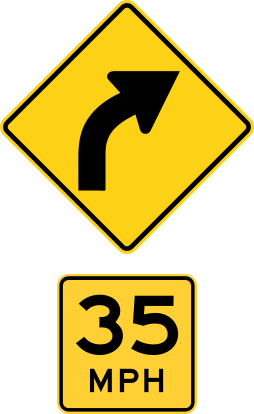
- The legal minimum speed on the road
- An advisory speed for the curve ahead
- The new speed limit for the next mile
- A speed for trucks only on the curve
Show answer
An advisory speed for the curve ahead. The guide shows this pairing as Advisory Speed Around Curve. The yellow color makes it a warning, not a regulatory speed limit sign, which is black and white. It suggests a safe speed for taking the curve in good conditions. Speed limits assume ideal conditions, so on a wet or slippery road you may need to go slower than the plate shows. Begin slowing before the curve, since cornering force grows quickly as speed rises.
Study this in the handbook: Warning, regulatory, guide and work zone signs
19. You are in the right lane of a highway as a truck tries to merge from an entrance ramp. What does courtesy call for?
- Speed up so the truck merges behind you
- Hold your lane so the truck has to wait
- Flash your headlights to wave it in ahead
- Move over, if safe, to let the truck merge
Show answer
Move over, if safe, to let the truck merge. The guide says courtesy calls for moving over from the right lane to let a truck merge. A large truck takes much longer to get up to speed than a car, so racing it for the gap or holding your lane makes the merge harder. Also be careful when you pull in behind a truck that has just entered the highway, because it will still be gaining speed. Flashing headlights is not a substitute for giving the truck space.
20. The car has no free seat, so an adult offers to hold a small child on their lap with one belt around both. What does the guide say?
- It is fine for short trips under 25 mph
- It is fine if the child is older than two
- It is fine if the adult rides in the back seat
- Never do it; an adult cannot hold the child
Show answer
Never do it; an adult cannot hold the child. The guide is direct: never hold a child on your lap, and never buckle yourself and a child into one safety belt. An adult is not strong enough to hold even a small child in a crash or a sudden stop. A short trip, a low speed or a back seat does not change that. Every child must ride in a restraint suited to the child's age and size, and no child should ride standing on a seat.
Study this in the handbook: Safety belts, child restraints and air bags
Every question is written from the official Louisiana Class D and E Driver's Guide. Need paper? Printable LA practice test with answer key.
Last verified 2026-10-05. How we check every question · Study all 500 as flashcards
Frequently asked questions
How many questions are on this Louisiana practice test?
This fixed set has 20 questions. It is test 24 of 25 from the 500 question Louisiana bank. The real LA exam asks 40 questions and you need 32 correct.
What is the passing score for the real Louisiana test?
80% minimum score is required That figure comes from the official Louisiana source cited on the DMV facts page.
How does this fixed test relate to the full Louisiana bank?
Each numbered test is a fixed set of questions in a fixed order, so you can retake the same test later and compare. Every test mixes road signs and the other topics in about the same proportion as the full bank. Tests 1 to 25 together cover every question in the Louisiana bank once. The full practice page mixes the whole bank at random.
Last verified 2026-10-05. See the Louisiana DMV facts page for sourced state details.
Return to the full Louisiana practice test · Study road signs