
Test 9 of 10 · 20 questions · Free 2026
LA Permit Practice Test 9
Jump to the test ↓A fixed 20 question set from the Louisiana bank with answers and plain English explanations. The real LA exam is 40 questions, 80 percent to pass; take the full length version on the main practice page.
Question 1 of 20 · 0 right so far
All 20 questions in test 9
Every question below comes from the Louisiana question bank on this page. Open a question to see the correct answer and the explanation. Nothing here is hidden behind a signup.
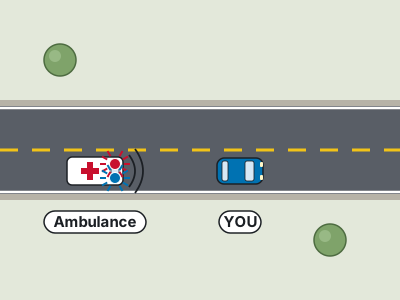
1. When an emergency vehicle is approaching, where should you wait?
- In the nearest intersection
- On the left shoulder facing traffic
- At the right edge of the roadway, clear of intersections
- Immediately beside the emergency vehicle
Show answer
At the right edge of the roadway, clear of intersections. The roadside position matters as much as stopping. Drivers should pull to the right edge of the roadway, clear of intersections, and remain stopped until the emergency vehicle has gone by. Waiting in an intersection can obstruct cross traffic and the responding vehicle, while the left shoulder may put the driver in the emergency vehicle's path. Do not move again merely because the first vehicle has passed. Look and listen for other responders before reentering the lane, then resume only when the route is clear.
Study this in the handbook: Right of way and other laws you should know
2. What does a single solid yellow line on a two-lane road identify?
- A boundary between lanes moving the same direction
- A lane where passing is required
- A no-passing zone
- A place where a U-turn is always required
Show answer
A no-passing zone. A single solid yellow line on a two-lane road marks a zone where passing is prohibited. It may be crossed to make a turn, or when a dashed yellow line is present on the driver’s side, but it is not a general passing invitation. Yellow separates opposing traffic, while white separates lanes moving together. Treat the solid line as a warning about limited sight distance and wait for a legal, visible opportunity before overtaking.
Study this in the handbook: Traffic lights and arrows
3. A pedestrian is crossing outside a marked crosswalk. What does the Louisiana guide require a driver to do?
- Continue because pedestrians only have priority in marked crosswalks
- Yield and stop for the pedestrian
- Pass a stopped vehicle that is waiting for the pedestrian
- Sound the horn and keep the same speed
Show answer
Yield and stop for the pedestrian. The guide says drivers must yield to pedestrians at all times, even when a person is crossing where crossing is illegal. A marked crosswalk gives pedestrians a clear right of way, but its absence does not permit a driver to continue through someone’s path. Passing a vehicle stopped at a crosswalk is specifically unsafe because it can hide the pedestrian. Slow early, keep the person visible, and stop when needed. The important cue is the pedestrian's presence in the roadway, not whether paint is visible.
Study this in the handbook: Night driving, pedestrians and phones
4. How should a Louisiana driver treat a flashing red signal before entering an intersection?
- As a signal to wait until it becomes steady red
- As a yield sign without making a full stop
- As a green light if no vehicle is visible
- As a stop sign, stopping completely before proceeding when safe
Show answer
As a stop sign, stopping completely before proceeding when safe. A flashing red light requires the driver to stop behind the stop bar, crosswalk, or intersection before entering. The guide then directs the driver to use the same procedure as a stop sign: come to a complete stop, look both ways, and yield right of way. A yield only response skips the required stop, while treating the signal as green ignores an active control. Make the full stop first, then check vehicles, pedestrians, and cyclists before proceeding through the intersection.
Study this in the handbook: Traffic lights and arrows
5. What shape and colors are typical of Louisiana warning signs?
- Blue with white lettering, usually rectangular
- White with green lettering, usually circular
- Yellow with black lettering or symbols, usually diamond-shaped
- Orange with black lettering, usually triangular
Show answer
Yellow with black lettering or symbols, usually diamond-shaped. Louisiana warning signs are usually yellow with black lettering or symbols and have a diamond shape. That combination alerts a driver to a possible hazard or special roadway condition ahead. Blue rectangular signs generally point to services, while white signs commonly communicate regulations. Orange backgrounds identify temporary traffic control areas, not the ordinary warning-sign category. When the diamond shape and yellow background appear together, scan ahead and be ready to slow or stop for the condition shown.
Study this in the handbook: Warning, regulatory, guide and work zone signs
6. What is the minimum age for a Louisiana learner's permit under the graduated licensing program?
- 14
- 15
- 16
- 17
Show answer
15. Stage 1 of Louisiana's graduated licensing program begins with a learner's permit, and the applicant must be at least 15 years old. The next stage requires age 16, while a full license can be obtained through the listed pathway at age 17. Age 14 is below the learner's permit threshold. The permit also carries instruction, testing, supervision, and holding period requirements, so reaching the age does not by itself complete the licensing process. Keep the three stages in order when distinguishing the age associated with each license.
Study this in the handbook: The graduated licensing program
7. How early must a Louisiana driver continuously signal before making a turn?
- Only when another vehicle is close behind
- For not less than 25 feet before the turn
- Only after the vehicle begins turning
- For not less than 100 feet before the turn
Show answer
For not less than 100 feet before the turn. Louisiana requires a right or left turn signal continuously for at least 100 feet before making the turn. The distance gives other roadway users time to recognize the intended movement and adjust. Twenty-five feet is shorter than the stated minimum, and waiting until the turn begins gives no useful advance notice. Signaling is not optional just because no vehicle appears nearby. Activate the signal early, keep it on through the approach, and cancel it after completing the maneuver so the next movement is not misread.
Study this in the handbook: Roundabouts and traffic circles
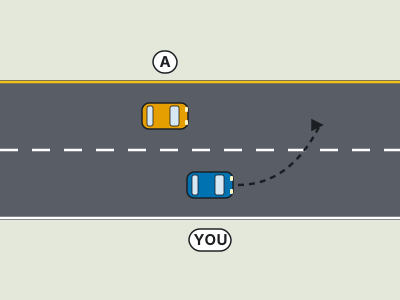
8. Before changing lanes, what should you do to check the area your mirrors cannot show?
- Look only at the vehicle directly ahead
- Turn your head and look over the shoulder toward the lane you plan to enter
- Turn on the hazard flashers and move immediately
- Rely on the inside mirror without checking beside the vehicle
Show answer
Turn your head and look over the shoulder toward the lane you plan to enter. A blind spot is an area around the vehicle that the mirrors cannot reveal. Before moving sideways, check the new lane and behind you, then turn your head toward that lane to inspect the blind spot. The choice about looking only ahead ignores traffic that may be beside or approaching from the rear. Hazard flashers do not replace a lane-change check, and the inside mirror alone leaves areas hidden. Use the sequence as a driving cue: mirror check, shoulder glance, signal, then move only after the lane is clear.
Study this in the handbook: Lane changes, passing and wet roads
9. What kinds of information do traffic signs provide?
- Only vehicle ownership and registration dates
- Only fuel prices and restaurant menus
- Only weather forecasts and emergency broadcasts
- Traffic rules, hazards, roadway location, directions, and services
Show answer
Traffic rules, hazards, roadway location, directions, and services. The guide explains that traffic signs communicate several kinds of roadway information, including traffic rules, hazards, roadway location, roadway directions, and the location of roadway services. Drivers should use the sign's shape, color, symbols, and words to understand the category and respond in time. A sign is not limited to commercial menus, weather reports, or registration records. Scan ahead for the sign, identify what kind of information it gives, and adjust speed, lane position, or route choice as the message requires.
Study this in the handbook: Warning, regulatory, guide and work zone signs
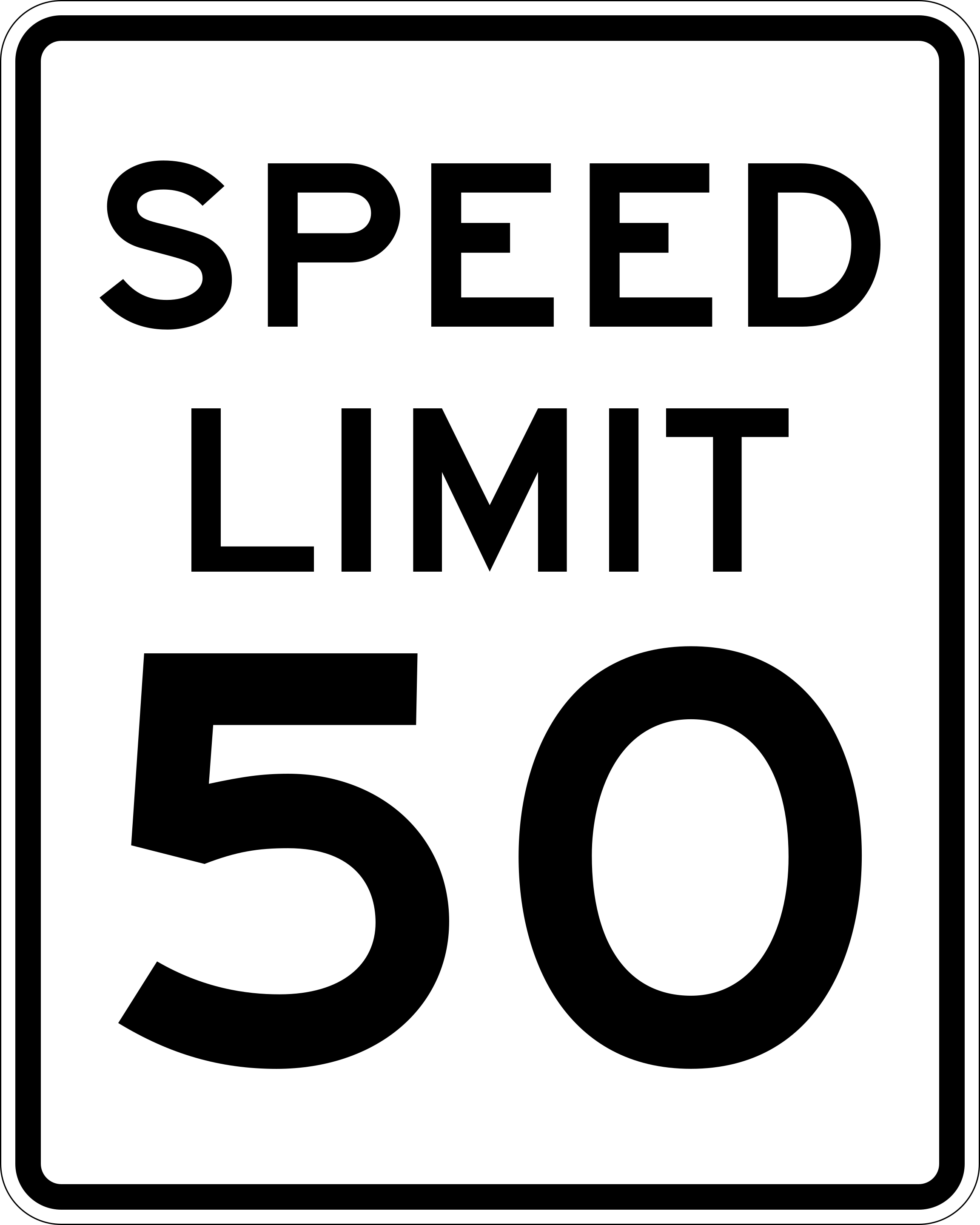
10. What kind of sign is a white rectangle that posts a speed limit?
- A temporary incident sign
- A recreational information sign
- A regulatory sign
- A railroad advance warning sign
Show answer
A regulatory sign. Rectangular signs with a white background commonly give regulatory instructions, including speed limits, school zones, and parking rules. Regulatory signs tell drivers about laws that must be obeyed, so a posted speed limit is more than a suggestion. Recreational information belongs with brown guide signs, temporary incidents use a different temporary-sign system, and railroad advance warnings use a separate yellow sign shape. Read the number, compare it with conditions, and slow further when weather or traffic requires it.
Study this in the handbook: Sign shapes and colors
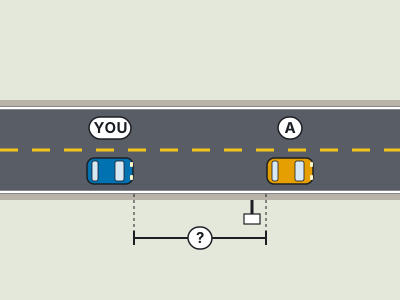
11. How can a driver apply the three-second following rule?
- Keep exactly three car lengths behind at every speed
- Count three seconds after the vehicle ahead passes a fixed object
- Count three seconds before the vehicle ahead reaches an object
- Follow one second behind when the pavement is dry
Show answer
Count three seconds after the vehicle ahead passes a fixed object. Choose a fixed object such as a sign, pole, or tree. When the vehicle ahead passes it, count three seconds. If your car reaches the checkpoint sooner, you are too close and should drop back. Car lengths vary with vehicle size and speed, so that shortcut is unreliable. Use four seconds in bad weather or on wet pavement, then repeat the count after creating more space.
Study this in the handbook: Scanning ahead, stopping distance and following distance
12. How many crashes did drowsy driving cause, according to statistics in the Louisiana guide?
- Over 72,000
- About 500
- About 5 million
- About 1,000
Show answer
Over 72,000. According to recent statistics, drowsy driving caused over 72,000 crashes. On long trips the guide suggests 100 to 110 miles every two hours with 10 to 15 minute breaks every 2 to 3 hours, hour long meal stops, and no more than 10 to 11 hours of total driving even with drivers sharing. Ask a passenger to serve as co pilot and stop at the first sign of drowsiness.
Study this in the handbook: Defensive driving, fatigue and aggressive drivers
13. What does a Louisiana Class E license permit?
- Operation of any single motor vehicle under 10,001 pounds, recreational vehicles and certain farm vehicles
- Motorcycles only
- Commercial trucks
- Any vehicle under 26,001 pounds
Show answer
Operation of any single motor vehicle under 10,001 pounds, recreational vehicles and certain farm vehicles. Class E permits the operation of any single motor vehicle under 10,001 pounds, recreational vehicles and certain farm use vehicles not defined as commercial vehicles. Class D is the chauffeur's license for a single vehicle used in commerce rated from 10,001 to under 26,001 pounds, and as long as the combined gross vehicle weight rating of truck and trailer is under 26,001 pounds, a Class D applies; that applicant must be at least 17. Motorcycles need a separate endorsement.
Study this in the handbook: Who needs a license, license classes and the tests
14. What fine and prison range does Louisiana law set for a third DWI conviction?
- A fine of $300 to $1,000 and up to six months in jail
- A fine of $750 to $1,000 with 48 hours mandatory jail
- A warning and treatment only
- A $2,000 fine and 1 to 5 years in prison, with at least one year served without parole
Show answer
A $2,000 fine and 1 to 5 years in prison, with at least one year served without parole. Louisiana Revised Statute 14:98.3 treats a third DWI as a felony level offense: the offender is fined $2,000 and imprisoned, with or without hard labor, for one to five years. At least one year of the sentence must be served without benefit of parole, probation, or suspension, unless the offender is accepted into a drug division probation program. The $300 to $1,000 fine is the first offense range, and the 48 hour minimum goes with a second offense. A warning and treatment alone is never the penalty for a third conviction.
15. A Louisiana resident is 19 and never entered the graduated licensing program. What course lets them apply for a license or permit?
- No course at all
- The 30 hour classroom course only
- A 38 hour driver's education course, or a 6 hour pre-licensing course plus an eight hour behind-the-wheel course
- A 50 hour supervised driving log
Show answer
A 38 hour driver's education course, or a 6 hour pre-licensing course plus an eight hour behind-the-wheel course. Since August 2012, applicants 18 or older who did not enter the graduated licensing program may apply for a full Class E license or a learner's permit after completing a thirty-eight hour driver's education course, or a six hour pre-licensing course and an eight hour behind-the-wheel course. Skipping education entirely is not allowed. The 30 hour classroom course is the teen permit route, and the 50 hour log is a teen intermediate license requirement.
Study this in the handbook: The graduated licensing program
16. What does Louisiana's knowledge test cover for a first-time applicant?
- Navigation and fuel economy only
- Vehicle repair and engine rebuilding only
- Road construction employment procedures only
- Traffic signs and signals, safe driving practices, and Louisiana driving laws
Show answer
Traffic signs and signals, safe driving practices, and Louisiana driving laws. The knowledge test confirms understanding of traffic signs and signals, safe driving practices, and Louisiana laws related to driving. It is not an engine-repair exam, a road-construction employment test, or a fuel-economy assessment. Those distractors name useful subjects in other contexts but do not describe the test's stated scope. The cue is to remember the three-part coverage: controls on the road, safe operation, and Louisiana law.
Study this in the handbook: Who needs a license, license classes and the tests
17. How long are driving privileges suspended for a first refusal of Louisiana's alcohol analysis test?
- 365 days
- 180 days
- 730 days
- 30 days
Show answer
365 days. A first refusal to submit to the alcohol analysis test brings a 365-day suspension of driving privileges. The 730-day period applies to a second or subsequent refusal, while 180 days is associated with particular test results rather than the first refusal described here. Thirty days is not the stated consequence. The cue is to identify refusal before looking at the duration, then distinguish first offense, repeat offense, and a submitted test with a measured BAC.
Study this in the handbook: Implied consent and DWI penalties
18. If smoke comes from under your vehicle's hood, what is the first safe response?
- Drive clear of traffic, stop, and turn off the engine
- Keep driving until the smoke disappears
- Open the hood while the vehicle is moving
- Pour water over the engine before stopping
Show answer
Drive clear of traffic, stop, and turn off the engine. Smoke under the hood may signal an engine fire or another serious failure. Move off the roadway clear of traffic, stop, and shut down the engine before doing anything else. Continuing to drive can feed a fire and leaves passengers exposed. Opening the hood while moving is unsafe and may intensify flames once air reaches them. Water is especially inappropriate for gasoline, oil, or electrical fires. The practical cue is separation: stop away from traffic, switch off, and get everyone out and away.
Study this in the handbook: Stuck pedals, fires, floods and crashes
19. What does a green arrow at an intersection allow you to do?
- Turn in any direction without checking for people or vehicles
- Turn in the arrow's direction when the intersection is clear
- Proceed only after the arrow changes to yellow
- Enter the intersection and stop in the crosswalk
Show answer
Turn in the arrow's direction when the intersection is clear. A green arrow gives a protected movement in the arrow's direction, but it does not remove the need for a clear path. Check for roadway users, pedestrians, and signs that prohibit the turn before moving. The broad choice allowing any direction changes the limited permission into something much wider. Waiting for yellow defeats the signal, while stopping in a crosswalk creates a hazard and blocks pedestrians. Treat the arrow as permission for one indicated movement, subject to a final safety check.
Study this in the handbook: Traffic lights and arrows
20. At a roundabout, which traffic must yield?
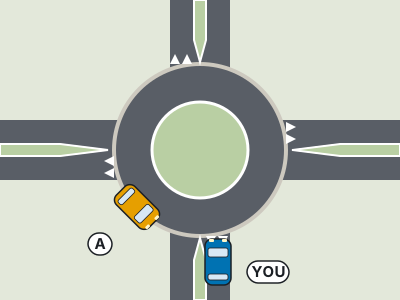
- Entering traffic yields to traffic in the circulating lanes
- Traffic already circulating yields to every entering vehicle
- The largest vehicle always enters first
- Drivers may enter without checking for traffic
Show answer
Entering traffic yields to traffic in the circulating lanes. At a roundabout, entering traffic yields to vehicles already moving in the circulating lanes. The entering driver should slow, look to the left for circulating traffic, and wait for a safe gap before joining. Vehicle size does not create priority, and entering without checking can cause a side collision. Once inside, maintain the lane and follow the roundabout's markings until reaching the intended exit. The key cue is the boundary between entering and circulating traffic: the vehicle already in the circle has priority over the vehicle waiting to enter.
Study this in the handbook: Right of way and other laws you should know
QualitySpace is expanding to Louisiana
We are a California-based independent insurance brokerage working on licensing in more states. We cannot help with Louisiana insurance yet. Leave your email and we will let you know when we can.
Every question is written from the official Louisiana Class D and E Driver's Guide. Need paper? Printable LA practice test with answer key.
Last verified 2026-10-05. How we check every question · Study all 218 as flashcards
Frequently asked questions
How many questions are on this Louisiana practice test?
This fixed set has 20 questions. It is test 9 of 10 from the 218 question Louisiana bank. The real LA exam asks 40 questions and you need 32 correct.
What is the passing score for the real Louisiana test?
80% minimum score is required That figure comes from the official Louisiana source cited on the DMV facts page.
How does this fixed test relate to the full Louisiana bank?
Each numbered test is a fixed set of questions in a fixed order, so you can retake the same test later and compare. Every test mixes road signs and the other topics in about the same proportion as the full bank. Tests 1 to 10 together cover 200 of the 218 questions in the Louisiana bank, each once. The full practice page mixes the whole bank at random.
Last verified 2026-10-05. See the Louisiana DMV facts page for sourced state details.
Return to the full Louisiana practice test · Study road signs