
Test 8 of 10 · 20 questions · Free 2026
LA Permit Practice Test 8
Jump to the test ↓A fixed 20 question set from the Louisiana bank with answers and plain English explanations. The real LA exam is 40 questions, 80 percent to pass; take the full length version on the main practice page.
Question 1 of 20 · 0 right so far
All 20 questions in test 8
Every question below comes from the Louisiana question bank on this page. Open a question to see the correct answer and the explanation. Nothing here is hidden behind a signup.
1. How many reckless driving convictions within 12 months can cost a Louisiana driver the license?
- Two
- Five
- One
- Three
Show answer
Three. Three convictions of reckless driving committed within a 12-month period are on Louisiana's list of grounds for losing the driving privilege. One or two convictions in that time do not trigger this ground, and five is more than needed. Reckless driving itself is a crime punishable by a fine and jail. Other grounds include DWI, refusing an alcohol test, and failing to stop for a school bus.
Study this in the handbook: Insurance, renewal, your record and losing your license
2. A Louisiana student who is 16 withdraws from school before graduating. What can happen?
- Nothing, because school is unrelated to driving
- The driving privilege can be lost
- Only a fine is charged
- The license is upgraded
Show answer
The driving privilege can be lost. The guide lists withdrawing from school before graduation, if you are 15 but less than 18, or being found habitually absent or tardy, as a way to lose the driving privilege. So school status does matter for young drivers. A fine alone is not the listed outcome, and nothing about leaving school upgrades a license. Staying enrolled and attending regularly is part of keeping the privilege for drivers in this age range, alongside safe driving.
Study this in the handbook: Insurance, renewal, your record and losing your license
3. Which sign color means stop or do not?
- Fluorescent pink
- Amber
- Orange
- Red
Show answer
Red. Red carries a stop or prohibition message in the guide. It is used for stop and yield signs, along with DO NOT ENTER and WRONG WAY signs. Amber signals caution and preparation to slow, orange marks temporary traffic control, and fluorescent pink identifies incident management. A red sign therefore deserves an immediate check of the required action, not the assumption that it is merely a route or service marker.
Study this in the handbook: Sign shapes and colors
4. A driver is leaving a driveway to enter a public road. To whom must the driver yield?
- Only vehicles approaching from the driver's left
- Vehicles already on the main road
- No one if the driveway has a paved surface
- Only pedestrians standing on the sidewalk
Show answer
Vehicles already on the main road. A driver entering a road from a driveway, alley, or roadside must yield to vehicles already on the main road. The duty is not limited to traffic from one direction, and paving the driveway does not turn it into a priority roadway. Pedestrians also deserve attention, but the choice naming only them omits the vehicle traffic the rule specifically addresses. Stop or slow enough to see both directions, wait for a safe opening, and enter without interfering with traffic that already has the roadway.
Study this in the handbook: Right of way and other laws you should know
5. If another road user is not following the right-of-way rules, what should a driver do?
- Accelerate to establish control of the intersection
- Insist on proceeding because the law gives the driver priority
- Let that road user proceed even when the driver is legally entitled to go
- Stop in the travel lane and confront the other road user
Show answer
Let that road user proceed even when the driver is legally entitled to go. Louisiana explains that right-of-way rules identify who must yield, but they do not make a collision impossible or grant permission to force a conflict. If another driver or pedestrian fails to follow the rules, let that person have the right-of-way even when it belongs to you. Insisting, accelerating, or confronting someone increases the chance of a crash. Scan for mistakes, slow when needed, and preserve a clear escape path. Legal priority is useful for orderly traffic, but avoiding impact remains the immediate safety decision.
Study this in the handbook: Right of way and other laws you should know
6. Which BAC limit does the Louisiana guide list for a driver who is 20 years old or younger?
- .15 percent
- .08 percent
- .04 percent
- .02 percent
Show answer
.02 percent. Louisiana lists .02 percent for drivers who are 20 years old or younger. That threshold is different from the .08 percent adult limit and the .04 percent commercial motor vehicle limit. Selecting .08 overlooks the age distinction, while .04 describes another operating category. The age wording is the useful memory cue: when the question says 20 or younger, look for .02 rather than applying the adult figure automatically.
Study this in the handbook: Alcohol and Louisiana's BAC limits
7. What does a railroad crossbuck sign require a driver to do?
- Speed up before the train arrives
- Stop only if the train is already crossing
- Yield the right of way to a train
- Treat the tracks as a four-way stop
Show answer
Yield the right of way to a train. A railroad crossbuck is required at public railroad crossings and means the driver must yield the right of way to a train. The sign does not make stopping conditional on seeing the train already enter the crossing, and it does not authorize rushing across the tracks. A four-way-stop procedure is a different traffic control rule. The cue is the crossbuck's railroad setting: identify the train as the road user that receives priority before entering.
8. What percentage must a first-time applicant answer correctly to pass Louisiana's knowledge test?
- 80 percent
- 70 percent
- 90 percent
- 100 percent
Show answer
80 percent. A first-time applicant must correctly answer 80 percent of the knowledge-test questions to receive a passing score. The guide does not require a perfect result, so 100 percent sets the bar higher than the stated standard. Seventy and 90 percent are not the listed threshold. The useful test-taking cue is to separate the passing percentage from the number of questions: the manual gives the percentage, and each item still comes from the guide's traffic and safety material.
Study this in the handbook: Who needs a license, license classes and the tests
9. What category does the curved-arrow sign in the picture belong to?

- A red regulatory sign prohibiting every turn
- A yellow diamond warning about an approaching condition
- A green guide sign showing a destination
- A blue service sign identifying a hospital
Show answer
A yellow diamond warning about an approaching condition. The curved arrow is shown on a yellow diamond, the shape the manual uses for warning and approaching hazard signs. Such signs tell drivers to expect a condition ahead and to adjust speed or driving manner before reaching it. The sign does not prohibit every turn, provide destination directions, or identify a service. Ease off before the curve, keep a controlled lane position, and look through the bend for the next roadway development. The yellow diamond is the advance warning cue, while the arrow supplies the specific roadway information.
Study this in the handbook: Sign shapes and colors
10. When an authorized emergency vehicle approaches with audible or visual signals, where should a driver stop?
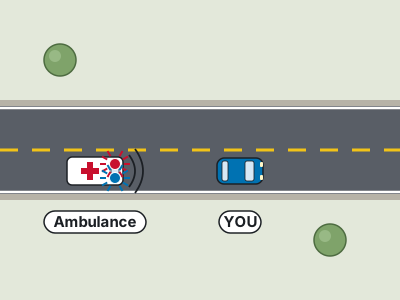
- In the nearest intersection
- Immediately beside the center line
- On the left shoulder regardless of road direction
- Parallel to the right-hand edge or curb
Show answer
Parallel to the right-hand edge or curb. An authorized emergency vehicle using audible or visual signals has priority over ordinary traffic. Yield immediately, move parallel to the right hand edge or curb, and remain stopped until the vehicle passes. Stopping beside the center line can obstruct the responder, while stopping in an intersection leaves the emergency route blocked. The guide also describes a lane change for roads with multiple lanes traveling in the same direction, when safety permits. The practical cue is the emergency signal: yield, move right or change lanes away from the stopped vehicle, then wait until the roadway is clear.
Study this in the handbook: Stuck pedals, fires, floods and crashes
11. At a steady green light, when may a driver turn left?
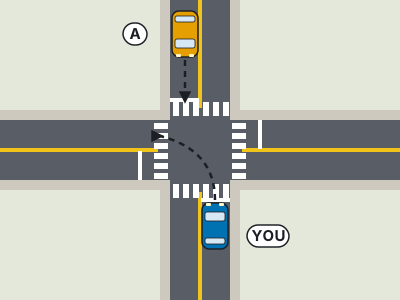
- Only after waiting for the next red light
- As soon as the light changes, regardless of approaching traffic
- Only when the intersection is clear and oncoming traffic and pedestrians have been yielded to
- Without checking for pedestrians if the arrow is not red
Show answer
Only when the intersection is clear and oncoming traffic and pedestrians have been yielded to. A steady green permits movement, but a left turn still depends on a clear intersection. The turning driver must yield to the oncoming traffic flow and pedestrians. The choice that allows an immediate turn ignores those road users, while waiting for a red light invents a delay that the guide does not require. Before moving across the opposing lane, scan for vehicles, bicycles, and people in the crossing. A green signal gives permission to proceed when safe, not an automatic priority over everyone already using the intersection.
Study this in the handbook: Traffic lights and arrows
12. What must a driver do when pedestrians are in a marked crosswalk?

- Yield only when a crossing guard is present
- Continue if the vehicle is already within one car length
- Sound the horn and pass before the pedestrians reach the center
- Stop for the pedestrians because they have the right-of-way
Show answer
Stop for the pedestrians because they have the right-of-way. Pedestrians in a crosswalk have the right-of-way over motor vehicles, so the driver must stop for them. A vehicle’s closeness does not erase that protection, and a horn does not replace yielding. A crossing guard is not required for the crosswalk rule to apply. Watch the road edges as well as the lane ahead, stop before the crossing, and remain stopped until the pedestrians are safely clear of the vehicle’s path.
Study this in the handbook: Center lines, lane lines and crosswalks
13. A Louisiana driver refuses the alcohol test. Before driving privileges are reinstated, what proof must be filed?
- A letter from an employer
- An SR-22 high risk insurance filing, or $30,000 in cash or security
- A new vision test
- Nothing beyond waiting out the suspension
Show answer
An SR-22 high risk insurance filing, or $30,000 in cash or security. Refusing the test brings a 365 day suspension on a first offense and 730 days on a second. Before reinstatement, the driver must file proof of future financial responsibility by submitting an SR-22, which is high risk insurance, or $30,000 in cash or security, and must keep the SR-22 for three years from the date of conviction. An employer letter and a vision test are not the requirement, and waiting alone is not enough.
Study this in the handbook: Implied consent and DWI penalties
14. What are Louisiana's penalties for simple littering?
- A $10 fine
- A $150 fine or eight hours of community service for a first offense, up to $900 or 20 hours for a second
- A warning
- Jail for a first offense
Show answer
A $150 fine or eight hours of community service for a first offense, up to $900 or 20 hours for a second. Under state law the penalties for simple littering range from a first offense of a $150 fine or eight hours of community service to a $900 fine or 20 hours of community service for a second offense. Louisiana spends $91.4 million a year on litter cleanup and prevention, and a roadside study counted over 143.8 million pieces of litter. Report littering to 855-LA-Litter.
15. What does Louisiana's three-second rule help a driver judge?
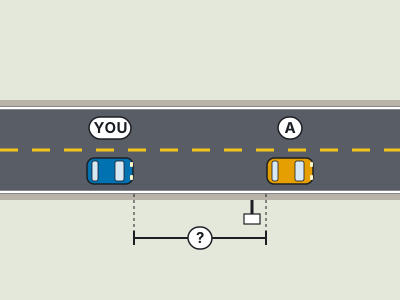
- Whether the vehicle is following too closely
- Whether a turn signal has been on for 100 feet
- Whether a traffic light will stay green
- Whether a tire has enough air pressure
Show answer
Whether the vehicle is following too closely. The three second rule helps a driver judge following distance without guessing the number of feet between vehicles. Choose a fixed object, begin counting when the vehicle ahead passes it, and compare the time until your vehicle reaches that object. If the interval is under three seconds, drop back and count again. The method does not measure tire pressure, signal duration, or traffic light timing. Increase the interval to four seconds during bad weather or on wet pavement because stopping may take longer.
Study this in the handbook: Scanning ahead, stopping distance and following distance
16. How many vehicle train crashes occurred in 2016, according to Federal Railroad Administration figures in the Louisiana guide?
- 2,049 crashes, killing 255 and injuring 852
- About 50,000
- About 20
- About 500, with no deaths
Show answer
2,049 crashes, killing 255 and injuring 852. According to the Federal Railroad Administration there were 2,049 vehicle train crashes in 2016, killing 255 people and injuring 852. You cannot judge the distance and speed of an oncoming train, and when a 3,000 pound car meets a train weighing many tons tragedy always occurs. State law bars stopping on the tracks and requires stopping 15 to 50 feet from the rail when a train approaches.
Study this in the handbook: Right of way and other laws you should know
17. When the gas pedal sticks, what should you do first?
- Turn the ignition to lock immediately at highway speed
- Pump the accelerator repeatedly while speeding up
- Shift the vehicle into neutral
- Open the driver's door to slow the vehicle
Show answer
Shift the vehicle into neutral. A stuck accelerator can keep the engine driving the vehicle, so the first listed action is to disconnect that drive by shifting into neutral. Then keep your eyes on the road, try to free the pedal safely, turn the ignition off without locking the steering, brake, and pull over. Repeatedly pumping the accelerator may maintain the problem. Locking the ignition while moving can interfere with steering, and opening a door is not a controlled braking method. Neutral is the immediate control cue.
Study this in the handbook: Stuck pedals, fires, floods and crashes
18. What is the safest initial response when a tire blows out?
- Hold the wheel firmly and keep the vehicle in its lane
- Slam on the brakes before steering
- Turn sharply toward the nearest shoulder
- Shift into reverse immediately
Show answer
Hold the wheel firmly and keep the vehicle in its lane. A blowout can pull the vehicle to one side, so the first priority is preserving directional control. Hold the steering wheel firmly and keep the vehicle in the same lane while it slows. Slamming the brakes can worsen the loss of control, and a sharp turn may send the vehicle into another lane or off the road. Once the speed has fallen to about 30 mph, brake gently and pull into a safe area. Think control, coast, gentle braking, then a safe exit from traffic.
Study this in the handbook: Skids, blowouts and hydroplaning
19. When may a driver cross a single broken yellow centerline on a two-lane road?
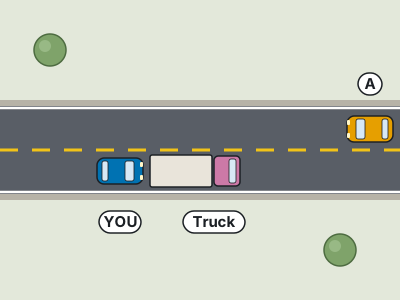
- When it is safe to turn or pass another vehicle
- Only after stopping and waiting for a green signal
- Whenever the driver wants to use the opposite lane
- Never, because all yellow lines prohibit crossing
Show answer
When it is safe to turn or pass another vehicle. A single broken yellow line divides opposing traffic on a two-lane road, and the driver must remain to its right during ordinary travel. The line may be crossed for a turn or to pass another vehicle when the maneuver is safe. The claim that every yellow line forbids crossing ignores the distinction between broken and solid markings. Check sight distance, oncoming traffic, and nearby hazards before moving across the centerline.
Study this in the handbook: Center lines, lane lines and crosswalks
20. What does a flashing DON'T WALK pedestrian signal mean?
- Cross only after running to the opposite curb
- Start crossing immediately before the signal changes
- Do not start crossing, but finish if already in the roadway
- Remain in the roadway until another flashing signal appears
Show answer
Do not start crossing, but finish if already in the roadway. A flashing DON'T WALK signal means pedestrians who have not entered must not start crossing. Someone already in the roadway may continue to the nearest sidewalk, traffic island, or safety zone. Starting immediately ignores the signal's protective purpose, while running or waiting in the roadway is not the stated procedure. Drivers should expect people already crossing and yield as required. For a person at the curb, the practical cue is the flashing hand: wait for a permitted crossing indication rather than stepping into traffic and trying to hurry across.
Study this in the handbook: Lane changes, passing and wet roads
QualitySpace is expanding to Louisiana
We are a California-based independent insurance brokerage working on licensing in more states. We cannot help with Louisiana insurance yet. Leave your email and we will let you know when we can.
Every question is written from the official Louisiana Class D and E Driver's Guide. Need paper? Printable LA practice test with answer key.
Last verified 2026-10-05. How we check every question · Study all 218 as flashcards
Frequently asked questions
How many questions are on this Louisiana practice test?
This fixed set has 20 questions. It is test 8 of 10 from the 218 question Louisiana bank. The real LA exam asks 40 questions and you need 32 correct.
What is the passing score for the real Louisiana test?
80% minimum score is required That figure comes from the official Louisiana source cited on the DMV facts page.
How does this fixed test relate to the full Louisiana bank?
Each numbered test is a fixed set of questions in a fixed order, so you can retake the same test later and compare. Every test mixes road signs and the other topics in about the same proportion as the full bank. Tests 1 to 10 together cover 200 of the 218 questions in the Louisiana bank, each once. The full practice page mixes the whole bank at random.
Last verified 2026-10-05. See the Louisiana DMV facts page for sourced state details.
Return to the full Louisiana practice test · Study road signs