
Test 10 of 10 · 20 questions · Free 2026
LA Permit Practice Test 10
Jump to the test ↓A fixed 20 question set from the Louisiana bank with answers and plain English explanations. The real LA exam is 40 questions, 80 percent to pass; take the full length version on the main practice page.
Question 1 of 20 · 0 right so far
All 20 questions in test 10
Every question below comes from the Louisiana question bank on this page. Open a question to see the correct answer and the explanation. Nothing here is hidden behind a signup.
1. What must a driver do at a steady red traffic light before making a permitted right turn?
- Wait for a green arrow in every case
- Slow down and turn without stopping if traffic is light
- Turn first, then stop beyond the intersection
- Stop behind the stop bar or crosswalk and yield before turning
Show answer
Stop behind the stop bar or crosswalk and yield before turning. A steady red signal requires a stop behind the stop bar, crosswalk, or intersection. A right turn may follow only when no sign prohibits it and after the driver yields to traffic and pedestrians. Rolling through because the road looks empty is still a violation and removes the time needed to check for a person crossing from the side. A green arrow is not required for every permitted right turn. Stop completely, scan both directions and the crosswalk, then turn only when the movement is legal and safe.
Study this in the handbook: Traffic lights and arrows
2. How long does texting take a driver's eyes off the road, according to the Louisiana guide?
- 4.6 seconds
- 30 seconds
- Half a second
- 10 seconds
Show answer
4.6 seconds. Texting causes a driver to look away from the road for 4.6 seconds, long enough to cover a football field at highway speed. The guide notes that 47 states ban texting while driving and 17 ban all handheld phone use, and that 44 percent of teens say they drive more safely without friends in the car. Put the phone away before you start the engine.
Study this in the handbook: Night driving, pedestrians and phones
3. What does a steady DON'T WALK pedestrian signal tell a person at the curb?
- Cross if no vehicle is immediately visible
- Do not enter the roadway toward the signal
- Cross normally because the signal is not flashing
- Wait only for a vehicle to wave the pedestrian through
Show answer
Do not enter the roadway toward the signal. The steady DON'T WALK indication means pedestrians must not enter the roadway toward that signal. A person cannot replace the signal with a quick visual check or a driver's wave, because traffic can approach from outside the immediate view. The fact that the signal is steady does not make it permissive. Wait for a steady WALK indication before beginning, and continue checking traffic while crossing. For drivers, a person already in the crosswalk remains a roadway user who must be given space and time to finish safely.
Study this in the handbook: Lane changes, passing and wet roads
4. What hand positions does the Louisiana guide recommend on the steering wheel?
- 10 and 2 at all times
- 12 and 6
- 9 and 3 or 8 and 4, with 12 o'clock only while backing
- One hand at 12
Show answer
9 and 3 or 8 and 4, with 12 o'clock only while backing. The recommended positions are 9 and 3 or 8 and 4, which keep the arms clear of a deploying air bag and give balanced control. The only time 12 o'clock is recommended is when backing to the left or right and the driver must turn in the seat to see the path, and there is little need to reposition the hands during almost all open road driving.
Study this in the handbook: Safety belts, child restraints and air bags
5. What does a steady yellow traffic light mean?
- The signal is about to change to red, so stop if safely possible
- Speed up because the light will remain yellow for one minute
- Stop only after entering the intersection
- Treat it exactly like a flashing yellow light and continue
Show answer
The signal is about to change to red, so stop if safely possible. A steady yellow warns that the signal is about to change to red. The driver should slow and make a complete stop before the stop bar when that can be done safely. If already in the intersection, continue safely through rather than stopping in the conflict area. The speed-up choice increases risk, and a steady yellow is not the same as a flashing yellow caution. Check mirrors, brake smoothly, and avoid an abrupt stop when stopping would itself be unsafe.
Study this in the handbook: Traffic lights and arrows
6. How far ahead do low beam and high beam headlights let you see, according to the Louisiana guide?
- About 50 feet and 100 feet
- About 1,000 feet on both
- About 150 to 200 feet on low beam and 350 to 400 feet on high beam
- About 500 feet and one mile
Show answer
About 150 to 200 feet on low beam and 350 to 400 feet on high beam. Your lower beam headlights let you see clearly about 150 to 200 feet ahead, and high beams about 350 to 400 feet, so at highway speed you can easily overdrive your low beams. Slow down at night, use high beams on open road when no one is approaching, and dim them for oncoming and followed vehicles. Night driving creates a different set of problems.
Study this in the handbook: Night driving, pedestrians and phones
7. What does a downward pointing triangular sign mean?
- Expect a railroad crossing immediately
- Stop for every vehicle approaching from behind
- Enter a no passing zone
- Yield to traffic that has the right of way
Show answer
Yield to traffic that has the right of way. The downward pointing triangle is used exclusively for yield signs. It directs the driver to slow down and allow traffic with the right of way to cross before entering. A yield does not require an automatic full stop when the path is clear, although stopping may be necessary if traffic requires it. An octagon identifies stop, while no passing and railroad warnings use other shapes. Approach with a reduced speed, scan across the intersection, and be prepared to stop without forcing another road user to brake.
Study this in the handbook: Warning, regulatory, guide and work zone signs
8. Which first-time Louisiana license applicants must submit a detailed report from a physician or vision specialist?
- Everyone under 18
- Only commercial drivers
- Physically impaired persons and persons over 60
- Only applicants who wear glasses
Show answer
Physically impaired persons and persons over 60. Every physically impaired person and every person over the age of 60 applying for a license for the first time must submit a detailed report from a physician and/or vision specialist, on a form from the Office of Motor Vehicles. Teens under 18 are not singled out. The rule is not limited to commercial drivers or glasses wearers, and the OMV may require a medical or visual report from anyone.
Study this in the handbook: Insurance, renewal, your record and losing your license
9. Until what age must a Louisiana driver keep the intermediate license?
- The 17th birthday
- The 16th birthday
- The 18th birthday
- The 21st birthday
Show answer
The 17th birthday. Stage 2 of Louisiana's program, the intermediate license, must be maintained until the seventeenth birthday. The driver can then move to Stage 3, the full license, after completing Stages 1 and 2. Sixteen is the minimum age to get the intermediate license, not the end of it. Eighteen and 21 are not the Stage 2 cutoff. While intermediate, the driver faces the 11:00 p.m. curfew and the evening passenger limit.
Study this in the handbook: The graduated licensing program
10. What maximum prison term does Louisiana law set for a fourth DWI conviction?
- 5 years
- 30 years
- 6 months
- 10 years
Show answer
30 years. Louisiana Revised Statute 14:98.4 sets a fourth or later DWI at a $5,000 fine and imprisonment, with or without hard labor, for not less than ten years nor more than thirty years, so the maximum is 30 years. Two years of that sentence must be served without benefit of parole, probation, or suspension. Ten years is the minimum, not the maximum. Five years is the top of the third conviction range, and six months is the most jail for a first or second conviction.
11. What score must a Louisiana learner's permit applicant get on the knowledge exam?
- At least 70% accuracy
- At least 90% accuracy
- At least 60% accuracy
- At least 80% accuracy
Show answer
At least 80% accuracy. Louisiana requires a learner's permit applicant to pass the vision exam and the knowledge exam with at least 80% accuracy. The road skills test for the intermediate license uses the same 80% standard. Seventy, 90 and 60 percent are not the Louisiana passing marks. The applicant must also be at least 15 and finish 30 classroom hours and 8 behind-the-wheel hours.
Study this in the handbook: The graduated licensing program
12. About how much can a first DWI conviction cost a Louisiana driver, counting court costs, fines and lawyer fees?
- $4,500
- $500
- $250
- $25,000
Show answer
$4,500. The guide warns that your first DWI conviction could cost you $4,500 once court costs, fines, lawyer fees and similar expenses are added. The court fine is only one part of that total, so a figure near the fine alone understates the cost. Two hundred fifty and five hundred dollars are far too low, and $25,000 is not the guide's estimate. A first conviction also brings a criminal record and possible loss of license for a year.
Study this in the handbook: Alcohol and Louisiana's BAC limits
13. What should a driver do when visibility ahead is blocked by a curve, hill, or vehicle?
- Maintain speed because the obstruction hides danger
- Slow down and be ready to adjust the path of travel
- Move immediately into the opposing lane
- Use the shoulder as a normal passing lane
Show answer
Slow down and be ready to adjust the path of travel. A blocked view removes the time needed to react to a hazard, so the guide calls for slowing down and preparing to adjust the path. Maintaining speed treats unseen roadway conditions as harmless. Moving into opposing traffic or using the shoulder adds a new danger and is not a visibility solution. Reduce speed before the curve or hill, keep the vehicle in its lane, and scan for a safe path as the view opens. The concrete cue is limited sight distance, which requires more preparation before the hazard becomes visible.
Study this in the handbook: Scanning ahead, stopping distance and following distance
14. At a simultaneous intersection approach, which driver must yield?
- Both drivers must proceed together
- The driver on the right yields to the driver on the left
- The driver on the left yields to the driver on the right
- The larger vehicle always goes first
Show answer
The driver on the left yields to the driver on the right. When two vehicles approach an intersection together, the driver on the left yields to the vehicle on the right. This rule resolves a simultaneous-arrival conflict without relying on vehicle size or asking both drivers to enter together. Reversing the sides changes who must yield and is therefore unsafe. The cue is to locate your vehicle relative to the other one: if you are on the left, wait and allow the vehicle on your right to proceed.
Study this in the handbook: Right of way and other laws you should know
15. On a multilane highway, how should you respond to a stopped emergency vehicle displaying warning lamps?
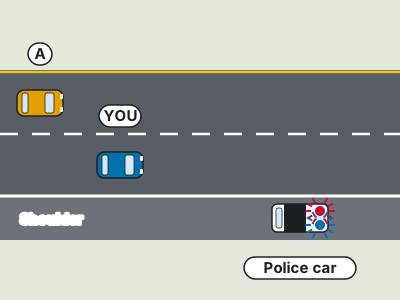
- Stop in the lane next to the emergency vehicle
- Change to a lane not adjacent to it when safe, or slow to a reasonably safe speed
- Keep your speed and pass without changing lanes
- Move onto the emergency vehicle's shoulder
Show answer
Change to a lane not adjacent to it when safe, or slow to a reasonably safe speed. Louisiana's emergency vehicle rule gives priority to creating space around a parked responder. On a highway with two or more lanes in the same direction, change into a lane that is not next to the parked vehicle when traffic and safety allow. If a lane change cannot be made, slow to a reasonably safe speed. Stopping beside the responder can create a new conflict, and normal speed leaves too little protection for people working roadside. Scan early, signal, check the next lane, and make the safest available adjustment.
Study this in the handbook: Emergency vehicles and the move over rule
16. What does the winding-road sign's yellow diamond shape communicate?

- A warning about an approaching roadway condition
- A requirement to stop at every curve
- A route direction toward a named city
- A temporary order to use the shoulder
Show answer
A warning about an approaching roadway condition. The winding road symbol is a yellow diamond warning sign, so it alerts the driver to an approaching roadway condition. The manual specifically describes yellow diamond signs as warnings about curves, side roads, and traffic flow. Continue scanning beyond the first bend, reduce speed before the series, and keep enough space to react to an unseen road user. The sign does not require a stop at each curve, give destination directions, or order shoulder travel. Its shape provides the broad warning while the winding symbol identifies the kind of condition ahead.
Study this in the handbook: Sign shapes and colors
17. When do most teen crash deaths occur, according to the Louisiana guide?
- On weekday mornings
- During school hours
- On weekends, when 53 percent of all teen crashes occur
- In winter only
Show answer
On weekends, when 53 percent of all teen crashes occur. Most teenage deaths from motor vehicle collisions occur on weekends, as 53 percent of all teen crashes occur on the weekend. In 2016, 818 teen drivers and 569 passengers died in vehicles driven by teens, and 58 percent of those passengers were not buckled up. The guide adds that the top factors for fatal crashes involving teens are unsafe speeds and non use of seat belts, so weekday mornings, school hours, and winter are not the pattern it describes.
18. What does orange usually mean on a roadway sign?
- A recreational or cultural destination
- A hospital or medical service
- A permanent speed restriction
- A construction zone or temporary traffic control
Show answer
A construction zone or temporary traffic control. Orange is the basic color for temporary traffic control and construction signs. It tells the driver to expect workers, machinery, barricades, lane changes, or unusual roadway conditions and to be ready to slow or stop. Blue service signs identify places such as hospitals, while green and brown guide signs point toward routes or recreational destinations. A permanent speed restriction is shown by a regulatory sign. When orange appears, look beyond the sign for work-zone devices and changing traffic patterns.
Study this in the handbook: Warning, regulatory, guide and work zone signs
19. What is the rule for crossing double solid yellow center lines?
- The lines separate lanes traveling in the same direction
- Passing is required whenever the road ahead is open
- Only trucks may cross to overtake
- Passing across the lines is prohibited, but a turn may cross them
Show answer
Passing across the lines is prohibited, but a turn may cross them. Double solid yellow lines mark the center of a roadway with four or more lanes and prohibit crossing to pass. The manual allows crossing them for a turn, which is narrower than general permission to overtake. The lines do not require passing, grant a special privilege to trucks, or separate same-direction lanes. Use the color and pattern as a cue: yellow divides opposing traffic, and two solid lines mean stay put unless the movement is a lawful turn.
Study this in the handbook: Center lines, lane lines and crosswalks
20. Which Louisiana children must wear an approved helmet on a bicycle?
- Children under 6
- Children under twelve
- Everyone under 18
- Only children riding as passengers
Show answer
Children under twelve. Louisiana requires children under the age of twelve to wear approved helmets when operating a bicycle or riding as a passenger, fastened securely with the straps. Children who weigh less than forty pounds or are less than forty inches tall must ride in an approved restraining seat. Six and 18 are not the rule's age, and the helmet rule covers riders as well as passengers.
Study this in the handbook: Bicycles, motorcycles and big trucks
QualitySpace is expanding to Louisiana
We are a California-based independent insurance brokerage working on licensing in more states. We cannot help with Louisiana insurance yet. Leave your email and we will let you know when we can.
Every question is written from the official Louisiana Class D and E Driver's Guide. Need paper? Printable LA practice test with answer key.
Last verified 2026-10-05. How we check every question · Study all 218 as flashcards
Frequently asked questions
How many questions are on this Louisiana practice test?
This fixed set has 20 questions. It is test 10 of 10 from the 218 question Louisiana bank. The real LA exam asks 40 questions and you need 32 correct.
What is the passing score for the real Louisiana test?
80% minimum score is required That figure comes from the official Louisiana source cited on the DMV facts page.
How does this fixed test relate to the full Louisiana bank?
Each numbered test is a fixed set of questions in a fixed order, so you can retake the same test later and compare. Every test mixes road signs and the other topics in about the same proportion as the full bank. Tests 1 to 10 together cover 200 of the 218 questions in the Louisiana bank, each once. The full practice page mixes the whole bank at random.
Last verified 2026-10-05. See the Louisiana DMV facts page for sourced state details.
Return to the full Louisiana practice test · Study road signs