
Test 11 of 25 · 20 questions · Free 2026
LA Permit Practice Test 11
Jump to the test ↓A fixed 20 question set from the Louisiana bank with answers and plain English explanations. The real LA exam is 40 questions, 80 percent to pass; take the full length version on the main practice page.
Question 1 of 20 · 0 right so far
All 20 questions in test 11
Every question below comes from the Louisiana question bank on this page. Open a question to see the correct answer and the explanation. Nothing here is hidden behind a signup.
1. Your adult friend rides in the back seat of your pickup truck's crew cab. Under Louisiana law, must your friend buckle up?
- No, only riders in the front seat must
- Yes, back seat riders must buckle
- No, pickups are not covered
- Only if the trip is on a highway
Show answer
Yes, back seat riders must buckle. Louisiana's mandatory safety belt law covers all passengers in both the front and back seats of cars, vans and pickup trucks. A back seat rider in a pickup is included. The law does not depend on the type of road. Unbelted back seat passengers can be thrown into other riders or out of the vehicle in a crash, which is why the rule reaches every seat.
Study this in the handbook: Safety belts, child restraints and air bags
2. When should a three point turnabout be used to turn around?
- Whenever it saves time compared with a U-turn
- Only on a wide four lane divided highway
- Whenever heavy traffic is waiting behind you
- When a U-turn won't fit and you can't circle the block
Show answer
When a U-turn won't fit and you can't circle the block. The three point turnabout is the most difficult and dangerous way to turn around. Use it only when the street is too narrow for a U-turn and you cannot go around the block, and only on a two lane roadway. Saving time is not a reason, and heavy traffic makes it worse, not better. The guide says it is better to circle an entire block than to turn around on a busy street.
3. In thick fog you can make out an eight-sided sign ahead, but you cannot read its words. What should you do?
- Slow down and yield only if traffic is near
- Keep going; you cannot confirm its message
- Slow down and come to a complete stop
- Slow down for a curve ahead
Show answer
Slow down and come to a complete stop. Shapes let you recognize a sign before you can read it. Louisiana's guide says the octagon is used only for stop signs, and the action is to slow down and come to a complete stop. An eight-sided outline in fog is therefore a stop sign even if the letters are hidden. Yielding without stopping is the rule for the downward triangle, and curve warnings are yellow diamonds. Stop fully, then go only when the way is clear.
Study this in the handbook: Sign shapes and colors
4. Is it legal to change lanes while driving through or approaching an intersection in Louisiana?
- Yes, if you signal for at least 100 feet
- Yes, if the light is green and traffic is light
- No, it is dangerous and illegal there
- Only to pass a vehicle that is turning
Show answer
No, it is dangerous and illegal there. Louisiana's guide says changing lanes while approaching or driving through an intersection is dangerous and illegal. Wait until you are past the intersection before you change lanes. Intersections already mix cross traffic, turning vehicles, bicyclists and pedestrians, and a lane change adds another danger. The guide applies this to controlled and uncontrolled intersections and to busy shopping center entrances. Signaling, a green light or a turning car ahead does not make the lane change legal.
Study this in the handbook: School buses, turns and signals
5. Your light has just turned green. Why should you still look left and right before going?
- Cross traffic may hurry through as their light turns red
- Your green light may switch back to yellow at once
- Pedestrians always get the first few seconds of green
- The law requires a full three second wait on green
Show answer
Cross traffic may hurry through as their light turns red. Do not rely on a signal to tell you that no one will cross in front of you. Just after your light turns green is when drivers on the cross street are most likely to rush through before their light turns red. Some drivers do not obey or even see signals. Look to the front, left and right, and make sure the path is clear all the way through before you enter, so you will not block the intersection if you must stop.
Study this in the handbook: Scanning ahead, stopping distance and following distance
6. If you double your speed from 20 mph to 40 mph, what happens to your braking distance?
- It stays about the same
- It becomes 2 times longer
- It becomes 9 times longer
- It becomes 4 times longer
Show answer
It becomes 4 times longer. Speed raises crash force and braking distance much faster than drivers expect. Going from 20 to 40 mph makes the impact four times greater, and the braking distance is also four times longer. Tripling the speed to 60 mph makes both nine times greater, and 80 mph makes them sixteen times greater than at 20 mph. Doubling speed never just doubles the distance. Slowing down is the way to shorten braking distance.
Study this in the handbook: Scanning ahead, stopping distance and following distance
7. A car trying to pass you on a two-lane road cannot finish because of oncoming traffic, and the driver is dropping back. How can you help?
- Brake hard so the driver can pull in ahead of you
- Hold your exact speed and stay centered
- Sound your horn and keep your speed steady
- Speed up so the driver can move in behind you
Show answer
Speed up so the driver can move in behind you. When a passing driver gets caught by oncoming traffic, you can help prevent a crash. If the driver keeps trying to pass, slow down and move as far right as you safely can. If the driver clearly cannot complete the pass and must drop back, increase your speed so that car can move in behind you. Be certain of the other driver's intentions before you change speed, since braking and speeding up help in opposite situations.
8. What does the median-and-arrows symbol in this picture mean?

- A divided highway begins ahead
- A divided highway ends ahead
- Both lanes travel in one direction
- Traffic must turn around a roundabout
Show answer
A divided highway begins ahead. The sign warns that a divided highway begins ahead. Its arrows depict opposing traffic passing on separate sides of the divider. The divider is the important feature to recognize; the sign is not merely telling you that the road bends. A divided highway ending sign describes the reverse change, where the separation ends. Use the warning to anticipate the new roadway layout and follow the lanes on your side of the separation.
Study this in the handbook: Warning, regulatory, guide and work zone signs
9. When parking uphill beside a curb, which way should you turn the wheels?
- Toward the curb
- Away from the curb
- Straight ahead
- Toward the center of the parking space
Show answer
Away from the curb. For uphill parking where a curb is present, turn your wheels away from the curb. The guide also directs you to set the emergency brake and shift into low gear or park. Wheel position matters because the vehicle must not roll into traffic if the brakes fail to hold. First identify whether the car faces uphill or downhill and whether there is a curb; those conditions determine the correct wheel direction.
10. Your light is a steady green with no arrow. You want to turn left, but an oncoming car is near and a pedestrian is crossing the street you are entering. What should you do?
- Wait for the car and the pedestrian, then turn
- Turn now, since your light is green
- Turn ahead of the car, then stop for the walker
- Turn only after the light changes to yellow
Show answer
Wait for the car and the pedestrian, then turn. A steady green ball allows a left turn, but it does not protect it. Louisiana's guide says you may turn left on a steady green only when the intersection is clear, and you should always yield to oncoming traffic and pedestrians. Here both the oncoming car and the person crossing must go first. Cutting in front of the car is dangerous, and waiting for yellow is not the rule; turn once both are clear.
Study this in the handbook: Traffic lights and arrows
11. You are very angry after an argument and need to go somewhere. What does the guide advise?
- Drive fast to calm down
- Let someone else drive
- Play loud music and go
- Drive only on side streets
Show answer
Let someone else drive. Strong emotions affect driving. If you are worried, nervous, angry, frustrated or depressed, let someone else drive. Upset drivers can become impulsive and aggressive and take risks they normally would not. Emotions are hard to control and can make you temporarily collision prone. Speed, loud music or a quieter route do not remove the risk. Avoid driving when you are not emotionally ready for the stress driving can bring.
Study this in the handbook: Defensive driving, fatigue and aggressive drivers
12. You have a green arrow to turn left. A driver on the far side of the intersection is turning right on red into the same street. What should you keep in mind?
- You may turn without looking; you are protected
- You must stop and let that driver go first
- Turn, but watch for that driver entering the street
- Wait until the arrow turns yellow, then turn
Show answer
Turn, but watch for that driver entering the street. A green arrow lets you turn in its direction when the intersection is clear, and Louisiana's guide says oncoming or crossing traffic should yield to your turn. The guide also warns you to be careful of drivers making a right turn on red from the other side of the intersection, since they may pull into the street you are entering. Make your turn, but keep watching that driver. Waiting for yellow throws away your protected turn.
Study this in the handbook: Traffic lights and arrows
13. A school bus stops ahead of you on a two lane road with red lights flashing. You stop 10 feet behind it. Is that far enough?
- Yes, any full stop behind the bus is enough
- No, you must stop at least 30 feet away
- Yes, the distance only matters when meeting it
- No, you must stop at least 100 feet away
Show answer
No, you must stop at least 30 feet away. When a school bus is stopped to load or unload children, you must stop at least 30 feet away. That applies whether you are meeting the bus or traveling behind it. Ten feet is too close. As the bus stops, its red lights and stop signs activate, and you must wait for the bus to move and scan before driving again. Never pass a bus with red lights flashing on either side. One hundred feet is the starting point of the yellow warning lights, not the stopping distance.
Study this in the handbook: School buses, turns and signals
14. Driving at night through a wooded area, you see a deer cross the road ahead. What should you expect?
- That the road ahead is now clear
- That the deer will not come back
- That more deer may be close by
- That headlights will keep deer away
Show answer
That more deer may be close by. Wildlife is most active at dusk and dawn, and deer travel in groups. The guide says to keep your speed down at night and, if you see one animal, to expect another nearby. Slow down, scan both sides of the road, and watch for the reflection of your headlights in animals' eyes. An animal standing near the road may bolt or change direction at the last minute, so do not assume the danger has passed.
Study this in the handbook: Interstate and rural road driving
15. You are 24 years old and have been drinking at a party in Louisiana. What legal blood alcohol limit applies to you?
- 0.02 percent
- 0.04 percent
- 0.08 percent
- 0.10 percent
Show answer
0.08 percent. Louisiana sets the legal blood alcohol limit by age and vehicle type. A driver who is 21 years of age or older is held to 0.08 percent, so a 24 year old falls under that limit. The 0.02 percent limit applies to drivers 20 and younger, and 0.04 percent applies to anyone operating a commercial motor vehicle. Impairment begins with the first drink, so staying under the limit does not mean driving is safe.
Study this in the handbook: Alcohol and Louisiana's BAC limits
16. Your right wheels drift onto a shoulder that is level with the pavement. After slowing gently, how should you return?
- Gently steer back onto the road
- Turn the wheel sharply back at once
- Speed up and swing back quickly
- Stop fully, then back up onto the road
Show answer
Gently steer back onto the road. When your wheels slip off the edge of the road, do not try to turn back onto the pavement right away, because that could send you swerving into oncoming traffic. Stay on the shoulder and slow down by gently using your brakes. If there is no drop-off from the pavement, gently steer back onto the road. Only when the shoulder is much lower do you slow to about 10 mph and then turn the wheels sharply back.
Study this in the handbook: Skids, blowouts and hydroplaning
17. You are about to pass a large truck on the highway. How should you pass it?
- On the right, where its blind spots are smaller
- On the left, holding the wheel loosely in gusts
- On either side, as long as you pass quickly
- On the left, with a firm grip on the steering wheel
Show answer
On the left, with a firm grip on the steering wheel. When passing a truck, always pass on the left side. Leave plenty of room before you move back in front of it, and look for the whole front of the truck in your rear view mirror before pulling in. Keep a firm grip on the steering wheel, because the air turbulence around a truck can push your car. Holding the wheel loosely lets that push move you. The guide also says not to linger beside a truck, since you may be in a blind spot.
18. When is a road surface usually the most slippery during a rain shower?
- After it has rained steadily for an hour
- Right after the rain begins to fall
- Only once puddles cover the lanes
- When the rain has nearly stopped
Show answer
Right after the rain begins to fall. The first few minutes of rain are the most dangerous. Oil and grease on the pavement have not been washed away yet, so the water mixes with them and makes the surface slick. The guide says a road covered with oil and water can be like driving on ice. Waiting for puddles before slowing down is too late. When rain starts, reduce speed, use extra caution and leave twice your normal following distance.
Study this in the handbook: Lane changes, passing and wet roads
19. A red arrow is lit for your turning lane. When may you make that turn?
- After a full stop, if no one is coming
- When the cross street gets a red light
- After yielding to people in the crosswalk
- Only after the green arrow returns
Show answer
Only after the green arrow returns. A red arrow controls one movement, the turn it points to. Louisiana's guide says you must stop and you may not go in the arrow's direction until the green arrow returns. This differs from a steady red ball, where a right turn after stopping may be allowed when no sign prohibits it. Stopping first, waiting for cross traffic to get a red, or letting pedestrians pass does not release the arrow. Stay stopped until your green arrow appears.
Study this in the handbook: Traffic lights and arrows
20. What does a red circle with a red slash over a symbol mean?
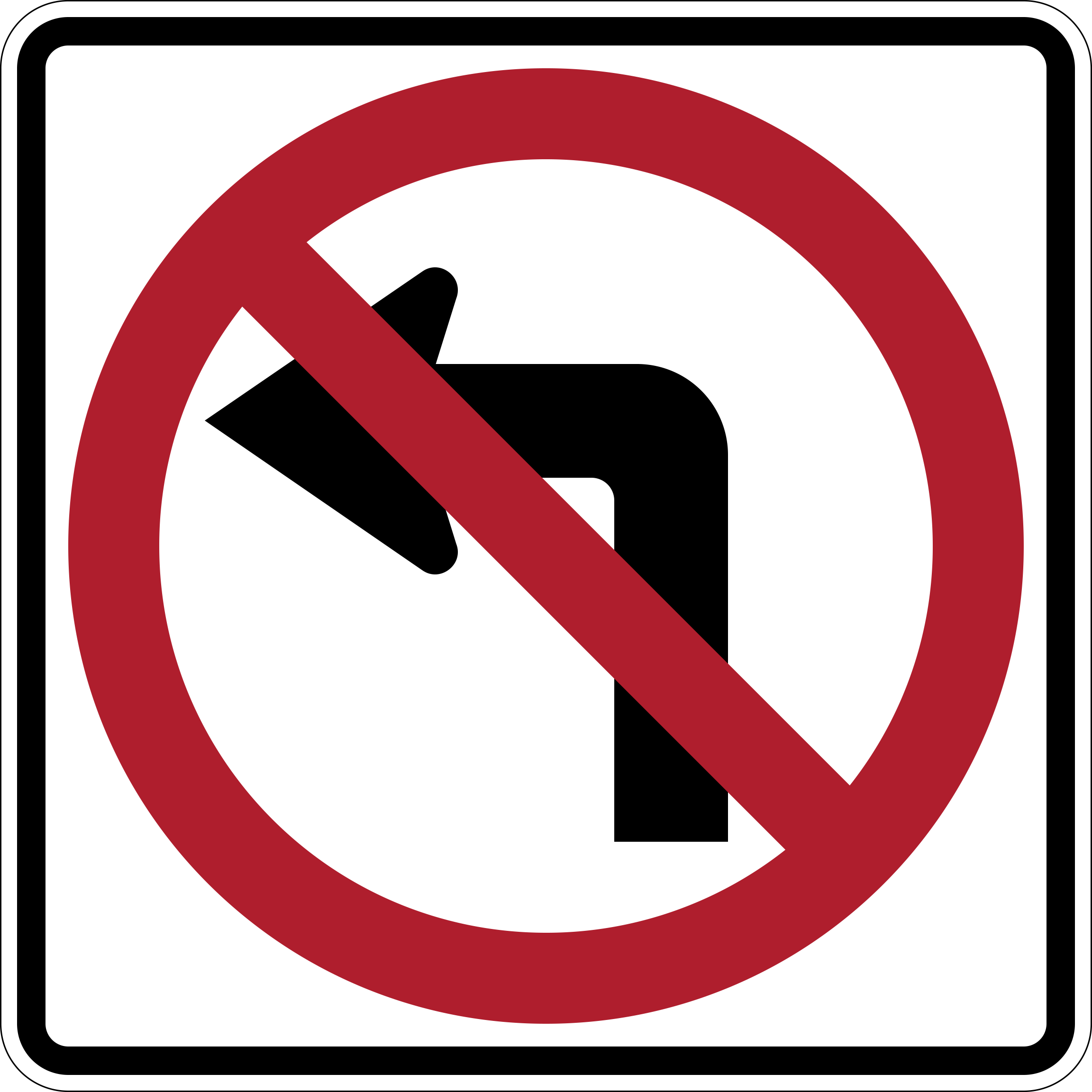
- The action represented by the symbol is prohibited
- The action is recommended at that location
- The symbol identifies a nearby traveler service
- The sign gives an advisory curve speed
Show answer
The action represented by the symbol is prohibited. A red circle with a slash is a prohibition symbol. It tells the driver not to perform the action shown, such as turning left, turning right, or making a U-turn. It is not a recommendation, a service marker, or an advisory speed message. Look at the crossed-out symbol itself to identify the forbidden movement, then obey the restriction even if the roadway appears clear. The red slash is the quick visual cue that the pictured action is not allowed.
Study this in the handbook: Warning, regulatory, guide and work zone signs
Every question is written from the official Louisiana Class D and E Driver's Guide. Need paper? Printable LA practice test with answer key.
Last verified 2026-10-05. How we check every question · Study all 500 as flashcards
Frequently asked questions
How many questions are on this Louisiana practice test?
This fixed set has 20 questions. It is test 11 of 25 from the 500 question Louisiana bank. The real LA exam asks 40 questions and you need 32 correct.
What is the passing score for the real Louisiana test?
80% minimum score is required That figure comes from the official Louisiana source cited on the DMV facts page.
How does this fixed test relate to the full Louisiana bank?
Each numbered test is a fixed set of questions in a fixed order, so you can retake the same test later and compare. Every test mixes road signs and the other topics in about the same proportion as the full bank. Tests 1 to 25 together cover every question in the Louisiana bank once. The full practice page mixes the whole bank at random.
Last verified 2026-10-05. See the Louisiana DMV facts page for sourced state details.
Return to the full Louisiana practice test · Study road signs