
Test 4 of 10 · 20 questions · Free 2026
WI Permit Practice Test 4
Jump to the test ↓A fixed 20 question set from the Wisconsin bank with answers and plain English explanations. The real WI exam has a 15 question road sign section with 12 correct to pass, plus 50 knowledge questions with 40 correct to pass; take the full length version on the main practice page.
Question 1 of 20 · 0 right so far

All 20 questions in test 4
Every question below comes from the Wisconsin question bank on this page. Open a question to see the correct answer and the explanation. Nothing here is hidden behind a signup.
1. What does an intersection or cross-road warning sign identify?
- A road that permits traffic in one direction only
- A lane reserved for turning vehicles only
- A railroad track that is no longer in use
- A place where two or more roads cross
Show answer
A place where two or more roads cross. The intersection or cross-road warning identifies a location where roads meet or cross, alerting the driver to watch for traffic entering the route. A reserved turning lane concerns pavement use, not the meaning of this warning. An out-of-service railroad notice concerns tracks, while one-way operation describes traffic direction rather than a crossing roadway. The useful driving cue is to scan both sides before reaching the junction, adjust speed, and be ready for vehicles or pedestrians approaching from another road.
Study this in the handbook: Warning and construction signs
2. What should a driver do after seeing a curved-road warning sign?

- Move immediately onto the shoulder
- Accelerate before the road changes direction
- Stop in the travel lane until the curve ends
- Slow down if needed to drive safely through the curve
Show answer
Slow down if needed to drive safely through the curve. A curved-road warning means the roadway will gradually move right or left, so the driver should reduce speed when conditions require it. The choice about accelerating creates less control as the path bends. Stopping in a travel lane adds a new hazard unless an emergency requires it, and moving onto the shoulder is not the handbook response to an ordinary curve. The practical cue is to read the curve early, ease off the accelerator, and keep the vehicle positioned safely within its lane. Speed should match visibility, traction, and the shape of the road.
Study this in the handbook: Warning and construction signs
3. What must a driver do when a railroad crossing gate is lowering?
- Cross after the gate reaches halfway down
- Drive around it if no train is visible
- Wait and do not drive around the gate
- Stop under the gate until the bell ends
Show answer
Wait and do not drive around the gate. A lowering railroad gate means the crossing is closing for a train, so wait and never drive around or under the gate. The gate itself is the warning to remain out of the crossing. Stopping under the gate is also barred, and the handbook says not to cross until the bell or horn has stopped. Stop before the crossing and proceed only when the warnings have ended and the path is clear.
Study this in the handbook: Railroad crossing signs and rules
4. When are Wisconsin drivers required to use low-beam headlights?
- Only when driving on an interstate highway
- From a half hour after sunset until a half hour before sunrise
- Only during rain, snow, or fog
- Whenever the vehicle is parked and idling
Show answer
From a half hour after sunset until a half hour before sunrise. The handbook requires low beams during the period beginning one-half hour after sunset and ending one-half hour before sunrise. It also requires them when a driver cannot see a vehicle or person 500 feet away. Rain, snow, fog, and windshield-wiper use are listed as recommended circumstances, not the only mandatory trigger. Parked vehicles should use parking lights as described separately. Check the lighting control before darkness begins, and return from high beams when another vehicle approaches.
Study this in the handbook: The horn, headlights and turn signals
5. What does Wisconsin say about exceeding the speed limit to pass another vehicle?
- It is allowed only on two-lane rural highways
- It is allowed for less than one mile
- It is not allowed
- It is required when traffic is backed up
Show answer
It is not allowed. Passing does not give a Wisconsin driver permission to exceed the posted limit. The one mile and rural highway choices invent exceptions that the handbook does not provide. Traffic backing up behind a slow vehicle may be frustrating, but it still does not change the maximum speed. Watch both the centerline markings and the speed sign before starting any pass.
Study this in the handbook: Speed limits and the sight distance rule
6. What must a driver do when an emergency vehicle approaches with lights and sirens?
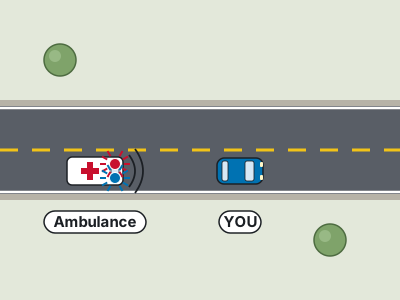
- Stop in the middle of the intersection
- Pull to the side and stop until it has passed
- Follow the emergency vehicle closely through traffic
- Remain in the nearest lane and continue normally
Show answer
Pull to the side and stop until it has passed. Flashing emergency lights and sirens signal the driver to move toward the side of the road and stop. Remaining in the nearest lane can obstruct the emergency response, and stopping in an intersection creates a dangerous blockage. Following the responding vehicle is not a permitted way to gain priority. If already in an intersection, clear it safely before stopping. The cue is to create open space, stay stopped, and wait until the emergency vehicle has gone by.
Study this in the handbook: Pedestrians, emergency vehicles and school buses
7. When may you turn right at a steady red light in Wisconsin?
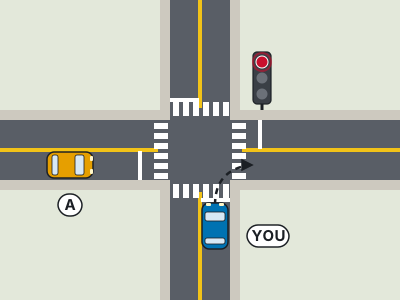
- Immediately, without stopping if the road is empty
- After stopping first, yielding to all traffic, and confirming it is safe with no prohibiting sign
- Only after the light turns green
- Whenever a vehicle behind you honks
Show answer
After stopping first, yielding to all traffic, and confirming it is safe with no prohibiting sign. A right turn on steady red requires a full stop first. After stopping, yield to all traffic, check for pedestrians, and turn only when it is safe and no sign prohibits the movement. An empty-looking road does not remove the stop requirement, and a horn from behind cannot authorize the turn. Waiting for green is more restrictive than the handbook’s rule, but proceeding immediately is unsafe and unlawful. The study sequence is stop, yield, check, then turn while staying in your lane.
Study this in the handbook: Traffic lights and arrows
8. You are about to enter a Wisconsin roundabout and traffic is already circulating. What must you do before entering?
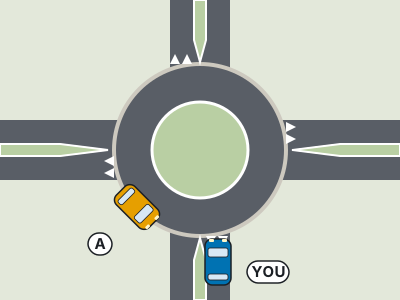
- Yield only to vehicles approaching from the right
- Stop in the circle and wait for a signal
- Enter before the circulating vehicles
- Yield to traffic already in the roundabout
Show answer
Yield to traffic already in the roundabout. Traffic already moving through the roundabout has priority over a driver who has not entered. The handbook specifically directs an approaching driver to yield to traffic on the left that is already in the roundabout, then enter when a safe gap appears. Stopping inside the circle is not the intended procedure, and entering first or watching only the right side reverses the priority. Slow down at the approach, look left, and wait for space. That sequence helps preserve the counterclockwise flow and avoids forcing circulating traffic to brake.
Study this in the handbook: Roundabouts, metered ramps and funeral processions
9. After you finish parallel parking in Wisconsin, how far should your vehicle be from the curb?
- About 3 feet away
- About a foot away
- Touching the curb
- About 6 inches over the curb
Show answer
About a foot away. The last parallel parking step is to straighten the wheels again, leaving the vehicle about a foot away from the curb and at least 2 feet from the vehicles in front and behind. Three feet sticks out into traffic. Touching or riding over the curb is not the target. The space you choose should be about 3 to 6 feet longer than the vehicle so there is room to finish in the right spot.
Study this in the handbook: The horn, headlights and turn signals
10. What action does Wisconsin prohibit a driver from taking around a funeral procession?
- Cutting into the line or interfering with the funeral line
- Turning on the vehicle’s headlights
- Following traffic signs and signals
- Leaving extra space around the procession
Show answer
Cutting into the line or interfering with the funeral line. Wisconsin’s handbook directs drivers not to cut into a funeral procession or interfere with its line. Headlights are expected on vehicles in the procession, and the first vehicle follows traffic signs and signals. Leaving space is a considerate response, but the specifically prohibited conduct is entering or disrupting the line. If you encounter the procession, wait rather than trying to weave through it. The visual cue is a continuous line of vehicles traveling together from a funeral home or place of worship toward a cemetery or crematorium.
Study this in the handbook: Roundabouts, metered ramps and funeral processions
11. When approaching a stopped emergency vehicle with flashing lights, which lane should you use?
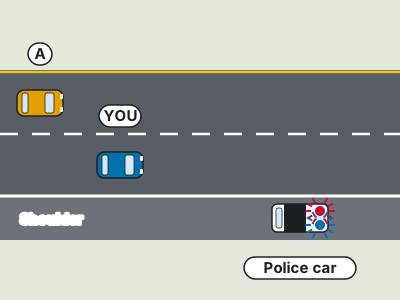
- The lane not nearest the stopped vehicle
- The lane nearest the stopped vehicle
- The shoulder between the vehicle and curb
- Any lane without slowing
Show answer
The lane not nearest the stopped vehicle. When an emergency vehicle is stopped with its lights flashing, move into the lane farthest from that vehicle when it is safe. This gives the officer and other responders a wider buffer from passing traffic. Choosing the nearest lane leaves too little separation, using the shoulder can put a driver where responders are working, and maintaining speed without moving ignores the handbook’s instruction. Scan ahead for flashing lights, change lanes carefully, and remain in the farther lane until you have passed.
Study this in the handbook: Pedestrians, emergency vehicles and school buses
12. Why should a Wisconsin driver avoid coasting in neutral?
- Neutral is required before every gradual stop
- Neutral makes the headlights turn off automatically
- Staying in gear helps keep full control of the vehicle
- Coasting is allowed only on divided highways
Show answer
Staying in gear helps keep full control of the vehicle. The handbook tells drivers not to coast in neutral because staying in gear helps maintain full control. Neutral can reduce the driver's ability to respond smoothly with power or braking when traffic changes. It does not control headlights, and Wisconsin does not require neutral before a gradual stop. A divided highway does not create an exception. The cue is any downhill or slowing situation where coasting seems convenient: keep the vehicle in gear and manage speed deliberately.
Study this in the handbook: Speed limits and the sight distance rule
13. A pedestrian with a white cane is approaching a roadway. How far away should you stop?
- At least 10 feet away until the person is off the roadway
- No closer than 3 feet, then proceed slowly
- At least 25 feet away until another driver passes
- Only at the nearest stop line
Show answer
At least 10 feet away until the person is off the roadway. Wisconsin gives special protection to a pedestrian carrying a white cane or using a guide dog, even when that person has not yet entered the intersection. Stop at least 10 feet away and remain stopped until the person is off the roadway. The three foot option understates the required space, and waiting only at a marked stop line misses the rule’s application outside an intersection. A white cane or guide dog should prompt an early, generous stop rather than a close approach.
Study this in the handbook: Right of way
14. A Wisconsin driver under 21 has what legal alcohol concentration limit while driving?
- 0.08 percent
- 0.02 percent
- 0.05 percent
- 0.00 percent
Show answer
0.00 percent. The handbook describes a zero-tolerance rule for drivers under 21: no alcohol may be in the driver's system while operating a vehicle. That makes 0.00 percent the applicable limit. The 0.08 percent choice is not a figure this handbook passage gives for drivers under 21. The smaller nonzero choices still permit measurable alcohol, which conflicts with Wisconsin's stated rule. A practical memory cue is that under-21 driving and alcohol must be separated completely, not merely kept below an adult threshold.
Study this in the handbook: Alcohol, drugs and implied consent
15. What instruction is given by a downward pointing red and white triangle?
- Yield right of way to other vehicles
- Stop and remain stopped for one minute
- Expect a railroad crossing immediately ahead
- Follow the lane reserved for buses
Show answer
Yield right of way to other vehicles. The inverted red and white triangle is a Yield sign. It tells the driver to give right of way to other vehicles, so approach slowly, inspect the traffic stream, and enter only when the movement is safe. It is not a timed stop requirement, a railroad warning, or a bus lane instruction. A full stop may still be prudent if visibility or traffic requires it, but the sign’s central command is yielding. Look beyond the sign for vehicles already occupying the intersection or roadway.
Study this in the handbook: Regulatory, destination and service signs
16. When may you cross a solid white line between lanes?
- Only for a hazard or a turn within the next block
- Whenever another driver is behind you
- Only when passing on the left
- At any time after signaling
Show answer
Only for a hazard or a turn within the next block. A solid white line normally means you cannot cross it. Wisconsin identifies two limited reasons: avoiding a hazard or turning within the next block. Signaling is important, but it does not make every crossing legal, so the choice “At any time after signaling” is too broad. Passing is not the listed exception either. Stay in your lane, monitor the road ahead, and cross only when one of those specific conditions applies safely.
Study this in the handbook: Lane lines, crosswalks and special lanes
17. What does a solid or dashed yellow line at the left edge of your lane indicate?
- A crosswalk reserved for pedestrians
- A bus-only lane beginning at the next block
- The left edge of traffic lanes going in your direction
- The right edge of the traffic lane
Show answer
The left edge of traffic lanes going in your direction. Wisconsin uses a solid or dashed yellow line to show the left edge of the traffic lanes going in your direction. That is different from a solid white line, which indicates the right edge of the traffic lane. A bus-only lane or crosswalk would be marked and signed differently. The useful cue is color and side: yellow on the left helps orient your lane position, especially near divided roadways, ramps, or unusual lane layouts.
Study this in the handbook: Lane lines, crosswalks and special lanes
18. A driver moves to Wisconsin with a regular license from another state. Within how many days should the driver apply for a Wisconsin license?
- 30 days
- 10 days
- 60 days
- 90 days
Show answer
60 days. An out of state transfer holding a regular driver license should apply for a Wisconsin license within 60 days after moving. Thirty days is the window the handbook gives for transferring a commercial driver license, so it is the easy mix-up. Ten and 90 days are not the stated periods. A REAL ID from the previous state does not carry over automatically; the new resident must present all acceptable documents to Wisconsin.
19. What vision standard does the Wisconsin handbook list for regular car applicants?
- 20/20 in both eyes with no glasses
- 20/40 in each eye, tested without glasses or contacts
- 20/200 in the better eye, with glasses allowed
- At least 20/40 in one eye and a 70-degree field of vision from the center of each eye
Show answer
At least 20/40 in one eye and a 70-degree field of vision from the center of each eye. Regular car and motorcycle applicants in Wisconsin need visual acuity of at least 20/40 in one eye, corrected or uncorrected, and a 70-degree field of vision from the center of each eye. Glasses or contacts are allowed, so a rule demanding 20/20 without glasses, or 20/40 in each eye without correction, overstates the standard. The handbook needs only one eye to reach 20/40. A 20/200 figure falls far short of that. An applicant who does not pass is sent to a vision specialist with the Certificate of Vision Examination form.
Study this in the handbook: The vision, signs, knowledge and skills tests
20. How should you interpret a No Turn sign showing a left arrow?
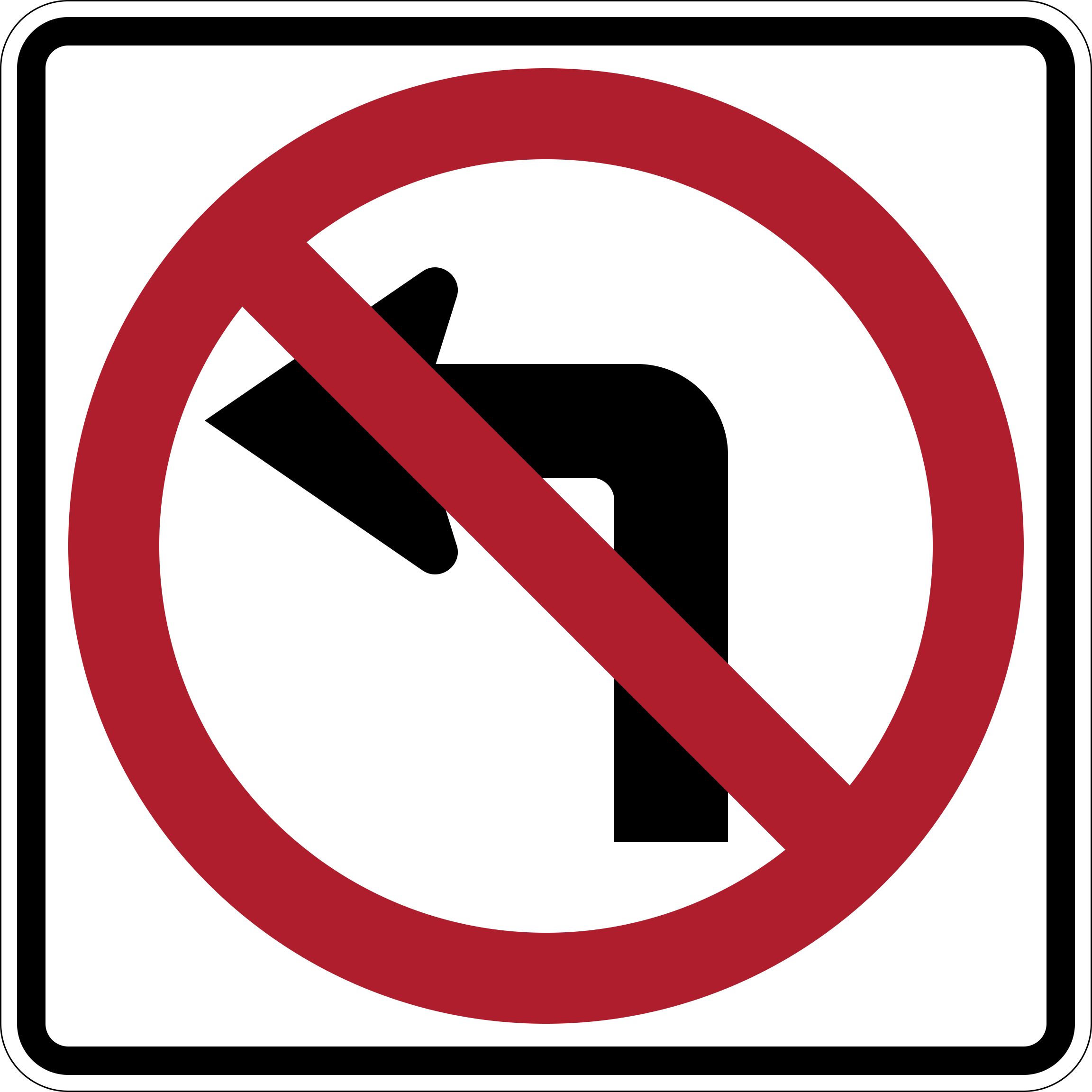
- You must turn left at the next intersection
- You may not turn in the arrow's direction
- Only trucks may turn left there
- The left lane becomes a railroad crossing
Show answer
You may not turn in the arrow's direction. A No Turn sign points toward the movement that is forbidden. With a left arrow, the restriction applies to a left turn, so the driver must choose another lawful movement. The choice “You must turn left at the next intersection” changes a prohibition into a command. The truck option adds a vehicle classification that is absent from the sign, and the railroad option describes an unrelated roadway feature. Check the arrow carefully before entering the intersection, because the handbook uses direction to identify which turn is not allowed.
Study this in the handbook: Regulatory, destination and service signs
QualitySpace is expanding to Wisconsin
We are a California-based independent insurance brokerage working on licensing in more states. We cannot help with Wisconsin insurance yet. Leave your email and we will let you know when we can.
Every question is written from the official Wisconsin Motorists' Handbook. Need paper? Printable WI practice test with answer key.
Last verified 2026-10-05. How we check every question · Study all 200 as flashcards
Frequently asked questions
How many questions are on this Wisconsin practice test?
This fixed set has 20 questions. It is test 4 of 10 from the 200 question Wisconsin bank. The real WI exam has a 15 question road sign section with 12 correct to pass, plus 50 knowledge questions with 40 correct to pass.
What is the passing score for the real Wisconsin test?
40 questions (80%) correctly to pass That figure comes from the official Wisconsin source cited on the DMV facts page.
How does this fixed test relate to the full Wisconsin bank?
Each numbered test is a fixed set of questions in a fixed order, so you can retake the same test later and compare. Every test mixes road signs and the other topics in about the same proportion as the full bank. Tests 1 to 10 together cover every question in the Wisconsin bank once. The full practice page mixes the whole bank at random.
Last verified 2026-10-05. See the Wisconsin DMV facts page for sourced state details.
Return to the full Wisconsin practice test · Study road signs