
Test 4 of 10 · 20 questions · Free 2026
IA Permit Practice Test 4
Jump to the test ↓A fixed 20 question set from the Iowa bank with answers and plain English explanations.
Question 1 of 20 · 0 right so far
All 20 questions in test 4
Every question below comes from the Iowa question bank on this page. Open a question to see the correct answer and the explanation. Nothing here is hidden behind a signup.
1. Which farm-equipment trip is listed as an Iowa driver's-license exemption?
- A daily commute in a passenger car owned by a farm
- Any farm trip across Iowa without a license
- Travel from a farm to any city beyond the county
- Travel between the home farm and nearby farmland within two miles
Show answer
Travel between the home farm and nearby farmland within two miles. The manual exempts driving farm equipment between the home farm and nearby farmland or a farm operation within two miles. The distance and equipment conditions matter. The exemption is not a blanket permission for every farm trip across Iowa, and it does not cover a passenger car simply because a farm owns it. A city destination beyond the stated nearby operation also changes the situation. For recall, pair the special vehicle with the short two-mile farm-to-farm connection.
Study this in the handbook: Who Needs a License and What to Carry
2. When a driver illegally passes a stopped school bus, what license consequence may Iowa impose?
- A mandatory suspension of exactly 30 days
- A warning with no possible license action
- Permanent revocation for the first violation
- Suspension for up to 180 days
Show answer
Suspension for up to 180 days. Iowa says a school-bus passing violation may result in a driver's license being suspended for up to 180 days. The phrase up to sets a maximum period, not an automatic 30-day term, and the manual does not describe a permanent first-offense revocation here. A warning-only response understates the possible consequence. When a bus displays the relevant warning lights and stop arm, stop as required for the roadway scenario and remain stopped until the manual's release condition is met.
Study this in the handbook: Stopping for School Buses
3. What is a safe way to manage a vehicle that is following too closely behind you?
- Block the passing lane by accelerating hard
- Tap the brakes repeatedly to punish the driver
- Signal early and encourage the driver to pass
- Stop in the travel lane without warning
Show answer
Signal early and encourage the driver to pass. The manual recommends signaling early for turns, stops, or lane changes when you are being tailgated, and trying to slow down enough to encourage the driver behind to pass. That gives the other driver more time to react and reduces the chance that your next maneuver surprises them. Repeated brake tapping, hard acceleration, or an abrupt stop can provoke conflict or cause a crash. Keep a generous gap ahead, make your intentions obvious, and if the problem persists, leave the traffic flow only where a safe place is available.
Study this in the handbook: Turns, Lane Changes, Passing and Tailgaters
4. Under Iowa's hands-free law, which phone activity is prohibited while driving?
- Manually scrolling or typing on the phone
- Using voice activation to place a call
- Listening through a hands-free system
- Receiving a safety-related traffic alert
Show answer
Manually scrolling or typing on the phone. The hands-free rules prohibit manually scrolling, typing, or interacting with a phone while driving. Voice activation and a hands-free call are treated differently, and receiving safety-related traffic information is listed as an exception. The wording does not make every electronic function illegal, but it does remove hand-held interaction from ordinary driving. Put the device away before moving, or use an approved hands-free method. The concrete cue is that a finger touching the phone to scroll or type is the prohibited behavior tested here.
Study this in the handbook: Iowa's Hands-Free Law and Distractions
5. When an emergency vehicle is on the other side of a divided highway, what does Iowa require?
- You do not have to stop
- You must stop in the median
- You must reverse to the last intersection
- You must follow the emergency vehicle
Show answer
You do not have to stop. Iowa provides an exception when a street or highway is separated by a median and the emergency vehicle is on the other side: the driver does not have to stop. This does not authorize crossing the median, reversing, or following the emergency vehicle. On an undivided road, the normal response remains to pull right, and a driver already in an intersection should clear it before pulling over. Look for the median and the emergency vehicle’s position before deciding.
Study this in the handbook: Intersections and Right of Way
6. What movement is prohibited by a red slash over a left-turn arrow?
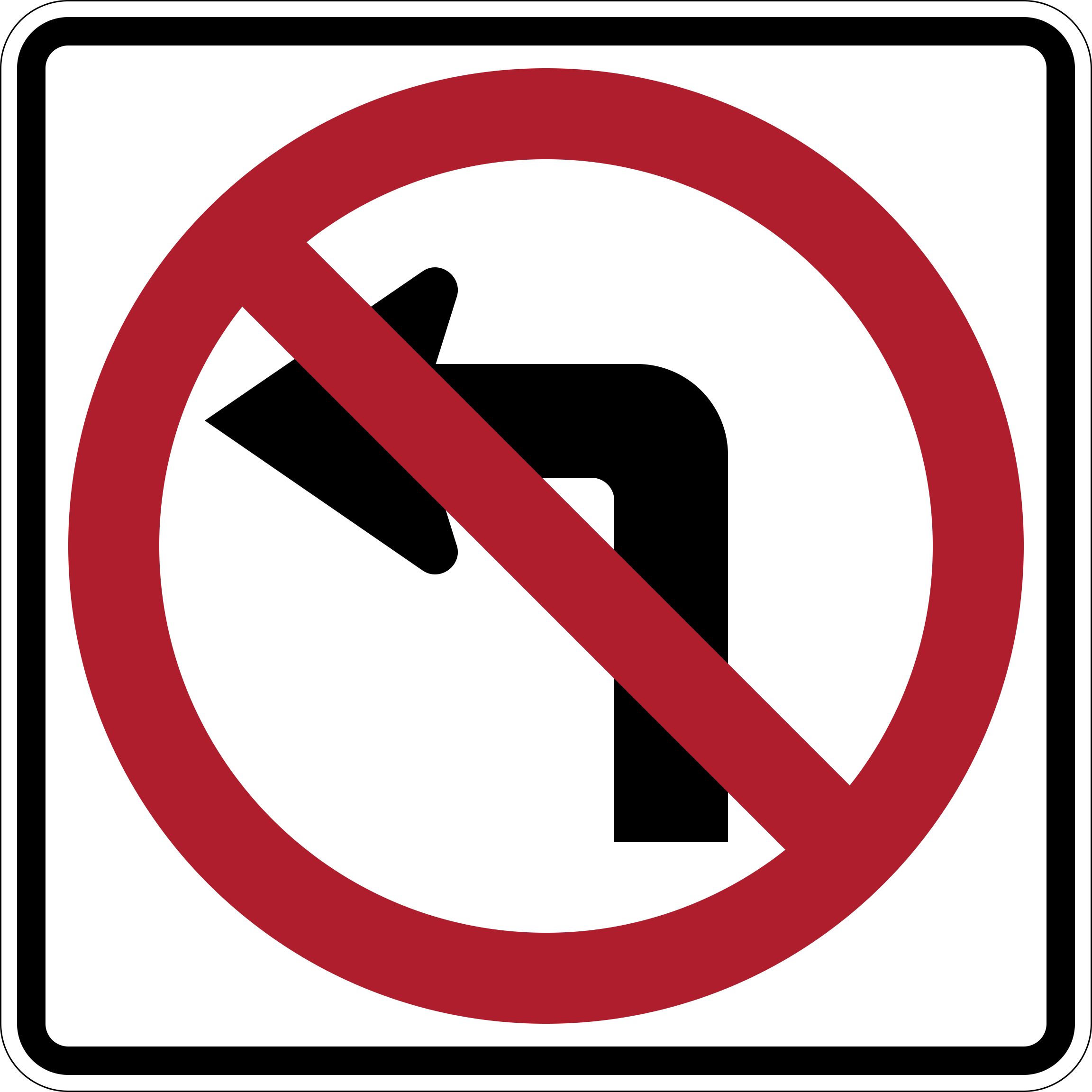
- A right turn
- A left turn
- A U-turn
- Going straight through the intersection
Show answer
A left turn. The symbol identifies a prohibited left turn. It does not automatically ban a right turn, a U-turn, or continuing straight, unless another sign or traffic control device restricts those movements. The arrow pictured inside the red circle is the key clue, and the slash tells you that movement cannot be made there. Before entering the intersection, choose a permitted path and watch for lane arrows or other signs that further limit where you may go.
Study this in the handbook: Regulatory Signs
7. When no limit is posted, what is the general speed limit on Iowa primary roads and urban interstate highways?
- 70 mph
- 65 mph
- 60 mph
- 55 mph
Show answer
60 mph. Iowa's general limit is 60 mph on all primary roads, on urban interstate highways, and on secondary roads, including unpaved roads, from sunrise to sunset. Seventy mph applies only on rural interstate highways. The 45 mph figure is for suburban districts and for any vehicle pulling another vehicle. Sixty five and 55 mph are not among Iowa's listed general limits. On any interstate, the minimum speed is 40 mph.
Study this in the handbook: Iowa Speed Limits
8. What following distance does the Iowa manual recommend at 40 mph?
- One second
- Two seconds at all speeds
- Four to five seconds
- Ten seconds
Show answer
Four to five seconds. At speeds of 40 mph, Iowa recommends a four to five second following distance. Two seconds may be sufficient for an experienced driver in normal conditions, but the manual gives four to five seconds at 40 mph. One second is tailgating, and ten seconds is more than the manual calls for. When roads are slippery or the vehicle ahead blocks your view, increase the gap to six or more seconds.
Study this in the handbook: Following Distance and Stopping
9. On a two-way road, what does a solid yellow line on your side of the center line indicate?
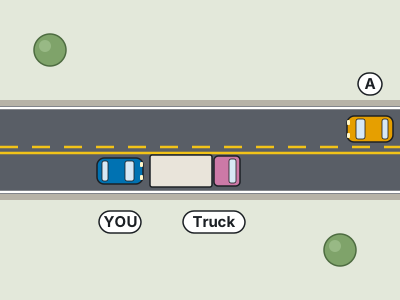
- You may pass only after sounding the horn
- Passing is required before the next intersection
- Your lane is reserved for left turns
- Passing is not allowed on your side of the line
Show answer
Passing is not allowed on your side of the line. A solid yellow line beside your lane marks a side where passing is not allowed. The restriction remains even when the opposing lane looks open, because the pavement marking identifies a no passing zone for your direction. The choice about sounding the horn invents a condition that cannot turn a prohibited maneuver into a legal one. A dashed line beside the solid line may permit traffic on the dashed-line side to pass when safe, but that permission belongs to the other direction. Use the line nearest your vehicle as the cue, and wait until your side is marked for passing before moving around another vehicle.
Study this in the handbook: Pavement Markings and Lane Use
10. What roadway change is announced by a lane-ends warning?

- A new passing lane will open
- Two lanes will soon become one
- The road will become one-way in both directions
- The shoulder will become a travel lane permanently
Show answer
Two lanes will soon become one. A lane-ends warning means two lanes of traffic will soon become one lane. Drivers must yield when merging, so do not assume the other lane has to disappear without cooperation. Check traffic beside and behind you, signal, and move into the continuing lane when a safe gap is available. The sign does not announce a new passing lane or a permanent shoulder lane. Early awareness helps you merge without an abrupt brake application.
Study this in the handbook: Warning, Guide and Service Signs
11. What do the shape and color of a traffic sign help a driver identify?
- The vehicle's required fuel grade
- The type of information the sign provides
- The distance since the last license renewal
- The weather forecast for the next hour
Show answer
The type of information the sign provides. Sign shape and color are recognition tools that help a driver understand whether the message concerns a law, hazard, destination, service, or another roadway condition. The choice “The type of information the sign provides” describes that purpose. The remaining choices invent information that traffic signs are not designed to provide. Once the general category is recognized, read the symbol or wording and respond to the actual instruction. For example, a warning color should prompt a scan for the hazard ahead, while a regulatory color signals an enforceable rule. Good sign reading combines the visual clue with the road situation.
Study this in the handbook: Sign Colors and Shapes
12. How must a driver handle a flashing red traffic signal?
- Treat it the same as a stop sign
- Treat it as a flashing yellow and continue without stopping
- Stop and wait until the signal becomes solid green
- Slow only if cross traffic is visible
Show answer
Treat it the same as a stop sign. A flashing red signal has the same stopping meaning as a stop sign. Come to a complete stop, check the intersection and crosswalk, and proceed only after the movement is safe and permitted. Continuing without stopping confuses red with flashing yellow. Waiting for a solid green is also unnecessary because the driver may go after the stop when the way is clear. Do not decide based only on whether another vehicle is visible; pedestrians and traffic can approach from outside the first glance. Stop first, then scan fully.
Study this in the handbook: Traffic Signals and Pedestrian Beacons
13. What scheduled fines does Iowa law set for seat belt and child restraint violations?
- $25 for every violation regardless of age
- $50, or $100 when the passenger is under 18
- $70 for a seat belt violation, or $135 for a restraint violation involving a passenger under 18
- $500 for the driver only, with no passenger fine
Show answer
$70 for a seat belt violation, or $135 for a restraint violation involving a passenger under 18. Iowa Code section 805.8A sets the scheduled fines for these violations. A seat belt violation under section 321.445 carries a $70 fine, and a violation of the restraint rule in section 321.446 carries a $135 fine. The schedule has no flat $25 fine for every case and no $500 driver only fine. The manual explains who must be restrained: adults 18 and older must wear a seat belt in the front seats, and passengers under 18 must be secured in every seating position, front and back. Buckle every occupant before the vehicle moves.
14. On a road with two or more lanes moving in the same direction, what is the left lane generally used for?
- Passing
- Parking whenever traffic is heavy
- Entering from driveways only
- Traveling slowly below the flow of traffic
Show answer
Passing. Iowa's general lane-use guidance says the left lane is generally used for passing when two or more lanes travel in the same direction. It is not a parking lane, a driveway-only lane, or a place to remain slow while other traffic approaches. On roads with three or more lanes, the manual advises staying in the right or center lane except to pass. Use the left lane for the passing task, then return when the maneuver is complete and conditions allow.
Study this in the handbook: Pavement Markings and Lane Use
15. At an uncontrolled intersection on a rural gravel road, what should drivers be prepared to do?
- Use the shoulder as the normal through lane
- Follow a dust cloud without reducing speed
- Assume the crossing is clear after one glance
- Stop for oncoming traffic
Show answer
Stop for oncoming traffic. Rural gravel intersections may have no yield or stop signs, and dust can hide a crossing vehicle. Drivers should slow down and be prepared to stop for oncoming traffic. Following a dust cloud at speed reduces the time available to react, while a single glance cannot prove that the crossing is clear. The shoulder is softer and less stable, not a substitute lane. Approach with reduced speed, look beyond the dust, and keep enough control to stop before entering the other road.
Study this in the handbook: Roundabouts and Uncontrolled Intersections
16. Under Iowa's hands-free law, may you type a destination into your GPS while driving?
- Yes, GPS is exempt
- No, entering an address while driving is prohibited
- Yes, if you are under 25 mph
- Yes, at night only
Show answer
No, entering an address while driving is prohibited. Iowa's hands-free law says you cannot enter an address into a GPS while driving. You also cannot hold the phone, scroll, type, view texts or videos, or make video calls. There is no GPS exemption and no speed or time of day exception. Set your destination before you start, or stop completely off the traveled portion of the roadway first. Voice commands may be used for calls.
Study this in the handbook: Iowa's Hands-Free Law and Distractions
17. What does a red circle with a red slash over a symbol on a regulatory sign mean?
- The roadway is reserved for the symbol shown
- The action shown is recommended during bad weather
- The action shown by the symbol is prohibited
- The symbol identifies the next available service
Show answer
The action shown by the symbol is prohibited. A red circle with a red slash is used on regulatory signs to show that a driver cannot do the action represented by the symbol. Examples include no left turn, no right turn, and no U-turn. The marking is not a recommendation, reservation, or service symbol. Study the picture beneath the slash because that picture identifies the prohibited movement. Before turning, scan for the sign so a permitted maneuver at one intersection is not carried into a restricted one.
Study this in the handbook: Regulatory Signs
18. Does Iowa's implied consent law apply to a driver licensed in another state who is driving through Iowa?
- No, only Iowa license holders
- Yes, it applies to non-resident drivers too
- Only if the driver stays more than 30 days
- Only for commercial drivers
Show answer
Yes, it applies to non-resident drivers too. Iowa license holders agree to testing on demand by law enforcement, and the manual states the law also applies to any non-resident drivers traveling in the state. An out of state license does not exempt a driver, and there is no 30 day residency condition or commercial only limit for this rule. Refusing the test brings an automatic one year revocation of the license.
Study this in the handbook: Operating While Intoxicated (OWI)
19. What happens to stopping distance as vehicle speed increases?
- It disappears when the brakes are applied
- It becomes shorter on every road surface
- It stays exactly the same
- It takes longer to stop
Show answer
It takes longer to stop. Higher speed increases the distance needed to bring a vehicle to a stop. The shorter-distance choice ignores the extra travel that occurs before and during braking, while the unchanged option treats speed as irrelevant. Stopping distance cannot disappear when the brakes are used; braking is the process that reduces motion over distance. Scan farther ahead as speed rises, leave a larger cushion, and begin slowing early rather than waiting for a hazard to be close. A useful cue is to connect more speed with more space required, even when the road and vehicle are in good condition.
Study this in the handbook: Following Distance and Stopping
20. After shifting a stuck accelerator to neutral, when should the driver turn off the engine?
- After the vehicle has stopped
- Before steering toward a safe place
- Only after reaching a fuel station
- Immediately while traveling at full speed
Show answer
After the vehicle has stopped. The manual places engine shutdown after the vehicle has been brought to a stop. Turning the engine off immediately at full speed can create an added loss of control, especially in vehicles whose steering may lock when the key is removed. The fuel station choice adds an unsafe destination and the steering choice ignores the need to leave the roadway safely. Keep your attention on the path, select neutral, move off the road when safe, stop, and then switch off the engine. That order reduces the emergency one step at a time.
Study this in the handbook: Equipment Failures and Crashes
QualitySpace is expanding to Iowa
We are a California-based independent insurance brokerage working on licensing in more states. We cannot help with Iowa insurance yet. Leave your email and we will let you know when we can.
Every question is written from the official Iowa Driver's License Manual. Need paper? Printable IA practice test with answer key.
Last verified 2026-10-05. How we check every question · Study all 210 as flashcards
Frequently asked questions
How many questions are on this Iowa practice test?
This fixed set has 20 questions. It is test 4 of 10 from the 210 question Iowa bank.
How does this fixed test relate to the full Iowa bank?
Each numbered test is a fixed set of questions in a fixed order, so you can retake the same test later and compare. Every test mixes road signs and the other topics in about the same proportion as the full bank. Tests 1 to 10 together cover 200 of the 210 questions in the Iowa bank, each once. The full practice page mixes the whole bank at random.
Last verified 2026-10-05. See the Iowa DMV facts page for sourced state details.