
Test 6 of 10 · 20 questions · Free 2026
IA Permit Practice Test 6
Jump to the test ↓A fixed 20 question set from the Iowa bank with answers and plain English explanations.
Question 1 of 20 · 0 right so far
All 20 questions in test 6
Every question below comes from the Iowa question bank on this page. Open a question to see the correct answer and the explanation. Nothing here is hidden behind a signup.
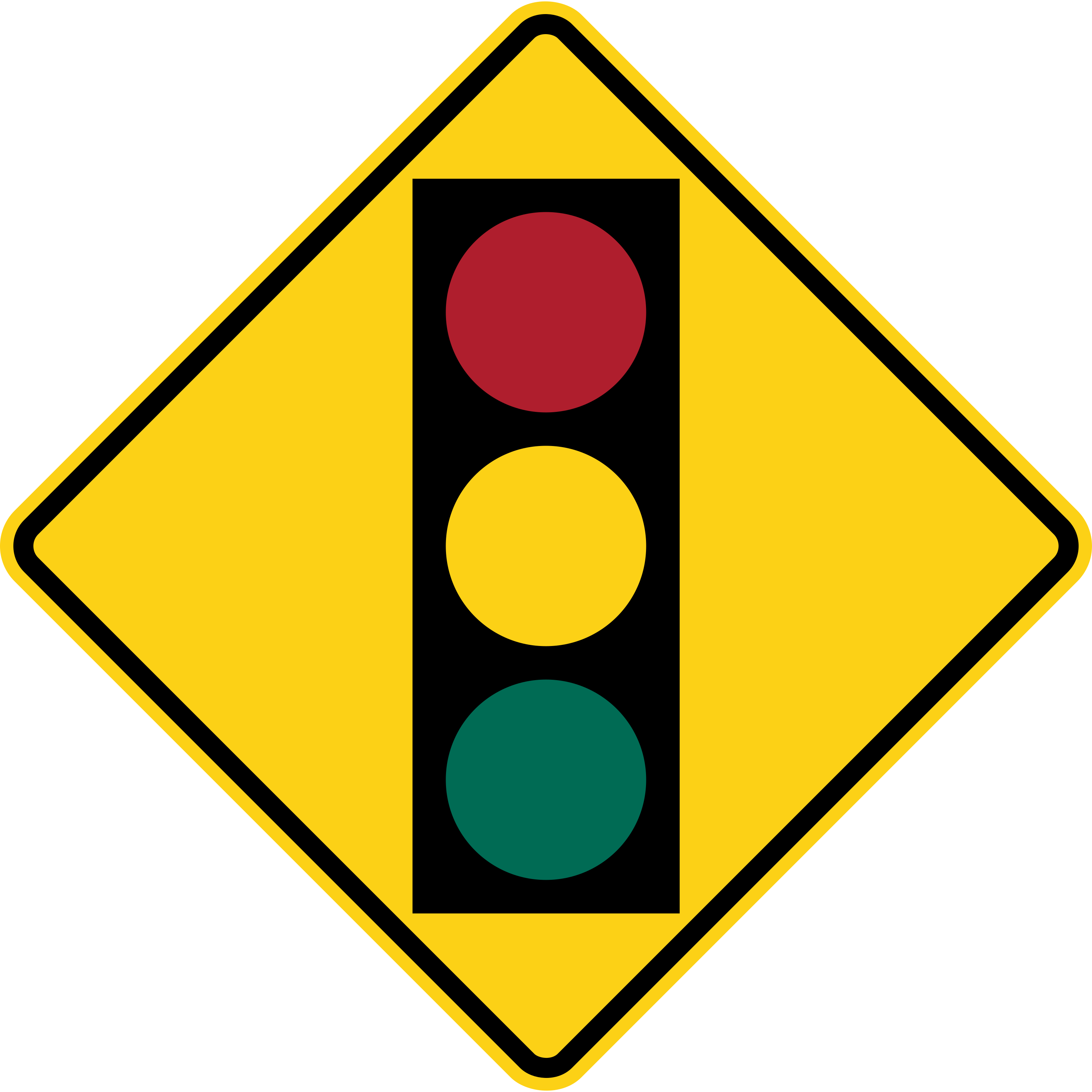
1. What is ahead when a signal-ahead warning is posted?
- A railroad crossing with no signal
- An intersection and a stop light
- A lane reserved for buses
- A road that ends without an intersection
Show answer
An intersection and a stop light. A signal-ahead warning tells you that an intersection and traffic light are coming. It is commonly placed where higher speeds make early preparation important. Begin checking your speed, lane position, and sightline so you can respond to the light without a sudden maneuver. The sign does not mean the light is currently red, nor does it describe a railroad or a reserved lane. Expect changing traffic and be ready to stop smoothly.
Study this in the handbook: Warning, Guide and Service Signs
2. What does an Iowa yield sign tell a driver to do?
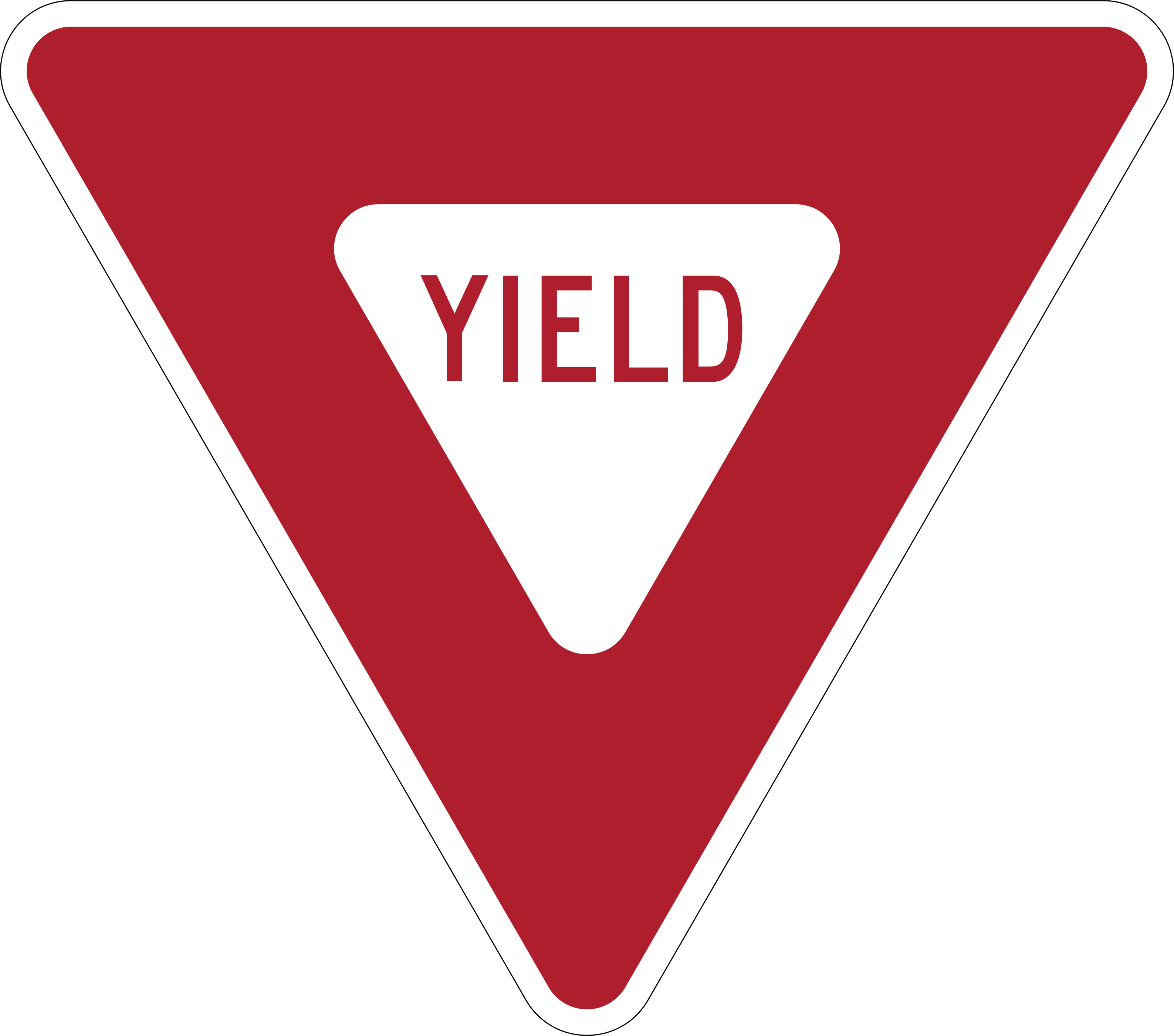
- Slow down and yield to traffic in the intersection or roadway being entered
- Stop at every yield sign even when no traffic is present
- Accelerate so cross traffic must wait
- Enter the roadway without checking for other users
Show answer
Slow down and yield to traffic in the intersection or roadway being entered. A yield sign directs the driver to slow down and yield the right of way to traffic in the intersection being crossed or the roadway being entered. It is not an automatic full-stop command in every circumstance, so the choice “Stop at every yield sign even when no traffic is present” adds a condition the manual does not state. Accelerating would reverse the sign's purpose, and entering without checking defeats the obligation to yield. Approach with reduced speed, scan for traffic, and stop if the situation requires it to give others priority.
Study this in the handbook: Regulatory Signs
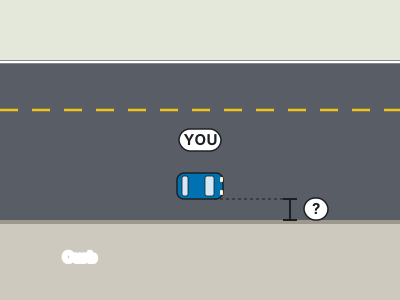
3. If parking beside a curb in Iowa, how close should the vehicle be?
- Within 3 feet of the curb
- Within 18 inches of the curb or closer
- At least 18 inches away from the curb
- With two wheels resting on the curb
Show answer
Within 18 inches of the curb or closer. When parking on a roadway beside a curb, Iowa's manual says to park within 18 inches of the curb or closer. The goal is to stay away from moving traffic without creating an obstruction. Three feet is farther than the stated limit, and the choice requiring at least 18 inches reverses the direction of the measurement. Placing wheels on the curb is not the parking guidance. Read the number as a maximum lateral gap: the vehicle may be nearer, but not farther than 18 inches.
Study this in the handbook: Railroad Crossings and Rural Roads
4. What education must an Iowa applicant under 18 show when applying for a license?
- Two years of unsupervised driving experience
- Completion of a college defensive-driving seminar
- A certificate from a vehicle repair school
- Successful completion of an Iowa-approved driver's education course
Show answer
Successful completion of an Iowa-approved driver's education course. Applicants under 18 must show successful completion of an Iowa-approved driver's education course. The requirement is tied to age and approval by Iowa, not to college attendance, mechanical training, or an arbitrary amount of unsupervised experience. The manual presents education as one application step, alongside testing and screening. A helpful cue is to notice that the rule asks for documented course completion, so a claim about experience alone cannot replace the required education evidence.
Study this in the handbook: Who Needs a License and What to Carry
5. What do fluorescent pink signs mean on Iowa roads?
- Construction zones
- School zones
- Recreation areas
- Warning and guide signs for incident management, such as crash cleanup or debris removal
Show answer
Warning and guide signs for incident management, such as crash cleanup or debris removal. Fluorescent pink is the sign color for incident management. Pink warning and guide signs mark temporary situations such as crash cleanup, debris removal and the traffic changes around them. Orange marks construction work, fluorescent yellow green marks school and pedestrian areas, and brown points to recreation and cultural sites. When you see pink, expect responders in the road and slow down.
Study this in the handbook: Sign Colors and Shapes
6. How far behind you must you be able to see in your rearview mirror under Iowa's rules?
- At least 200 feet
- At least 50 feet
- At least 1,000 feet
- Only as far as the car behind you
Show answer
At least 200 feet. You must be able to see at least 200 feet behind you in the rearview mirror. If a load blocks that view, you must have an outside mirror, and vans must have both left and right outside mirrors. Fifty feet is too short, 1,000 feet is not the rule, and simply seeing the car behind you does not meet a fixed distance standard. Backup cameras and mirrors alone should not be trusted for backing.
Study this in the handbook: Vehicle Checks, Seat Belts and Child Restraints
7. Which person is listed as an exception to Iowa's hands-free law?
- A driver on a rural road
- A driver in stop-and-go traffic
- A driver using the phone for work email
- A member of a public safety agency performing official duties
Show answer
A member of a public safety agency performing official duties. The exceptions to Iowa's hands-free law are members of public safety agencies performing official duties, healthcare professionals in emergencies, and a person receiving safety related alerts such as emergency, traffic, or weather information. Rural roads and slow traffic are not exceptions, and checking work email is exactly what the law bans. Other drivers must stop completely off the roadway before handling a phone.
Study this in the handbook: Iowa's Hands-Free Law and Distractions
8. Which vehicle must a driver yield to when it uses a siren or air horn?
- Only a school bus with flashing lights
- Only a private vehicle with hazard lights
- A police vehicle, fire engine, ambulance, or other emergency vehicle
- Only a maintenance vehicle with amber lights
Show answer
A police vehicle, fire engine, ambulance, or other emergency vehicle. Iowa requires drivers to yield to a police vehicle, fire engine, ambulance, or another emergency vehicle using a siren or air horn, or red or blue flashing lights. A private vehicle with hazard lights, a school bus, and a maintenance vehicle with amber lights are covered by separate rules and do not replace the emergency-vehicle definition here. Identify the vehicle and warning equipment first, then pull to the right or as near to the right as possible so the responding vehicle has a clear route.
Study this in the handbook: Intersections and Right of Way
9. When the top two red lights of a pedestrian hybrid beacon become solid, what must motorists do?
- Continue without slowing
- Stop for pedestrians
- Speed up before the lights flash
- Turn off the headlights
Show answer
Stop for pedestrians. A pedestrian hybrid beacon progresses through several stages, and solid red lights require motorists to stop for pedestrians. Proceeding without slowing ignores the active stop phase, while accelerating or turning off headlights has no role in the signal sequence. After a period, the top red lights begin flashing, and motorists who have not already stopped must stop and may proceed cautiously only when the crosswalk is clear. The practical cue is the pair of solid red lights at the top of the beacon. Treat that display as a stop instruction and watch the crossing area before moving again.
Study this in the handbook: Traffic Signals and Pedestrian Beacons
10. What testing agreement does an Iowa driver license holder make under implied consent?
- Consent to a field sobriety test upon demand by law enforcement
- Consent only after a court conviction
- Consent only when the driver is an Iowa resident
- Consent to testing only if no traffic stop occurred
Show answer
Consent to a field sobriety test upon demand by law enforcement. By holding an Iowa driver's license, the driver contractually agrees to consent to a field sobriety test when law enforcement demands one. The agreement is not delayed until a conviction, and it also applies to nonresident drivers traveling in Iowa. The choices “Consent only when the driver is an Iowa resident” and “Consent to testing only if no traffic stop occurred” add limits that the manual does not recognize. Implied consent is a condition connected to the driving privilege, not a promise that testing will occur only in a particular case. Treat a lawful demand seriously and understand that refusal has separate consequences.
Study this in the handbook: Operating While Intoxicated (OWI)
11. Under Iowa's passing rules, within what distance of a railroad crossing is passing prohibited?
- 50 feet
- 15 feet
- 100 feet
- 1,000 feet
Show answer
100 feet. Iowa prohibits passing within 100 feet of a railroad crossing, the same distance that applies near intersections and posted narrow bridges. Fifteen feet is the minimum gap to leave between your vehicle and the nearest rail when stopped, and 50 feet is the Iowa no parking distance from a crossing. One thousand feet is not a passing rule. The manual also says to avoid passing where a vehicle may enter the roadway ahead of you, such as intersections and driveways.
Study this in the handbook: Turns, Lane Changes, Passing and Tailgaters
12. What does Iowa right-of-way law give a driver?
- Permission to continue whenever the driver arrives first
- A guarantee that other road users will stop
- A duty to yield when required, but not an automatic right to proceed
- Priority over pedestrians in every intersection
Show answer
A duty to yield when required, but not an automatic right to proceed. Iowa's law says who must yield, but it does not grant anyone an automatic right to occupy the intersection. Even when a driver appears favored by a rule, the driver should do everything possible to avoid striking a pedestrian or another vehicle. The guarantee and arrival-first choices encourage claiming space instead of preventing a crash. Pedestrians are not subordinate in every intersection, so the choice “Priority over pedestrians in every intersection” is also unsafe. Use the rule to coordinate, then keep scanning and yield when another road user has not cleared the conflict.
Study this in the handbook: Traffic Signals and Pedestrian Beacons
13. What is Iowa's general unposted limit on a rural interstate highway?
- 55 mph
- 70 mph
- 65 mph
- 60 mph
Show answer
70 mph. The manual gives rural interstate highways a general unposted limit of 70 mph. The 60 mph choice belongs to primary roads, urban interstates, and secondary roads during the listed period, while 55 and 65 mph are not the general rural interstate figure in this section. This number is still a maximum for ideal conditions. A driver must consider the road, weather, traffic, and visibility before choosing a safe speed, and a lower limit can be posted for particular conditions. Identify rural interstate first, then recall its higher figure.
Study this in the handbook: Iowa Speed Limits
14. What speed does Iowa's reflective orange triangle identify on a vehicle's rear?
- The vehicle is traveling 35 mph or less
- The vehicle is traveling exactly 25 mph
- The vehicle is carrying hazardous cargo
- The vehicle is stopped for an emergency
Show answer
The vehicle is traveling 35 mph or less. A reflective orange triangle marks a vehicle traveling at 35 mph or less. It warns approaching drivers about slow equipment such as road maintenance machines, farm vehicles, or horse-drawn wagons. The symbol does not set an exact 25 mph speed, identify hazardous cargo, or mean the vehicle is stopped. Treat the triangle as a speed-and-awareness cue: reduce your approach speed, allow extra time, and pass slowly when the roadway permits.
Study this in the handbook: Warning, Guide and Service Signs
15. At night, an oncoming vehicle's headlights are blinding you. What does Iowa say to do?
- Flash your high beams back at the other driver
- Speed up to get past the glare quickly
- Slow down and watch the white stripe at the right edge of the pavement
- Close your eyes briefly until the vehicle passes
Show answer
Slow down and watch the white stripe at the right edge of the pavement. Glare from oncoming headlights makes it hard to see. If another vehicle's lights blind you, Iowa says to slow down and keep your eyes on the white stripe along the right edge of the pavement, which keeps you in your lane while the light passes. The feeling of being blinded goes away quickly. Flashing your own high beams only adds glare, and speeding up gives you less time to react while your vision is reduced. Looking toward the right side of the road also helps cut glare.
16. According to the Iowa manual, being awake for 18 hours straight is as impairing as what BAC?
- 0.05 percent
- 0.02 percent
- 0.08 percent
- 0.15 percent
Show answer
0.08 percent. Being awake for 18 hours straight is as impairing as a blood alcohol concentration of 0.08 percent, which is legally drunk and leaves you at equal risk for a crash. The manual says drowsy driving is just as dangerous as drunk driving, and drowsy drivers have slow reaction times. Plan rest before a long drive, stop when you feel drowsy, and switch drivers when you notice warning signs.
Study this in the handbook: Operating While Intoxicated (OWI)
17. When a steady yellow signal appears, which response matches Iowa guidance?
- Do not enter if you can stop safely; otherwise continue cautiously
- Enter the intersection faster to beat the red signal
- Stop in the intersection even if the vehicle has already crossed the line
- Treat it as a flashing red signal and wait for a full cycle
Show answer
Do not enter if you can stop safely; otherwise continue cautiously. A steady yellow signal marks a transition and calls for a judgment about stopping safely. If the vehicle can stop without creating a hazard, it should not enter the intersection. If stopping safely is no longer possible, the driver should proceed through with caution. Accelerating to beat red is an unsafe gamble, while stopping after already entering can block cross traffic. Look ahead, check the intersection, and avoid a harsh stop when the vehicle is too close to the line. Yellow means prepare and decide, not race.
Study this in the handbook: Traffic Signals and Pedestrian Beacons
18. If you cannot see the driver of a large truck in its mirror, what should you assume?
- The truck must yield immediately
- The truck driver is signaling you to pass
- You are outside every truck blind spot
- The truck driver cannot see you
Show answer
The truck driver cannot see you. Large trucks have no-zones at the front, back, and sides. The manual gives a simple visibility test: if you cannot see the truck driver in the truck's mirror, that driver cannot see you. The signal choice invents permission to pass, and being unable to see the driver is evidence of a blind spot, not proof that you are clear. Increase space and change position only when the maneuver is safe. Avoid lingering beside or directly behind the truck.
Study this in the handbook: Trucks, Motorcycles, Bicyclists and Pedestrians
19. A front tire blows out. Which way will the car jerk, and what should you avoid?
- Toward the side with the good tire; avoid braking at all
- Toward the side with the flat tire; avoid overcorrecting the steering
- Straight ahead; avoid taking your foot off the gas
- Toward the center line; avoid using the shoulder
Show answer
Toward the side with the flat tire; avoid overcorrecting the steering. Iowa warns that a front tire blowout can be more serious than other flats because it jerks the car violently toward the side with the flat tire. The danger is overcorrecting by yanking the wheel the other way. Hold the steering wheel tightly, keep the car going straight, take your foot off the gas, and use the brakes lightly. Straighten the car out, then move gradually to the right shoulder as soon as possible and stop off the road. Pulling toward the good side or refusing to brake is not the advice given.
Study this in the handbook: Equipment Failures and Crashes
20. What does a brown sign usually point you toward in Iowa?
- Hospitals and fuel stations
- Road work zones
- Directions and distances to cities
- Recreation areas, parks, and historical sites
Show answer
Recreation areas, parks, and historical sites. Iowa uses sign color to hint at the message. Brown signs mark recreation and cultural points of interest, giving directions to historical sites, parks, or recreational areas. Hospitals and fuel stations are traveler services, which Iowa puts on blue signs. Road work and maintenance warnings are orange, and green signs show where a place is or how far it is from you. When you are looking for a state park or historical site, watch for brown.
Study this in the handbook: Sign Colors and Shapes
Every question is written from the official Iowa Driver's License Manual. Need paper? Printable IA practice test with answer key.
Last verified 2026-10-05. How we check every question · Study all 210 as flashcards
Frequently asked questions
How many questions are on this Iowa practice test?
This fixed set has 20 questions. It is test 6 of 10 from the 210 question Iowa bank.
How does this fixed test relate to the full Iowa bank?
Each numbered test is a fixed set of questions in a fixed order, so you can retake the same test later and compare. Every test mixes road signs and the other topics in about the same proportion as the full bank. Tests 1 to 10 together cover 200 of the 210 questions in the Iowa bank, each once. The full practice page mixes the whole bank at random.
Last verified 2026-10-05. See the Iowa DMV facts page for sourced state details.