
Test 15 of 25 · 20 questions · Free 2026
IA Permit Practice Test 15
Jump to the test ↓A fixed 20 question set from the Iowa bank with answers and plain English explanations.
Question 1 of 20 · 0 right so far
All 20 questions in test 15
Every question below comes from the Iowa question bank on this page. Open a question to see the correct answer and the explanation. Nothing here is hidden behind a signup.
1. During extremely dusty conditions on a rural road, which lights should make the vehicle more visible?
- No lights until the dust clears
- High beams only
- Parking lights only
- Low-beam headlights
Show answer
Low-beam headlights. The manual directs drivers to use low-beam headlights during extremely dusty conditions so other road users can see the vehicle. High beams are not the instruction given for this situation; the manual names low beams. Parking lights provide less useful visibility, and waiting for the dust to clear removes an important warning to approaching traffic. The light choice does not replace slower, alert driving. Reduce speed, expect limited sight distance, look for vehicles entering from the side, and keep enough space to stop if the dust hides a hazard.
Study this in the handbook: Railroad Crossings and Rural Roads
2. Other Iowa roads look clear on a freezing morning, yet a bridge deck shines icy. Why?
- Bridge decks are always salted last in every storm
- Sunlight never reaches any bridge deck in winter
- Cold air under the deck freezes moisture faster there
- Bridges collect extra rain only on their decks
Show answer
Cold air under the deck freezes moisture faster there. Black ice in Iowa can occur anywhere, but it is common on bridges and overpasses, where moisture freezes quickly due to circulating air both above and below the road surface. Bridges and overpasses may therefore be slippery even when other road surfaces are not. Black ice is hardly visible and catches drivers by surprise. Ease speed before every bridge in freezing weather, avoid sudden inputs on the deck, and increase following distance through winter generally.
Study this in the handbook: Night Driving, Bad Weather and Floods
3. You overtake a person cycling on a two lane Iowa road. How must you pass that rider?
- Squeeze past within the same lane as the rider
- Pass half in the lane and half on the shoulder
- Change lanes fully and give the rider the whole lane
- Brush past closely if no cars are coming now
Show answer
Change lanes fully and give the rider the whole lane. When passing bicyclists in Iowa, completely change lanes, giving the bicyclist the entire lane like you would any other vehicle. Do not return to the right until you can see the bicyclist in your rearview mirror. Motorists may drive in bicycle lanes only for turning movements, checking beside and behind carefully. Be ready to yield to bicyclists even when they should yield, since riders are vulnerable in crashes. Full lane passing replaces guesswork about handlebar clearance.
Study this in the handbook: Trucks, Motorcycles, Bicyclists and Pedestrians
4. You stop to cross a rural Iowa four lane road with a median from a side road. How should you cross?
- Cross the whole road in one move without stopping
- Stop in the far lanes to check traffic behind you
- Cross only when a truck waves you through the median
- Cross to the median, stop there, then cross the rest
Show answer
Cross to the median, stop there, then cross the rest. When crossing or turning left onto a rural four lane Iowa road, do not try to cross both directions at one time to avoid stopping in the median. Stop at the stop sign, look left, and proceed into the median when safe. Remain stopped in the median, look right, and cross or turn left when safe. Traffic moves very fast here, so caution matters. Longer vehicles such as semis may not fit a narrow median, requiring extra judgment.
5. Extra chevron signs line an Iowa curve beside the curve warning. Why are they there?
- To mark where parking is allowed along the curve
- To show the exact speed limit through the curve
- To draw added attention to the direction change
- To replace the need for any curve warning sign
Show answer
To draw added attention to the direction change. Chevron signs in Iowa are used in addition to curve signs when there is a need to draw added attention to a change in the road direction. A row of chevrons traces the bend so drivers can judge its path at night or in poor weather. They do not set speed limits or parking areas, and they never replace the advance curve warning. Slow before the curve and steer smoothly through the line the chevrons reveal.
Study this in the handbook: Warning, Guide and Service Signs
6. You pass an Iowa deer crossing warning on a rural road at dusk. What should you do?

- Slow down and watch carefully for deer moving
- Speed up to clear the deer area more quickly at dusk
- Watch only the left ditch for any deer sign
- Stop in the lane and wait until dark passes
Show answer
Slow down and watch carefully for deer moving. A deer crossing warning in Iowa means deer may try to cross the roadway in the area. Slow down and watch carefully, especially at sunrise and sunset when deer move most. Deer travel in groups, so one animal often means more following. If an animal appears with no time to stop, do not swerve or veer into a more severe crash. Scanning both road edges early gives the braking room that speed removes.
Study this in the handbook: Warning, Guide and Service Signs
7. At night in Iowa, what should a driver watch for to spot bicyclists on the road?
- Bicycle reflectors or lights moving at night
- Only bicycle bells ringing from side streets
- Painted lane arrows pointing toward bicycles
- Service signs listing bicycle rental locations
Show answer
Bicycle reflectors or lights moving at night. Look for bicyclists at night in Iowa and watch for their reflectors or lights. People riding bicycles have the right to be on the road and are often prohibited from riding on sidewalks, so respect their right to be there. When passing, completely change lanes and give the bicyclist the entire lane, then do not return right until the bicyclist appears in your rearview mirror. Watch for bikes coming from behind before turning right. Reflectors often reveal a rider before the rider shape itself.
Study this in the handbook: Trucks, Motorcycles, Bicyclists and Pedestrians
8. Starting from a stop on Iowa ice, how should a driver pull away?
- Turn the wheels first, then accelerate hard away
- Keep wheels straight and accelerate gently away
- Spin the tires until they bite through the ice
- Rock the car with quick hard gas pedal pumps
Show answer
Keep wheels straight and accelerate gently away. When starting to drive from a stopped position on Iowa ice or snow, keep the wheels straight ahead and accelerate gently to avoid spinning the tires. Decrease speed throughout the trip to make up for lost traction, and stay far behind the vehicle ahead so a sudden stop will not cause skidding. Clear the entire vehicle of snow and ice before driving, including lights and signals. Hard launches and turned wheels spend the little grip available before the vehicle is even moving.
Study this in the handbook: Night Driving, Bad Weather and Floods
9. In Iowa, how is a reserved lane for special vehicles often marked?
- With signs plus a white diamond marking
- With a red X light above and a lowering gate
- With an orange triangle fixed on a slow vehicle
- With mile markers spaced along the shoulder
Show answer
With signs plus a white diamond marking. Reserved lanes in Iowa are marked by signs stating that the lane is reserved for special use. They often have a white diamond posted at the side of the road, painted on the road surface, or both. Do not travel in one unless you are operating that type of vehicle. A red X belongs to reversible lanes, and an orange triangle marks a slow moving vehicle. The diamond is your quick cue that the lane is not open to general traffic.
Study this in the handbook: Pavement Markings and Lane Use
10. In Iowa, who counts as a pedestrian for right of way at crosswalks?
- Only people walking without any device at all
- People on foot and people using human powered devices
- Only children walking to or from a school
- Only people crossing at a marked crosswalk
Show answer
People on foot and people using human powered devices. Iowa vehicles must yield the right of way to pedestrians on foot and to those using any human powered device, also called a pedestrian conveyance. That group reaches beyond people walking with nothing in their hands. Children, adults, and device users all count, and crosswalk duties are not limited to painted crossings alone. When the manual says pedestrians, it means pedestrians and pedestrian conveyances together. Scan sidewalks and crossing paths for wheels as well as feet before you turn.
11. How much space does the Iowa manual say you should keep between your chest and the steering wheel airbag?
- At least 2 inches
- At least 24 inches
- It does not matter with modern airbags
- At least 10 inches
Show answer
At least 10 inches. Sit with your back against the seat and at least 10 inches between the steering wheel and your chest, with the airbag pointed at your chest. Two inches is dangerously close, and 24 inches is not the figure the manual gives. Airbag distance always matters. Shorter drivers may need a seat cushion or pedal extenders to sit safely 10 inches from the airbag.
Study this in the handbook: Vehicle Checks, Seat Belts and Child Restraints
12. A flashing yellow arrow allows a left turn at an Iowa signal. What must happen before turning?
- Oncoming traffic must yield to your flashing arrow turn
- Pedestrians must wait until your turn finishes
- You must stop fully even with a clear path
- Yield to oncoming traffic and pedestrians first
Show answer
Yield to oncoming traffic and pedestrians first. A flashing yellow arrow in Iowa means yield to oncoming traffic and pedestrians, then turn left proceeding with caution. Oncoming traffic has a green light during that phase. A steady green arrow differs because oncoming traffic must stop, yet turning drivers still yield to vehicles and pedestrians already in the intersection. A steady red arrow means turning drivers must stop. Matching arrow color and steadiness to the right duty prevents left turn conflicts.
Study this in the handbook: Warning, Guide and Service Signs
13. A winter storm is forecast along your planned Iowa route. What does the manual say about planning?
- Leave at once so you are ahead of the weather and off the road early
- Rely on cruise control so your speed stays even
- Wait until you are on the road to check conditions
- Do your research first and adjust or postpone the trip if needed
Show answer
Do your research first and adjust or postpone the trip if needed. Iowa says the best way to prepare for inclement weather is to avoid getting caught by surprise. Do your research before you go so you can determine if you need to adjust or postpone your trip. The 511 site and app show weather related road conditions and camera images. If you must drive in bad weather, slow down and increase your following distance, and do not use cruise control.
14. You need distance to the next Iowa city on a trip. Which signs supply that help?
- Regulatory signs showing enforceable town ordinances
- Warning signs showing hazard distances in towns
- Guide signs showing directions and town distances
- Incident signs showing cleanup distances in towns
Show answer
Guide signs showing directions and town distances. Guide signs in Iowa show directions and distance to various locations or areas such as cities, airports, and state lines, and to places of interest such as national parks, historical areas, or museums. Mile markers add your exact position from the state entry point. Regulatory signs state enforceable laws, and warning signs flag hazards instead. Green coloring usually carries guide information. Reading guide signs early prevents late lane dives near exits.
Study this in the handbook: Warning, Guide and Service Signs
15. An Iowa sign slashes a right turning arrow where you planned to turn. What is banned?
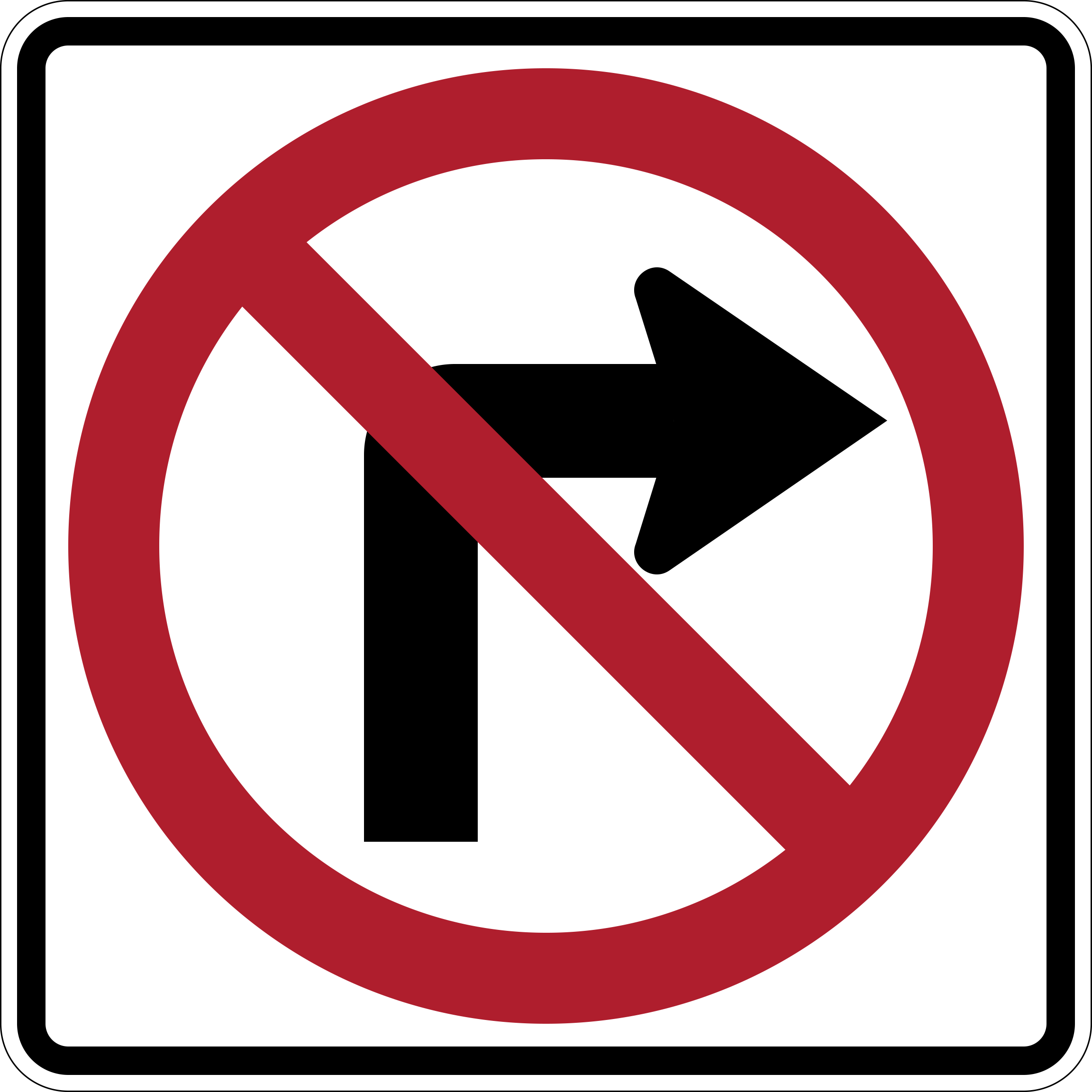
- Turning left where that sign is posted
- Turning right where that sign is posted
- Driving straight past that sign location
- Turning right at every Iowa intersection
Show answer
Turning right where that sign is posted. A red slash over a right turn arrow in Iowa forbids turning right at that location. The slash system also bans left turns and U turns where those symbols appear, so the arrow under the slash decides. Straight travel remains governed by signals and lane markings. Do not creep around the corner on the shoulder to evade the ban. Continue to a corner where the turn is lawful and signaled properly.
Study this in the handbook: Regulatory Signs
16. In Iowa, where should U turns be performed?
- Only where not prohibited and where safe to do so
- At any intersection with a wide paved apron
- On any hill crest with a clear paved shoulder
- Across any double yellow line at low speed
Show answer
Only where not prohibited and where safe to do so. U turns in Iowa should only be performed where their use is not prohibited and where it is safe to do so. A wide apron, a hill crest, or a double yellow line does not create permission. Three point turns are generally not a safe maneuver and can increase risk and exposure to collisions, so proceeding to the nearest intersection is better. Do not cut corners or swing wide on turns either. Plan the turn ahead and watch for pedestrians and other vehicles.
Study this in the handbook: Turns, Lane Changes, Passing and Tailgaters
17. Under Iowa's hands free law, which of these may a driver receive while driving?
- Social media posts from friends while moving
- Streaming video clips with voice commands on
- Safety information such as emergency or weather alerts
- Text messages read aloud at every stop sign
Show answer
Safety information such as emergency or weather alerts. Iowa's hands free law lists a few exceptions, and one is a person receiving safety related information, including emergency, traffic, and weather alerts. Members of public safety agencies performing official duties and healthcare professionals in emergencies are the other listed exceptions. Everyone else may not hold the phone, scroll or type, view texts, videos, or social media, enter a GPS address, or stream video even with voice commands. To read or write a message, stop completely off the traveled portion of the roadway.
Study this in the handbook: Iowa's Hands-Free Law and Distractions
18. On an Iowa interstate entrance ramp, what should a driver avoid doing?
- Stopping fully on the ramp without real need
- Matching the speed of traffic before merging
- Scanning the roadway from the entrance area
- Merging when a safe gap opens in traffic
Show answer
Stopping fully on the ramp without real need. An Iowa on ramp has three segments. The entrance area gives time to scan the roadway and evaluate space and speed. The acceleration and merge area brings your vehicle up to the speed of traffic so you can merge when safe. Do not completely stop on the ramp unless absolutely necessary, because a stopped ramp vehicle must then enter fast traffic from zero. Traffic already on the interstate should move over, slow down, or speed up to allow ramp traffic to enter when it can.
19. With a flat tire in Iowa, what should a driver do with speed and steering?
- Brake hard at once and stop in the travel lane
- Hold the wheel tightly and slow down gradually
- Speed up to reach the next town on the flat
- Turn sharply toward the nearest side street
Show answer
Hold the wheel tightly and slow down gradually. If your tire suddenly goes flat in Iowa, hold the steering wheel tightly and keep the vehicle going straight. Slow down gradually, take your foot off the gas pedal, and use the brakes lightly. Do not stop on the road if at all possible; pull off to a safe place. A front tire blowout will jerk the car violently toward the flat side, so be careful not to overcorrect. Straighten the car out, then gradually move to the right shoulder as soon as possible.
Study this in the handbook: Equipment Failures and Crashes
20. In an Iowa roundabout, what should a driver do after passing the street before the exit?
- Signal left and exit across the inside lane
- Stop inside the circle and wait for a gap outside
- Change lanes inside the circle to reach the exit
- Signal for a right turn, then exit to the right
Show answer
Signal for a right turn, then exit to the right. In a multi lane Iowa roundabout, select the appropriate lane before the yield line using lane control signs and pavement markings. When entering, yield to all traffic already in the roundabout. After passing the street before your exit, signal for a right turn, then exit. Be aware of traffic in the other lane. Do not change lanes in the roundabout, and do not pass or drive beside trucks or buses, since they may straddle lanes or may not see you.
Study this in the handbook: Roundabouts and Uncontrolled Intersections
Every question is written from the official Iowa Driver's License Manual. Need paper? Printable IA practice test with answer key.
Last verified 2026-10-05. How we check every question · Study all 500 as flashcards
Frequently asked questions
How many questions are on this Iowa practice test?
This fixed set has 20 questions. It is test 15 of 25 from the 500 question Iowa bank.
How does this fixed test relate to the full Iowa bank?
Each numbered test is a fixed set of questions in a fixed order, so you can retake the same test later and compare. Every test mixes road signs and the other topics in about the same proportion as the full bank. Tests 1 to 25 together cover every question in the Iowa bank once. The full practice page mixes the whole bank at random.
Last verified 2026-10-05. See the Iowa DMV facts page for sourced state details.