
Test 5 of 10 · 20 questions · Free 2026
IA Permit Practice Test 5
Jump to the test ↓A fixed 20 question set from the Iowa bank with answers and plain English explanations.
Question 1 of 20 · 0 right so far
All 20 questions in test 5
Every question below comes from the Iowa question bank on this page. Open a question to see the correct answer and the explanation. Nothing here is hidden behind a signup.
1. What does the Iowa manual recommend as a defense against other people's aggressive driving?
- Match their speed to keep pace
- Use the horn to warn them off
- Follow closely so they cannot cut in
- Avoid aggressive and inattentive tendencies yourself and leave plenty of space in front
Show answer
Avoid aggressive and inattentive tendencies yourself and leave plenty of space in front. Avoiding aggressive and inattentive driving tendencies yourself puts you in a stronger position to deal with other people's driving choices. Leave plenty of space between you and the car in front, and always wear your seatbelt. Matching an aggressive driver's speed, honking, or closing the gap all escalate the situation. Space and calm give you room to react when someone else makes a bad choice.
Study this in the handbook: Turns, Lane Changes, Passing and Tailgaters
2. What roadway situation is identified by a pentagon-shaped sign?
- A railroad crossing ahead
- A school area or school crossing
- A no-passing zone
- A general service area
Show answer
A school area or school crossing. The five-sided pentagon marks a school area or school crossing. That distinctive outline gives the driver an early visual cue to watch for children and people using the marked crossing. A circular sign warns of a railroad crossing, a pennant marks a no-passing zone, and service information uses a different sign system. The shape does not itself set a speed, so the driver should also read the posted message and respond to nearby children, buses, and crossing activity. Slow early enough to stop without a sudden maneuver.
Study this in the handbook: Sign Colors and Shapes
3. Under Iowa's Steer It Clear It law, what must you do after a crash with no injuries?
- Leave the vehicles where they stopped until police arrive
- Push the vehicles onto the median
- Drive away and report later
- Move an operable vehicle out of the driving lanes if it can be safely moved
Show answer
Move an operable vehicle out of the driving lanes if it can be safely moved. If you are involved in a crash with no injuries, Iowa law requires that you move your vehicle out of the driving lanes of traffic if the vehicle is operable and can be safely moved. For every minute a lane on the interstate is blocked, the risk of a secondary crash rises by roughly 2.8 percent. Clearing the lane protects everyone at the scene; you still contact law enforcement by calling 911 and provide insurance, registration and your license.
Study this in the handbook: Emergency Vehicles and the Move Over Law
4. What is the purpose of a solid green bicycle box at a signalized intersection?
- It provides bicyclists a safe way to turn
- It marks a lane where cars may park during a red light
- It identifies a pedestrian-only sidewalk
- It shows where motorcycles must stop behind trucks
Show answer
It provides bicyclists a safe way to turn. A bicycle box is a solid green pavement marking installed to give bicyclists a safe way to turn at a signalized intersection. It sits next to the crosswalk and covers the full width of the travel lane, so it is not a parking area, sidewalk, or motorcycle queue. Drivers should recognize the marking as space associated with bicycle movement and watch carefully before entering or crossing it. The green paint describes the facility, not permission for a car to occupy it.
Study this in the handbook: Pavement Markings and Lane Use
5. What is the required response to a flashing yellow traffic signal?
- Accelerate because cross traffic must stop
- Stop completely and wait for a green light
- Proceed with caution, yielding to vehicles and pedestrians
- Treat it as a flashing red signal
Show answer
Proceed with caution, yielding to vehicles and pedestrians. A flashing yellow signal permits movement only with caution. The driver must yield to vehicles and pedestrians and proceed when the path is safe. A complete stop and wait for green applies to a different signal condition, while treating yellow as red would impose the wrong rule. Acceleration is especially risky because the flashing signal does not give the driver priority over people or traffic already moving through the conflict area. Reduce speed, scan both directions, identify anyone crossing, and continue only after the intersection is clear enough.
Study this in the handbook: Warning, Guide and Service Signs
6. What change does a divided-highway-begins warning announce?

- The roadway is ending at a railroad track
- All traffic will share one undivided lane
- Two-way traffic will be divided by a center strip
- U-turns are required around the next island
Show answer
Two-way traffic will be divided by a center strip. The divided-highway warning means the two-way roadway is approaching a center strip that separates traffic. Follow your side of the roadway and keep the median or barrier to the proper side as directed. This is not an instruction to share one lane, stop at railroad tracks, or make a U-turn. Reduce speed if the change in alignment is difficult to see, and use lane markings and arrows to confirm your path around the center strip.
Study this in the handbook: Warning, Guide and Service Signs
7. How should a driver respond when a warning sign shows a changing road direction ahead?

- Prepare for the change before entering it
- Wait until the vehicle reaches the hazard to react
- Drive on the shoulder to make more room
- Treat the warning as a speed minimum
Show answer
Prepare for the change before entering it. The gradual curve symbol gives advance notice that the road direction will change. A driver should prepare before entering the curve by choosing a safe speed, looking through the bend, and staying in the lane. Waiting until the vehicle reaches the hazard leaves less time for a smooth correction. The shoulder is not a regular travel lane, and a warning sign does not establish a minimum speed. Read the sign as an early control cue: reduce speed before the alignment changes, then steer smoothly instead of braking or swerving abruptly inside the curve.
Study this in the handbook: Warning, Guide and Service Signs
8. What driving adjustment belongs with a slippery-when-wet warning?

- Accelerate sharply to clear the slick area
- Slow down when the road is wet
- Brake hard before every curve
- Follow the vehicle ahead more closely
Show answer
Slow down when the road is wet. A slippery-when-wet warning means the road can lose traction during wet weather, so slow down under those conditions. Hard acceleration, abrupt braking, and a short following gap reduce your margin when tires have less grip. Ease off the accelerator, leave extra space, and steer smoothly through the area. The warning is about changing surface conditions, not a command to speed up or to apply the brakes aggressively before every curve.
Study this in the handbook: Warning, Guide and Service Signs
9. If a vehicle's motor keeps speeding up after the driver releases the accelerator, what should the driver do first?
- Remove the ignition key while moving
- Quickly shift to neutral
- Pump the accelerator repeatedly
- Turn sharply toward oncoming traffic
Show answer
Quickly shift to neutral. A stuck accelerator requires the driver to preserve steering control while removing engine drive. Quickly shifting to neutral separates the engine from the wheels, giving time to guide the vehicle safely. Pulling the key while moving can lock the steering wheel, and pumping the accelerator does not address a pedal that remains open. A sharp move toward oncoming traffic creates a second emergency. Keep your eyes on the road, shift to neutral, pull off when safe, and turn the engine off after stopping. The sequence is control, escape the travel lane, then shut down.
Study this in the handbook: Equipment Failures and Crashes
10. What license penalty can a driver face for violating Iowa's Move Over or Slow Down Law?
- A written warning only
- Suspension for up to 30 days
- Permanent revocation
- Suspension for up to one year
Show answer
Suspension for up to one year. Violating Iowa's Move Over or Slow Down Law may result in a license suspension of up to one year. The law covers stopped emergency, tow, maintenance, construction, and garbage or recycling vehicles with flashing lights, and any stopped vehicle showing hazard lights. If changing lanes is unsafe or not possible, you must slow down and be prepared to stop. It is not a warning only offense, 30 days understates it, and revocation is not permanent.
Study this in the handbook: Emergency Vehicles and the Move Over Law
11. At what blood alcohol concentration does Iowa define operating while intoxicated for alcohol?
- A BAC of .02 or higher for every driver
- A BAC of .08 or higher
- A BAC of .10 or higher only
- Any BAC below .08 is automatically OWI for adults
Show answer
A BAC of .08 or higher. For alcohol, Iowa defines operating while intoxicated as having a blood alcohol concentration of .08 or higher. The .02 figure belongs to a separate underage rule and should not be applied to every driver in this question. A .10 threshold is higher than the manual's stated point, while the choice “Any BAC below .08 is automatically OWI for adults” overstates the adult definition. The manual also notes that operating with any amount of a controlled substance is covered. Do not use a personal feeling of sobriety as a substitute for the legal threshold or a safe driving decision.
Study this in the handbook: Operating While Intoxicated (OWI)
12. At an Iowa all-way stop, two vehicles arrive at the same time. Which vehicle proceeds first?
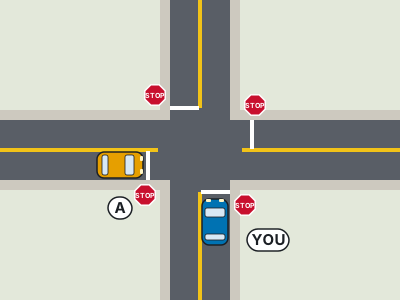
- The vehicle on the right
- The vehicle on the left
- The larger vehicle
- The vehicle that flashes headlights
Show answer
The vehicle on the right. When vehicles arrive at an all-way stop at the same time, the vehicle on the right goes first after both drivers have come to a complete stop. The vehicle on the left must yield, and size or a headlight flash does not decide the order. If one vehicle arrived first, that earlier arrival controls instead, so confirm the timing before using the side-based tie rule. The key sequence is full stop first, then right goes first only when arrival is simultaneous.
Study this in the handbook: Intersections and Right of Way
13. When meeting a school bus from the front on a two or three lane road with amber lights flashing, what is required?
- Stop 100 feet before the bus even if it keeps moving
- Continue at the posted speed without watching the bus
- Slow to no more than 20 mph and be prepared to stop
- Pass on the shoulder before the stop arm extends
Show answer
Slow to no more than 20 mph and be prepared to stop. For a driver meeting the bus from the front in the described two or three lane setting, amber warning lights require slowing to no more than 20 mph and preparing to stop. Continuing at the posted speed ignores the warning, and the manual does not require an arbitrary 100-foot stop when the bus is still moving. Passing on the shoulder is never a safe substitute for following the bus procedure. The important combination is amber lights, a 20 mph ceiling, and readiness to stop.
Study this in the handbook: Stopping for School Buses
14. Which activity does Iowa prohibit even when voice commands are used?
- Receiving an emergency alert
- Making a phone call through a hands-free system
- Dialing a number by voice activation
- Streaming videos or making video calls
Show answer
Streaming videos or making video calls. Iowa's hands-free law lets drivers call, text, or dial only by using hands-free or voice activation, but it singles out one activity that voice control does not rescue: you can't stream videos or make video calls, even with voice commands. A hands-free call and dialing by voice activation are the permitted ways to place a call, and a person receiving safety-related information, including emergency, traffic, and weather alerts, is listed as an exception to the law. Before writing, sending, or reading a text, email, or social media post, bring the vehicle to a complete stop off the traveled portion of the roadway.
Study this in the handbook: Iowa's Hands-Free Law and Distractions
15. What minimum speed does the Iowa manual identify for the interstate system?
- 40 mph
- 30 mph
- 50 mph
- 55 mph
Show answer
40 mph. The interstate system has a minimum speed of 40 mph in the manual. That figure is different from the maximum limits listed for particular road types, including 70 mph on rural interstates. A vehicle that cannot reach at least 40 mph under ordinary conditions should use another route, because moving far below the traffic flow can create a hazard. The 30, 50, and 55 mph options do not match the stated interstate minimum. When reviewing this rule, separate the floor for interstate travel from the ceiling for a specific highway.
Study this in the handbook: Iowa Speed Limits
16. If another vehicle is tailgating you, what adjustment can give that driver a better view ahead?
- Move slightly to the right and create more space ahead
- Brake sharply whenever the vehicle gets close
- Speed up until you are beyond the posted limit
- Turn off your lights so the other driver backs away
Show answer
Move slightly to the right and create more space ahead. When a driver follows too closely, move slightly to the right to give that driver a better view of the road ahead. Signal early for turns, stops, or lane changes, and if possible slow enough to encourage the other driver to pass. Sudden braking can cause a rear-end crash, and speeding beyond the limit trades one hazard for another. Turning off lights reduces visibility. Keep your attention on the roadway, leave room in front of your own vehicle, and pull out of the traffic flow if the tailgating continues and a safe opportunity exists.
Study this in the handbook: Turns, Lane Changes, Passing and Tailgaters
17. What do Iowa speed limit signs indicate?
- The exact speed everyone must drive
- The maximum or minimum safe speed allowed, with maximums set for ideal conditions
- A suggested speed only
- The speed for trucks only
Show answer
The maximum or minimum safe speed allowed, with maximums set for ideal conditions. Iowa speed limit signs indicate the maximum or minimum safe speed that is allowed. Maximum limits are set for ideal driving conditions, so you must sometimes slow down when the road is slippery from rain or snow or when fog makes it hard to see clearly ahead. Some high speed roads also post a minimum speed, and if that minimum is too fast for you, the manual says to use another route. The posted number is a legal limit, not an exact target or a suggestion, and it is not reserved for trucks.
Study this in the handbook: Regulatory Signs
18. What can cause a vehicle to skid when the driver applies the brakes too hard?
- A clean windshield in daylight
- Only a freshly paved road
- A full fuel tank on a level road
- Loose gravel, snow, ice, or even dry pavement
Show answer
Loose gravel, snow, ice, or even dry pavement. Hard braking can make a vehicle lose traction on loose gravel, snow, ice, and even dry pavement. The freshly paved road choice overlooks the manual's warning that ordinary dry pavement can also produce a skid when braking is too forceful. Fuel level does not determine whether the tires slide, and windshield condition affects visibility rather than tire grip. Use a progressive squeeze on the brake pedal, especially when the surface feels loose or slippery. A useful cue is that stopping technique and pavement condition work together: the same pedal pressure can behave differently from one surface to another.
Study this in the handbook: Following Distance and Stopping
19. How close to a fire hydrant may a vehicle be parked in Iowa?
- No closer than 15 feet
- No closer than 10 feet
- No closer than five feet
- No closer than 20 feet
Show answer
No closer than five feet. Iowa's parking list bars parking closer than five feet from a fire hydrant, or in a designated hydrant red zone, along with double parking beside another stopped or parked car, parking closer than 10 feet from a stop sign, in an intersection, on a sidewalk, and on interstates and highways. Fifteen feet is not a figure in that list, and twenty feet is the distance the list uses for a fire station entrance, not a hydrant.
Study this in the handbook: Railroad Crossings and Rural Roads
20. Which documents should an Iowa driver carry while operating a vehicle?
- A passport, title, and repair invoices
- Only a driver's license and vehicle title
- A current license or permit, registration proof, and an insurance card
- Only electronic proof of registration
Show answer
A current license or permit, registration proof, and an insurance card. The manual says drivers should have their license or permit with them and carry current proof of registration plus an insurance card. The insurance card may be printed or electronic, but registration proof is also required. A vehicle title is not listed as the substitute document, and a passport does not satisfy this carrying requirement. Remember the trio as personal credential, registration, and liability insurance evidence. That combination is the practical checklist to review before driving in Iowa.
Study this in the handbook: Who Needs a License and What to Carry
QualitySpace is expanding to Iowa
We are a California-based independent insurance brokerage working on licensing in more states. We cannot help with Iowa insurance yet. Leave your email and we will let you know when we can.
Every question is written from the official Iowa Driver's License Manual. Need paper? Printable IA practice test with answer key.
Last verified 2026-10-05. How we check every question · Study all 210 as flashcards
Frequently asked questions
How many questions are on this Iowa practice test?
This fixed set has 20 questions. It is test 5 of 10 from the 210 question Iowa bank.
How does this fixed test relate to the full Iowa bank?
Each numbered test is a fixed set of questions in a fixed order, so you can retake the same test later and compare. Every test mixes road signs and the other topics in about the same proportion as the full bank. Tests 1 to 10 together cover 200 of the 210 questions in the Iowa bank, each once. The full practice page mixes the whole bank at random.
Last verified 2026-10-05. See the Iowa DMV facts page for sourced state details.