
Test 21 of 25 · 20 questions · Free 2026
IA Permit Practice Test 21
Jump to the test ↓A fixed 20 question set from the Iowa bank with answers and plain English explanations.
Question 1 of 20 · 0 right so far
All 20 questions in test 21
Every question below comes from the Iowa question bank on this page. Open a question to see the correct answer and the explanation. Nothing here is hidden behind a signup.
1. The car ahead leaves no tracks in Iowa road water and reflections shine. What risk is near?
- Your car could freeze on black ice instantly
- Your tires could grip better on flooded pavement
- Your car could hydroplane on that deep water
- A train could cross on hidden tracks there
Show answer
Your car could hydroplane on that deep water. Hydroplaning in Iowa occurs when road water deeper than tire tread reduces friction and can cause loss of control. If you can see deep water, reflections on pavement, or the car ahead leaves no tracks on the water, your car could hydroplane, so slow down. Six inches of moving water can sweep a vehicle away, and flooded roads may hide washed out surfaces. Slowing before the water keeps tread in contact instead of surfing on top of it.
Study this in the handbook: Night Driving, Bad Weather and Floods
2. A bicyclist wobbles near your Iowa intersection path where you hold priority. What is safest?
- Hold priority firmly because the rider must yield
- Pass closely to finish the conflict more quickly
- Stay ready to yield because riders are vulnerable there
- Honk until the rider leaves the intersection area
Show answer
Stay ready to yield because riders are vulnerable there. Iowa motorists should use defensive driving around bicyclists and be ready to yield the right of way even at times bicyclists should yield to you. Bicycle riders are very vulnerable in crashes and have no defense against a vehicle. When passing, change lanes fully and return only when the rider shows in your rearview mirror. Before turning across a bicycle lane, look carefully beside and behind your vehicle. Yielding early costs seconds and prevents the worst outcome.
Study this in the handbook: Traffic Signals and Pedestrian Beacons
3. A driver tailgates your Iowa car on a two lane road. How can you help them pass safely?
- Brake suddenly to teach the follower a lesson
- Speed up to match whatever pace they demand
- Weave slightly to block every passing attempt
- Move slightly right and give a better view ahead
Show answer
Move slightly right and give a better view ahead. If you are being tailgated in Iowa, move slightly to the right and give the tailgater a better view of what is ahead. Signal early for turns, stops, or lane changes. Try slowing down and encouraging the driver behind to pass. If all else fails, pull out of the traffic flow. Tapping brake lights three or four times can warn of an unexpected slowdown, yet brake checking to punish a follower creates the crash both drivers should avoid.
Study this in the handbook: Turns, Lane Changes, Passing and Tailgaters
4. Sunset approaches on an Iowa road with visibility still above 500 feet. When are headlights required?
- From sunset to sunrise, both headlights are required
- Only after midnight on roads outside city limits
- Only when visibility drops below 100 feet total
- Only on interstate highways after sunset hours
Show answer
From sunset to sunrise, both headlights are required. Iowa law requires use of both headlights from sunset to sunrise or whenever visibility is 500 feet or less from fog, heavy rain, snow, or similar conditions. Switch headlights on ahead of sunset so other drivers spot the car sooner. Turn headlights on whenever you struggle to see other vehicles, and use wipers as a cue. Automatic systems may still need manual activation in bright daytime snowstorms, so verify the lights are truly on.
Study this in the handbook: Night Driving, Bad Weather and Floods
5. You wait in an Iowa shared left turn lane to turn left. What else may that lane be used for?
- Passing slow traffic when the lane looks empty
- Nothing else; it is reserved for left turns only there
- Driving straight through the next intersection
- Parking briefly while waiting for a passenger
Show answer
Nothing else; it is reserved for left turns only there. Shared left turn lanes in Iowa are reserved for vehicles making left turns from either direction. On the pavement, left turn arrows for one direction alternate with arrows for the other, and the lane is marked each side by solid yellow plus dashed yellow lines. Vehicles may enter and stop in the lane before making a left turn, but the lane cannot be used for passing. Straight travel and parking also abuse space that opposing turners expect to share.
Study this in the handbook: Pavement Markings and Lane Use
6. In Iowa, how must a 12 year old be secured in the back seat?
- In a child restraint system or by a seat belt
- No restraint is required in the back seat
- Only in a booster seat
- Only in a rear-facing seat
Show answer
In a child restraint system or by a seat belt. A child from age six up to 18 must be secured in a child restraint system or by a seat belt in every seating position, front and back. That is why the back seat is not exempt for a 12 year old. A booster only or rear-facing only rule is too narrow for this age. Adults 18 and older are required to buckle up in the front seats, while passengers under 18 must be restrained in the back as well.
Study this in the handbook: Vehicle Checks, Seat Belts and Child Restraints
7. In Iowa, how should a driver finish a turn with the steering wheel?
- Let the wheel slip through the fingers freely
- Release the wheel and let the car center itself
- Spin the wheel quickly with one open palm
- Straighten the wheel by hand after the turn
Show answer
Straighten the wheel by hand after the turn. When you complete a turn in Iowa, straighten out the steering wheel by hand. Letting it slip through your fingers could be dangerous if a bump or gust moves the car. Use the hand over hand or push pull technique when turning corners, and look well down the road before you get to traffic situations where you will need to steer. That early look gives time to steer smoothly and safely. A controlled unwind keeps the vehicle in the intended lane.
Study this in the handbook: Iowa Speed Limits
8. Most vehicle warning systems are described as passive. What does that mean for you as the driver?
- They warn of a problem but do not automatically prevent a crash
- They take over braking and steering when you do not react
- They work only while the car is parked or backing up
- They need no further driver action once a warning has sounded and cleared
Show answer
They warn of a problem but do not automatically prevent a crash. Vehicle warning system technologies notify you with a sound, light, or vibration that a crash is about to occur, or that there is a malfunction. Iowa explains that most of these are passive. They warn the driver of a potential issue but do not automatically prevent a problem or crash, so the driver may still need to make changes to the operation of the vehicle. A warning is an alert to act, not a substitute for acting.
9. In Iowa, what must a driver never do with a running engine inside a garage?
- Open a window while sitting in a running vehicle inside
- Check the exhaust system for leaks each season
- Leave the engine running in a closed garage space
- Follow the owner manual for engine maintenance
Show answer
Leave the engine running in a closed garage space. Fumes from a leaky exhaust in Iowa can cause death in a very short time. Never leave your engine running in the garage, or sit in a running vehicle without opening a window. The exhaust system removes toxic gases, reduces noise, and cools hot gases, yet a poorly tuned engine may pollute and stall. A vehicle started inside a closed space fills that space with gases you cannot see. Move the vehicle outside before letting it idle, and keep garage doors open if the engine must run briefly.
Study this in the handbook: Vehicle Checks, Seat Belts and Child Restraints
10. In Iowa, how should a driver accelerate from a stop to keep control?
- As fast as possible to reach full traffic speed sooner
- Gradually and smoothly without spinning the wheels
- With quick gas bursts until the wheels catch grip
- Only after revving the engine high at the stop
Show answer
Gradually and smoothly without spinning the wheels. Accelerate gradually and smoothly in Iowa. Trying to start too fast can cause the drive wheels to spin, particularly on slippery surfaces, causing the vehicle to slide. With a manual shift vehicle, practice using the clutch and accelerator so the engine does not run too fast or stall when shifting. Smooth starts also protect passengers and following traffic from sudden surges. The same gentle input helps on gravel, rain slick pavement, and ice where grip is limited.
Study this in the handbook: Following Distance and Stopping
11. A high speed alert beeps because you are over the posted limit. How should you slow down?
- Carefully ease off the accelerator or brake lightly
- Slam the brakes hard so the alert stops as soon as possible
- Shift into neutral and coast down to the limit
- Silence the alert and judge your speed by feel
Show answer
Carefully ease off the accelerator or brake lightly. A high speed alert sounds or flashes when you go over the posted speed, as long as the GPS or infotainment map is up to date. Iowa says that when it warns you, carefully slow the car to the posted limit by releasing the accelerator or lightly braking, and not by slamming the brakes. You should not rely on the alert, since you are the one who must monitor your speed and obey the limit on the road.
12. You are in a minor crash on a busy Iowa road and your car can still move. What should you do first?
- Get it out of the path of traffic, turned off, and no longer moving
- Leave it in the lane so police can see exactly where it stopped
- Call your insurance company first, before you touch anything on the car
- Exchange phone numbers while standing beside the lane
Show answer
Get it out of the path of traffic, turned off, and no longer moving. Iowa's guide for a crash starts with Step 1, Steer It, Clear It. If possible, make sure your vehicle is out of the path of traffic, turned off, and no longer moving. The main goal after any crash, however minor, is that all drivers and passengers are safe. Only after that do you contact law enforcement, provide your insurance and contact information, and report the crash to your insurer. Moving the car first keeps a second crash from happening.
Study this in the handbook: Equipment Failures and Crashes
13. You approach an Iowa roundabout yield line with cars circulating and a person crossing. Who gets yielded to?
- Only traffic circulating inside the roundabout
- Only the person crossing before the roundabout
- Neither, because entering traffic goes first there
- Both the person crossing and traffic circulating
Show answer
Both the person crossing and traffic circulating. Approaching Iowa roundabout vehicles must yield to pedestrians in the crosswalk and to traffic in the roundabout. Slow to the posted advisory speed on approach, yield at the yield line markings, wait for a gap, then merge counterclockwise. Continue until your street, avoid stopping inside, then signal and exit right while yielding to crosswalk users again. Multi lane drivers must choose lanes before entry and never change lanes inside the circle.
Study this in the handbook: Roundabouts and Uncontrolled Intersections
14. A green arrow glows above a reversible Iowa lane as a red X glows above the next lane. Which lane may you use?
- The lane beneath the red X if it looks empty
- The lane beneath the green arrow only there
- Either lane, since arrows are advisory only
- Neither lane until both arrows turn yellow
Show answer
The lane beneath the green arrow only there. Reversible lanes in Iowa carry traffic one direction at certain times and the opposite at other times, usually marked by double dashed yellow lines. A green arrow means you can use the lane beneath it, while a red X means you may not. A flashing yellow X limits the lane to turning, and a steady yellow X means lane use is changing so you should move out when safe. Overhead lights decide the lane, not how empty it looks.
Study this in the handbook: Pavement Markings and Lane Use
15. In Iowa, what must be cleared of snow and ice from the whole vehicle before driving?
- Windows, headlights, turn signals, and taillights fully
- Only the front windshield center patch for viewing
- Only the roof panel above the driver seat area
- Only the rear license plate and bumper edge
Show answer
Windows, headlights, turn signals, and taillights fully. Make sure your entire Iowa vehicle is clear of snow and ice before driving, including windows, headlights, turn signals, and taillights. Beware of black ice when temperatures drop, since moisture may turn to ice on the road surface that is hardly visible. Bridges and overpasses may be slippery even when other surfaces are not. When starting from a stop, keep wheels straight and accelerate gently to avoid spinning tires. Decrease speed to make up for lost traction throughout the trip.
Study this in the handbook: Night Driving, Bad Weather and Floods
16. In Iowa, what should a driver expect at a farm machinery warning sign?
- A farm entrance where trucks load grain
- A market where farm goods are sold weekly
- Slow moving farm equipment on the roadway ahead
- A detour around fields closed to traffic
Show answer
Slow moving farm equipment on the roadway ahead. A farm machinery warning means slow moving farm equipment may be on the roadway in Iowa. Reduce your speed and pass slowly, because wide equipment can fill much of the lane and turn without much warning. Loading entrances, farm markets, and field detours describe places rather than moving hazards. Early slowing gives you time to judge width and oncoming traffic before passing. Leave extra room, since farm equipment may swing wide at unmarked field entrances.
Study this in the handbook: Warning, Guide and Service Signs
17. Rain begins on an Iowa road posted with slippery when wet signs. How should you adjust?

- Hold normal speed because signs overstate rain risk
- Use cruise control to hold a steady rain speed
- Brake harder than usual to test the wet grip
- Slow down because the road gets slick when wet
Show answer
Slow down because the road gets slick when wet. A slippery when wet warning in Iowa means the road ahead becomes slippery in wet weather, so slow down under those conditions. Wet roads also call for wipers, low beam headlights, longer following distance, and extra caution on curves and at intersections. Cruise control must stay off in wet or slippery conditions. Bridges and overpasses can turn icy before other surfaces. Extra space and gentle inputs replace the grip the water removes.
Study this in the handbook: Warning, Guide and Service Signs
18. Most Iowa warning signs share which color and shape pairing?
- Orange coloring with a rectangle shape mostly
- Yellow coloring with a diamond shape mostly
- White coloring with an octagon shape mostly
- Green coloring with a pentagon shape mostly
Show answer
Yellow coloring with a diamond shape mostly. Warning signs in Iowa are yellow with black lettering or symbols and most are diamond shaped. These signs warn you to slow down and be prepared to stop if necessary because a special situation or hazard is ahead. Orange belongs mainly to work zones, white to regulatory law, and green to direction. Pentagon shapes mark schools. Seeing yellow diamond early should trigger slower speed and a wider scan before the hazard itself appears.
Study this in the handbook: Warning, Guide and Service Signs
19. Two opposing arrows appear on an Iowa warning as your divided road ends. What is starting?
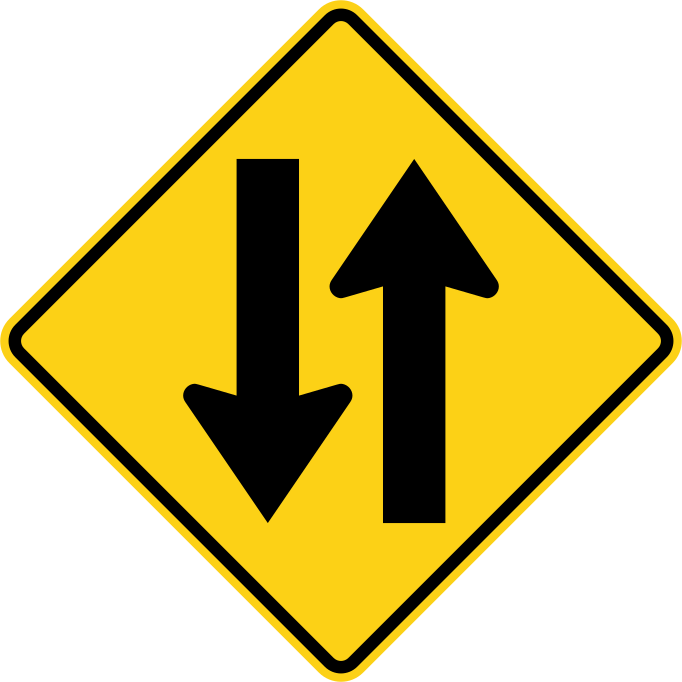
- One way traffic in the direction of one arrow
- A reversible lane controlled by overhead lights
- A shared left turn lane for both directions
- Two way traffic on a road no longer divided
Show answer
Two way traffic on a road no longer divided. Two opposing arrows in Iowa warn that you are leaving a one way road and entering a two way road, so keep to the right. The same change appears when a divided highway ends and two way traffic will no longer be divided by a center strip. Oncoming vehicles will soon run in the lane beside you. Adjust lane position early and watch for drivers who drift across the fading separation. Yellow lines will separate opposing traffic from that point.
Study this in the handbook: Warning, Guide and Service Signs
20. Two cars reach an Iowa all way stop together, you on the left and another on your right. Who goes first?
- You go first because you stopped a moment sooner
- The vehicle turning left goes first after stopping
- The vehicle on the right goes first after stopping
- Both vehicles go together if drivers wave politely
Show answer
The vehicle on the right goes first after stopping. At an Iowa all way stop, the driver reaching the intersection first goes first after a complete stop. When arrivals tie, priority passes to the driver on the right side. The driver on the left therefore waits. Left turners additionally yield to oncoming traffic going straight. Predictable order lets every driver plan the same sequence instead of negotiating with waves or inching contests at the stop lines.
Study this in the handbook: Intersections and Right of Way
Every question is written from the official Iowa Driver's License Manual. Need paper? Printable IA practice test with answer key.
Last verified 2026-10-05. How we check every question · Study all 500 as flashcards
Frequently asked questions
How many questions are on this Iowa practice test?
This fixed set has 20 questions. It is test 21 of 25 from the 500 question Iowa bank.
How does this fixed test relate to the full Iowa bank?
Each numbered test is a fixed set of questions in a fixed order, so you can retake the same test later and compare. Every test mixes road signs and the other topics in about the same proportion as the full bank. Tests 1 to 25 together cover every question in the Iowa bank once. The full practice page mixes the whole bank at random.
Last verified 2026-10-05. See the Iowa DMV facts page for sourced state details.