
Test 2 of 10 · 20 questions · Free 2026
IA Permit Practice Test 2
Jump to the test ↓A fixed 20 question set from the Iowa bank with answers and plain English explanations.
Question 1 of 20 · 0 right so far
All 20 questions in test 2
Every question below comes from the Iowa question bank on this page. Open a question to see the correct answer and the explanation. Nothing here is hidden behind a signup.
1. Which visitor may drive in Iowa without an Iowa driver's license?
- A visitor carrying only a vehicle registration
- A visitor with a current license from their home state or country
- A visitor who has never been licensed anywhere
- A visitor using an expired license from another state
Show answer
A visitor with a current license from their home state or country. Iowa recognizes a current license from a visitor's home state or country. The credential must be current, so an expired out-of-state license does not meet the stated condition. Registration identifies a vehicle but does not grant driving privileges, and having no license anywhere provides no basis for the visitor exception. The key cue is the pairing of visitor status with a current home-jurisdiction license. That is different from becoming an Iowa resident or operating without a credential.
Study this in the handbook: Who Needs a License and What to Carry
2. Which vehicles must have working turn signals under Iowa law?
- Only trucks over 10,000 pounds
- All cars, trucks, and trailers wider than 40 inches
- Only vehicles built after 2000
- Only vehicles used at night
Show answer
All cars, trucks, and trailers wider than 40 inches. Iowa requires turn signals on all cars, trucks, and trailers wider than 40 inches, and if a vehicle has turn signals they must work. The rule is not limited to heavy trucks, newer vehicles, or night driving. Iowa law also requires you to signal at least 100 feet before a turn, or 300 feet when the speed limit is faster than 45 mph.
Study this in the handbook: Vehicle Checks, Seat Belts and Child Restraints
3. At what speed do snowplows typically operate on Iowa roads?
- 55 to 65 mph
- 5 to 10 mph
- 25 to 35 mph
- 45 to 55 mph
Show answer
25 to 35 mph. Snowplows typically operate at 25 to 35 mph, and many drivers fail to realize how slowly they move and hit them from behind. Five to ten mph and the higher ranges are not the speeds the manual gives. Give plows room to work, and expect them to kick up a cloud of snow that makes it hard to see and be seen. Bridges and overpasses may also be slippery even when other road surfaces are not.
Study this in the handbook: Night Driving, Bad Weather and Floods
4. What is Iowa's general speed limit on an unsurfaced (gravel) secondary road after sunset, when no limit is posted?
- 50 mph
- 35 mph
- 60 mph
- 25 mph
Show answer
50 mph. Iowa's general limit on unsurfaced secondary roads is 50 mph from sunset until sunrise, and trucks are held to 50 mph on secondary roads at any time of day. During daylight, secondary roads including unpaved ones fall under the 60 mph general limit, so 60 is the daytime figure. Thirty five and 25 mph are not the rural gravel road limits, although you may need to drive slower for loose surfaces.
Study this in the handbook: Iowa Speed Limits
5. A lane-control sign shows an arrow bending to the right around an obstruction. What does it tell the driver to do?
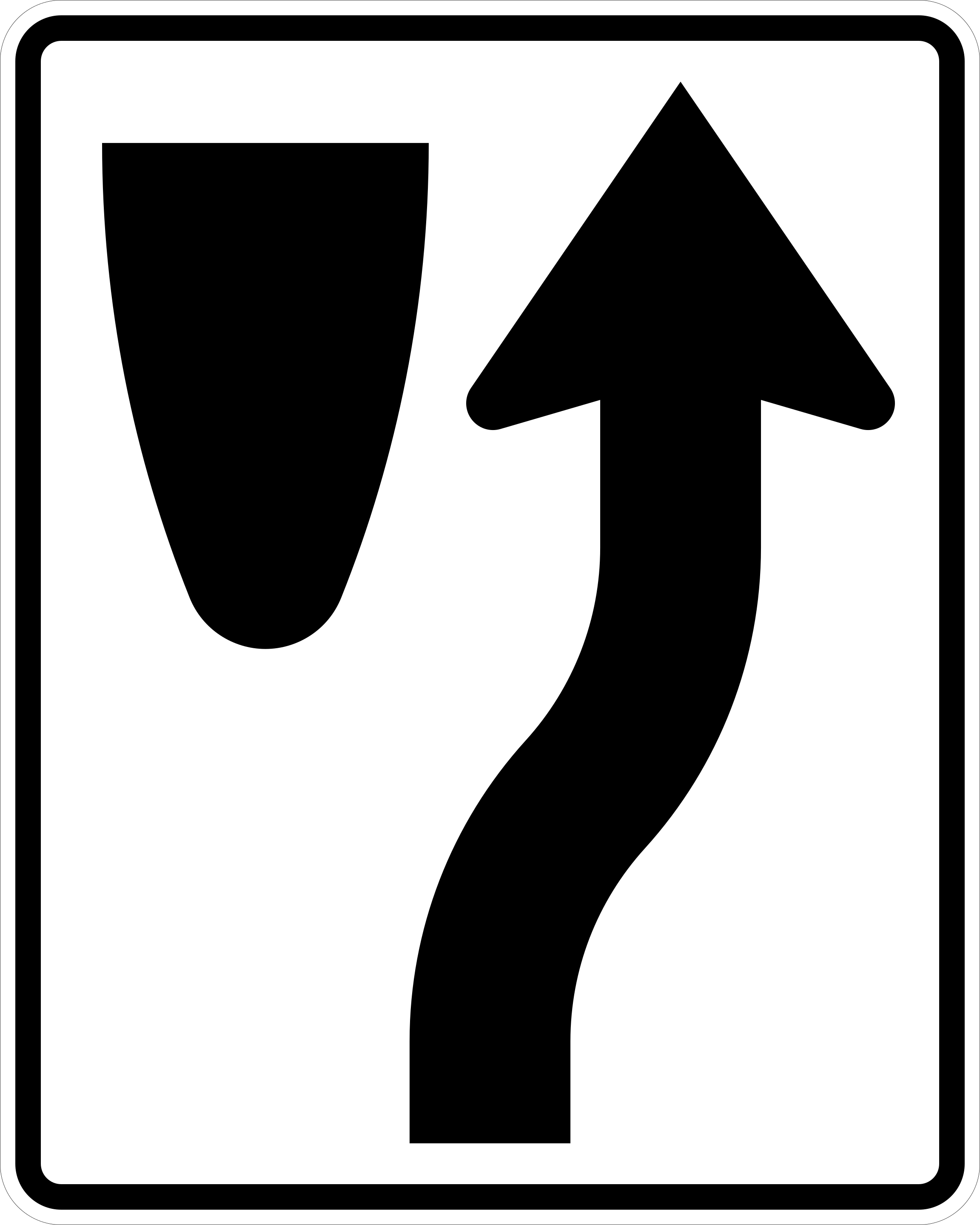
- Turn around before reaching the obstruction
- Use the shoulder for passing
- Stay in the left lane until the road ends
- Keep to the right of the obstruction
Show answer
Keep to the right of the obstruction. Lane-control signs show where traffic may go and where a turn can be made. An arrow bending around an obstruction to the right directs you on that side of the divider or barrier. It does not authorize shoulder passing, require a prolonged stay in the left lane, or call for a U-turn. Reduce speed as needed, follow the marked path, and keep enough space from the obstruction to avoid drifting into opposing or conflicting traffic.
Study this in the handbook: Regulatory Signs
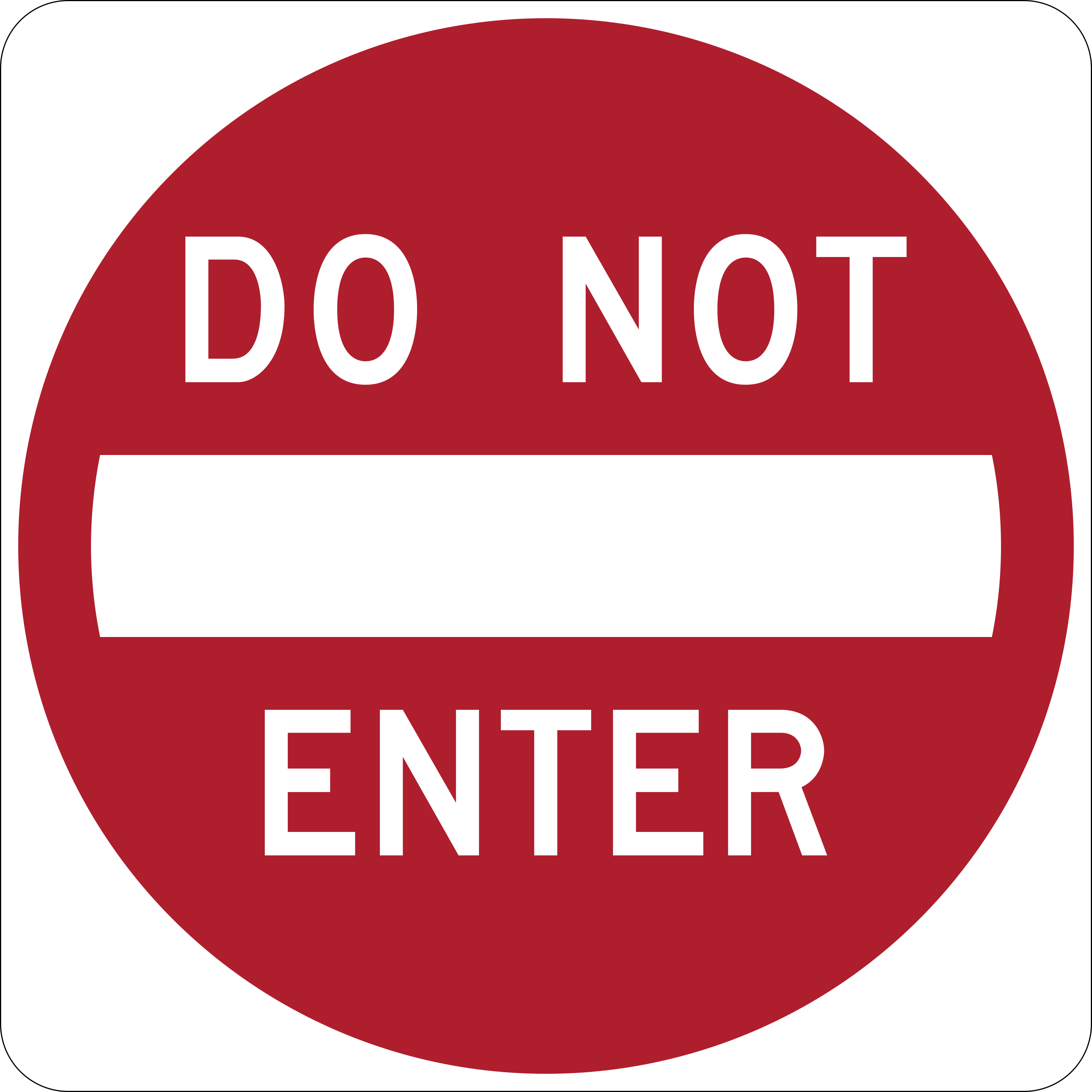
6. Where might an Iowa driver encounter a do not enter sign?
- Only where a speed limit changes
- Only before a railroad crossing
- At every legal entrance to a public street
- At an exit ramp, a divided-road crossover, or a one-way road opening
Show answer
At an exit ramp, a divided-road crossover, or a one-way road opening. Iowa's manual lists exit ramps, crossovers on divided roadways, and numerous locations on one-way roads as places where a do not enter sign may appear. These are openings the driver must not use in that direction. The sign is not limited to railroad crossings or speed-limit changes, and it cannot mark every legal street entrance because its purpose is to prohibit a particular entry. Scan the roadway geometry as well as the sign so an exit or crossover is not mistaken for an entrance.
Study this in the handbook: Regulatory Signs
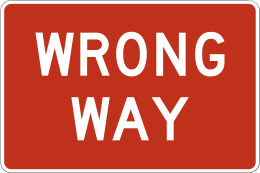
7. What situation does an Iowa wrong-way sign describe?
- A lane is reserved for buses only
- The roadway ahead has a steep hill
- A wrong turn has placed the vehicle in a lane of oncoming traffic
- The driver may pass because traffic is light
Show answer
A wrong turn has placed the vehicle in a lane of oncoming traffic. The wrong-way sign indicates that a driver made a wrong turn and entered a lane of oncoming traffic. The manual directs the driver to remove the vehicle from the traveled portion, get stopped, and turn around as quickly and safely as possible. A hill or bus restriction describes a different sign, while light traffic never makes opposing travel safe. If this sign faces you, treat it as an urgent warning of conflict, not as information about ordinary road conditions.
Study this in the handbook: Regulatory Signs
8. What restraint is required for a child under six years old in Iowa?
- A rear-facing restraint only after the child turns six
- A seat belt alone in every seating position
- A child restraint system, such as a safety seat or booster seat
- No restraint if the trip is within the neighborhood
Show answer
A child restraint system, such as a safety seat or booster seat. A child under six must be secured in a child restraint system, which the manual describes as a safety seat or booster seat rather than a seat belt alone. The neighborhood exception is not part of the rule, and a rear-facing system is tied to a different age and weight condition. The seat-belt-only choice therefore provides the wrong protection for this age group. Select a suitable child restraint, install it correctly, and use it for every trip, including short local drives.
Study this in the handbook: Vehicle Checks, Seat Belts and Child Restraints
9. What does Iowa's Deer Crossing sign tell a driver to do?
- Stop until a deer crosses
- Sound the horn continuously
- Speed up to clear the area
- Slow down and watch carefully because deer may be trying to cross
Show answer
Slow down and watch carefully because deer may be trying to cross. The Deer Crossing warning means there may be deer trying to cross the roadway in the area, and the manual's instruction is to slow down and watch carefully. The manual also says to be on the lookout for animals especially at sunrise and sunset. Stopping in the lane without cause and honking do not help, and speeding through the zone gives you less time to react. If there is not time to stop, do not swerve or veer, since the manual says that will likely result in a more severe crash.
Study this in the handbook: Warning, Guide and Service Signs
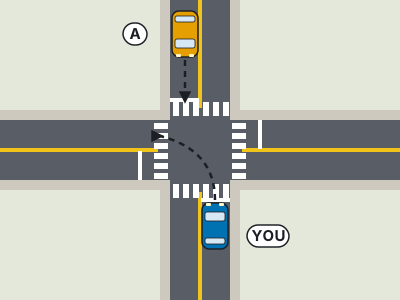
10. A driver beginning a left turn must yield to which approaching vehicles?
- No traffic once the turn signal is on
- Only vehicles approaching from behind
- Oncoming cars traveling straight ahead
- Vehicles parked along the opposite curb
Show answer
Oncoming cars traveling straight ahead. A left turn crosses the path of vehicles coming toward the intersection, so the turning driver must yield to oncoming cars going straight. Activating a signal communicates an intention but does not remove another driver's right of way. Traffic behind the turning vehicle is not the specific conflict described here, and parked vehicles are not moving through the intersection. Check the opposing lane, wait for a safe gap, and complete the turn without forcing an approaching driver to brake or swerve.
Study this in the handbook: Intersections and Right of Way
11. Your car is swept into water and submerged in Iowa. What does the manual say about opening the doors?
- Wait for the vehicle to fill with water; once full, the doors are easier to open, then hold your breath and swim to the surface
- Break the windshield first
- Wait for rescuers to open them
- Force the doors open immediately
Show answer
Wait for the vehicle to fill with water; once full, the doors are easier to open, then hold your breath and swim to the surface. If your car is swept into the water and submerged, remain calm and wait for the vehicle to fill with water. Once the vehicle is full, the doors are easier to open; hold your breath and swim to the surface. Breaking the windshield first, waiting for rescuers, and forcing the doors right away are not steps the manual gives; it says to wait until the vehicle is full. The best defense is never driving into floodwater.
Study this in the handbook: Night Driving, Bad Weather and Floods
12. How should you respond when another driver shows signs of aggressive driving toward you?
- Make eye contact and challenge the driver
- Slow down or pull over to avoid the driver
- Race ahead to prevent the driver from passing
- Brake suddenly to make the driver stop
Show answer
Slow down or pull over to avoid the driver. If another driver is showing signs of aggression, slow down or pull over to avoid that person. If the driving is dangerous enough to worry you, try to leave the roadway by turning right or taking the next exit when it is safe. Eye contact, racing, and sudden braking can escalate the encounter or reduce your control. Keep your attention on finding distance and an escape route rather than proving a point. Do not stop in an exposed travel lane; choose a safe place where the aggressive driver can continue away from you.
Study this in the handbook: Turns, Lane Changes, Passing and Tailgaters
13. What should you do at an actively protected railroad crossing when the lights flash or gates are down?
- Stop and wait; never go around the gate
- Cross quickly if you do not see a train
- Drive around the gate after checking both directions
- Stop only if the warning bell is also sounding
Show answer
Stop and wait; never go around the gate. Flashing lights or lowered gates mean that a train is approaching at an actively protected crossing. The driver must obey those warnings and wait. Seeing no train does not make it safe to cross, because trains may be closer and traveling faster than they appear and can run on any track at any time. Going around the gate creates a direct conflict with the protection system. The bell is not the only condition that matters. Treat the lights and gate position as sufficient warning, remain clear of the tracks, and proceed only after the crossing is legally open.
Study this in the handbook: Railroad Crossings and Rural Roads
14. You are in an Iowa crash with more than $1,500 in property damage. What happens if you fail to report it within 72 hours?
- Nothing, if the other driver reports it
- You lose your driving privileges and face further penalties
- Only your insurance rate can change
- You receive a warning letter
Show answer
You lose your driving privileges and face further penalties. Iowa law requires reporting a crash that involves injury or death or property damage of more than $1,500. If you fail to do so within 72 hours, you lose your driving privileges and face further penalties. Another driver's report does not satisfy your duty, and the consequence is not just an insurance change or a warning. Call 911 to report the crash and give the officer your insurance, registration, and license.
Study this in the handbook: Equipment Failures and Crashes
15. How does the Iowa manual say to check tire tread with a penny?
- Insert the penny tail first and look for the memorial
- Measure the tread with the penny's edge
- Insert the penny head first; if the tread does not reach the top of Lincoln's head, replace the tire
- Roll the penny across the tire
Show answer
Insert the penny head first; if the tread does not reach the top of Lincoln's head, replace the tire. Check tire tread with a penny by sticking the penny into the tread head first. If the tread does not come at least to the top of Lincoln's head, the tire is unsafe and should be replaced. Shallow tread cannot channel water away and invites hydroplaning and longer stops. The test takes seconds, so pair it with checking air pressure with a gauge while the tires are cold.
Study this in the handbook: Vehicle Checks, Seat Belts and Child Restraints
16. What does Iowa reserve the octagon shape for?
- A stop sign
- A yield sign
- A railroad crossing warning
- A school crossing sign
Show answer
A stop sign. The octagon is reserved for the stop sign; the manual says to come to a full stop at an intersection controlled by this sign. A yield sign uses an equilateral triangle, a railroad crossing advance sign is circular, and a school crossing sign uses a pentagon. The manual says the shape and color of traffic signs give clues to the type of information they provide. Once the octagonal sign is identified, the driver must make a full stop and wait until the relevant traffic and crosswalk are clear before proceeding.
Study this in the handbook: Sign Colors and Shapes
17. What must a driver do for pedestrians in a marked or unmarked crosswalk?
- Proceed first if the vehicle has a turn signal on
- Yield or stop for them
- Yield only when the crosswalk has painted stripes
- Stop only when a crossing guard is present
Show answer
Yield or stop for them. Iowa requires a driver to yield or stop for pedestrians in marked or unmarked crosswalks. Painted stripes are not required for the duty to apply, and a turn signal does not give a vehicle priority over someone crossing. A crossing guard may provide directions, but the rule does not wait for one to be present. Scan the full crossing area before moving through an intersection, reduce speed when visibility is limited, and be ready to stop smoothly. The absence of paint or a guard is not a reason to continue into a pedestrian's path.
Study this in the handbook: Intersections and Right of Way
18. On a two-lane road, how close may you stop behind a school bus with its stop arm extended?
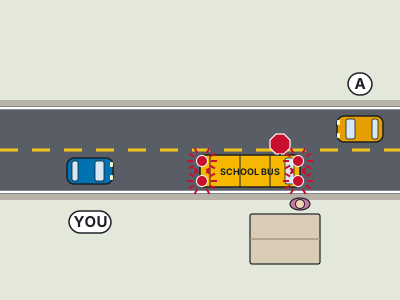
- Only after the bus begins moving again
- Within 5 feet, if no children are visible
- At any distance, provided the driver uses hazard lights
- No closer than 15 feet, remaining stopped until the arm retracts and the bus moves
Show answer
No closer than 15 feet, remaining stopped until the arm retracts and the bus moves. A vehicle approaching the rear of a stopped school bus must not pass when the warning lights are flashing. It must stop behind the bus at least 15 feet away and remain there until the stop arm retracts and the bus starts moving again. Visibility of children does not remove the duty, and hazard lights do not authorize a closer position. Leave enough space for the bus and its loading area, watch the arm rather than guessing from traffic movement, and proceed only after the stated release conditions occur.
Study this in the handbook: Stopping for School Buses
19. What happens to an Iowa driver's license when the driver refuses a breathalyzer test?
- A warning for a first refusal
- Nothing, refusal is a right
- A 30 day suspension
- An automatic one year revocation, a consequence more severe than failing the test
Show answer
An automatic one year revocation, a consequence more severe than failing the test. Refusing a breathalyzer test does not avoid an OWI, and the refusal itself still results in revocation because Iowa's implied consent law treats driving as agreement to be tested. The manual says the consequences for refusing are more severe than failing the test, with an automatic one year revocation of your license and a minimum $1,250 fine. The court may also order a substance use class and evaluation or an ignition interlock device. A 30 day suspension and a warning are not the penalties listed.
Study this in the handbook: Underage Drinking, Refusal and Open Containers
20. Which crash must be reported to Iowa police under the manual's stated threshold?
- A crash involving injury or death, or property damage above $1,500
- Only a crash that blocks an interstate for more than one hour
- Only a crash involving two commercial vehicles
- Any minor scrape, but not a crash involving an injury
Show answer
A crash involving injury or death, or property damage above $1,500. Iowa requires police notification when a crash involves injury or death to another person or property damage exceeding $1,500. That threshold is broader than the commercial-vehicle and interstate conditions in the distractors. A driver should first protect people, move an operable vehicle out of traffic when it can be done safely, and call 911 with the location and possible injuries. Leaving because damage looks inconvenient is not a substitute for reporting. The key numbers are injury or death, or damage greater than $1,500, followed by the 72-hour reporting consequence described in the manual.
Study this in the handbook: Equipment Failures and Crashes
QualitySpace is expanding to Iowa
We are a California-based independent insurance brokerage working on licensing in more states. We cannot help with Iowa insurance yet. Leave your email and we will let you know when we can.
Every question is written from the official Iowa Driver's License Manual. Need paper? Printable IA practice test with answer key.
Last verified 2026-10-05. How we check every question · Study all 210 as flashcards
Frequently asked questions
How many questions are on this Iowa practice test?
This fixed set has 20 questions. It is test 2 of 10 from the 210 question Iowa bank.
How does this fixed test relate to the full Iowa bank?
Each numbered test is a fixed set of questions in a fixed order, so you can retake the same test later and compare. Every test mixes road signs and the other topics in about the same proportion as the full bank. Tests 1 to 10 together cover 200 of the 210 questions in the Iowa bank, each once. The full practice page mixes the whole bank at random.
Last verified 2026-10-05. See the Iowa DMV facts page for sourced state details.