
Test 18 of 25 · 20 questions · Free 2026
IA Permit Practice Test 18
Jump to the test ↓A fixed 20 question set from the Iowa bank with answers and plain English explanations.
Question 1 of 20 · 0 right so far
All 20 questions in test 18
Every question below comes from the Iowa question bank on this page. Open a question to see the correct answer and the explanation. Nothing here is hidden behind a signup.
1. Your car stalls on Iowa tracks as a train approaches and everyone is out. Which way should people move?
- Straight away from the tracks behind the car line
- At 45 degrees toward the approaching train direction
- At 45 degrees away from the approaching train
- Along the tracks running beside the moving train
Show answer
At 45 degrees toward the approaching train direction. If your Iowa car stalls on tracks as a train approaches, get everyone out immediately and move away from the tracks at a 45 degree angle in the direction of the approaching train. That angle clears the strike zone while avoiding debris thrown down the track line. Keep trying to restart only until you see the train, and wave at the engineer from beside the car only if time allows before evacuation. Call the ENS number or 911 once everyone is far away.
Study this in the handbook: Railroad Crossings and Rural Roads
2. You plan to pass a slow car on an Iowa road with tracks 80 feet ahead. Is passing allowed there?
- Yes, if the crossing has no gates or lights on it
- Yes, if you can finish before the tracks begin
- Yes, when the slow car waves you around it
- No, passing within 100 feet of tracks is banned
Show answer
No, passing within 100 feet of tracks is banned. Iowa bans passing within 100 feet of a railroad crossing and within 100 feet of an intersection. Passing on the right, near hilltops, around obstructed curves, and near signed narrow bridges, viaducts, or tunnels is also illegal. At crossings themselves, stop back at least 15 feet from the nearest rail when required and be sure you can clear the tracks fully. A pass that ends beside tracks leaves no escape if a train or cross traffic appears.
Study this in the handbook: Turns, Lane Changes, Passing and Tailgaters
3. A police officer waves you through an Iowa intersection where the signal hangs dark. Whose direction controls?
- The dark signal controls because signals outrank people
- The officer direction controls over the dark signal
- The first driver to honk controls the intersection flow
- Posted signs control while officers only watch traffic
Show answer
The officer direction controls over the dark signal. Traffic control in Iowa can be provided by law enforcement, highway personnel, or school crossing guards in addition to traffic signals, and you must follow directions from these persons. An officer directing at a dark signal therefore controls your movement. Required stops also include stopping at the request of any law officer. Human direction adapts to crashes, outages, and work that fixed signals cannot see, which is why it takes precedence in the moment.
Study this in the handbook: Warning, Guide and Service Signs
4. You plan to pass on an Iowa two lane road just before an intersection 80 feet ahead. Is that allowed?
- Yes, if the intersection has no stop sign facing you
- No, passing within 100 feet of an intersection is banned
- Yes, if you finish the pass before the intersection
- Yes, when the vehicle ahead travels below the limit
Show answer
No, passing within 100 feet of an intersection is banned. Iowa bans passing within 100 feet of an intersection and within 100 feet of a railroad crossing. Passing is also illegal approaching a hilltop, around a curve with an obstructed view, within 100 feet of a signed narrow bridge, viaduct, or tunnel, on the right, and when oncoming traffic is dangerously close. Avoid passing where vehicles may enter ahead, such as intersections and driveways. Only pass one vehicle at a time when markings permit and space is clearly enough.
Study this in the handbook: Turns, Lane Changes, Passing and Tailgaters
5. Solid white triangles point toward you across your Iowa lane. What do they mark?
- The point where vehicles must park ahead
- The start of a bicycle only lane ahead
- The point where vehicles should yield ahead
- The end of a no passing zone ahead
Show answer
The point where vehicles should yield ahead. Yield lines in Iowa consist of a row of solid white triangles pointing toward approaching vehicles. They extend across a travel lane to indicate the point where vehicles should yield in compliance with yield signs or yield here to pedestrians and bicycles signs. Roundabout entries, crosswalks, and signal approaches can all use them. Stop your yield at the triangles rather than rolling into the conflict area while you judge gaps in traffic or people crossing.
Study this in the handbook: Pavement Markings and Lane Use
6. In Iowa, how may some bicycle lanes be set apart from car traffic?
- With double yellow lines and a center median
- With gates that open only for bicycles
- With orange cones moved each morning by crews
- With double white lines, curbs, posts, or planters
Show answer
With double white lines, curbs, posts, or planters. Some Iowa bike lanes are further separated from traffic through double white lines, curbs, posts, or planters. Bicycle lanes themselves are marked by solid white lines along with bicycle pavement markings and signs. Double yellow lines separate opposing traffic instead, and cones belong mainly to work zones. Physical separation gives cyclists room that paint alone cannot provide. Motorists should pay close attention near these lanes and look for bicyclists before crossing any green pavement.
Study this in the handbook: Pavement Markings and Lane Use
7. In Iowa, where should the top of the steering wheel sit for a proper seat position?
- No higher than the driver shoulders
- Well above the driver shoulders at eye level
- At chin level for the tallest view over it
- Below the knees for a relaxed arm bend
Show answer
No higher than the driver shoulders. The top of the steering wheel should be no higher than your shoulders in Iowa. Sit with your back firmly against the seat and keep at least ten inches between the steering wheel and your chest, with the air bag pointing at your chest. A wheel at eye or chin level blocks the view and weakens control, while a wheel near the knees sits too low for safe steering. Move the seat forward or backward so your heel touches the floor and you can pivot between pedals.
Study this in the handbook: Vehicle Checks, Seat Belts and Child Restraints
8. In Iowa defensive driving, what should a driver assume about other drivers at signs?
- Assume some will run red lights or stop signs
- Assume every driver will stop exactly on time
- Assume others will move aside for every merge
- Assume signals always show true turning plans
Show answer
Assume some will run red lights or stop signs. Defensive driving in Iowa means not depending on other drivers. Be considerate of others but look out for yourself. Do not assume another driver is going to move out of the way or allow you to merge. Assume drivers will run through red lights or stop signs and be prepared to react. Plan movements anticipating the worst case scenario. That habit pairs with scanning 20 to 30 seconds ahead, keeping speed down for conditions, and always leaving an escape route open.
Study this in the handbook: Turns, Lane Changes, Passing and Tailgaters
9. You turn left across an Iowa intersection as a car approaches going straight. Who yields?
- The straight car yields to your left turn path
- Both cars proceed together through the middle
- The car behind you decides who proceeds first
- You yield to the oncoming car going straight
Show answer
You yield to the oncoming car going straight. Drivers turning left in Iowa must yield to oncoming cars that are going straight ahead. Failure to yield the right of way is the top cause of traffic related fatalities in the state, and left turns create that conflict often. With a flashing yellow arrow, yield to oncoming traffic and pedestrians, then turn with caution while oncoming traffic holds a green. Wait until the straight path is clear or the oncoming driver clearly stops.
Study this in the handbook: Intersections and Right of Way
10. You back out of a space and no rear cross-traffic alert sounds. What should you still do?
- Back out at your normal speed, since a silent alert means the whole way is clear
- Honk once and then rely on the sensors at the rear of the car alone
- Watch only the mirrors on the dash and doors, not over your shoulder
- Use mirrors, head checks, and cameras while watching for people or objects
Show answer
Use mirrors, head checks, and cameras while watching for people or objects. Rear cross-traffic alert uses sensors around the rear of the vehicle to detect cars approaching from the left or right while you back up, and it may warn you with a tone or flashing lights. Iowa says not to depend on it. Stay aware of your surroundings using mirrors, head checks, and rear cameras, including people or objects that may enter the path near the rear of the vehicle.
11. What does a crossroad warning tell the driver to watch for?

- A school bus loading area only
- A mandatory stop at a railroad gate
- Cross traffic at another road ahead
- A lane reserved for emergency vehicles
Show answer
Cross traffic at another road ahead. The crossroad warning means another road crosses the one you are traveling on. Watch carefully for cross traffic in your path, reduce speed if visibility is limited, and be prepared to yield or stop according to the intersection controls. The sign does not identify a railroad gate, limit the area to school-bus activity, or create an emergency-vehicle lane. Look beyond the sign for stop signs, signals, pedestrians, and vehicles approaching from either side.
Study this in the handbook: Warning, Guide and Service Signs
12. An Iowa school bus stop ahead warning stands before a curve. What may happen beyond it?
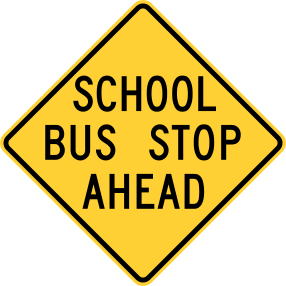
- A school crossing guard stopping all traffic flow
- A railroad crossing hidden by the curve bend
- A speed trap operated by local police daily
- A stopped bus loading or unloading passengers
Show answer
A stopped bus loading or unloading passengers. A school bus stop ahead warning in Iowa means you are nearing an area where a stopped school bus will pick up or drop off passengers. Watch for children and be prepared to stop. On two or three lane roads, meeting traffic with amber lights flashing must slow to no more than 20 mph and prepare to stop. From behind, stop no closer than 15 feet from the bus rear and remain stopped until the arm retracts and the bus moves.
Study this in the handbook: Warning, Guide and Service Signs
13. A steady red arrow points right at an Iowa signal where you want to turn right. What must you do?
- Stop, because turning drivers must stop on red arrow
- Turn after yielding, like a flashing yellow arrow
- Proceed because arrows never require full stops
- Turn from any lane if the intersection is empty
Show answer
Stop, because turning drivers must stop on red arrow. A steady red arrow in Iowa means drivers turning left or right must stop. A steady yellow arrow warns the turn signal is about to turn red, and a flashing yellow arrow allows turning after yielding to oncoming traffic and pedestrians. A steady green arrow permits the turn while yielding to those already in the intersection. Color and flash pattern together set the duty, so a red arrow never becomes a yield only instruction.
Study this in the handbook: Warning, Guide and Service Signs
14. You drive beside an Iowa semi and cannot see its driver in the truck mirror. What should you assume?
- The truck driver sees you through other mirrors well
- The truck driver cannot see your car either there
- Your car is safely smaller than the blind spot area
- The driver will check by leaning out the window
Show answer
The truck driver cannot see your car either there. If you cannot see an Iowa truck driver in the truck mirror, the truck driver cannot see you. Large trucks have blind spots, or no zones, around the front, back, and sides that make it difficult for drivers to see. Avoid being caught in a truck no zone by speeding up or slowing down. When passing, view the truck front in your rearview mirror before returning. Give trucks extra room for wide right turns as well.
Study this in the handbook: Trucks, Motorcycles, Bicyclists and Pedestrians
15. With automatic emergency braking in Iowa, what must the driver still do?
- Stop scanning because the car watches the road
- Follow closely since the car brakes on its own
- Keep scanning ahead and keep a safe following gap
- Turn the system off in slow or stopped traffic
Show answer
Keep scanning ahead and keep a safe following gap. Automatic emergency braking in Iowa can sense slow or stopped traffic or an object ahead and urgently apply the brakes if you fail to respond. If you fail to brake or steer, the vehicle will slow rapidly or stop on its own to avoid a crash. You should continue to scan the road for hazards and maintain a safe following distance. The system assists one part of driving in specific circumstances. It does not watch mirrors, choose lanes, or excuse close following.
16. Under Iowa Move Over law, which stopped vehicle with hazard lights counts for lane changes?
- Any stopped motor vehicle displaying hazard lights
- Only tow trucks with flashing amber lights on
- Only police cars with red and blue lights on
- Only snowplows working during winter storms
Show answer
Any stopped motor vehicle displaying hazard lights. Iowa Move Over or Slow Down law requires motorists to change lanes when approaching stopped vehicles displaying flashing lights. The list covers emergency, tow, recovery, maintenance, construction, solid waste, and recycling vehicles with lights activated. It also covers any stopped motor vehicle, including a passenger vehicle, continually displaying hazard lights. If a lane change is not possible, prohibited, or unsafe, slow down and be prepared to stop at a speed reasonable for conditions. Tow and police only readings miss the stranded driver case.
Study this in the handbook: Emergency Vehicles and the Move Over Law
17. In Iowa, which places count as intersections where traffic merges or crosses?
- Cross streets, side streets, driveways, and parking lots
- Only signalized crossings with marked stop lines
- Only highway interchanges with entrance ramps
- Only railroad crossings with gates or lights
Show answer
Cross streets, side streets, driveways, and parking lots. Intersections in Iowa are any place where traffic merges or crosses. They include cross streets, side streets, driveways, parking lots, and roadways open to public travel. That wide meaning matters because yield and scanning duties apply at a parking lot exit just as at a signalized corner. Before entering any such place, identify its type and traffic controls, scan for a clear path, and look left, right, and left again. Small openings produce the same conflicts as large ones.
Study this in the handbook: Intersections and Right of Way
18. You stop at an Iowa stop sign and later creep forward for a better view. Where was the first stop?
- Past the crosswalk before creeping forward
- In the intersection before creeping forward
- At the stop line before creeping forward
- At the far curb before creeping forward
Show answer
At the stop line before creeping forward. At an Iowa stop sign, stop at the stop line if one is present. If necessary, you may then pull forward to the stop sign or the edge of the intersection and proceed when safe. When required to stop by sign or signal generally, stop before your vehicle reaches the stop line or a crosswalk if there is one. The first stop protects the crosswalk, and the creep only improves sight lines afterward. Never roll the first stop into the crossing itself.
Study this in the handbook: Regulatory Signs
19. Your car beeps faster as it nears a bicyclist at low speed. What is the right habit?
- Trust the beeps and look away from the sides of the road
- Wait for the beeps to become one steady tone before reacting
- Keep scanning for bicyclists and pedestrians yourself
- Turn the sensors off in town to avoid false alarms
Show answer
Keep scanning for bicyclists and pedestrians yourself. Bicycle, pedestrian, and obstacle detection alerts you at low speeds, often with beeps that get faster as the car gets closer. A continuous tone means a crash is imminent. Iowa says you should not depend on it. Always remain aware of your surroundings and check for bicyclists, pedestrians, and obstacles regularly, especially in urban areas. Some systems only detect things directly ahead and moving the same way, so your own scanning covers what the sensors miss.
20. An Iowa divided highway ends warning appears ahead. What road change is coming?
- Two way traffic will soon become divided
- A center turn lane will begin for left turns
- Two way traffic will no longer be divided
- A one way street will begin at the next light
Show answer
Two way traffic will no longer be divided. A divided highway ends warning in Iowa means two way traffic will no longer be divided by a center strip. Watch out for oncoming vehicles as the barrier between directions disappears. Keep right and expect headlights in the adjacent lane where a median recently sat. A divided highway begins warning announces the opposite change. The transition zone deserves slower speed and fresh lane discipline until the new pattern feels stable.
Study this in the handbook: Warning, Guide and Service Signs
Every question is written from the official Iowa Driver's License Manual. Need paper? Printable IA practice test with answer key.
Last verified 2026-10-05. How we check every question · Study all 500 as flashcards
Frequently asked questions
How many questions are on this Iowa practice test?
This fixed set has 20 questions. It is test 18 of 25 from the 500 question Iowa bank.
How does this fixed test relate to the full Iowa bank?
Each numbered test is a fixed set of questions in a fixed order, so you can retake the same test later and compare. Every test mixes road signs and the other topics in about the same proportion as the full bank. Tests 1 to 25 together cover every question in the Iowa bank once. The full practice page mixes the whole bank at random.
Last verified 2026-10-05. See the Iowa DMV facts page for sourced state details.