
Test 7 of 10 · 20 questions · Free 2026
IA Permit Practice Test 7
Jump to the test ↓A fixed 20 question set from the Iowa bank with answers and plain English explanations.
Question 1 of 20 · 0 right so far
All 20 questions in test 7
Every question below comes from the Iowa question bank on this page. Open a question to see the correct answer and the explanation. Nothing here is hidden behind a signup.
1. From what distance must the red tail light on the back of a vehicle be visible under Iowa's equipment rules?
- At least 100 feet
- At least 200 feet
- At least 1,000 feet
- At least 500 feet
Show answer
At least 500 feet. Iowa requires at least one red light on the back of the vehicle, visible for at least 500 feet, plus two headlights and a white light for the rear license plate. One hundred and 200 feet are too short, and 1,000 feet is not the equipment standard. The 500 foot figure also shows up in Iowa's headlight rule, which requires headlights whenever visibility is 500 feet or less.
Study this in the handbook: Vehicle Checks, Seat Belts and Child Restraints
2. How close to an intersection may you pass another vehicle on an Iowa two-lane road?
- You may not pass within 100 feet of an intersection
- You may pass anywhere with a broken center line
- You may pass as close as 50 feet
- You may not pass within 500 feet
Show answer
You may not pass within 100 feet of an intersection. Iowa prohibits passing within 100 feet of an intersection, and also around a curve where your view is blocked. The same 100 foot rule applies near a railroad crossing and near a posted narrow bridge, viaduct, or tunnel. A broken center line does not override these rules. Passing as close as 50 feet breaks the rule, and 500 feet is not the Iowa distance. Vehicles may enter from side roads at intersections, which is why passing there is dangerous.
Study this in the handbook: Turns, Lane Changes, Passing and Tailgaters
3. Besides fines, what can a distracted driving conviction cost an Iowa driver?
- Only higher insurance rates
- Suspension or revocation of the license or permit
- A mandatory new vision test
- Nothing more, since it is a minor offense
Show answer
Suspension or revocation of the license or permit. In addition to fines, a distracted driving conviction could result in your license or permit being suspended or revoked. Distracted driving is a primary offense, so an officer can stop you for it alone. It is not limited to insurance consequences or a vision test, and it is not treated as trivial. Causing a death while distracted can bring more than $1,000 in fines, suspension, and possibly a vehicular homicide charge.
Study this in the handbook: Iowa's Hands-Free Law and Distractions
4. What do Iowa guide signs show?
- The location of traveler services only
- A prohibition on entering a roadway
- A warning that workers are ahead
- Directions and distance to various locations
Show answer
Directions and distance to various locations. Iowa guide signs show directions and distance to locations such as cities, airports, state lines, national parks, historical areas, and museums. A do-not-enter message is regulatory, work-zone information is a warning category, and traveler services are shown by service signs. Read guide signs early enough to choose the needed lane or exit without a sudden maneuver. Their purpose is navigation, so use the place name and distance to plan ahead while continuing to obey speed, lane, and yielding controls.
Study this in the handbook: Warning, Guide and Service Signs
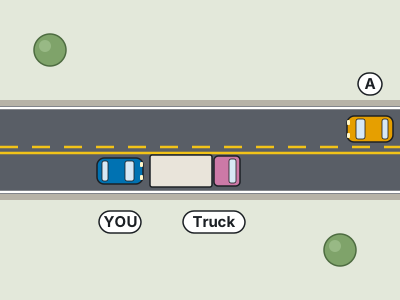
5. What does a solid yellow line on a two-way road mean for the traffic beside it?
- The lane is reserved for left turns only
- Passing is required before the next intersection
- Passing is not allowed from that side
- Traffic may cross it whenever the driver signals
Show answer
Passing is not allowed from that side. A solid yellow line marks the side where passing is prohibited. The restriction reflects limited sight distance or another condition that makes entering the opposing lane unsafe. A driver cannot cancel that restriction by signaling, and the marking does not convert the lane into a left-turn-only lane. A nearby dashed line may allow passing for traffic traveling in the opposite direction when safe, but that permission belongs to the other side. Use the solid line as a firm no-pass boundary and wait for a lawful passing section.
Study this in the handbook: Pavement Markings and Lane Use
6. An Iowa driver under 18 has a license revoked for OWI. Can they get a temporary restricted license?
- No, offenders under 18 are not eligible for a temporary restricted license during the revocation
- Yes, after 30 days
- Yes, for school and work only
- Yes, with an ignition interlock
Show answer
No, offenders under 18 are not eligible for a temporary restricted license during the revocation. Iowa's underage OWI rules are stricter than the adult rules. Offenders under age 18 are not eligible for a temporary restricted license while their license is revoked for OWI, so there is no school or work exception and no interlock option for them during the revocation. The underage limit is a BAC of .02 or more. The manual also sets a minimum 60 day revocation at .02 and 180 days at .08 or more for an underage driver.
Study this in the handbook: Operating While Intoxicated (OWI)
7. How close to a stop sign may an Iowa driver park?
- No closer than 10 feet
- No closer than 5 feet
- No closer than 50 feet
- No closer than 30 feet
Show answer
No closer than 10 feet. Iowa prohibits parking closer than 10 feet from a stop sign. The same list bans parking in an intersection, on a sidewalk, on interstates and highways, within five feet of a hydrant or in a hydrant red zone, and double parking. Fifty feet is the distance the list sets for a railroad crossing, and thirty feet does not appear in the rule at all.
Study this in the handbook: Railroad Crossings and Rural Roads
8. If an emergency vehicle approaches while you are in an intersection, what should you do first?
- Reverse into the cross street
- Stop immediately across the intersection
- Drive through the intersection before pulling over
- Turn around and follow the emergency vehicle
Show answer
Drive through the intersection before pulling over. Iowa's manual directs a driver already in an intersection to drive through it before pulling over. Iowa says to yield to an emergency vehicle by pulling over to the right edge of the road, but only after the intersection is behind you. Stopping across the intersection can obstruct traffic, while reversing or turning around introduces unnecessary movements near a response vehicle. Once beyond the intersection, pull toward the right as near to the edge as possible. The special median exception is separate and applies when the emergency vehicle is on the other side of a divided roadway.
Study this in the handbook: Emergency Vehicles and the Move Over Law
9. When should you use a turn signal even if you do not see another vehicle nearby?
- Before turning, changing lanes, merging, or parking
- Only after another vehicle appears in your mirror
- Only for a left turn at an intersection
- Only once the steering wheel begins to turn
Show answer
Before turning, changing lanes, merging, or parking. Turn signals communicate intentions to other road users, including people you may not have noticed yet. Use one before changing lanes, turning right or left, merging into traffic, or parking. Waiting until another vehicle appears leaves less time for that person to react, and signaling only after steering begins is late communication. A signal is not limited to left turns. Activate it with enough lead time, avoid signaling so early that an intervening driveway causes confusion, and make sure it is off after the turn is complete.
Study this in the handbook: Turns, Lane Changes, Passing and Tailgaters
10. What general speed limit applies in an Iowa suburban district when no limit is posted?
- 20 mph
- 25 mph
- 45 mph
- 60 mph
Show answer
45 mph. Iowa lists 45 mph as the general limit for an unposted suburban district. The nearby figures are tied to different settings: 20 mph is for a business district, 25 mph covers a residential or school district, and 60 mph is associated with primary roads, urban interstates, and secondary roads during the stated daylight period. The word suburban is the key classification here. Even at 45 mph, the driver must reduce speed when traffic, visibility, weather, or pavement conditions make the posted or general maximum unsafe.
Study this in the handbook: Iowa Speed Limits
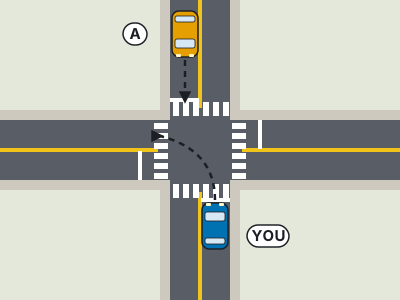
11. When turning left at an intersection, which traffic must the turning driver yield to?
- No traffic if the turn signal is on
- Cars parked on the left shoulder
- Only vehicles behind the turner
- Oncoming cars going straight
Show answer
Oncoming cars going straight. A left-turning driver must yield to oncoming cars that are proceeding straight ahead. Activating a turn signal communicates intent, but it does not remove the opposing driver's priority or make the path clear. Parked vehicles and traffic behind the turner are not the specific conflict named in this intersection rule. Before crossing the opposing lane, check for approaching vehicles, judge their distance and speed, and wait until the movement can be completed safely. The simple cue is left turn across traffic means oncoming straight traffic goes first.
Study this in the handbook: Intersections and Right of Way
12. Who may not ride in the back (cargo bed) of a moving pickup truck in Iowa?
- Anyone under 21
- Only children under 6
- Anyone under 18
- No one; it is always allowed on farm roads
Show answer
Anyone under 18. The Iowa manual states that a child under the age of 18 cannot ride in the rear of a moving pickup truck. The cutoff is 18, not 21, and it is not limited to young children under 6. The manual gives no farm road exception. The rule fits the rest of Iowa's restraint law, which requires everyone under 18 to be secured by a restraint system or seat belt in every seating position.
Study this in the handbook: Vehicle Checks, Seat Belts and Child Restraints
13. When an emergency vehicle approaches and you are already in an intersection, when should you pull over?
- Only after following the emergency vehicle
- Before entering the intersection
- Immediately in the intersection
- After driving through the intersection
Show answer
After driving through the intersection. Iowa instructs a driver who is already in an intersection, including a roundabout, to drive through the intersection before pulling over. Stopping in the crossing can block the emergency vehicle and make the scene less predictable. Pulling over before entering, stopping immediately, or following the emergency vehicle does not follow that procedure. Keep moving only far enough to clear the intersection, then pull to the right edge or as near to the right as possible and stop.
Study this in the handbook: Intersections and Right of Way
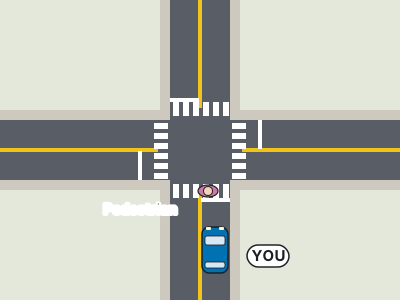
14. What must a driver do for a pedestrian who is in or about to enter a crosswalk?
- Yield to the pedestrian
- Continue if the crosswalk has no painted lines
- Yield only at a traffic signal
- Sound the horn and proceed first
Show answer
Yield to the pedestrian. Drivers must yield to anyone in or about to enter a crosswalk. Iowa's manual also warns that not all crosswalks are marked, so the absence of painted lines does not cancel the duty. The traffic-signal-only choice is too narrow, and sounding the horn does not replace yielding. Reduce speed while approaching crossings, scan both sides for people, and be ready to stop before entering their path. Treat an unmarked crossing at an intersection as a place where pedestrians may still have the protection described by the rule.
Study this in the handbook: Pavement Markings and Lane Use
15. What color are most Iowa warning signs?
- Blue
- Yellow
- White
- Brown
Show answer
Yellow. Most Iowa warning signs are yellow with black lettering or symbols, and most have a diamond shape. Blue signs point to traveler services, white signs provide regulatory information, and brown signs identify recreation or cultural points of interest. Warning color is an early cue that a special situation or hazard is ahead, but the symbol or wording supplies the exact message. Reduce speed and scan for the condition shown, especially near curves, crossings, merging traffic, or slippery pavement. Color helps classify the sign before its detailed instruction is read.
Study this in the handbook: Warning, Guide and Service Signs
16. When driving on an Iowa rural road, which group should you expect to encounter as slower or larger road users?
- Farm equipment, ATVs or UTVs, bicycles, horse-drawn vehicles, and maintenance equipment
- Only passenger cars traveling at the posted limit
- Only pedestrians inside marked crosswalks
- Only emergency vehicles using sirens
Show answer
Farm equipment, ATVs or UTVs, bicycles, horse-drawn vehicles, and maintenance equipment. Rural roads can include many road users that move slowly or occupy more width than an ordinary car. The manual names farm equipment, ATVs or UTVs, bicycles, horse-drawn vehicles, and roadway maintenance equipment. Expecting only cars hides the very hazards that require early scanning and slower approach. These vehicles may be difficult to see, may need extra room, or may not maneuver like a passenger vehicle. Spot them early, reduce speed, and leave room before passing.
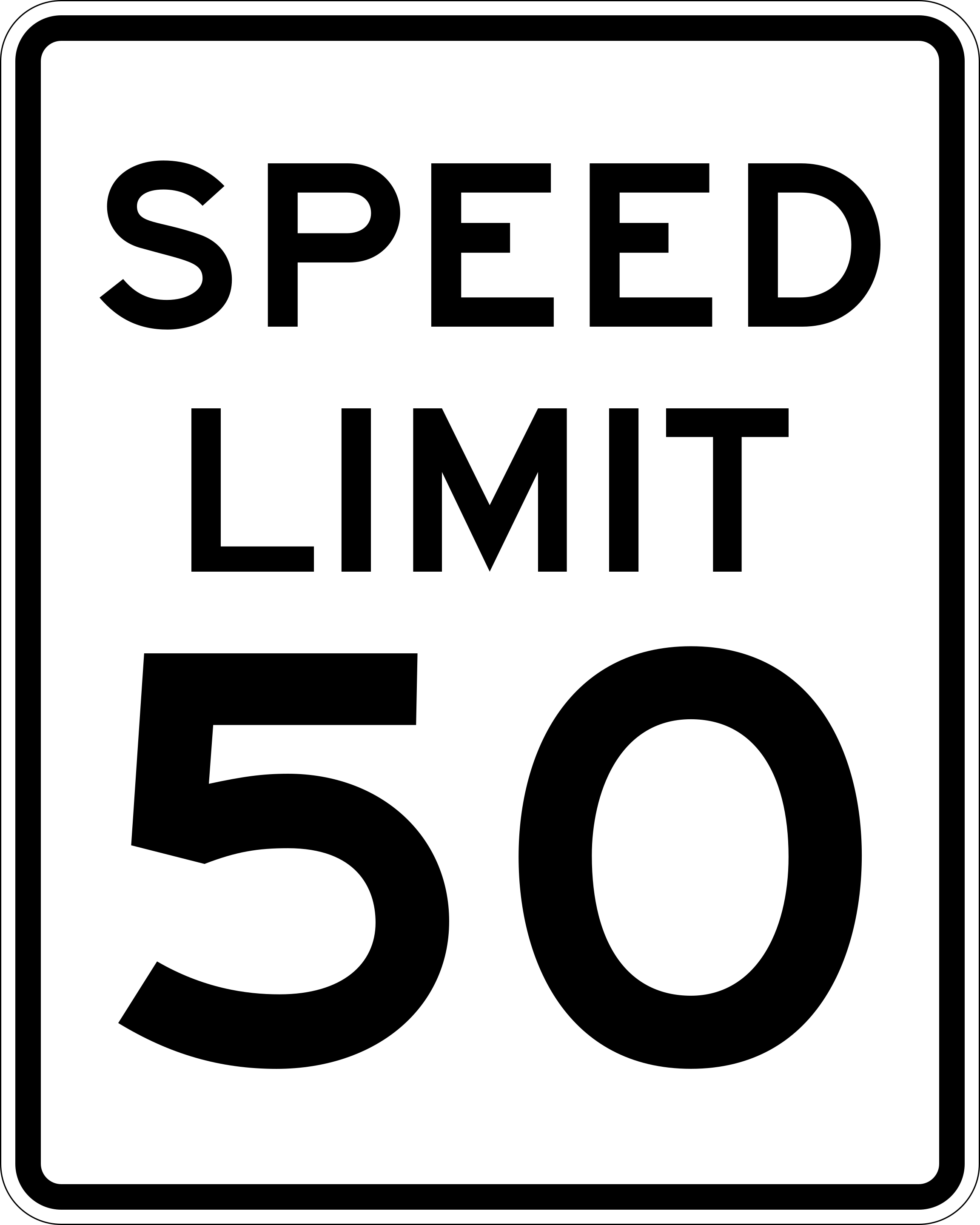
17. What does a posted speed limit represent when road conditions are ideal?
- A suggested speed that may always be exceeded
- The maximum permitted speed
- The minimum speed for every vehicle
- The speed required during rain or fog
Show answer
The maximum permitted speed. A speed-limit sign states the maximum speed allowed under ideal driving conditions. Rain, snow, fog, or a slippery roadway can require a lower speed, even when the posted number is higher. The sign is not a guarantee that the road is safe at that number, and it is not automatically a minimum for ordinary travel. Use the posted limit as an upper boundary, then reduce speed whenever visibility, traction, traffic, or roadway conditions make that necessary.
Study this in the handbook: Regulatory Signs
18. A pedestrian-crossing warning requires the driver to watch for:

- Railroad workers beside the road
- Only people inside marked crosswalks
- People walking, running, riding, or using mobility devices
- Farm equipment entering from a field
Show answer
People walking, running, riding, or using mobility devices. The pedestrian-crossing warning covers more than a person walking. Iowa's manual specifically calls attention to people walking, running, riding, and using wheelchairs or low-speed micromobility devices. Do not narrow the warning to a painted crosswalk or assume a person must be on foot. Ease off the accelerator, scan both sides, and be prepared to yield as people approach or enter the crossing area.
Study this in the handbook: Warning, Guide and Service Signs
19. What happens to Iowa driving privileges after operating while intoxicated, even without an OWI conviction in criminal court?
- They remain valid unless a judge orders a suspension
- They are revoked for a minimum of 180 days
- They are suspended for exactly 30 days
- They are revoked only after a second offense
Show answer
They are revoked for a minimum of 180 days. Iowa still revokes driving privileges for at least 180 days after operating while intoxicated, even when criminal court does not produce an OWI conviction. The choice “They remain valid unless a judge orders a suspension” confuses the criminal case with the separate licensing consequence. Thirty days is shorter than the period stated, and the choice “They are revoked only after a second offense” incorrectly makes the rule depend on repetition. Treat the administrative driving consequence as its own issue after an intoxicated-driving event. The key cue is the phrase even if you are not convicted, which signals that the revocation does not wait for a criminal judgment.
Study this in the handbook: Operating While Intoxicated (OWI)
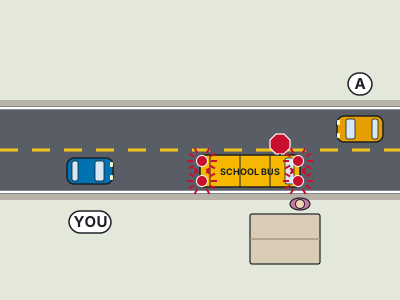
20. How far from the rear of a stopped school bus must a driver stop?
- No closer than 5 feet
- No closer than 15 feet
- At least 50 feet away
- Only far enough to see the stop arm
Show answer
No closer than 15 feet. When the school bus stops with its stop arm extended, the driver behind it must stop no closer than 15 feet from the rear. Five feet leaves too little protection around children and the bus, while 50 feet is not the stated minimum. Visibility alone is not the measure because the manual specifies a distance. Remain stopped until the stop arm retracts and the bus starts moving again. The number to associate with the bus's rear is 15 feet, not the other distances in the choices.
Study this in the handbook: Stopping for School Buses
QualitySpace is expanding to Iowa
We are a California-based independent insurance brokerage working on licensing in more states. We cannot help with Iowa insurance yet. Leave your email and we will let you know when we can.
Every question is written from the official Iowa Driver's License Manual. Need paper? Printable IA practice test with answer key.
Last verified 2026-10-05. How we check every question · Study all 210 as flashcards
Frequently asked questions
How many questions are on this Iowa practice test?
This fixed set has 20 questions. It is test 7 of 10 from the 210 question Iowa bank.
How does this fixed test relate to the full Iowa bank?
Each numbered test is a fixed set of questions in a fixed order, so you can retake the same test later and compare. Every test mixes road signs and the other topics in about the same proportion as the full bank. Tests 1 to 10 together cover 200 of the 210 questions in the Iowa bank, each once. The full practice page mixes the whole bank at random.
Last verified 2026-10-05. See the Iowa DMV facts page for sourced state details.