
Test 13 of 25 · 20 questions · Free 2026
IA Permit Practice Test 13
Jump to the test ↓A fixed 20 question set from the Iowa bank with answers and plain English explanations.
Question 1 of 20 · 0 right so far
All 20 questions in test 13
Every question below comes from the Iowa question bank on this page. Open a question to see the correct answer and the explanation. Nothing here is hidden behind a signup.
1. Your car stalls on Iowa tracks and the crossing has a blue ENS sign. What is it for?
- Requesting a tow truck discount for members
- Finding the nearest fuel station to the tracks
- Reporting the stall with the crossing ID by phone
- Posting the speed limit for the crossing road
Show answer
Reporting the stall with the crossing ID by phone. The blue Emergency Notification System sign in Iowa is posted at railroad crossings and provides critical information for reporting a problem or emergency on or near the tracks. It includes a phone number to contact the railroad and a unique crossing identification number. Drivers should use the phone number and crossing ID to report stalled vehicles, malfunctioning signals, or other hazardous situations. If your vehicle stalls on tracks, get everyone out first, move away, then call using that sign or call 911.
Study this in the handbook: Regulatory Signs
2. You drive the main Iowa road and pass a merging traffic warning. What should you prepare for?

- Other vehicles blending into your lane ahead
- Your lane ending with traffic yielding to you
- A divided highway starting beyond the merge
- Oncoming traffic entering a two way stretch
Show answer
Other vehicles blending into your lane ahead. If you are on the main road in Iowa and see a merging traffic sign, be prepared for other vehicles blending into your lane. Check mirrors, hold a steady speed, and open a gap rather than racing the entering vehicle. A lane ends warning instead tells two lanes becoming one that traffic must yield when merging. Ramp drivers should match traffic speed in the acceleration area, while highway traffic can move over or adjust speed to help entry when safe.
Study this in the handbook: Warning, Guide and Service Signs
3. In an Iowa work zone, what do large flashing arrow panels usually mean?
- A school bus is loading just ahead
- A lane or shoulder is closed ahead
- The speed limit has ended for the day
- A railroad gate is about to lower
Show answer
A lane or shoulder is closed ahead. Large flashing arrow panels in Iowa work zones are typically used when a lane or shoulder is closed. The panel directs drivers to move over early and follow the open path. It does not announce a school bus, the end of a speed limit, or a railroad gate. Treat the first panel as the start of your lane change, not the last moment to merge. Early movement keeps traffic flowing and protects workers near the closed stretch.
4. A person waits at an unmarked Iowa crosswalk at a corner. What must drivers do?
- Yield or stop for that pedestrian at the corner
- Proceed because unmarked crosswalks need no yielding
- Yield only when the person waves cars to stop
- Stop only when a painted crosswalk is present
Show answer
Yield or stop for that pedestrian at the corner. Iowa drivers must yield or stop for pedestrians in marked or unmarked crosswalks. Crosswalks define where pedestrians cross, yet not all crosswalks are marked, so be alert at intersections without defined crosswalks. You must yield to anyone in or about to enter a crosswalk. Pedestrians include people using human powered devices such as wheelchairs and scooters. Never pass a vehicle stopped for a pedestrian, since the person may be hidden from your view.
Study this in the handbook: Intersections and Right of Way
5. When passing a motorcycle in Iowa, how much lane room must the driver allow?
- Half a lane shared closely beside the motorcycle
- A full lane for the motorcycle without crowding
- Room only at the front wheel of the motorcycle
- No extra room beyond a normal car mirror gap
Show answer
A full lane for the motorcycle without crowding. When passing a motorcycle in Iowa, allow a full lane for the motorcycle and never crowd into the same lane as the cycle. Respect the vehicle space of the motorcycle and its position in traffic. When driving behind a motorcycle, allow at least a three to four second following distance, and stay further behind on wet or slippery roads, since two wheels can become unstable in quick stops. Intersections are the most likely places for car and motorcycle collisions, so confirm the rider speed before turning.
Study this in the handbook: Trucks, Motorcycles, Bicyclists and Pedestrians
6. You need fuel and a hospital on an Iowa highway. Which sign color directs you to services?
- Brown signs directing travelers toward services
- Blue signs directing travelers toward services
- Yellow signs directing travelers toward services
- White signs directing travelers toward services
Show answer
Blue signs directing travelers toward services. Blue service signs in Iowa direct travelers to places such as rest areas, tourist sites, hospitals, lodging, fuel stations, and restaurants. Service signs also show locations like campgrounds. Brown signs point to recreation and cultural interest, green signs give direction and distance, and white signs state regulatory law. Following blue when you need fuel or care keeps you from hunting exits blindly. Watch for the blue group before the exit rather than at it.
Study this in the handbook: Sign Colors and Shapes
7. In Iowa, which kind of distraction means the driver hands leave the wheel?
- Visual distraction, such as looking at a GPS
- Cognitive distraction, such as daydreaming aloud
- Hearing distraction, such as listening to music
- Manual distraction, such as eating or makeup
Show answer
Manual distraction, such as eating or makeup. Manual distraction covers tasks that require the driver to take one or both hands off the wheel in Iowa, such as eating or putting on makeup. Visual distraction requires looking away from the driving task, like looking at a GPS. Cognitive distraction makes the mind wander or focus elsewhere. Many common tasks fit more than one category at once, which compounds the danger. Keep hands on the wheel, eyes on the road, and mind on driving to cut all three kinds.
Study this in the handbook: Iowa's Hands-Free Law and Distractions
8. In Iowa, when may a driver travel in a reserved lane?
- Whenever traffic in other lanes is moving slowly
- Only when operating the type of vehicle it is reserved for
- Whenever the reserved lane looks empty ahead
- Whenever the driver plans to turn within a block
Show answer
Only when operating the type of vehicle it is reserved for. Do not travel in an Iowa reserved lane unless you are operating the type of vehicle the lane is reserved for. Signs state the special use, and a white diamond often marks the lane at the roadside or on the pavement. Slow traffic, an empty lane, and a coming turn do not change that restriction. Examples include lanes held for buses or high occupancy vehicles. Using the lane without qualifying blocks the vehicles the lane was built to serve.
Study this in the handbook: Pavement Markings and Lane Use
9. Bright headlights from an oncoming Iowa car blind you at night. Where should you look?
- Toward the white stripe at the right road edge
- Directly into the oncoming headlights ahead
- At the center line until the car passes by
- Down at the dashboard until vision fully clears
Show answer
Toward the white stripe at the right road edge. If you are blinded by another vehicle headlights in Iowa, slow down and watch the white stripe at the right edge of the pavement. The bright light may make you feel somewhat blinded, but the feeling quickly disappears. Looking toward the right side of the road and adjusting the rearview mirror can also reduce headlight glare generally. At night, lower speed and increase following distance to compensate for reduced visibility overall. The edge stripe keeps your lane while eyes recover.
10. You brake too hard on dry Iowa pavement and the car starts to skid. What triggered that skid risk?
- Any braking at all causes skids on dry roads
- Only ice and snow can cause vehicle skids in Iowa ever
- Skids happen only when tires are brand new
- Braking too hard can cause a vehicle skid there
Show answer
Braking too hard can cause a vehicle skid there. Loose gravel roads, snow and ice, or even dry pavement in Iowa may cause your vehicle to skid if brakes are applied too hard. Accelerating too fast can spin drive wheels the same way on slippery surfaces. On ice, brake only in a straight line and begin slowing long before stops. Smooth gradual inputs preserve the friction that panic inputs spend. If brakes fail entirely, pump the pedal first to rebuild pressure before using slower parking brake measures.
Study this in the handbook: Following Distance and Stopping
11. Sharrows appear painted in an Iowa travel lane. What do those shared lane markings do?
- Reserve the lane for bicycles alone in traffic
- Mark where drivers must stop for crossing bikes
- Alert drivers to bicyclists and support safe passing
- Show the optimum spot to trigger traffic signals
Show answer
Alert drivers to bicyclists and support safe passing. Shared lane pavement markings, called sharrows, alert Iowa motorists to the presence of bicyclists, encourage safe passing, and reduce wrong way bicycling and door crashes. Unlike bike lanes, sharrows do not designate a portion of roadway for exclusive bicycle use. Bicycle lanes use solid white lines with bicycle markings and signs, and motorists may enter them only for turning movements with care. Sharrows therefore mean share the lane with awareness, not claim it or surrender it.
Study this in the handbook: Pavement Markings and Lane Use
12. At an Iowa pedestrian hybrid beacon, what does a flashing bottom yellow light require?
- Stop fully and wait for a green light stage
- Slow down for the crossing activation ahead
- Proceed at full speed because yellow means go
- Turn off the headlights until the beacon ends
Show answer
Slow down for the crossing activation ahead. Pedestrian hybrid beacons in Iowa operate only when activated by a pedestrian. Once activated, the bottom yellow light flashes, and motorists must slow down. The bottom yellow then becomes solid and motorists must prepare to stop, followed by two solid red lights where motorists must stop for pedestrians. When all lights are dark, motorists can proceed with caution. Reading the stage correctly prevents both needless stops and late braking at the crosswalk.
Study this in the handbook: Traffic Signals and Pedestrian Beacons
13. You see an Iowa crossbuck beside the road ahead. What does that marker identify?
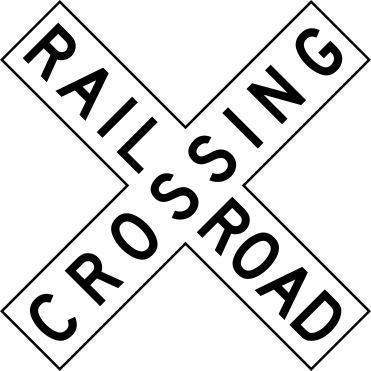
- A school crossing zone starting there
- A divided highway beginning at that point
- A route marker for a county road junction
- A railroad crossing at that location
Show answer
A railroad crossing at that location. Crossbuck signs in Iowa are placed at each railroad crossing. A number sign under the crossbuck shows how many sets of train tracks you must cross. Advance warning signs and pavement markings also indicate tracks ahead on approach. At actively protected crossings, obey flashing lights and gates and never go around them. At passive crossings with only a crossbuck and stop or yield sign, slow down, look for a train, and always expect one in either direction.
Study this in the handbook: Sign Colors and Shapes
14. Near Iowa farm equipment on a rural road, what turning risk should a driver expect?
- Quick narrow turns that finish within one lane
- Turns announced by flashing blue lights on top
- Wide turns at unmarked entrances with faint signals
- Turns only at paved intersections with signals
Show answer
Wide turns at unmarked entrances with faint signals. Large farm equipment in Iowa may make wide turns at unmarked entrances. Some farm equipment is wider than the road itself. Proceed with extreme caution when attempting to pass, because operators may not see your vehicle and a turn signal may be difficult to detect. Identify slow and large vehicles early and slow down when approaching. Quick narrow turns, paved only turning points, and emergency light cues all misread how farm machinery moves between fields and roads.
15. At night in Iowa, when should high beams be used?
- Whenever the road has a posted speed above 35
- Whenever fog makes the road hard to see ahead
- Whenever another vehicle is close ahead in lane
- Only where other drivers will not see the beams
Show answer
Only where other drivers will not see the beams. High beams in Iowa should only be used when other drivers will not see them, such as isolated roadways with little traffic. To compensate for reduced visibility at night, lower your speed and increase following distance. Headlights should be turned on before the sun goes down to make the car more visible. Fog calls for low beams instead, since high beams reflect back as glare. If blinded by another vehicle, slow down and watch the white stripe at the right edge of the pavement.
16. Rain starts to wet your windshield on an Iowa road. Which two steps does the manual list?
- Turn on the wipers and the low-beam headlights
- Turn on the high beams and slow the wipers to save wear
- Switch on the cruise control and keep the wipers off
- Turn on the hazard flashers and drive in the left lane
Show answer
Turn on the wipers and the low-beam headlights. For wet roads, Iowa lists a short set of habits. Turn on the wipers as soon as the windshield becomes wet, and turn on the low-beam headlights, which helps other drivers see you through the rain and spray. The manual also advises driving slower than normal, increasing following distance, and keeping the defroster on to stop the windows from fogging. Precipitation reduces vision and changes how well tires grip, so visibility and speed both need attention.
Study this in the handbook: Night Driving, Bad Weather and Floods
17. You sit inside an Iowa intersection as a fire truck approaches with sirens. What comes first?
- Drive through the intersection before pulling over
- Stop inside the intersection and wait there
- Pull over inside the intersection to the right
- Back out of the intersection against traffic
Show answer
Drive through the intersection before pulling over. If you are in an Iowa intersection, including a roundabout, when an emergency vehicle approaches, drive through the intersection before you pull over. Then pull to the right edge of the road for a police vehicle, fire engine, ambulance, or other emergency vehicle using sirens or flashing lights. Stopping inside the box traps everyone. One exception exists on streets separated by a median when the emergency vehicle travels on the other side, where you do not have to stop.
Study this in the handbook: Intersections and Right of Way
18. Your car stalls in Iowa floodwater covering a rural road. What does the manual say to do?
- Stay inside and wait for the water to recede
- Push the vehicle through the deepest section
- Abandon the vehicle and move to higher ground
- Restart the engine repeatedly until it catches
Show answer
Abandon the vehicle and move to higher ground. If your vehicle stalls in Iowa floodwater, abandon the vehicle and move to higher ground. Do not stay in a flooded vehicle. As little as six inches of moving water may sweep away a vehicle, including SUVs and pickups, and almost half of flash flood deaths happen in vehicles. Never drive through a flooded road or bridge, since the surface beneath could be washed out. Turn around and find another route before water traps the vehicle.
Study this in the handbook: Night Driving, Bad Weather and Floods
19. You drive well below the pace of traffic on an Iowa highway because it feels safer. What does the manual say?
- Driving too slowly can also cause a crash, so go with the general flow
- Driving slower is always the safest choice
- Traffic will pass you, so the speed does not matter
- Use the left lane so faster cars see you coming
Show answer
Driving too slowly can also cause a crash, so go with the general flow. The posted limit is the maximum legal speed under ideal conditions, and your speed should depend on the posted limit, road conditions, and weather. Iowa adds that while driving too fast is a major cause of crashes, driving too slow may also cause a crash. Try to drive with the general traffic flow on any road. On the interstate there is also a minimum speed of 40 mph.
Study this in the handbook: Iowa Speed Limits
20. A 12 year old rides in the back seat of an Iowa car. How must that child be secured?
- By a restraint system or a seat belt in that seat
- By nothing, because back seats need no restraint system
- By a rear facing infant seat in that back seat
- Only by holding the door handle while riding
Show answer
By a restraint system or a seat belt in that seat. An Iowa child from age six up to age 18 must be secured in a child restraint system or by a seat belt, in all seating positions front and back. Adults 18 and older must wear seat belts in front seats, and back seat passengers under 18 fall under the youth rule. Under six children need a restraint system rather than a belt alone. The back seat therefore still requires a belt or restraint for a 12 year old on every trip.
Study this in the handbook: Vehicle Checks, Seat Belts and Child Restraints
Every question is written from the official Iowa Driver's License Manual. Need paper? Printable IA practice test with answer key.
Last verified 2026-10-05. How we check every question · Study all 500 as flashcards
Frequently asked questions
How many questions are on this Iowa practice test?
This fixed set has 20 questions. It is test 13 of 25 from the 500 question Iowa bank.
How does this fixed test relate to the full Iowa bank?
Each numbered test is a fixed set of questions in a fixed order, so you can retake the same test later and compare. Every test mixes road signs and the other topics in about the same proportion as the full bank. Tests 1 to 25 together cover every question in the Iowa bank once. The full practice page mixes the whole bank at random.
Last verified 2026-10-05. See the Iowa DMV facts page for sourced state details.