
Test 3 of 10 · 20 questions · Free 2026
IA Permit Practice Test 3
Jump to the test ↓A fixed 20 question set from the Iowa bank with answers and plain English explanations.
Question 1 of 20 · 0 right so far
All 20 questions in test 3
Every question below comes from the Iowa question bank on this page. Open a question to see the correct answer and the explanation. Nothing here is hidden behind a signup.
1. Who must have an Iowa permit or driver's license when using public roads?
- Only Iowa residents who have lived there for one year
- Only people operating commercial trucks
- Anyone operating a motor vehicle, motorcycle, or moped
- Only drivers traveling outside city limits
Show answer
Anyone operating a motor vehicle, motorcycle, or moped. Iowa requires a permit or license for anyone operating a motor vehicle, motorcycle, or moped on public roads. The rule covers more than people driving cars, so the commercial truck option is too narrow. A one year residency requirement is not part of the rule, and city boundaries do not determine whether a credential is needed. When studying this requirement, connect the credential to the type of vehicle and the public-road setting. That cue helps distinguish the general licensing rule from special exemptions described elsewhere in the manual.
Study this in the handbook: Who Needs a License and What to Carry
2. What do shared lane pavement markings, called sharrows, do on Iowa roads?
- Show where bicycles must ride on the sidewalk
- Reserve the lane for bicycles only
- Mark a no passing zone
- Alert motorists that bicyclists may be present and encourage safe passing, without reserving part of the road for bikes
Show answer
Alert motorists that bicyclists may be present and encourage safe passing, without reserving part of the road for bikes. Shared lane pavement markings, also called sharrows, alert motorists to the presence of bicyclists, encourage safe passing, and reduce wrong way bicycling and door crashes. Unlike bike lanes, sharrows do not designate a particular portion of the roadway for the exclusive use of bicycles, so the lane remains shared. They are not a passing restriction, and bicycles belong on the road, not the sidewalk.
Study this in the handbook: Pavement Markings and Lane Use
3. What should a driver do when approaching a farm vehicle traveling slowly on a rural road?
- Pass immediately because farm equipment must yield to every car
- Assume it will move onto the shoulder without signaling
- Identify it early, slow down, and use extreme caution before attempting to pass
- Follow closely so no other vehicle can enter the gap
Show answer
Identify it early, slow down, and use extreme caution before attempting to pass. Large farm equipment may be wider than the road, make wide turns at unmarked entrances, and have a turn signal that is difficult to detect. The manual therefore calls for early identification, reduced speed, and extreme caution before passing. A close follow removes the time needed to react, while assuming the machine will leave the road ignores its limited maneuvering room. Watch for a possible left or right turn and wait until the entire passing path is visible and safe.
4. What can an Iowa driver face for causing a death while distracted?
- A $100 fine
- More than $1,000 in fines, license suspension, and possibly a vehicular homicide charge
- A warning letter
- Only civil liability
Show answer
More than $1,000 in fines, license suspension, and possibly a vehicular homicide charge. If you are distracted and cause the death of another person, the manual says you could face more than $1,000 in fines, have your license suspended, and depending on the circumstances be charged with vehicular homicide. Distracted driving is also a primary offense, so an officer can pull you over for it. The hands free law requires a complete stop off the roadway before handling a message.
Study this in the handbook: Iowa's Hands-Free Law and Distractions
5. What does it mean that not wearing a seat belt is a primary offense in Iowa?
- An officer can stop you for the seat belt violation alone
- You can be ticketed only after a crash
- You get a warning the first time
- It only counts if you commit another violation first
Show answer
An officer can stop you for the seat belt violation alone. A primary offense means an officer can stop you for the sole purpose of the seat belt violation. Iowa does not require a crash or another violation first, and the manual does not promise a first time warning. Iowa Code section 805.8A sets the scheduled fine at $70 for a seat belt violation and $135 for a child or teen restraint violation. Distracted driving is also a primary offense in Iowa.
Study this in the handbook: Vehicle Checks, Seat Belts and Child Restraints
6. You are towing a small trailer on an Iowa road with no posted speed limit. What general limit applies?
- 55 mph
- 45 mph
- 60 mph
- 65 mph
Show answer
45 mph. Iowa sets a general limit of 45 mph for any vehicle pulling another vehicle when no other limit is posted. That is the same figure as a suburban district. Sixty mph is the general limit for primary roads and urban interstates without a trailer, 55 is not one of Iowa's listed general limits, and 65 is higher than any unposted limit for a towing vehicle. A lower limit can always be set for the conditions.
Study this in the handbook: Iowa Speed Limits
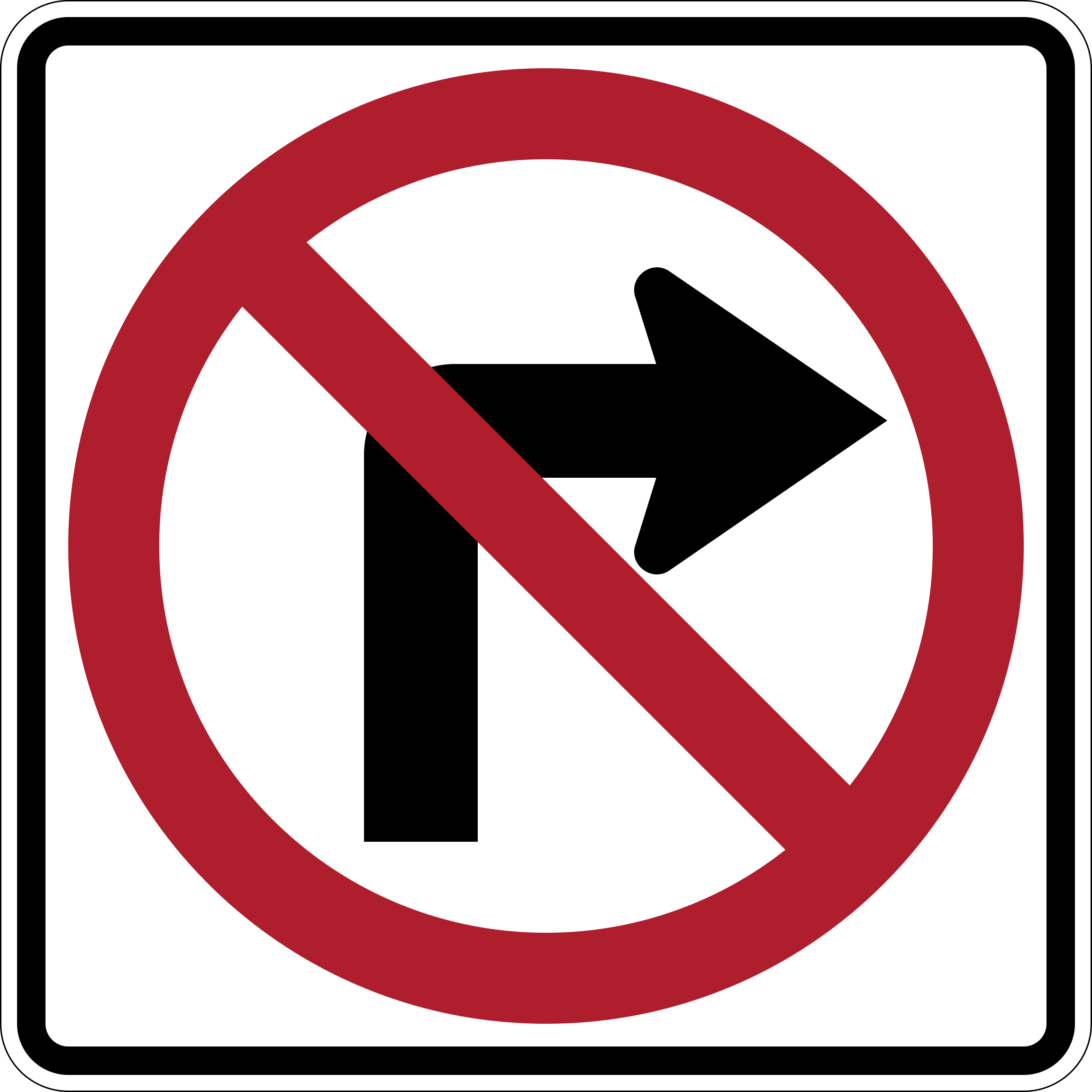
7. When this sign is posted, which maneuver is forbidden?
- Changing lanes after the intersection
- Turning left
- Driving straight ahead
- Turning right
Show answer
Turning right. A crossed right-turn arrow prohibits turning right at the signed location. It does not prohibit a left turn, straight travel, or a later lane change by itself. The restriction follows the movement shown in the symbol inside the red circle and slash. Scan for a permitted route, obey any lane arrows, and remember that the sign controls the turn even when the roadway appears otherwise open.
Study this in the handbook: Regulatory Signs
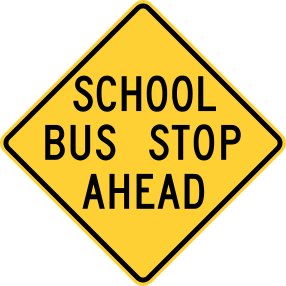
8. What does a school-bus-stop-ahead warning tell a driver to expect?
- A stop sign has been removed
- A stopped school bus may pick up or drop off passengers
- A railroad gate is about to close
- A school zone has ended
Show answer
A stopped school bus may pick up or drop off passengers. The warning identifies an area where a stopped school bus may pick up or drop off passengers. Watch for children and prepare to stop rather than treating the sign as a routine intersection stop or a railroad signal. The advance notice gives you time to lower speed and cover the brake. If the bus displays its warning lights and stop arm, follow the school-bus stopping rules for the roadway and your direction of travel.
Study this in the handbook: Warning, Guide and Service Signs
9. What should a driver prepare for at a gradual-curve warning?

- A road that becomes a dead end
- A lane reserved for bicycles only
- An immediate railroad stop
- A change in road direction ahead
Show answer
A change in road direction ahead. The gradual-curve warning tells you that the road will change direction ahead. Prepare before entering the bend by choosing a safe speed and staying within your lane. The sign does not signal a bicycle-only lane, a railroad stop, or a dead end. A smooth approach gives you time to see the continuing roadway and respond to other traffic. Avoid waiting until the vehicle is already in the curve to make a sharp steering or braking correction.
Study this in the handbook: Warning, Guide and Service Signs
10. What should you do when approaching horse-drawn vehicles or other slow-moving road users?
- Rev the engine to make the animal hurry
- Honk continuously until the road user moves
- Reduce your speed and pass slowly when safe
- Pass at the normal speed without changing position
Show answer
Reduce your speed and pass slowly when safe. Horse-drawn vehicles normally travel slowly and may display a reflective orange triangle, the Iowa sign for a vehicle moving 35 mph or less. The manual advises reducing speed and passing slowly. Revving the engine or honking continuously is not part of that advice. Passing at normal speed reduces your response time and ignores the warning cue. Slow early, leave a broad cushion, and wait for enough sight distance and road space before moving past the vehicle.
Study this in the handbook: Warning, Guide and Service Signs
11. What do blue service signs direct drivers toward?
- Traveler services such as hospitals, fuel, or restaurants
- A no passing zone ahead
- The start of a school crossing
- A lane that changes direction
Show answer
Traveler services such as hospitals, fuel, or restaurants. Blue signs identify services available to travelers, including hospitals, fuel stations, restaurants, rest areas, and lodging. A no passing warning uses a different sign type, school warnings use fluorescent yellow-green or yellow, and reversible lane controls are conveyed by lane signals and markings. Service signs help a driver locate support without confusing it with a traffic command. Look for the blue background when seeking a facility, but continue obeying separate speed, lane, and intersection controls along the route.
Study this in the handbook: Sign Colors and Shapes
12. With a solid green signal, when may a driver proceed?
- Only after stopping for a full minute
- Immediately, even if another vehicle is crossing
- When the intersection is clear
- By entering in the direction opposite the lane arrow
Show answer
When the intersection is clear. A solid green signal permits movement only when the intersection is clear. A green light does not erase vehicles or pedestrians that are still crossing, and it does not authorize movement against lane direction. A full minute stop is not required, but the driver must yield to users already in the intersection and give them time to clear. Look through the intersection before moving, not merely at the signal. The practical cue is green plus clear space, followed by a cautious entry when the path is open.
Study this in the handbook: Warning, Guide and Service Signs
13. For a beginning driver in normal conditions, what following gap does the Iowa manual recommend at minimum?
- One second, regardless of speed
- At least three seconds
- Exactly two seconds for every driver
- A fixed distance of one car length
Show answer
At least three seconds. The three-second minimum applies to an inexperienced or beginning driver under normal driving conditions. It is a time gap, so the physical distance grows as speed increases. An experienced driver may sometimes use two seconds in normal conditions, but that does not replace the beginning-driver recommendation. Slippery roads or blocked visibility call for six or more seconds; the manual measures the gap in seconds, not car lengths. Pick a roadside object, count the seconds after the vehicle ahead passes it, and increase the gap whenever weather, speed, or sight distance worsens.
Study this in the handbook: Following Distance and Stopping
14. At a stop sign with a marked stop line, where should the vehicle stop?
- At or beyond the crosswalk so the driver can see cross traffic
- Beside the sign, even if that is inside the intersection
- At the stop line, before the vehicle reaches it
- Only after another vehicle has stopped first
Show answer
At the stop line, before the vehicle reaches it. When a sign requires a stop and a stop line is present, the vehicle must stop before reaching that line. The manual says to stop before the stop line, or before a crosswalk if there is one, so stopping at or beyond the crosswalk is wrong. Stopping beside the sign can place the vehicle in the intersection, and the duty to stop does not depend on another vehicle stopping first. If necessary, you may then pull forward to the stop sign or the edge of the intersection and proceed when it is safe.
Study this in the handbook: Regulatory Signs
15. When should tire pressure be checked, according to the Iowa manual?
- Right after a long highway drive
- With an air pressure gauge when the tires are cold
- Once a year
- Only at a repair shop
Show answer
With an air pressure gauge when the tires are cold. Check tire air pressure with an air pressure gauge when the tires are cold. The recommended pressure is commonly listed on a sticker inside the driver's door or in the owner's manual. Worn, bald or unbalanced tires and under or over inflation all affect handling and stopping, so the check is a regular habit, not a yearly or shop only task.
Study this in the handbook: Vehicle Checks, Seat Belts and Child Restraints
16. On a two-way road, what does a dashed yellow line beside a solid yellow line permit?
- Passing from both sides at any time
- Passing from the dashed-line side when it is safe
- Passing only by vehicles making a left turn
- No passing from either side
Show answer
Passing from the dashed-line side when it is safe. The side with the dashed yellow line may use the opposing lane to pass, but only after the driver confirms that the maneuver is safe. The solid-line side may not pass across its marking. The choice “Passing from both sides at any time” incorrectly removes the safety condition, while the choice “No passing from either side” ignores the different meanings of the two lines. Before crossing the center line, check distance, sight distance, oncoming traffic, signs, and driveways. The simple visual cue is that the dashed side has permission to consider passing, not a guarantee that passing is wise.
Study this in the handbook: Pavement Markings and Lane Use
17. Which general speed rule applies to trucks on Iowa secondary roads?
- The 50 mph rule applies at any time of day
- Trucks have no secondary-road limit
- Trucks may always travel 70 mph
- The rule applies only from sunrise to sunset
Show answer
The 50 mph rule applies at any time of day. For trucks on secondary roads, Iowa applies the 50 mph limit at any time of day. The sunset-to-sunrise wording applies to the general 50 mph provision for other vehicles, so limiting trucks to nighttime misses the special condition. Trucks also do not receive an unlimited or 70 mph exception. Check the vehicle type and the road classification together before applying the time rule. A practical cue is truck plus secondary road means 50 mph around the clock, subject to any lower posted or condition-based limit.
Study this in the handbook: Iowa Speed Limits
18. What is the recommended first response when your brakes fail while driving?
- Pump the brake pedal several times to build pressure
- Use the parking brake slowly if pumping does not work
- Start shifting to lower gears after the parking brake does not work
- Turn off the engine while moving
Show answer
Pump the brake pedal several times to build pressure. When the brakes stop working, begin by pumping the brake pedal several times. That action may build enough pressure to let you stop. If it does not work, the manual moves to the parking brake, used slowly so the rear wheels do not lock and skid, and then lower gears if needed. The lower-gear option is a later step, not the first response. Turning off the engine while moving can complicate control. Keep a firm steering grip, look for a safe place to stop, and make each response in sequence.
Study this in the handbook: Equipment Failures and Crashes
19. When an underage Iowa driver's BAC is .08 or more, what is the minimum license revocation period?
- 30 days
- 60 days
- 120 days
- 180 days
Show answer
180 days. The underage revocation minimum rises to 180 days when the BAC is .08 or more. That is distinct from the minimum 60 days applied to the .02 through .079 range. The 30, 60, and 120-day options either use the lower range or invent a period not provided by the manual. Pay attention to the phrase .08 or more, because the boundary moves the driver into the longer consequence. The practical cue is to remember the paired figures as 60 for the lower underage range and 180 at .08 or above.
Study this in the handbook: Underage Drinking, Refusal and Open Containers
20. An Iowa driver on an undivided street, not in an intersection, sees an emergency vehicle approaching with warning equipment on. What should the driver do?
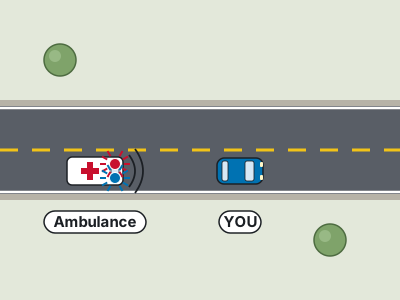
- Pull to the right edge, or as near to it as possible
- Stop in the center of the nearest intersection
- Follow the emergency vehicle closely to pass traffic
- Move left and accelerate through the next block
Show answer
Pull to the right edge, or as near to it as possible. When a police vehicle, ambulance, fire engine, or other emergency vehicle approaches with a siren, air horn, or qualifying flashing lights, the driver should pull to the right edge or as near to it as possible. Stopping in an intersection can block the responding vehicle, and following it closely creates another hazard. Moving left and accelerating works against the yielding duty. The practical cue is to clear the emergency vehicle's path on the right while remaining alert to surrounding traffic.
Study this in the handbook: Emergency Vehicles and the Move Over Law
QualitySpace is expanding to Iowa
We are a California-based independent insurance brokerage working on licensing in more states. We cannot help with Iowa insurance yet. Leave your email and we will let you know when we can.
Every question is written from the official Iowa Driver's License Manual. Need paper? Printable IA practice test with answer key.
Last verified 2026-10-05. How we check every question · Study all 210 as flashcards
Frequently asked questions
How many questions are on this Iowa practice test?
This fixed set has 20 questions. It is test 3 of 10 from the 210 question Iowa bank.
How does this fixed test relate to the full Iowa bank?
Each numbered test is a fixed set of questions in a fixed order, so you can retake the same test later and compare. Every test mixes road signs and the other topics in about the same proportion as the full bank. Tests 1 to 10 together cover 200 of the 210 questions in the Iowa bank, each once. The full practice page mixes the whole bank at random.
Last verified 2026-10-05. See the Iowa DMV facts page for sourced state details.