
Test 10 of 10 · 20 questions · Free 2026
VT Permit Practice Test 10
Jump to the test ↓A fixed 20 question set from the Vermont bank with answers and plain English explanations. The real VT exam is 20 questions, 80 percent to pass; take the full length version on the main practice page.
Question 1 of 20 · 0 right so far
All 20 questions in test 10
Every question below comes from the Vermont question bank on this page. Open a question to see the correct answer and the explanation. Nothing here is hidden behind a signup.
1. A 16-year-old with a new Vermont Junior Driver's License is offered a pizza delivery job. When may the teen drive for work?
- Right away, if the employer approves
- After three months
- Only after age 21
- After one year with the junior license, or at 18, whichever comes first
Show answer
After one year with the junior license, or at 18, whichever comes first. While holding a Junior Driver's License, a person cannot operate a vehicle in the course of employment for one year after the license is issued, or until reaching 18, whichever comes first. The manual uses a pizza delivery driver as its example. Employer approval does not override the rule, three months is the first passenger stage, and 21 is not part of it. Driving for employment early brings a 90-day recall.
Study this in the handbook: Junior license passenger rules and recalls
2. What recall does Vermont impose on a junior operator caught texting while driving?
- A 90-day recall with no fine
- A 30-day recall, with a fine of at least $100 and at least two points
- A warning only
- A one-year revocation
Show answer
A 30-day recall, with a fine of at least $100 and at least two points. The Junior Operator texting recall is a 30-day recall, and the offense also includes fines of at least $100 and at least two points on the driving record. The 90-day recalls apply to carrying passengers for hire, driving for employment, and point accumulation. A warning alone and a one-year revocation are not in the recall list. While any recall is in effect, the driver is ineligible for a junior or full license.
Study this in the handbook: Junior license passenger rules and recalls
3. A Vermont junior license holder is convicted of a single 3 point speeding violation. What happens?
- Nothing, since it is only 3 points
- A 30-day recall
- Permanent revocation
- A 90-day recall of the junior license
Show answer
A 90-day recall of the junior license. Vermont's Junior Operator Points Accumulation Recall is a 90-day recall, triggered by a single 3 point speeding violation or a total of 6 points. So one 3 point speeding ticket is enough; it is not ignored. A 30-day recall is for texting or a diversion board recommendation. Permanent revocation is not a recall outcome; a recalled permit or license is restored after the term and any required re-examination.
Study this in the handbook: Junior license passenger rules and recalls
4. After failing a Vermont road test, how long must an applicant generally wait before taking another one?
- At least one week
- At least one day
- At least two weeks
- No waiting period
Show answer
At least one week. A failed Vermont road test requires a wait of at least one week before another attempt. The one-day period applies to retaking the knowledge test after failure, not the road test. A two-week wait and no waiting period are not the intervals stated. If the road test has been failed three times, the manual adds a minimum waiting period of one month, so repeated attempts should be separated by focused practice rather than rushed scheduling.
Study this in the handbook: Tests, renewals and license rules
5. What is the lowest BAC threshold for Vermont's under-21 alcohol driving rule?
- 0.00 or more
- 0.02 or more
- 0.05 or more
- 0.08 or more
Show answer
0.02 or more. Vermont's youth alcohol driving rule is found in 7 V.S.A. 656, which bars anyone under 21 from operating or being in actual physical control of a vehicle on a highway at a blood alcohol concentration of 0.02 or more. A violation is a civil violation that brings referral to the Youth Substance Awareness Safety Program and a license suspension, with added penalties for failing to complete the program. The adult 0.08 threshold does not replace this lower youth line, so the safest plan is no alcohol at all before driving.
6. What should you do when approaching any law enforcement, emergency, or repair vehicle with a flashing light on the roadside?
- Slow down and change lanes away from it when safe
- Keep your speed and remain in the lane beside it
- Stop directly behind the vehicle on the shoulder
- Pass on the shoulder to create more distance
Show answer
Slow down and change lanes away from it when safe. The Vermont manual extends this roadside caution to law enforcement, emergency, and repair vehicles. The driver should slow down and make a lane change away from the vehicle as soon as it is safe. Remaining at speed leaves less room for workers and unexpected movement. Stopping behind the vehicle or using the shoulder creates additional exposure and may obstruct the scene. Look ahead for flashing lights, reduce speed early, check the neighboring lane, and move away only after confirming that the path is clear.
Study this in the handbook: Highway markings and passing
7. What is the best practice for driving in strong wind, especially when towing a trailer?
- Increase speed to reduce the time in the wind
- Use cruise control to keep speed constant
- Drive at slower speeds
- Follow a large truck closely for shelter
Show answer
Drive at slower speeds. Vermont says wind can be a problem for all motorists and is especially hazardous for large vehicles and for drivers towing trailers, and it names driving at slower speeds as the best practice. For hazardous storm conditions the manual also says to reduce your speed and not to use cruise control. Speeding up or drafting closely behind a large truck reduces your safety margin. Be aware that strong winds and heavy snow or ice may cause trees and wires to fall into the roadway, and never get near or cross downed wires.
Study this in the handbook: Floods, winter, skids and visibility
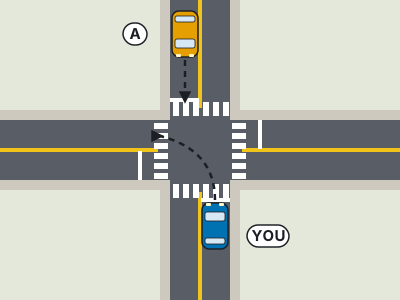
8. When turning left in Vermont, which road user has the right-of-way over the turning driver?
- No one, because the left-turning vehicle entered first
- A vehicle behind the turner that is changing lanes
- A driver approaching from a private driveway behind the turner
- An oncoming motor vehicle or bicyclist
Show answer
An oncoming motor vehicle or bicyclist. A left turn must wait for oncoming traffic, including either a motor vehicle or a bicyclist. The behind-the-turner choices describe road users who do not erase the oncoming user's priority. The manual also reminds drivers to yield to pedestrians crossing the street being entered. A concrete cue is to scan the path you will cross before turning: if an oncoming vehicle or bicycle is present, keep the wheels straight and wait for a clear opening.
Study this in the handbook: Stopping, braking and following distance
9. At a Vermont crash scene, to whom must you show your driver's license?
- Only a police officer
- Only your insurance company
- Anyone who is injured or whose property has been damaged
- No one until a lawyer is present
Show answer
Anyone who is injured or whose property has been damaged. After a crash you must also show your license to anyone who is injured or whose property has been damaged. The police officer who responds will also need to see your license, proof of valid registration, and insurance. If you hit a parked vehicle and cannot find the owner, leave your name, address and phone number in or on that vehicle. If someone is hurt or damage exceeds $3,000, a written report must also reach the DMV within 72 hours.
Study this in the handbook: What to do after a crash
10. When you buy a new or used non-leased vehicle and no exemption applies, what is Vermont's Purchase and Use Tax?
- 3 percent of the price paid
- 10 percent of the price paid
- 6 percent of the price paid or the fair market value, whichever is greater
- A flat $100
Show answer
6 percent of the price paid or the fair market value, whichever is greater. When you buy a new or used vehicle in Vermont, you pay a Purchase and Use Tax of 6 percent of the price you paid for a non leased vehicle or the current fair market value, whichever is greater. A flat fee or a 3 or 10 percent rate does not match the manual. New residents who already paid sales or use tax elsewhere may be exempt if that tax was equal to or greater than the Vermont tax; if the tax paid in the other jurisdiction was less, the difference is due. Leased vehicles use a separate computation.
11. A Vermont driver without insurance is in a crash, even one that is not their fault. What happens to their license?
- The vehicle is confiscated permanently
- A $25 fine is issued
- Nothing on a first offense
- The Commissioner of Motor Vehicles takes the license away until the driver gets insurance
Show answer
The Commissioner of Motor Vehicles takes the license away until the driver gets insurance. If you are driving without insurance and you are in a crash, even if it is not your fault, your license will be taken away by the Commissioner of Motor Vehicles until you get insurance, and you must then prove to the Commissioner that you have insurance for a full 3 years. The same applies to other listed events such as driving under the influence or leaving the scene of a crash. Being stopped by an officer without insurance is handled differently: a ticket, a fine, and two points on your record.
Study this in the handbook: Insurance, points and phone laws
12. How must a driver respond to a flashing circular red traffic signal?
- Stop, then proceed after yielding to pedestrians, bicyclists, and vehicles
- Slow down and continue without stopping
- Wait for the signal to become a solid green arrow
- Turn left only after sounding the horn
Show answer
Stop, then proceed after yielding to pedestrians, bicyclists, and vehicles. A flashing circular red signal has the same stopping expectation as a stop sign. The driver must stop, then yield the right of way to pedestrians, bicyclists, and vehicles before proceeding. Merely slowing is insufficient, and waiting for a green arrow or using the horn does not describe the required response. At the approach, identify the signal color and flashing pattern, bring the vehicle to a full stop, scan all conflicting paths, and move only after the intersection is safe.
Study this in the handbook: Traffic lights, arrows and roundabouts
13. What following distance does Vermont recommend when conditions are poor or visibility is limited?
- Exactly one second
- Exactly two seconds
- At least four seconds, with more when conditions require it
- No distance if the vehicle ahead has brake lights
Show answer
At least four seconds, with more when conditions require it. The four-second method gives a basic safety spacing, but the manual says drivers should allow more than four seconds when roads are poor, visibility is poor, or speeds are higher. A fixed two-second gap does not provide that added margin, and brake lights do not replace space. The practical check is to watch the vehicle ahead pass a sign or other checkpoint, count until your vehicle reaches it, and increase the gap if the count is under four.
Study this in the handbook: Stopping, braking and following distance
14. What should a driver do when a warning sign indicates a pedestrian crosswalk?

- Increase speed before reaching the crossing
- Slow down and watch for people crossing
- Use the opposite lane to avoid yielding
- Stop only if a traffic officer is present
Show answer
Slow down and watch for people crossing. Warning signs are placed where there is danger, and the manual says drivers should slow down. A pedestrian crosswalk warning means people may be crossing, so reduce speed and watch carefully. Increasing speed reduces reaction time, and using the opposite lane can create a conflict with approaching traffic or pedestrians. The presence of a traffic officer is not required for the warning to matter. A downward arrow under a pedestrian sign marks the crosswalk or crossing area itself, so look toward both sides of the road and be ready to yield.
Study this in the handbook: Road signs
15. What condition does the skidding vehicle symbol warn about?

- Slippery pavement, especially when wet
- A lane reserved for disabled parking
- A road closed because of flooding
- Loose livestock crossing the highway
Show answer
Slippery pavement, especially when wet. The skidding vehicle symbol warns that the pavement may provide reduced traction, especially during or soon after rain. Slow down before the hazard, leave extra following space, and make steering, braking, and acceleration movements gradual. The disabled parking, flood closure, and livestock choices describe unrelated signs or conditions. Fresh rain can combine oil, rubber, dirt, and water on the surface, making the road particularly slick. Use the symbol as a cue to lower speed and increase control margin before the vehicle begins to slide, rather than trying to correct a skid after it starts.
Study this in the handbook: Stopping, braking and following distance
16. About how long does the average driver take to apply the brakes after seeing a danger?
- About one-tenth of a second
- About three-fourths of a second
- About two seconds
- About five seconds
Show answer
About three-fourths of a second. The manual says the average driver takes about three-fourths of a second to apply the brakes after seeing danger. That interval is reaction time, and the vehicle continues traveling during it. Speed increases the distance covered before braking begins, while road conditions affect the later braking distance. The two-second choice is too long for the stated average and can understate the urgency of scanning ahead. Leave space and keep your attention on the road so hazards are recognized sooner.
Study this in the handbook: Stopping, braking and following distance
17. What is the general purpose of a rectangular regulatory sign with a white background?
- To identify a recreational campground
- To warn only of wildlife at night
- To state actions or limits a driver must or must not follow
- To mark the edge of a bicycle lane
Show answer
To state actions or limits a driver must or must not follow. White rectangular regulatory signs communicate requirements and prohibitions, including speed limits, turning rules, passing rules, and other directions. They tell drivers what is legally required or forbidden rather than merely suggesting a scenic destination or warning about wildlife. The campground and wildlife choices describe information or warning functions, and a bicycle lane edge is a pavement or lane marking issue. Read the wording, obey the displayed restriction, and check for additional signs that modify it. The white rectangular shape is the cue to think regulation before convenience.
Study this in the handbook: Turn signals and turning
18. On a four-lane highway, what additional action may Vermont’s Move Over Law require when a stopped emergency vehicle displays flashing lights?
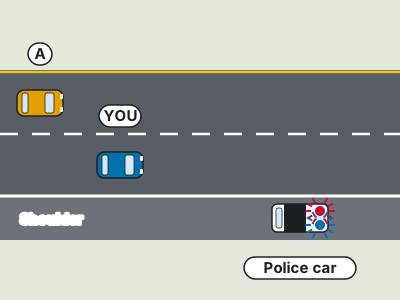
- Change lanes when it can be done safely
- Drive onto the shoulder without checking traffic
- Stop in the lane beside the emergency vehicle
- Pass the emergency vehicle at the posted speed
Show answer
Change lanes when it can be done safely. On a four-lane highway, Vermont adds a lane-change requirement when a stopped police or emergency vehicle displays the listed flashing lights, provided the move is safe. The shoulder is not a shortcut around the rule, and stopping beside the emergency vehicle can create another obstruction. Passing at the speed limit does not provide the requested protection. First slow down and assess traffic, then change lanes if the maneuver can be completed safely while giving the stopped vehicle more room.
Study this in the handbook: Highway markings and passing
19. What does the Vermont manual say causes most skids?
- Worn tires alone
- Other drivers cutting in
- Sudden mechanical failure
- The driver's failure to react in time to adjust speed to road and traffic conditions
Show answer
The driver's failure to react in time to adjust speed to road and traffic conditions. Most skids are caused by the driver failing to react in time to adjust the vehicle speed to road and traffic conditions, which may include snow, ice, rain, dirt or gravel, and wet leaves. Worn tires, other drivers, or mechanical failure are not the cause the manual names. To avoid skidding, drive slower on roads that may be slippery and avoid sudden changes in speed or direction. If a skid starts, do not hit the brakes, because that makes the skid worse, and steer in the direction you want the vehicle to go.
Study this in the handbook: Floods, winter, skids and visibility
20. After stopping completely at a circular red light in Vermont, a driver may usually turn right only after:
- Waiting for a green arrow in every instance
- Scanning the intersection and yielding to pedestrians and other vehicles
- Honking twice and entering without checking cross traffic
- Turning before the stop line if the curb lane is open
Show answer
Scanning the intersection and yielding to pedestrians and other vehicles. A right turn at a circular red light is usually allowed after a complete stop, but the driver must scan the intersection and yield to pedestrians and other vehicles. A green arrow is not required in every case, while a horn does not establish a safe gap or right-of-way. The stop must occur before the stop line or crosswalk as applicable. Use the cue stop, scan, yield, then turn, and obey any sign that prohibits a right turn on red.
Study this in the handbook: Traffic lights, arrows and roundabouts
QualitySpace is expanding to Vermont
We are a California-based independent insurance brokerage working on licensing in more states. We cannot help with Vermont insurance yet. Leave your email and we will let you know when we can.
Every question is written from the official Vermont Driver's Manual. Need paper? Printable VT practice test with answer key.
Last verified 2026-10-05. How we check every question · Study all 200 as flashcards
Frequently asked questions
How many questions are on this Vermont practice test?
This fixed set has 20 questions. It is test 10 of 10 from the 200 question Vermont bank. The real VT exam asks 20 questions and you need 16 correct.
What is the passing score for the real Vermont test?
You must answer at least 16 questions correctly to pass the test (16 of 20) That figure comes from the official Vermont source cited on the DMV facts page.
How does this fixed test relate to the full Vermont bank?
Each numbered test is a fixed set of questions in a fixed order, so you can retake the same test later and compare. Every test mixes road signs and the other topics in about the same proportion as the full bank. Tests 1 to 10 together cover every question in the Vermont bank once. The full practice page mixes the whole bank at random.
Last verified 2026-10-05. See the Vermont DMV facts page for sourced state details.