
Test 6 of 10 · 20 questions · Free 2026
VT Permit Practice Test 6
Jump to the test ↓A fixed 20 question set from the Vermont bank with answers and plain English explanations. The real VT exam is 20 questions, 80 percent to pass; take the full length version on the main practice page.
Question 1 of 20 · 0 right so far

All 20 questions in test 6
Every question below comes from the Vermont question bank on this page. Open a question to see the correct answer and the explanation. Nothing here is hidden behind a signup.
1. What do Vermont warning signs generally indicate about the roadway?
- A legal permission to pass at any speed
- A hazard such as a sharp curve, unsafe intersection, or dip
- A guaranteed stop at the next signal
- A parking area reserved for school buses
Show answer
A hazard such as a sharp curve, unsafe intersection, or dip. Vermont warning signs may identify sharp curves, unsafe intersections, dips, and other roadway dangers. They prompt a driver to reduce speed and prepare for the condition shown. They do not grant permission to pass, promise a stop at a signal, or designate school-bus parking. Some warning signs add a safe speed or distance, so read the supplemental information instead of treating every warning as the same hazard. Slow early, then adjust to what appears ahead.
Study this in the handbook: Road signs
2. What should a driver do when a traffic light turns yellow?
- Accelerate so the vehicle reaches the intersection sooner
- Stop immediately in the middle of the intersection
- Prepare to stop, unless stopping safely is no longer possible
- Treat the light exactly like a green arrow
Show answer
Prepare to stop, unless stopping safely is no longer possible. A yellow light warns that the signal is about to turn red. A driver who can stop safely should prepare to stop, while a vehicle already too close to stop safely may continue through cautiously. Accelerating is not the manual's response because it increases speed as the signal changes. Stopping in the intersection creates a hazard, and a yellow light does not grant the protected movement of a green arrow. Look ahead for the stopping distance before entering the intersection approach.
Study this in the handbook: Traffic lights, arrows and roundabouts
3. Before a Vermont Junior Driver's License, how much supervised practice must a teen log beyond driver education?
- 20 hours, with 5 at night
- 30 hours, with none required at night
- 40 hours, with at least 10 at night
- 50 hours, with 15 at night
Show answer
40 hours, with at least 10 at night. Vermont requires an additional 40 hours of practice behind the wheel, with at least 10 hours of nighttime driving, while accompanied by a qualified supervisor riding beside the driver. The 40 hours come on top of the six hours of behind the wheel instruction in driver training. Thirty hours is the classroom portion of driver education, not practice. Nighttime means 30 minutes after sunset to 30 minutes before sunrise.
Study this in the handbook: Junior license passenger rules and recalls
4. What do rectangular Vermont signs with white backgrounds generally indicate?
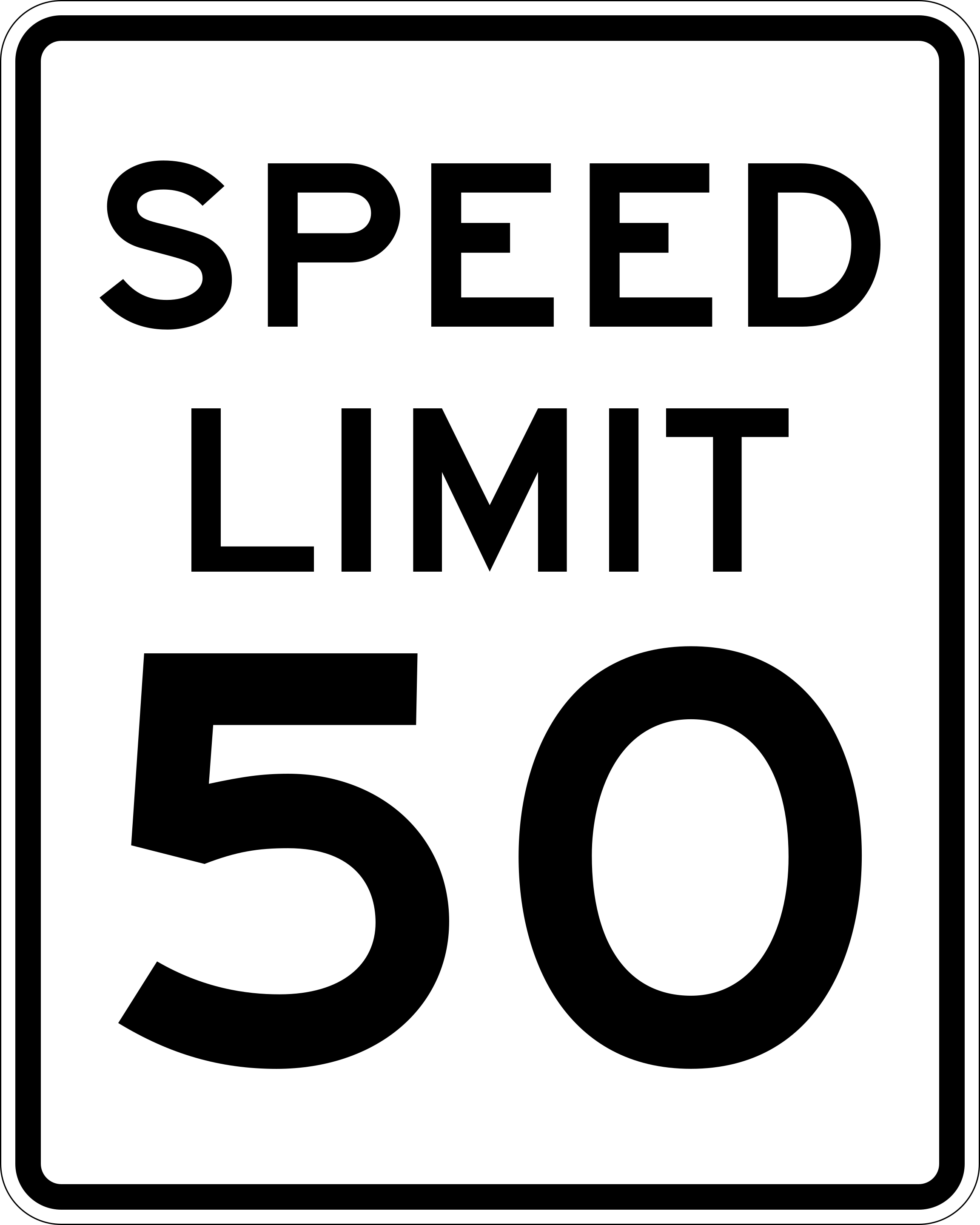
- Things a driver must or must not do
- A scenic viewpoint ahead
- A railroad crossing with two tracks
- A roadway surface that is slippery
Show answer
Things a driver must or must not do. Rectangular signs with white backgrounds are regulatory signs, and Vermont says they indicate things a driver must or must not do. They can display speed limits, turning and passing laws, and other directions. A scenic viewpoint is information, a railroad crossing uses different signs, and slippery pavement is a warning condition. When you see this rectangular white format, read it as an instruction that controls your driving rather than as a suggestion about services or scenery. Follow the posted requirement even when the roadway appears empty.
Study this in the handbook: Turn signals and turning
5. How soon must a new Vermont resident transfer a commercial driver's license from another state?
- Within 60 days
- Within one year
- Within 30 days of establishing residency
- At the next renewal
Show answer
Within 30 days of establishing residency. In accordance with state and federal law, any person holding a commercial driver's license from another state must transfer it within 30 days of establishing residency in Vermont. That is a shorter window than the 60 days the manual gives a new resident to obtain a regular Vermont license. Waiting for the next renewal or a full year would run well past the 30 day transfer deadline.
Study this in the handbook: Learner's Permit and Junior Driver's License
6. A Vermont junior license holder is caught driving for an employer in the first year. What recall follows?
- 90 days
- 60 days
- 30 days
- 180 days
Show answer
90 days. Driving For Employer/Employment is a junior operator violation carrying a 90-day recall. Carrying passengers for hire is also a 90-day recall. Thirty days is the recall for texting or for a diversion or reparative board recommendation. Sixty and 180 days are not Vermont recall periods. The junior holder may request a hearing when a recall is issued, and while the recall is in effect the driver cannot qualify for a junior or full license.
Study this in the handbook: Junior license passenger rules and recalls
7. A driver is entering a public road from a driveway, alley, or parking lot. Who has the right-of-way?
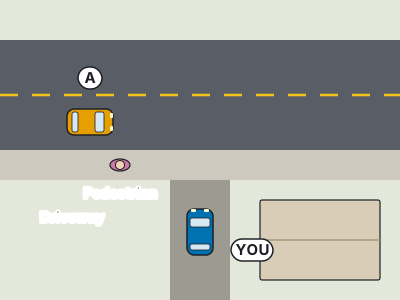
- The vehicle with the larger engine
- The driver leaving the driveway
- Traffic already on the road
- Whichever driver reaches the centerline first
Show answer
Traffic already on the road. A driver coming from a driveway, alley, parking lot, or T-intersection must yield to all traffic already traveling on the road. The entering vehicle does not gain priority by reaching the centerline first, having a larger engine, or being first to move. Stop or slow as needed, look in both directions, and wait for a clear opening before joining the roadway. This same habit protects the traffic that has already established its path and reduces conflicts at narrow entrances.
Study this in the handbook: Stopping, braking and following distance
8. According to the Vermont manual, when does idling waste more fuel than restarting the engine?
- After five minutes
- When idling for more than 10 seconds while parked in town
- Only after 30 minutes
- Never, restarting always uses more fuel
Show answer
When idling for more than 10 seconds while parked in town. If you are parked in town, idling for more than 10 seconds uses more fuel than shutting off and restarting the engine. The manual lists this among ten green driving tips that save money and reduce emissions. Vehicles collectively account for over half of the air pollution generated in Vermont, so shutting off the engine while waiting is one of the easiest ways to cut your share.
Study this in the handbook: Insurance, points and phone laws
9. By how much do studies say daytime low beam headlights reduce head-on collisions, according to the Vermont manual?
- By about 5 percent
- By 50 percent
- They have no measurable effect
- By more than 20 percent
Show answer
By more than 20 percent. Vermont's manual says studies have shown that driving with low beam headlights on during the daytime reduces the risk of head-on collisions by more than 20 percent. Daytime running lights and headlights help other drivers see your vehicle during daylight hours, but daytime running lights should not be confused with headlights. When snow, rain, and fog limit visibility you must turn your headlights on, and the best practice is to always drive with at least low beams on.
Study this in the handbook: Floods, winter, skids and visibility
10. If a bicyclist is riding toward the center of the lane, what should a driver understand?
- The cyclist has surrendered the right to use the roadway
- The bicyclist must move onto the shoulder immediately
- The driver may use the horn to force the cyclist right
- The bicyclist may be taking the lane for safety or proper positioning
Show answer
The bicyclist may be taking the lane for safety or proper positioning. A bicyclist may move toward the lane center when that position is safer, avoids hazards, or sets up a proper turn. The rider does not automatically have to use the shoulder, and a motorist should not pressure the rider with a horn. Being in the travel lane does not surrender the cyclist's legal roadway rights. Reduce speed, provide room to maneuver, and pass only after the lane and sight distance make the movement safe.
Study this in the handbook: School buses and railroad crossings
11. What is the usual shape and color of a Vermont warning sign?
- A yellow or green diamond
- A red circle
- A white rectangle
- An orange octagon
Show answer
A yellow or green diamond. Warning signs identify danger ahead and are usually diamond shaped with yellow or green backgrounds. A red circle is not the general warning format described here, and a white rectangle usually carries information or a rule rather than the broad warning pattern. An orange octagon is not the manual’s warning design. When dirt, snow, or darkness obscures wording, recognizing the diamond outline and yellow or green color can still alert you to slow down and prepare for a curve, unsafe intersection, dip, or another hazard.
Study this in the handbook: Road signs
12. During the first three months under a Vermont junior driver's license, what is the passenger rule?
- The driver may carry any number of friends
- The driver must drive alone unless a qualified adult is in the front seat
- The driver may carry immediate family members only
- The driver may carry passengers for hire
Show answer
The driver must drive alone unless a qualified adult is in the front seat. For the first three months, a junior license holder is restricted to driving alone. Passengers become permitted when a licensed and unimpaired parent or guardian, a qualified driver education instructor, or a licensed and unimpaired person at least 25 rides in the front seat. The family-only option belongs to the second three-month period. Carrying passengers for hire is prohibited while holding a junior license. The cue is the timeline: first three months means alone, subject to the qualified-supervisor exception.
Study this in the handbook: Junior license passenger rules and recalls
13. What do the yellow center lines on a major Vermont highway divide?
- Parking spaces on the same side of the road
- Travel lanes carrying traffic in opposite directions
- Bike lanes traveling with motor traffic
- Two lanes moving in the same direction only
Show answer
Travel lanes carrying traffic in opposite directions. Yellow center lines divide a highway into lanes used by traffic traveling in opposite directions. They are not parking-space boundaries or automatic bike-lane markings. A broken white line, rather than a yellow center line, separates lanes traveling in the same direction on a multilane highway. Treat yellow on the center of the roadway as a separation from opposing traffic. Check the line pattern before considering a pass, and never cross into opposing traffic casually.
Study this in the handbook: Turn signals and turning
14. How many questions are on Vermont's online knowledge test, and how many must be answered correctly to pass?
- 20 questions, with 16 correct required
- 15 questions, with 12 correct required
- 25 questions, with 20 correct required
- 30 questions, with 24 correct required
Show answer
20 questions, with 16 correct required. The knowledge test contains 20 questions, and an applicant must answer at least 16 correctly to pass. The four-answer format does not mean four questions are enough, and the one-day retest wait does not change the passing count. A good preparation cue is to study the road rules broadly because the test samples the manual rather than asking one repeated fact. If the test is failed, the manual says another attempt requires at least a one-day wait.
Study this in the handbook: Tests, renewals and license rules
15. About how long does the body take to process the alcohol in one drink, per Vermont's manual?
- About 10 minutes
- It depends only on coffee intake
- About 4 hours per drink
- At least an hour per drink
Show answer
At least an hour per drink. Vermont's manual says it takes at least an hour per drink for alcohol and its effects to be processed out of the body, so a driver may have to wait several hours after drinking. Time is the only way to reduce the effects; coffee, a cold shower, or exercise will not sober a person up. Ten minutes is far too short, and four hours per drink overstates the manual's figure.
Study this in the handbook: Alcohol, drugs and implied consent
16. You are already in a roundabout when an emergency vehicle approaches. What should you do?
- Drive onto the center island so the emergency vehicle can pass
- Stop where you are inside the roundabout
- Back up to the line where you entered the roundabout
- Exit the roundabout safely, then pull over
Show answer
Exit the roundabout safely, then pull over. Vermont says to always yield to emergency vehicles in a roundabout. If you are not already in the roundabout, pull over and let the emergency vehicles pass. If you are already in it, keep going and pull over once you have safely exited the roundabout. Stopping inside the circle can block the circulating lane the emergency vehicle needs, backing up against the flow of traffic creates a new conflict, and the center island is not a place to drive. The cue is to clear the roundabout first, then yield from a safe spot.
Study this in the handbook: Traffic lights, arrows and roundabouts
17. What do the smaller signs below a Vermont crossbuck indicate?
- Whether the crossing is on an Interstate
- How many tracks are at the crossing
- The speed limit after the crossing
- Which lane must turn after the crossing
Show answer
How many tracks are at the crossing. Small signs mounted below a railroad crossbuck tell drivers how many tracks exist at that crossing. A second or third track can hide a train moving in the opposite direction, so a driver must look and listen beyond the first visible train. The Interstate choice confuses road classification with crossing information. Speed limits are shown on regulatory signs, not on these track signs. Lane direction is controlled by markings and traffic signs. The practical cue is to count the rails or track warning information before proceeding, especially after one train has passed.
Study this in the handbook: Road signs
18. When a driver sees a train approaching a Vermont railroad crossing, what is required?
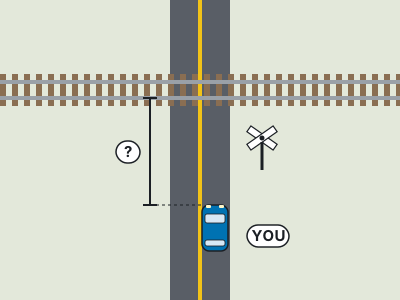
- Continue if the train is moving slowly
- Stop only if the crossing has two or more tracks
- Stop at least 15 feet from the nearest rail
- Wait for another vehicle to stop first
Show answer
Stop at least 15 feet from the nearest rail. Vermont law requires drivers to stop not less than 15 feet from the nearest rail when they see a train or hear its whistle, when flashing lights, lowered gates, or a flagman signal a train, and when there is a stop sign at the crossing. After the full stop, the vehicle may cross only when it is safe to do so. A slow train is still an approaching train, the number of tracks does not remove the duty, and another driver stopping first is irrelevant. With two or more tracks, one train passing might hide a train coming the other way.
Study this in the handbook: School buses and railroad crossings
19. How soon must someone moving to Vermont register their vehicle?
- Within 10 days
- Within 30 days
- Within 60 days of moving into the state
- Before crossing the state line
Show answer
Within 60 days of moving into the state. If you are moving to Vermont from another state, you must register your vehicle within 60 days of moving into the state, the same period allowed for obtaining a Vermont driver's license. The registration plates must be properly affixed so they do not become loose, and the plates you receive may only be used on that vehicle. Purchase and use tax may be due if the tax paid elsewhere was lower.
20. When parking on a rural highway, where must a driver avoid stopping because the vehicle cannot be seen far enough?
- Where the vehicle cannot be seen for at least 150 feet in either direction
- Only where the vehicle can be seen for 50 feet
- Anywhere the road has a curve shorter than 20 feet
- Only where the road is posted for 75 miles per hour
Show answer
Where the vehicle cannot be seen for at least 150 feet in either direction. On a rural highway, a driver should not stop where the vehicle cannot be seen for at least 150 feet in either direction. The 50-foot and 20-foot figures are not the visibility standard in this passage, and a 75 mile per hour posting does not determine whether the stopped vehicle can be seen. Look beyond the immediate shoulder before parking, especially near hills and curves, and choose a location that gives approaching drivers adequate sight distance.
Study this in the handbook: Parking rules
QualitySpace is expanding to Vermont
We are a California-based independent insurance brokerage working on licensing in more states. We cannot help with Vermont insurance yet. Leave your email and we will let you know when we can.
Every question is written from the official Vermont Driver's Manual. Need paper? Printable VT practice test with answer key.
Last verified 2026-10-05. How we check every question · Study all 200 as flashcards
Frequently asked questions
How many questions are on this Vermont practice test?
This fixed set has 20 questions. It is test 6 of 10 from the 200 question Vermont bank. The real VT exam asks 20 questions and you need 16 correct.
What is the passing score for the real Vermont test?
You must answer at least 16 questions correctly to pass the test (16 of 20) That figure comes from the official Vermont source cited on the DMV facts page.
How does this fixed test relate to the full Vermont bank?
Each numbered test is a fixed set of questions in a fixed order, so you can retake the same test later and compare. Every test mixes road signs and the other topics in about the same proportion as the full bank. Tests 1 to 10 together cover every question in the Vermont bank once. The full practice page mixes the whole bank at random.
Last verified 2026-10-05. See the Vermont DMV facts page for sourced state details.