
Test 2 of 10 · 20 questions · Free 2026
VT Permit Practice Test 2
Jump to the test ↓A fixed 20 question set from the Vermont bank with answers and plain English explanations. The real VT exam is 20 questions, 80 percent to pass; take the full length version on the main practice page.
Question 1 of 20 · 0 right so far
All 20 questions in test 2
Every question below comes from the Vermont question bank on this page. Open a question to see the correct answer and the explanation. Nothing here is hidden behind a signup.
1. During the second three months of a Vermont junior license, which passengers may the driver begin transporting?
- Only a licensed adult supervisor
- Any passenger with a valid seat belt
- Immediate family members, specifically siblings and parents
- Passengers for hire if the trip is short
Show answer
Immediate family members, specifically siblings and parents. The second three-month stage expands the junior license privilege to immediate family members, and the manual specifies siblings and parents. It does not open the vehicle to any passenger, and it does not make passengers for hire permissible. A licensed adult supervisor is the exception relevant to the earlier alone-driving stage, not the definition of this stage. Keep the sequence in mind: first three months alone, second three months siblings and parents, then the six-month milestone.
Study this in the handbook: Junior license passenger rules and recalls
2. What does an upside-down triangle road sign mean in Vermont?
- Follow a route toward a hospital or other service
- Stop every time, even when no traffic is present
- Expect a railroad crossing immediately ahead
- Yield right of way after slowing and checking that the way is clear
Show answer
Yield right of way after slowing and checking that the way is clear. The upside-down triangle identifies a yield right of way sign. The driver must reduce speed enough to stop if necessary, search for road users, and enter only when the way is clear. That is not the same as an automatic stop, so an empty approach does not require waiting at a standstill. The shape also does not identify a railroad or a hospital. Slow early, look for pedestrians, bicyclists, and vehicles, and be ready to give them priority before entering the intersection.
Study this in the handbook: Stopping, braking and following distance
3. What does a Vermont work zone arrow panel show when it is in caution mode?
- A straight line of blinking lights, or blinking lights on the four corners of the sign
- A flashing left arrow
- A flashing red X
- Nothing, the panel is turned off
Show answer
A straight line of blinking lights, or blinking lights on the four corners of the sign. Flashing arrow panels may be used to guide drivers into the correct lane. When the arrows are not in use, the panels are put in caution mode, with a straight line of blinking lights or blinking lights on the four corners of the sign. The manual tells drivers to slow down when they see a panel in caution mode, so the display still calls for reduced speed and extra attention to the work zone ahead.
Study this in the handbook: Road signs
4. How often does the Vermont manual say someone is killed by a drunk driver?
- Once a week
- Every 4 hours
- Once a day
- On average every 40 minutes
Show answer
On average every 40 minutes. The manual says the drinking driver is the number one cause of fatal traffic crashes and that on average someone is killed by a drunk driver every 40 minutes. The figure shows that impaired driving is a constant danger, not a rare event. Alcohol affects judgment, vision, concentration, and reaction time, and even one drink impairs your judgment. If you are going to drink, plan first: use a designated driver who does not drink, call a parent or other responsible person for a safe ride, or stay overnight where you are if it is safe.
Study this in the handbook: Alcohol, drugs and implied consent
5. In Vermont, a child under eight who is not in a harnessed car seat must ride how?
- With the adult seat belt only
- In the front seat
- Properly secured in a booster seat
- In any seat with the belt behind the arm
Show answer
Properly secured in a booster seat. A child under eight years of age who is not properly secured in a harnessed car seat must be properly secured in a booster seat. The adult belt alone, a front seat, or a belt tucked behind the arm does not satisfy that rule, and the manual warns never to tuck a shoulder belt under the arm or behind the back. Children under two ride rear facing with a harness, a child under 13 must, if practical, ride in the back seat, and a child under 18 not in a harnessed car seat or booster seat must wear a seat belt.
Study this in the handbook: Safety belts and child restraints
6. What does a steady yellow traffic light warn a Vermont driver about?
- The intersection is reserved for left turns
- The driver may accelerate because cross traffic must stop
- The light is about to turn red
- The signal has failed and should be treated as a stop sign
Show answer
The light is about to turn red. A steady yellow light warns that the signal will soon become red. Assess distance and speed, stopping when that can be done safely. Accelerating to beat the change turns a warning into a risky maneuver, and the light does not reserve the intersection for a particular movement. A failed signal is handled differently from an ordinary steady yellow. With enough room to stop smoothly before the intersection, stop; if you are too close, continue through cautiously. Timing is the useful visual cue.
Study this in the handbook: Traffic lights, arrows and roundabouts
7. A Vermont driver should allow more than four seconds of following distance when:
- The vehicle ahead has just passed a checkpoint
- Road conditions or visibility are poor, or speed is higher
- The road is dry and traffic is moving slowly
- The driver is traveling on a familiar local street
Show answer
Road conditions or visibility are poor, or speed is higher. Four seconds is a baseline for normal conditions, but the manual calls for more space when road conditions are poor, visibility is poor, or speed is higher. The checkpoint choice describes how to measure the gap, not when to increase it. A useful cue is that less traction or less time to see creates a need for more time to react. Increase the interval before conditions become urgent, rather than waiting until the vehicle ahead brakes and discovering the original gap was too short.
Study this in the handbook: Stopping, braking and following distance
8. When braking hard with an anti-lock brake system in Vermont, what should you avoid doing?
- Pumping the brake or lifting your foot, because that disengages the anti-lock system
- Steering while braking
- Pressing the pedal firmly
- Holding the pedal down
Show answer
Pumping the brake or lifting your foot, because that disengages the anti-lock system. Vermont's manual says anti-lock brakes are an important breakthrough in safety because they allow you to brake and steer at the same time. Expect noise and vibration in the brake pedal. Do not pump the brake or take your foot off the brake pedal, because that will disengage the anti-lock system. Steering while braking, pressing the pedal, and keeping your foot on it are all consistent with the manual; pumping or lifting your foot is the mistake.
Study this in the handbook: Floods, winter, skids and visibility
9. How far from a crosswalk at an intersection must a Vermont driver park?
- At least 10 feet away
- At least 20 feet away
- At least 30 feet away
- At least 50 feet away
Show answer
At least 20 feet away. Parking within 20 feet of a crosswalk at an intersection is listed among the prohibited locations. The same list sets other distances, such as 6 feet from a fire hydrant and 30 feet from a stop sign or traffic light, so mixing them up is easy. A driver should scan the curb and intersection before leaving the vehicle, especially where pedestrians may need a clear crossing. The memory cue is crosswalk at an intersection equals 20 feet, while other distances belong to different roadside features.
Study this in the handbook: Parking rules
10. At a four-way stop, what should happen when two vehicles arrive at approximately the same time?
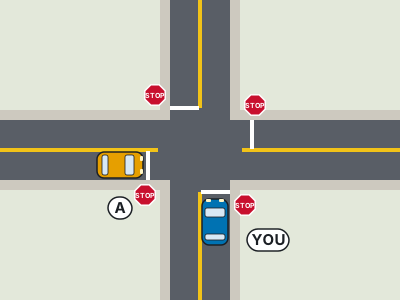
- Both drivers accelerate together
- The driver on the right yields to the driver on the left
- The driver on the left yields to the driver on the right
- The heavier vehicle goes first
Show answer
The driver on the left yields to the driver on the right. When two vehicles reach a four-way stop at roughly the same time from different directions, the driver on the left yields to the driver on the right. The rule resolves the tie without relying on vehicle size, acceleration, or a race into the intersection. If one vehicle arrived clearly first, that earlier arrival controls instead. The useful visual cue is to identify your own position relative to the other vehicle before moving.
Study this in the handbook: Right of way rules
11. Under Vermont's equipment rules, which vehicles must have directional signals?
- All vehicles regardless of age
- Only vehicles built after 1980
- Only commercial vehicles
- Vehicles manufactured or assembled after January 1, 1955
Show answer
Vehicles manufactured or assembled after January 1, 1955. Vermont's list of proper equipment in good mechanical condition includes headlights, horn, windshield wipers, rearview mirror, tail lights, tires, steering, windshield, exhaust system, brakes, fenders, bumpers, and, if the vehicle was manufactured or assembled after January 1, 1955, directional signals. The date limits the signal item to vehicles built after that point, and any driver whose directional lights fail must use hand signals until they are fixed. Safety belts and defrosters are required on 1964 and later models.
Study this in the handbook: Tests, renewals and license rules
12. What do Vermont warning signs generally tell a driver to do?

- Slow down because danger may be present
- Maintain the posted maximum speed through the hazard
- Stop at the sign even when no control requires it
- Use the shoulder to avoid the marked roadway
Show answer
Slow down because danger may be present. Warning signs identify places where danger may be present and tell drivers to slow down. They can describe sharp curves, unsafe intersections, dips, school areas, pedestrians, or animals. A warning sign does not by itself require a full stop, and it does not authorize using the shoulder. Holding the maximum speed ignores the purpose of the warning. When the sign appears, reduce speed early and look for the specific roadway condition shown by its symbol or words.
Study this in the handbook: Road signs
13. What does a circular sign marked with a large X and RR warn drivers about?

- A passing zone with two lanes
- A required U-turn at the next block
- A hospital entrance
- A railroad crossing ahead
Show answer
A railroad crossing ahead. A circular sign with a large X and the letters RR announces a railroad crossing ahead. It is an advance warning, so the driver should reduce speed and prepare to observe the crossing controls. It does not direct a U-turn, identify a hospital, or authorize passing. The sign's round shape and railroad lettering are the recognition cue. After seeing it, look for the crossbuck, tracks, lights, gates, and any instruction requiring a stop before crossing.
Study this in the handbook: Traffic lights, arrows and roundabouts
14. When does the Vermont manual warn that black ice can form quickly?
- Only below zero degrees
- When sleet, freezing rain or snow start to fall
- Only on bridges in daylight
- Only after the road has been plowed
Show answer
When sleet, freezing rain or snow start to fall. When sleet, freezing rain or snow start to fall, black ice can quickly form and you may not be able to see it. The warning is about the moment freezing precipitation begins, not only extreme cold, daylight on bridges, or the time after plowing. Slow down at the first sign of freezing precipitation and increase following distance. Bridges, ramps, and overpasses are likely to freeze first, and slippery spots may remain even after road crews have cleared the highway.
Study this in the handbook: Floods, winter, skids and visibility
15. What must a driver do when an intersection has pedestrians or bicyclists present?
- Maintain the posted speed and continue
- Drive at a speed that is safe for the conditions
- Stop only if a police officer is present
- Use the shoulder to pass through quickly
Show answer
Drive at a speed that is safe for the conditions. The manual treats pedestrians and bicyclists as conditions requiring a safe, adjusted speed at intersections. Maintaining the posted speed without considering people in the roadway can still be unsafe, because the posted number is not a command to travel that fast in every circumstance. Waiting for an officer or using the shoulder creates no lawful shortcut. The concrete cue is to scan the intersection early and ease off the accelerator whenever vulnerable road users are present.
Study this in the handbook: Speed limits and safe speeds
16. What should you do when a police or emergency vehicle is stopped with flashing lights on a four lane highway?
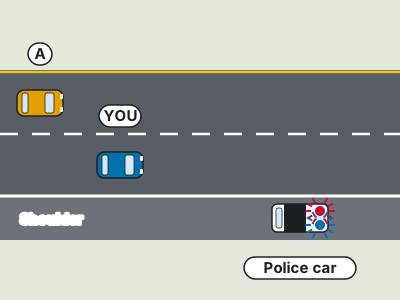
- Proceed cautiously and change lanes if you can do so safely
- Stop in the travel lane until the vehicle leaves
- Pass at full speed because the vehicle is already stopped
- Use the shoulder as a travel lane to get around it
Show answer
Proceed cautiously and change lanes if you can do so safely. A stopped police or emergency vehicle with flashing lights requires drivers to slow down and proceed with caution. On a four lane highway such as an Interstate, the law also requires a lane change when it can be made safely. Stopping in the travel lane creates a new hazard, and speed does not excuse the duty to protect people working at the roadside. The shoulder is not a shortcut or ordinary travel lane. Check mirrors, signal, move away when space permits, and return only after clearing the activity safely.
Study this in the handbook: Traffic lights, arrows and roundabouts
17. How many points does Vermont assess for failing to stop for a school bus with its red warning lights flashing?
- 2 points
- 3 points
- 5 points
- 8 points
Show answer
5 points. Vermont assesses 5 points for failing to stop for a stopped school bus with its red warning lights flashing, the same as failing to yield to an ambulance, fire truck, or police officer. Two points is the value for a stop sign or red light violation or driving without a license. Eight points is the top of the speeding range, and three points is not listed for this offense.
Study this in the handbook: Insurance, points and phone laws
18. What happens when a Vermont driver reaches a total of 10 points?
- Nothing until 15 points
- A letter is sent saying the driving privilege is to be suspended
- The license is revoked for life
- The driver must retake only the vision test
Show answer
A letter is sent saying the driving privilege is to be suspended. When a driver reaches 10 points, Vermont sends a letter notifying the driver that the privilege to drive is to be suspended. The driver may request a hearing to verify the convictions and points. The number of points received within 2 years determines the length of the suspension; more points mean a longer suspension. There is no 15 point threshold and no lifetime revocation for points.
Study this in the handbook: Insurance, points and phone laws
19. When may you pass beside a solid line and a broken line in your lane?
- Whenever the vehicle ahead is traveling slowly
- Never, because any solid line prohibits both directions
- Only when the solid line is in your lane
- When the broken line is in your lane and the way ahead is clear
Show answer
When the broken line is in your lane and the way ahead is clear. A broken line in your lane beside a solid line means you may pass if the road ahead is clear and the maneuver is otherwise safe and legal. The line arrangement assigns permission by side, so a solid line in your lane means you should not pass. A slow vehicle alone does not make passing safe, and the presence of a solid line does not automatically prohibit the driver on the broken line side. Check visibility, oncoming traffic, intersections, and signs before moving, then return only with adequate space.
Study this in the handbook: Highway markings and passing
20. What should you do if your vehicle stalls in a flooded area?
- Abandon it as soon as possible while respecting the force of running water
- Remain inside until the water reaches the windows
- Restart the engine repeatedly while water rises
- Drive around barricades to reach higher ground
Show answer
Abandon it as soon as possible while respecting the force of running water. Floodwater can rise quickly and sweep away a car and its occupants, so the manual advises abandoning a stalled vehicle as soon as possible. Remaining inside or repeatedly trying the engine increases exposure to a rapidly changing danger. Driving around barricades is specifically unsafe because water may conceal washouts and other damage. Leave the vehicle only with careful attention to moving water, and remember that even four inches can make walking difficult or hide hazards from view.
Study this in the handbook: Floods, winter, skids and visibility
QualitySpace is expanding to Vermont
We are a California-based independent insurance brokerage working on licensing in more states. We cannot help with Vermont insurance yet. Leave your email and we will let you know when we can.
Every question is written from the official Vermont Driver's Manual. Need paper? Printable VT practice test with answer key.
Last verified 2026-10-05. How we check every question · Study all 200 as flashcards
Frequently asked questions
How many questions are on this Vermont practice test?
This fixed set has 20 questions. It is test 2 of 10 from the 200 question Vermont bank. The real VT exam asks 20 questions and you need 16 correct.
What is the passing score for the real Vermont test?
You must answer at least 16 questions correctly to pass the test (16 of 20) That figure comes from the official Vermont source cited on the DMV facts page.
How does this fixed test relate to the full Vermont bank?
Each numbered test is a fixed set of questions in a fixed order, so you can retake the same test later and compare. Every test mixes road signs and the other topics in about the same proportion as the full bank. Tests 1 to 10 together cover every question in the Vermont bank once. The full practice page mixes the whole bank at random.
Last verified 2026-10-05. See the Vermont DMV facts page for sourced state details.