
Test 7 of 10 · 20 questions · Free 2026
VT Permit Practice Test 7
Jump to the test ↓A fixed 20 question set from the Vermont bank with answers and plain English explanations. The real VT exam is 20 questions, 80 percent to pass; take the full length version on the main practice page.
Question 1 of 20 · 0 right so far
All 20 questions in test 7
Every question below comes from the Vermont question bank on this page. Open a question to see the correct answer and the explanation. Nothing here is hidden behind a signup.
1. What does a Vermont crossbuck sign indicate?
- A school crossing with a required speed of 15 mph
- The beginning of a no-passing zone
- The location of railroad tracks
- A lane reserved for buses and bicycles
Show answer
The location of railroad tracks. Crossbuck signs are placed at railroad crossings and indicate where the tracks are. They do not mark a passing restriction, set a school-zone speed, or reserve a lane. At the crossing, the manual directs drivers to slow down, look both ways, and listen for trains before crossing. The cue is crossbuck equals tracks: identify the crossing early, check for trains, and remember that smaller signs below it show how many tracks the crossing has.
Study this in the handbook: Road signs
2. A Vermont driver should first practice with a Learner's Permit in:
- A busy downtown intersection during rush hour
- An empty parking lot or on roads with little traffic
- A highway entrance ramp at the posted speed
- A crowded parking garage with pedestrians moving nearby
Show answer
An empty parking lot or on roads with little traffic. The manual recommends starting in an empty parking lot or on roads that do not have much traffic. That setting lets a new driver build basic control before adding congestion and distractions. The tempting highway choice reverses the progression because a ramp introduces merging speed and nearby vehicles before those fundamentals are dependable. A useful cue is to match practice space to current skill: begin quiet, then move toward heavier traffic as control improves. The point is not to avoid public roads forever, but to develop steering, braking, starts, and stops where mistakes have fewer consequences.
Study this in the handbook: Stopping, braking and following distance
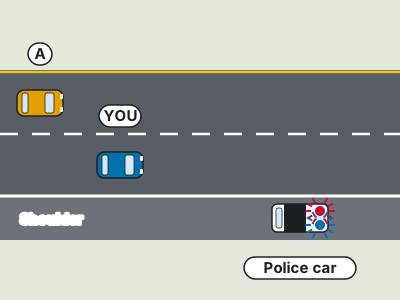
3. What is required when a stopped emergency vehicle is on a four lane highway and a safe lane change is possible?
- Drive onto the median to create space
- Keep the same speed and lane
- Stop beside the emergency vehicle
- Change lanes away from it and proceed cautiously
Show answer
Change lanes away from it and proceed cautiously. When you approach a law enforcement, emergency, or repair vehicle with a flashing light on the side of the road, Vermont law says you must proceed with caution and make a lane change away from the emergency vehicle as soon as it is safe to do so. Staying in the same lane at the same speed ignores that duty. Stopping beside the vehicle or entering the median creates unnecessary exposure and may block traffic. If you are unable to change lanes, the manual says you must slow down to 20 mph below the speed limit to go by the stopped vehicles.
Study this in the handbook: Highway markings and passing
4. What should a driver do when a low shoulder causes the vehicle's wheels to leave the pavement?
- Turn immediately across the center line to regain traction
- Brake hard and steer sharply back onto the pavement
- Accelerate until the tires climb onto the roadway
- Reduce speed without braking and return carefully at a slow speed
Show answer
Reduce speed without braking and return carefully at a slow speed. A low shoulder can pull the vehicle away from the pavement, so the manual calls for reducing speed without braking and returning carefully at a slow speed. Hard braking or a sharp steering correction can cause loss of control. Acceleration does not solve the drop-off safely, and crossing the center line creates a new conflict with oncoming traffic. Keep the steering steady, ease off the accelerator, check traffic, and reenter only when the vehicle is controlled.
Study this in the handbook: School buses and railroad crossings
5. When a recalled Vermont Learner's Permit or Junior Driver's License is restored, what reinstatement fee is due?
- $36
- $24
- None
- $62
Show answer
None. No reinstatement fee is due when a Learner's Permit or Junior Driver's License recall is restored. The permit or license is restored after the recall term ends and, if required, after a re-examination is passed. The other dollar figures are license and replacement fees from the fee schedule, not recall charges. The driver also has the right to a hearing when a recall is issued.
Study this in the handbook: Junior license passenger rules and recalls
6. What does a broken white line separating lanes generally tell a Vermont driver?
- The lanes carry traffic in opposing directions
- The road has no lane markings beyond the line
- The line marks the exact location of a railroad rail
- The line separates lanes traveling in the same direction
Show answer
The line separates lanes traveling in the same direction. A broken white line divides lanes used by vehicles traveling in the same direction. It is not the center marking for opposing traffic, which Vermont identifies with yellow center lines. The line does not mean that lane markings disappear or that a railroad rail is nearby. Before moving across it, still check mirrors, signal, and look for vehicles in the blind spot. A useful visual cue is the contrast between a broken white lane divider and yellow markings that separate opposing directions. Read the pavement together with the lane arrows and surrounding traffic so the marking guides a safe, deliberate lane choice.
Study this in the handbook: Turn signals and turning
7. A Vermont teen's Learner's Permit expired four years ago. What is needed before a road test can be given?
- Nothing, the road test can be taken right away
- A written exam
- A new driver education course
- A doctor's certificate
Show answer
A written exam. A person may take a road test if the Learner's Permit has not been expired more than 3 years and has been renewed before the exam. If it has been expired more than 3 years, a written exam is required before the road test can be given. Four years is past that limit, so the road test cannot be taken right away. A new driver education course or doctor's certificate is not what the rule requires.
Study this in the handbook: Learner's Permit and Junior Driver's License
8. Which roadway conditions may Vermont warning signs identify?

- Only lanes reserved for buses
- Only legal parking spaces and loading zones
- Only fuel stations and lodging areas
- Sharp curves, unsafe intersections, or dips in the road
Show answer
Sharp curves, unsafe intersections, or dips in the road. Vermont says warning signs may identify sharp curves, unsafe intersections, or dips in the road. Each condition can change visibility, steering, or stopping needs, so the driver should slow down and scan carefully. The other choices describe parking rules, traveler services, or lane controls rather than the examples given for warning signs. When the sign appears, look for the roadway feature it announces and choose a speed that leaves room to respond. The cue is that a warning describes a potential hazard ahead, not a destination or a standing parking permission.
Study this in the handbook: Road signs
9. On a Vermont road, what does a solid line in your lane indicate about passing?
- Passing is required before the line ends
- The line separates vehicles traveling in the same direction
- Passing is allowed whenever the shoulder is clear
- You should not pass from that lane
Show answer
You should not pass from that lane. The manual says a solid line in your lane means you should not pass. The choice “Passing is required before the line ends” invents a requirement to pass, while the choice “Passing is allowed whenever the shoulder is clear” substitutes a clear shoulder for the roadway condition and marking that control the maneuver. The choice “The line separates vehicles traveling in the same direction” describes a broken white line dividing same-direction lanes, not the restriction presented here. Before passing, identify which lane contains the broken line and confirm that the road ahead is clear. A solid line on your side is a cue to remain behind.
Study this in the handbook: Highway markings and passing
10. When a driver turns left at an intersection, what right-of-way rule applies?
- The turning driver yields to all oncoming traffic
- The turning driver proceeds before all oncoming traffic
- The turning driver yields only to trucks
- The turning driver has priority whenever the signal is used
Show answer
The turning driver yields to all oncoming traffic. Vermont's listed right-of-way rule requires a left-turning driver to yield to all oncoming traffic. That includes a bicyclist as well as a motor vehicle, and a turn signal only announces the maneuver. It does not change who must wait. The other choices either narrow the protected road users or treat signaling as priority. A reliable cue is to search the opposing lane and destination crosswalk before beginning the turn.
Study this in the handbook: Stopping, braking and following distance
11. After a Vermont crash, what is a driver's legal first responsibility?
- Stop and give any assistance that is reasonably necessary
- Leave if the vehicle can still be driven
- Move every injured person away from the vehicles
- Wait for police before stopping or checking anyone
Show answer
Stop and give any assistance that is reasonably necessary. A driver involved in a crash is required by law to stop and give any assistance that is reasonably necessary. Leaving because the vehicle remains drivable ignores that duty. Moving every injured person is not the manual advice: it says to leave an injured person where they are, because moving the person the wrong way may cause more injury, and to keep the person warm and calm. Waiting for police before stopping is backwards. If possible, move the vehicles out of the traveled lanes, and call 911 if someone is injured.
Study this in the handbook: What to do after a crash
12. A new Vermont resident holds a valid license from another state. How soon must they get a Vermont license?
- Within 10 days
- Within 60 days of moving into the state
- Before driving at all in Vermont
- Within six months
Show answer
Within 60 days of moving into the state. A person who has moved into Vermont from another jurisdiction with a valid license from that state must obtain a Vermont license within 60 days of moving into the state. The out of state license remains valid during that window, so the newcomer does not have to stop driving. Commercial license holders have a shorter clock, 30 days, and vehicle registration must also be transferred within 60 days.
Study this in the handbook: Tests, renewals and license rules
13. In which direction does traffic proceed through a Vermont roundabout?
- Counter clockwise, with entering and exiting traffic making right turns
- Clockwise, with left turns at each exit
- Straight through without turning
- Counter clockwise, but entering traffic has priority
Show answer
Counter clockwise, with entering and exiting traffic making right turns. A Vermont roundabout is designed so traffic enters and exits through right turns and proceeds counter clockwise. Drivers must yield to traffic already circulating, enter only through a safe gap, and yield to pedestrians and bicyclists. The clockwise option reverses the intended flow, while the priority option ignores the yield requirement. Reduce speed on approach, choose the lane directed by signs or markings, and signal your intention to exit when leaving the circle.
Study this in the handbook: Parking rules
14. Under what age must a Vermont child ride in the back seat when practical?
- Under 13
- Under 8
- Under 5
- Under 16
Show answer
Under 13. A child under 13 years of age must, if practical, ride in the back seat. The manual also warns never to place a child safety seat in front of an air bag. Vermont's restraint law also requires a harnessed rear facing seat under age two, a booster for children under eight who are not in a harnessed seat, and a seat belt for everyone else.
Study this in the handbook: Safety belts and child restraints
15. What minimum tread depth does Vermont require on tires?
- At least 1/32 of an inch
- At least 2/32 of an inch
- At least 4/32 of an inch
- At least 6/32 of an inch
Show answer
At least 2/32 of an inch. Tires must have at least 2/32 inch of tread depth. The manual adds that it is not safe or legal to use tires once the tread is worn off or worn down to the wear bars, and it suggests a penny test: if you can see all of Lincoln's head in the deepest groove, the tires are too worn. Keep the right air pressure as well, since both overinflated and underinflated tires reduce traction.
Study this in the handbook: Equipment, inspection and maintenance
16. Using Vermont's four-second method, when are you following too closely?
- When the vehicle ahead takes four seconds to pass a checkpoint
- When your vehicle reaches the checkpoint in less than four seconds
- When you can count only one thousand one
- When you leave more than four seconds in poor weather
Show answer
When your vehicle reaches the checkpoint in less than four seconds. The timing begins as the rear of the vehicle ahead passes a fixed checkpoint and ends when your vehicle reaches that same point. Fewer than four seconds means the gap is too short. Reaching it in four or more seconds meets the manual's basic spacing measure, although poor visibility, bad pavement, or higher speed calls for additional room. Choose a roadside sign or pole as the checkpoint and count consistently rather than estimating by car lengths.
Study this in the handbook: Stopping, braking and following distance
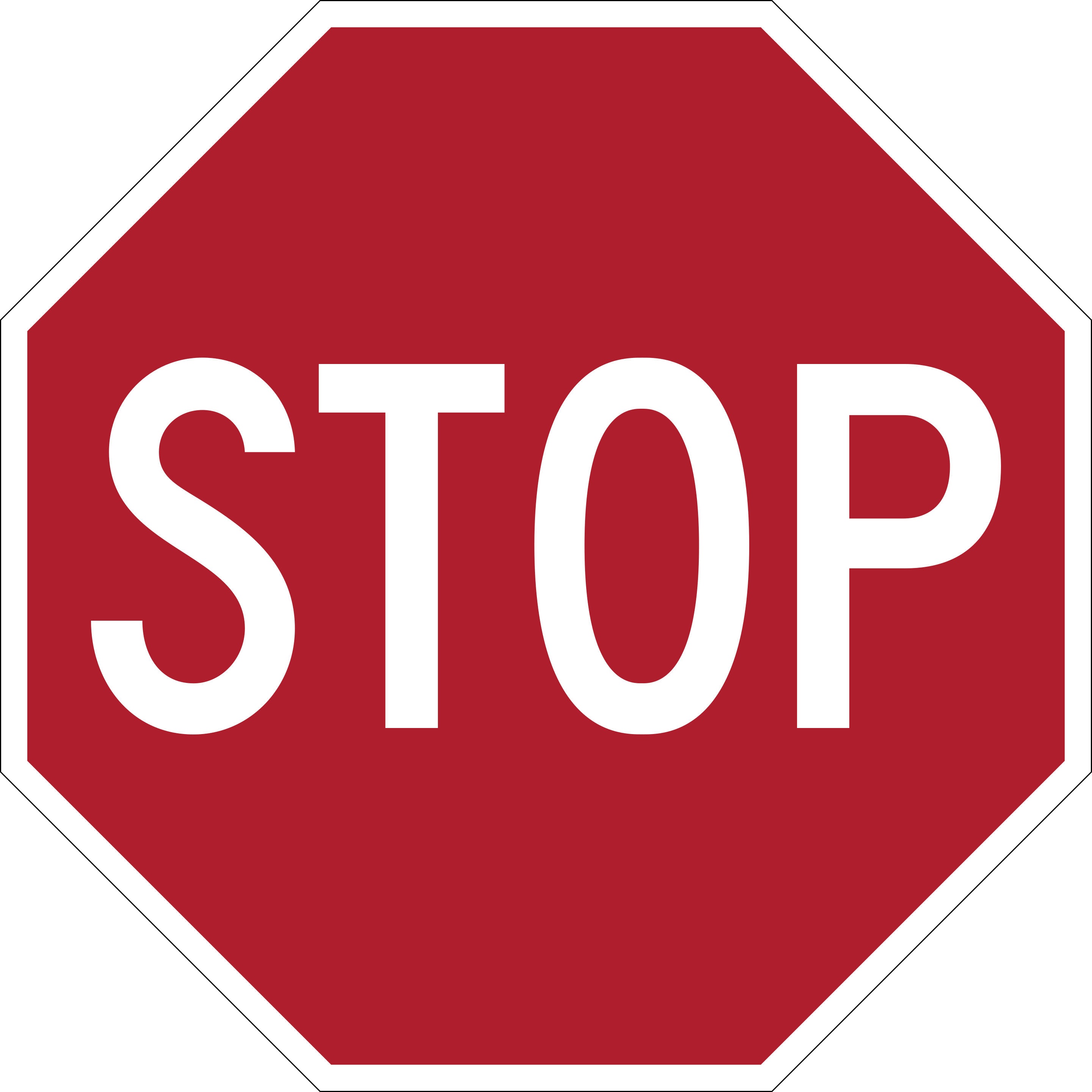
17. If a Vermont road sign is covered by dirt or snow, what should a driver still be able to recognize?
- The vehicle that last passed it
- Its exact distance from the next town
- Its general meaning from its shape
- The weather expected tomorrow
Show answer
Its general meaning from its shape. Even when dirt, snow, or another obstruction covers a sign, Vermont expects a driver to recognize its general meaning from the shape. That recognition can identify a warning, regulatory instruction, or information sign before every word is visible. The obstruction does not reveal a town distance, identify a passing vehicle, or forecast tomorrow’s weather. Slow down when the sign category signals a possible hazard and look for clearer wording or roadway clues as you continue. Shape recognition is a backup skill for poor visibility, not a replacement for reading the complete message when possible.
Study this in the handbook: Traffic lights, arrows and roundabouts
18. How many points does Vermont assess for the under 21 violation of driving with a BAC of 0.02 or more?
- 2 points
- 4 points
- None
- 10 points
Show answer
None. The Vermont statute says no points shall be assessed for the under 21 violation of operating with a BAC of 0.02 or more. The penalty works through license suspension and the Youth Substance Awareness Safety Program instead. A provisional license may also be recalled. The 2, 4, and 10 point choices come from the general point system, which does not apply to this particular violation.
19. What record must a Vermont applicant maintain during the six months before obtaining a junior driver's license?
- A clean record without permit recalls, suspensions, or revocations
- A record with no parking tickets only
- A clean record for six months after receiving the junior license
- A record showing at least six months of driving alone
Show answer
A clean record without permit recalls, suspensions, or revocations. The junior license requirement looks backward: the applicant must have a clean record without learner's permit recalls, suspensions, or revocations for the six months before obtaining the license. The requirement is not limited to parking tickets, and it is not a post-license condition. Six months of driving alone is also not the test. Review the permit history before applying, because a recall or suspension during that period interrupts the clean-record requirement.
Study this in the handbook: Learner's Permit and Junior Driver's License
20. With a valid Vermont learner's permit, where and when may a person drive?
- Only on roads approved in advance by a driving instructor
- Only on roads inside the driver's town during daylight
- Anywhere and anytime in Vermont with a qualified unimpaired front-seat supervisor
- Anywhere in the United States without an accompanying driver
Show answer
Anywhere and anytime in Vermont with a qualified unimpaired front-seat supervisor. A valid Vermont learner's permit permits driving anywhere and anytime within Vermont, but the driver must have a licensed and unimpaired parent or guardian, a licensed or certified unimpaired instructor, or a licensed and unimpaired person at least 25 in the front seat. The unrestricted United States option is too broad because another state may not honor the permit. Check that state's rules before crossing the border.
Study this in the handbook: Learner's Permit and Junior Driver's License
QualitySpace is expanding to Vermont
We are a California-based independent insurance brokerage working on licensing in more states. We cannot help with Vermont insurance yet. Leave your email and we will let you know when we can.
Every question is written from the official Vermont Driver's Manual. Need paper? Printable VT practice test with answer key.
Last verified 2026-10-05. How we check every question · Study all 200 as flashcards
Frequently asked questions
How many questions are on this Vermont practice test?
This fixed set has 20 questions. It is test 7 of 10 from the 200 question Vermont bank. The real VT exam asks 20 questions and you need 16 correct.
What is the passing score for the real Vermont test?
You must answer at least 16 questions correctly to pass the test (16 of 20) That figure comes from the official Vermont source cited on the DMV facts page.
How does this fixed test relate to the full Vermont bank?
Each numbered test is a fixed set of questions in a fixed order, so you can retake the same test later and compare. Every test mixes road signs and the other topics in about the same proportion as the full bank. Tests 1 to 10 together cover every question in the Vermont bank once. The full practice page mixes the whole bank at random.
Last verified 2026-10-05. See the Vermont DMV facts page for sourced state details.