
Test 3 of 10 · 20 questions · Free 2026
VT Permit Practice Test 3
Jump to the test ↓A fixed 20 question set from the Vermont bank with answers and plain English explanations. The real VT exam is 20 questions, 80 percent to pass; take the full length version on the main practice page.
Question 1 of 20 · 0 right so far
All 20 questions in test 3
Every question below comes from the Vermont question bank on this page. Open a question to see the correct answer and the explanation. Nothing here is hidden behind a signup.
1. Under Vermont law, which drivers may not use a portable electronic device, such as a phone, while driving?
- Only junior operators
- Only drivers under 21
- Only commercial drivers
- Any person operating a motor vehicle
Show answer
Any person operating a motor vehicle. The manual states that a person shall not use any portable electronic device while operating a motor vehicle, including reading, composing, or sending texts, instant messages, and emails. The rule is written for any person, not only junior operators, drivers under 21, or commercial drivers. Devices include cell phones, PDAs, tablets, and laptops. Texting while driving carries 2 to 5 points under the point system.
Study this in the handbook: Junior license passenger rules and recalls
2. Under Vermont law, how long is the license suspended for a first offense of driving under 21 with a BAC of 0.02 or more?
- 30 days
- 90 days, with automatic reinstatement after the period
- One year
- Until age 21
Show answer
90 days, with automatic reinstatement after the period. For a first offense of operating under 21 with a BAC of 0.02 or more, Vermont law sets a 90-day suspension with automatic reinstatement after the 90 days; a second or later offense means 145 days. The person is also referred to the Youth Substance Awareness Safety Program. Failing that program brings larger penalties, including longer suspensions, so one year and until age 21 describe the failure track for repeat offenses, not the first suspension.
3. How must a child under two years old ride in a Vermont vehicle?
- Properly secured in a federally approved rear-facing child car seat with a harness
- In a booster seat
- In a forward-facing seat with a harness
- On a parent's lap with the seat belt
Show answer
Properly secured in a federally approved rear-facing child car seat with a harness. Under 23 V.S.A. 1258, a child under two years of age must be properly secured in a federally approved rear facing child car seat with a harness, and a child in a rear facing car seat must not ride in front of an active airbag. A child over two but under five may ride rear or forward facing with a harness, a child under eight not in a harnessed seat needs a booster, and a child under 13 must, if practical, ride in the back seat. A booster or a lap does not meet the rule for a child under two.
Study this in the handbook: Safety belts and child restraints
4. Before turning left at a flashing yellow arrow, what must you do?
- Stop and remain stopped until a solid green arrow appears
- Turn immediately because the arrow gives protected priority
- Yield to oncoming traffic and pedestrians, then wait for a safe gap
- Yield only to vehicles, not to pedestrians in the crosswalk
Show answer
Yield to oncoming traffic and pedestrians, then wait for a safe gap. A flashing yellow arrow permits a left turn only after the driver yields to all oncoming traffic and pedestrians in the crosswalk. The arrow does not provide protected priority, and it does not require waiting through the entire signal cycle for a solid green arrow. Pedestrians remain part of the conflict check, not an exception. Read the arrow as permission with conditions: slow your approach, identify a safe opening, give way to opposing road users, and turn only when the path is clear.
Study this in the handbook: Traffic lights, arrows and roundabouts
5. What does a warning sign with a downward arrow below a school or pedestrian symbol indicate?
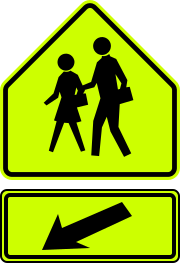
- A crosswalk or crossing area
- A no-parking area for the next mile
- A railroad track hidden below the pavement
- A lane reserved for buses
Show answer
A crosswalk or crossing area. The manual explains that a downward arrow beneath a school or pedestrian sign identifies a crosswalk or crossing area. It does not establish a parking restriction, railroad track, or bus-only lane. Warning signs call for reduced speed because a hazard or crossing may be present. The arrow is the practical cue that the crossing is at or immediately below the sign location. Scan both sides of the road and be ready to yield to people crossing.
Study this in the handbook: Road signs
6. At a two-lane roundabout without signs or arrows, what movement is permitted from the right lane?
- Any movement without yielding
- Left turns only
- U-turns across the center island
- Right turns or through movements
Show answer
Right turns or through movements. At a two-lane roundabout with no signs or arrows, the right lane may make a right turn or continue through. The left lane is permitted for left turns or through movements. The right lane does not authorize a U-turn across the center island, and lane position never removes the duty to yield before entering. Select the lane before entry, keep the assigned path, and use a signal to show the intention to exit. Do not change lanes inside the roundabout.
Study this in the handbook: Traffic lights, arrows and roundabouts
7. What should a driver do after seeing a warning for an unsafe intersection?

- Slow down and prepare for the intersection hazard
- Accelerate to clear the intersection before others arrive
- Ignore the sign if the pavement is dry
- Stop in the travel lane at the sign every time
Show answer
Slow down and prepare for the intersection hazard. An unsafe-intersection warning tells the driver to slow down and stay alert for the hazard ahead. Accelerating reduces the time available to search, while dry pavement does not remove the reason for the warning. The sign also does not automatically require a stop in the travel lane; the driver should respond to the intersection's actual controls and traffic. Reduce speed before the conflict area, scan all directions, and enter only when the path is clear and lawful.
Study this in the handbook: Road signs
8. What interstate speed does the Vermont manual suggest for saving fuel?
- Drive 55 or 60 miles per hour instead of 65
- Drive 45 in the right lane
- Drive 70 to keep the engine efficient
- Speed has no effect on fuel use
Show answer
Drive 55 or 60 miles per hour instead of 65. Among Vermont's green driving tips, the manual says to slow down and watch speed: on the interstate, drive 55 or 60 miles per hour instead of 65 to save fuel, and the EPA estimates up to a 15 percent improvement in fuel economy from this tip alone. Remember that 65 is the posted Interstate maximum, not a target, and the same list of tips also recommends accelerating and braking smoothly.
Study this in the handbook: Insurance, points and phone laws
9. What does a Vermont Class A commercial license cover?
- Any vehicle under 26,000 pounds
- Single vehicles over 26,001 pounds only
- Buses carrying 16 or more passengers
- Any combination of vehicles with a GCWR of 26,001 pounds or more, where the towed unit has a GVWR of 10,001 pounds or more
Show answer
Any combination of vehicles with a GCWR of 26,001 pounds or more, where the towed unit has a GVWR of 10,001 pounds or more. Class A covers any combination of vehicles with a gross combination weight rating of 26,001 pounds or more, provided the towed unit has a gross vehicle weight rating of 10,001 pounds or more. Class B covers single vehicles of 26,001 pounds or more towing a unit of 10,000 pounds or less, and Class C covers single vehicles of 26,000 pounds or less that transport placarded hazardous materials or are designed to carry 16 or more passengers including the driver. The heavy towed unit is what places a combination in Class A.
10. What must a Vermont insurance card show?
- Only the policy number
- The premium amount and agent's phone
- The driver's license number
- The carrier's name, effective and expiration dates, the insured's name, and the vehicle description including the VIN
Show answer
The carrier's name, effective and expiration dates, the insured's name, and the vehicle description including the VIN. Vermont requires the insurance card carried in the vehicle to state the name of the insurance carrier, the effective and expiration dates of coverage, the name of the insured, and a description of the vehicle including the vehicle identification number. An officer uses those details to confirm that this vehicle is covered on this date. A policy number alone, the premium, or a license number does not prove coverage.
11. What two actions help keep a parked vehicle from rolling into traffic on a hill?
- Leave the transmission in neutral and release the brake
- Turn off the engine but leave the wheels straight
- Turn the front wheels and set the parking brake
- Park with one wheel on the travel lane
Show answer
Turn the front wheels and set the parking brake. On a hill, the manual calls for turning the front wheels and setting the parking brake so the vehicle will not roll into traffic. Leaving the transmission in neutral or leaving the wheels straight removes two layers of protection. Placing a wheel in the travel lane is itself hazardous. The practical cue is to finish the parking maneuver by checking the wheel direction and physically setting the brake before stepping away from the vehicle.
Study this in the handbook: Parking rules
12. According to the Vermont manual, how far does a passenger car travel before stopping on dry pavement at 60 mph compared with 30 mph?
- 120 feet versus 60 feet
- 400 feet versus 100 feet
- 240 feet at 60 mph versus 75 feet at 30 mph
- About the same distance
Show answer
240 feet at 60 mph versus 75 feet at 30 mph. Among its tips for safe driving in Vermont work zones, the manual says to maintain a 4 second following distance and explains why: it takes 240 feet for a passenger car to come to a complete stop on dry pavement traveling at 60 mph, versus 75 feet for the same car to stop at 30 mph. Doubling the speed therefore more than triples the stopping distance in the manual's own figures, so the distances are far from the same.
Study this in the handbook: Stopping, braking and following distance
13. How does Vermont's graduated license law define nighttime driving?
- From sunset to sunrise
- From 30 minutes after sunset to 30 minutes before sunrise
- From 9 p.m. to 5 a.m.
- From dusk until dawn as judged by the driver
Show answer
From 30 minutes after sunset to 30 minutes before sunrise. For the graduated driver's license program, nighttime driving is defined as driving during the period of thirty minutes after sunset to thirty minutes before sunrise. The definition matters because at least 10 of the 40 required practice hours must be nighttime driving, and the half hour buffer gives an objective line instead of a judgment call. The same window is used for when headlights are needed.
Study this in the handbook: Junior license passenger rules and recalls
14. What must a Vermont vehicle's emergency or parking brake be able to do?
- Work only when the engine is running
- Stop the vehicle from 30 mph
- Lock all four wheels
- Hold the vehicle in neutral on any grade it is operated on, headed uphill or downhill
Show answer
Hold the vehicle in neutral on any grade it is operated on, headed uphill or downhill. Vermont's manual says emergency or parking brakes must be adequate to hold the vehicle in neutral on any grade on which it is operated, both with the vehicle headed uphill and downhill. The standard is about holding the vehicle, so it does not depend on the engine running, on stopping from a set speed, or on locking all four wheels. The manual lists these brakes among the equipment a road test vehicle must have in good mechanical condition.
Study this in the handbook: Tests, renewals and license rules
15. During a Vermont police stop, when may you get out of your vehicle?
- Whenever you want to explain the traffic offense
- Only when the officer requests it
- As soon as the officer turns on flashing lights
- Only after another driver stops nearby
Show answer
Only when the officer requests it. Vermont’s police-stop guidance says to stay in the vehicle unless the officer requests that you get out. Leaving to argue, explain, or approach the officer can create a safety problem for everyone at the roadside. Flashing lights announce the stop but do not authorize an unrequested exit. Keep movements limited, remain calm, and have your license, registration, and insurance available when asked. The simple cue is to stay seated until the officer gives a different instruction.
Study this in the handbook: Traffic lights, arrows and roundabouts
16. What authority does a flagger have in a Vermont work zone?
- Legal authority to control traffic, and must be obeyed
- Authority over trucks only
- None unless a police officer is present
- Advisory only
Show answer
Legal authority to control traffic, and must be obeyed. A flagger has the legal authority to control traffic and must be obeyed. Flaggers use stop and slow paddles, or sometimes orange flags, to guide traffic through a work zone, often because equipment must move or only one lane is open for both directions. Watch for the flagger well before the work area, slow down, and follow the directions exactly, since workers and equipment may be just beyond your view.
Study this in the handbook: Road signs
17. How should you approach an intersection controlled by a flashing yellow light?
- Turn left immediately without checking oncoming traffic
- Stop and remain stopped until green
- Slow down, scan, and proceed with caution
- Accelerate to clear the intersection before the light changes
Show answer
Slow down, scan, and proceed with caution. A flashing yellow signal calls for a slower, cautious approach rather than a complete stop. Scan the intersection and yield to oncoming vehicles before attempting a left turn, then proceed only when the movement is safe. The green-only choice treats the signal as a steady red, while an immediate left turn ignores the required traffic check. Accelerating to beat a change also sacrifices control and observation. Reduce speed early, look for pedestrians and vehicles, and let the flashing pattern prompt a deliberate search instead of an automatic stop or rush.
Study this in the handbook: Traffic lights, arrows and roundabouts
18. A police vehicle stops on a dark roadside and approaches your car. Which action is recommended?
- Turn off every light so the officer can see outside
- Turn on the vehicle's interior lights after stopping and before the officer approaches
- Leave the vehicle immediately to explain what happened
- Reach for documents before the officer comes to the window
Show answer
Turn on the vehicle's interior lights after stopping and before the officer approaches. During a stop in a dimly lit area, the manual advises turning on the vehicle's interior lights after stopping and before the officer approaches. The cabin light improves visibility for both people and makes movements easier to understand. Turning off all lights reduces that visibility. Exiting without being asked or reaching for documents early can create unnecessary concern. Remain inside, keep your movements limited, and wait for instructions before retrieving anything.
Study this in the handbook: Traffic lights, arrows and roundabouts
19. What does a yield right of way sign require before you enter?
- Stop every time even when no conflict exists
- Travel slowly enough to stop and enter only when the way is clear
- Enter at normal speed because the sign is advisory
- Yield only to vehicles, never to pedestrians or bicyclists
Show answer
Travel slowly enough to stop and enter only when the way is clear. A yield sign requires an approach speed that allows you to stop if necessary, followed by entry only when pedestrians, bicyclists, and vehicles do not create a conflict. A full stop may be needed, but it is not automatic when the way is clear. Treating the sign as optional or ignoring vulnerable road users defeats its purpose. Search in all directions before crossing the line, and be ready to wait for a safe gap. The upside down triangle is the cue to surrender priority rather than assume you have it.
Study this in the handbook: Traffic lights, arrows and roundabouts
20. What is the maximum speed for a vehicle on Vermont roads unless a different limit is posted?
- 35 miles per hour
- 55 miles per hour
- 50 miles per hour
- 65 miles per hour
Show answer
50 miles per hour. Vermont's general maximum for roads is 50 miles per hour unless a different limit is posted. The 65 mile per hour figure is reserved for an Interstate in Vermont or applies when posted there, so it is too high for the broad road rule. A driver must still reduce speed when traffic, weather, curves, intersections, construction, pedestrians, or bicyclists make the posted maximum unsafe. Think of 50 as the general ceiling, not a guarantee that speed is always appropriate.
Study this in the handbook: Speed limits and safe speeds
QualitySpace is expanding to Vermont
We are a California-based independent insurance brokerage working on licensing in more states. We cannot help with Vermont insurance yet. Leave your email and we will let you know when we can.
Every question is written from the official Vermont Driver's Manual. Need paper? Printable VT practice test with answer key.
Last verified 2026-10-05. How we check every question · Study all 200 as flashcards
Frequently asked questions
How many questions are on this Vermont practice test?
This fixed set has 20 questions. It is test 3 of 10 from the 200 question Vermont bank. The real VT exam asks 20 questions and you need 16 correct.
What is the passing score for the real Vermont test?
You must answer at least 16 questions correctly to pass the test (16 of 20) That figure comes from the official Vermont source cited on the DMV facts page.
How does this fixed test relate to the full Vermont bank?
Each numbered test is a fixed set of questions in a fixed order, so you can retake the same test later and compare. Every test mixes road signs and the other topics in about the same proportion as the full bank. Tests 1 to 10 together cover every question in the Vermont bank once. The full practice page mixes the whole bank at random.
Last verified 2026-10-05. See the Vermont DMV facts page for sourced state details.