
Test 11 of 25 · 20 questions · Free 2026
IN Permit Practice Test 11
Jump to the test ↓A fixed 20 question set from the Indiana bank with answers and plain English explanations.
Question 1 of 20 · 0 right so far
All 20 questions in test 11
Every question below comes from the Indiana question bank on this page. Open a question to see the correct answer and the explanation. Nothing here is hidden behind a signup.
1. How can a driver tell whether an Indiana work site speed limit currently applies?
- Work limits apply only during daylight hours
- Work limits never apply on weekends
- Work limits apply only when workers are visible
- Some work site limits apply only when flashing and others apply at all times, so obey the posted signing
Show answer
Some work site limits apply only when flashing and others apply at all times, so obey the posted signing. Work site speed limits are at least 10 mph below the maximum established speed limit for the area. Some apply only when flashing, while others apply at all times. Drivers must obey the posted work site speed limit. The cited passage reads: "work site speed limits are in effect only when flashing and others are in effect at all times." Daylight does not bound the limits.
Study this in the handbook: Speed limits, following distance and stopping
2. Which of these may serve as evidence of Indiana residency when you apply for a credential?
- Owning a car titled in Indiana
- Holding a job with an Indiana employer
- Renting a mailbox in Indiana
- Being a registered voter in Indiana
Show answer
Being a registered voter in Indiana. Being a registered voter in Indiana is listed as evidence of Indiana residency. The manual also lists maintaining an Indiana residential address without claiming residency elsewhere and having a dependent enrolled in an Indiana elementary or secondary school. The cited passage reads: "• Maintaining a residential address in Indiana and not claiming residency in another state • Being a registered voter in Indiana"
Study this in the handbook: Learner's permits, knowledge exam and skills exam
3. A new Indiana resident holds a valid motorcycle endorsement from another state. What motorcycle exam must the rider pass to add that endorsement to a valid Indiana driver’s license?
- Only the motorcycle knowledge exam
- Both the motorcycle knowledge and riding skills exams
- Only the riding skills exam
- A full driver license skills exam on a motorcycle
Show answer
Only the motorcycle knowledge exam. A new Indiana resident with a valid out-of-state motorcycle endorsement or motorcycle driver’s license may add a motorcycle endorsement to a valid Indiana driver’s license after passing the motorcycle knowledge exam. The cited passage reads: "driver’s license from another state may add a motorcycle endorsement to their valid Indiana driver’s license after passing the motorcycle knowledge exam. Your Indiana motorcycle endorsement is valid for the same period of time as your Indiana"
4. How far behind a tractor-trailer does its rear blind spot extend?
- About 20 feet behind
- Up to 200 feet behind
- About 75 feet behind
- There is no rear blind spot
Show answer
Up to 200 feet behind. A tractor-trailer’s blind spots extend up to 200 feet behind it and up to 20 feet in front of the cab, as well as along its sides. If you cannot see the driver’s rearview mirrors while following, the driver cannot see you. The cited passage reads: "Blind spots for the tractor-trailer driver will be up to 20 feet in front of the cab, on either side of the trailer, alongside the cab, and up to 200 feet behind the vehicle."
Study this in the handbook: Speed limits, following distance and stopping
5. A car has a passenger side air bag. Does that change the seat belt duty in Indiana?
- Yes, belts become optional
- No, belts must be used and air bags work with them
- Yes, only children need belts
- Yes, belts matter only at highway speed
Show answer
No, belts must be used and air bags work with them. An air bag does not replace a seat belt. The manual says seat belts must be used even in vehicles with air bags, and the two are designed to work together to slow occupants in a collision. Failure to wear a belt could cause injury from the air bag. The manual separately lists seat-belt exemptions. The cited passage reads: "A seat belt must be used even in a vehicle with one or more air bags. Air bags are designed to work in tandem with seat belts to slow down the vehicle’s occupants in the event of a collision."
Study this in the handbook: Move Over law, school buses and pedestrians
6. An officer signals a driver to stop on a stretch of road with no safe shoulder nearby. What should the driver do while looking for a place to pull over?
- Speed up to reach the next town
- Stop at once in the travel lane
- Slow down and turn on the hazard lights
- Turn onto the center median
Show answer
Slow down and turn on the hazard lights. If you cannot immediately find a safe place to stop, slow down and turn on your hazard lights. This tells the officer you acknowledge their presence and are looking for a safe stopping place. Move to the right shoulder or the next safest location; do not stop in the center median. The cited passage reads: "If you cannot find a safe place immediately, slow down and turn on hazard lights."
Study this in the handbook: Accidents, collisions and roadside emergencies
7. A vehicle floats after plunging into water and occupants have escaped through a window. Where should they go?
- Back inside to gather belongings
- Under the vehicle for shelter
- Onto the hood under waterline
- Onto the roof of the vehicle
Show answer
Onto the roof of the vehicle. Exit through an open window and move to the roof. This helps keep you dry and may let you ride the vehicle briefly like a boat. Once on the roof, call 911 and locate the nearest dry land. Swim only as a last resort, and never re-enter the vehicle to collect possessions. The cited passage reads: "• Exit the vehicle and move to the roof. This will keep you as dry as possible and even in moving water you can ride the vehicle like a boat for a short time."
Study this in the handbook: Accidents, collisions and roadside emergencies
8. At a pedestrian hybrid beacon, after two steady red lights show while the pedestrian crosses, what happens next?
- The two red lights flash so drivers may proceed if the crossing is clear
- The beacon turns green for drivers
- The beacon goes dark at once
- A steady yellow light returns
Show answer
The two red lights flash so drivers may proceed if the crossing is clear. After two steady red lights, the two red lights flash, allowing drivers to proceed if the crossing is clear of pedestrians. The beacon then goes dark until another pedestrian activates it. The cited passage reads: "Then, two steady red lights will be displayed while the pedestrian crosses, and then the two red lights will flash to allow drivers to proceed through if the crossing is clear"
9. Which driving pattern belongs on Indiana list of signs that a driver may be impaired?
- Stopping fully at every stop sign
- Stopping for no reason or turning abruptly or illegally
- Signaling early before each turn
- Holding a steady lane position
Show answer
Stopping for no reason or turning abruptly or illegally. The manual lists stopping for no reason or turning abruptly or illegally as possible signs of impairment. Other signs include weaving, straddling the center line, swerving, drifting, following too closely, and inconsistent signaling. The cited passage reads: "• Swerves, drifts, or follows too closely • Stops for no reason or turns abruptly or illegally" The listed warning is stopping for no reason, not stopping at stop signs.
Study this in the handbook: Accidents, collisions and roadside emergencies
10. A traffic signal shows only bicycle symbols. Who does it apply to?
- All drivers on the road
- Only bicyclists
- Only pedestrians
- Only buses
Show answer
Only bicyclists. A signal that displays only bicycle symbols controls a bike lane or a separate bike path and applies only to bicyclists. As with vehicle signals, red means stop, yellow means the right of way is ending, and green means go. Drivers of motor vehicles continue to follow the regular vehicle signals for their own lanes, and they must still yield to bicyclists where the rules require it, such as when turning across a bike lane.
Study this in the handbook: Turns, all way stops, roundabouts and interstates
11. Which experience counts as a warning sign of drowsy driving?
- Missing road signs or exits that should have been noticed
- Feeling alert after a full night of sleep
- Remembering every mile of the trip clearly
- Holding a steady speed with no effort
Show answer
Missing road signs or exits that should have been noticed. Missing road signs or exits is a listed sign of drowsiness. Other signs include difficulty remembering the last few miles, changing lanes unexpectedly, and failing to maintain a constant speed. Be prepared to stop driving if you cannot stay alert or experience these signs. Pull over to a safe area as soon as you can and take a short nap.
Study this in the handbook: Weather, night driving, drowsiness and distraction
12. What should you do with your turn signal when you enter traffic from a parking space?
- Leave it off to avoid confusing others
- Flash the hazard lights instead
- Use it
- Use it only at night
Show answer
Use it. The manual says to use your turn signal when entering traffic from a parking space. Be sure to look in both directions and double check for cars and pedestrians when backing out of a parking place. Also check for bicyclists after parking and before opening a door. Reversing is harder than driving forward because the vehicle blocks your view, so go slowly and watch carefully in all directions as you leave the space.
Study this in the handbook: Turns, all way stops, roundabouts and interstates
13. How many points follow disregarding a stop sign or yield sign in Indiana?
- Four points for the sign offense
- One point for the sign offense
- Six points for the sign offense
- No points on a first offense
Show answer
Four points for the sign offense. Disregarding a stop sign or yield sign carries four points. Failure to yield to an emergency vehicle and following another vehicle too closely each carry six points. The cited passage reads: "Disregarding a stop sign or yield sign 4 points Failure to yield to an emergency vehicle" The manual assigns four points to this offense, not one. Six belongs to other listed offenses.
Study this in the handbook: Points, driver safety program and insurance
14. Which offense counts toward the three major offenses in Habitual Traffic Violator Section B?
- A parking ticket
- Drag racing or a speed contest
- A single burned out taillight
- Rolling a stop sign once
Show answer
Drag racing or a speed contest. Drag racing or engaging in a speed contest in violation of the law is listed among Section B major offenses. Three major offenses within 10 years result in a 10-year suspension. The cited passage reads: "Drag racing or engaging in a speed contest in violation of the law" Parking tickets never enter this company. A single burned-out taillight is not listed among Section B major offenses; drag racing or an unlawful speed contest is.
Study this in the handbook: Operating while intoxicated and habitual traffic violators
15. How can a driver usually identify a designated center left turn lane?
- By green colored pavement in the lane
- By a solid white line on both sides
- By a sign with alternate arrows reading CENTER LANE ONLY or by pavement arrows
- By a pennant shaped sign on the left
Show answer
By a sign with alternate arrows reading CENTER LANE ONLY or by pavement arrows. A designated center left-turn lane can usually be identified by a sign with alternate directional arrows reading CENTER LANE ONLY or by pavement arrows, although some have neither. Be aware that opposite-direction vehicles may enter the lane to turn left in front of you. Never use this type of lane for passing. The cited passage reads: "Designated center lanes for left turns can usually be identified by a sign with alternate directional arrows that state “CENTER LANE ONLY” or with pavement arrows, although"
Study this in the handbook: Lane markings, lane changes and passing
16. At an all-way stop, two drivers are unsure who holds the right of way. What is the better move?
- Yield the right of way to the other driver
- Proceed quickly before the other driver moves
- Flash headlights and claim the crossing
- Both drivers should enter together slowly
Show answer
Yield the right of way to the other driver. At an all-way stop, the first vehicle to stop is the first to proceed. If two drivers arrive at the same time, the driver on the left yields. If there is doubt about who has the right of way or a chance of a crash, it is better to yield to the other driver. The cited passage reads: "However, if there is any doubt which driver has the right of way or if there is the chance of a crash, it is better to yield the right of way to the other driver."
Study this in the handbook: Lane markings, lane changes and passing
17. What should a driver do with posted advisory speeds on curves and ramps?
- Treat them as minimum speeds
- Exceed them by five on dry roads
- Not exceed those advisory speeds
- Ignore them on ramps only
Show answer
Not exceed those advisory speeds. To reduce rollover risk, slow down on curves and ramps and do not exceed the advisory speeds provided at those locations. The cited passage reads: "• Slow down on curves and ramps - Advisory speeds are provided at these locations - these advisory speeds should not be exceeded." The manual says advisory speeds should not be exceeded, not treated as minimums. Adding five breaks the ceiling.
Study this in the handbook: Speed limits, following distance and stopping
18. A driver holds an Indiana license with a for-hire endorsement but no CDL. Which vehicle stays off limits?
- A car carrying passengers for pay within endorsement limits
- A commercial motor vehicle
- A property vehicle registered at 20,000 pounds for hire
- A taxi operating inside the endorsement scope
Show answer
A commercial motor vehicle. A for-hire endorsement does not authorize operation of a commercial motor vehicle. It covers property-for-hire vehicles registered from 16,000 through 26,000 pounds gross weight, or vehicles designed for fewer than 16 people including the driver and used to carry passengers for hire. The cited passage reads: "A for-hire endorsement does not allow the credential holder to operate a commercial motor vehicle." Passenger hire within limits is allowed.
19. The pictured yellow sign shows a traffic signal symbol. What is it warning a driver about?
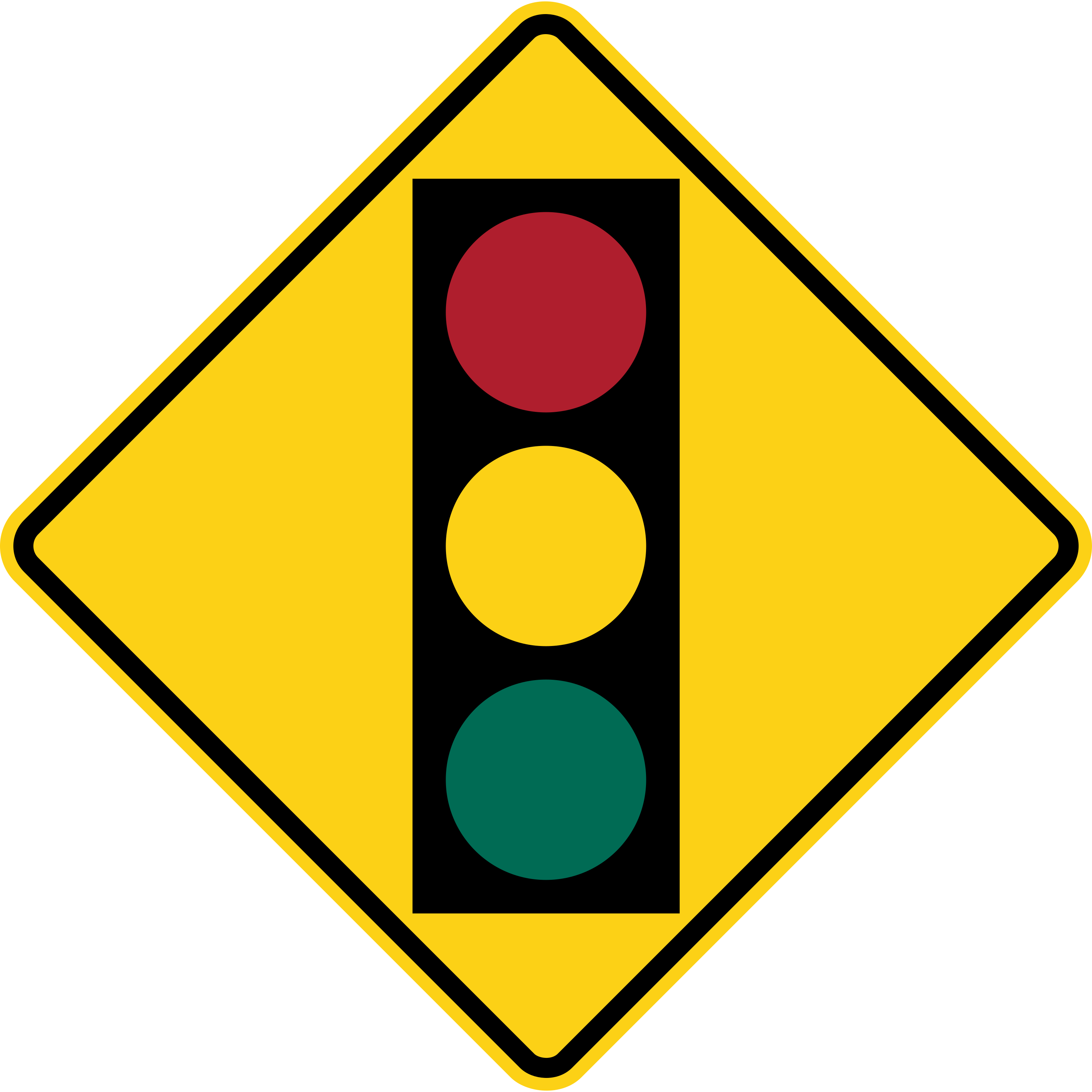
- A railroad crossing just ahead
- A stop sign hidden around a curve
- A flagger controlling traffic ahead
- A traffic signal ahead, so be ready to slow or stop
Show answer
A traffic signal ahead, so be ready to slow or stop. The yellow diamond sign warns of a traffic signal ahead. Yellow warning signs prepare drivers for conditions and hazards ahead. Circular warning signs indicate railroad crossings, and an orange Flagger Ahead sign warns of a work-site flagger. The cited passage reads: "Side Road Slippery When Wet “T” Intersection Traffic Signal" Railroad advance signs are round. This symbol identifies a traffic signal ahead, not a stop sign.
Study this in the handbook: Warning, regulation and guidance signs
20. An Indiana driver ignores a BMV notice to finish a Driver Safety Program in 90 days. What follows?
- Only a warning letter follows
- Points double at once
- The license expires early
- Driving privileges are suspended until completion is processed
Show answer
Driving privileges are suspended until completion is processed. Failure to complete the required Driver Safety Program within 90 days of the BMV’s mailed notice results in suspension of driving privileges. The suspension remains until the course is successfully completed and the completion is processed by the BMV. The cited passage reads: "Failure to complete a DSP course within 90 days from the date of the BMV’s mailed notice will result in the suspension of your driving privileges. The suspension will be in effect until you successfully complete the DSP course"
Study this in the handbook: Points, driver safety program and insurance
QualitySpace is expanding to Indiana
We are a California-based independent insurance brokerage working on licensing in more states. We cannot help with Indiana insurance yet. Leave your email and we will let you know when we can.
Every question is written from the official Indiana Driver's Manual. Need paper? Printable IN practice test with answer key.
Last verified 2026-10-05. How we check every question · Study all 500 as flashcards
Frequently asked questions
How many questions are on this Indiana practice test?
This fixed set has 20 questions. It is test 11 of 25 from the 500 question Indiana bank.
How does this fixed test relate to the full Indiana bank?
Each numbered test is a fixed set of questions in a fixed order, so you can retake the same test later and compare. Every test mixes road signs and the other topics in about the same proportion as the full bank. Tests 1 to 25 together cover every question in the Indiana bank once. The full practice page mixes the whole bank at random.
Last verified 2026-10-05. See the Indiana DMV facts page for sourced state details.