
Test 3 of 25 · 20 questions · Free 2026
IN Permit Practice Test 3
Jump to the test ↓A fixed 20 question set from the Indiana bank with answers and plain English explanations.
Question 1 of 20 · 0 right so far
All 20 questions in test 3
Every question below comes from the Indiana question bank on this page. Open a question to see the correct answer and the explanation. Nothing here is hidden behind a signup.
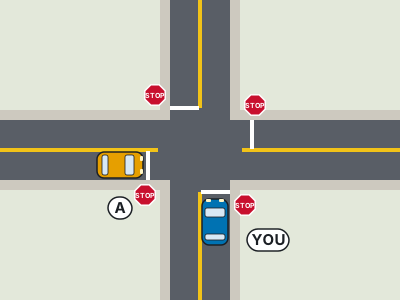
1. Two drivers stop at an all-way stop at the same time. Which driver must yield under Indiana's rule?
- The driver on the right yields to the driver on the left
- The driver on the left yields to the driver on the right
- The driver going straight always yields to a turning driver
- The larger vehicle automatically proceeds first
Show answer
The driver on the left yields to the driver on the right. At an all-way stop, Indiana first gives priority to the vehicle that stopped first. When arrival is simultaneous, the vehicle on the left yields to the one on the right. The opposite left-right assignment reverses the rule. Neither a vehicle's size nor whether it is turning creates an automatic priority in this tie. If there is doubt or a collision risk, the manual advises yielding, so a cautious driver should not force the movement simply because the right-side rule appears favorable.
Study this in the handbook: Turns, all way stops, roundabouts and interstates
2. What must an Indiana driver do when approaching an emergency vehicle with alternately flashing red or red and blue lights?
- Pass in the emergency vehicle's lane
- Stop beside the emergency vehicle
- Change lanes away from the authorized vehicle
- Turn off the headlights and continue
Show answer
Change lanes away from the authorized vehicle. Indiana requires motorists approaching an authorized emergency vehicle with the specified flashing lights to change lanes away from it. If a lane change cannot be made, the driver must reduce speed to 10 miles per hour under the posted limit and proceed cautiously. Stopping beside the vehicle or passing in its lane leaves the traffic exposure unchanged. The cue is the combination of emergency lights and a safe lane opportunity: move away when possible, then use the reduced speed fallback.
Study this in the handbook: Move Over law, school buses and pedestrians
3. For an indefinite Indiana no-insurance suspension, how long must an effective SR22 generally be maintained to terminate the suspension?
- Continuously for 30 days
- Until the next license renewal only
- Continuously for 180 days
- For one calendar year in every case
Show answer
Continuously for 180 days. For no-insurance suspensions that became effective on or after December 31, 2021, the suspension is indefinite. The manual says it can be stayed after the BMV receives an SR22 and terminated by maintaining that policy continuously for 180 days. Thirty days is too short, and a renewal date does not replace the stated period. One year is not the general requirement described here. The key is uninterrupted SR22 coverage on file with the BMV for the full 180 days.
Study this in the handbook: Points, driver safety program and insurance
4. Which equipment is excluded from Indiana's definition of a telecommunications device?
- CB radio operated by an FCC licensed operator, and communication systems in commercial vehicles over 10,000 pounds
- Pagers
- Text messaging devices
- Smartphones used hands free
Show answer
CB radio operated by an FCC licensed operator, and communication systems in commercial vehicles over 10,000 pounds. Indiana defines a telecommunications device as an electronic or digital device such as a wireless telephone, personal digital assistant, pager or text messaging device. The definition does not include citizen band radio equipment operated by a person licensed as a CB operator by the Federal Communications Commission, or a communications system installed in a commercial motor vehicle weighing more than 10,000 pounds. Points may be assessed for using a covered device while driving.
5. What does a green arrow displayed with a red or green light permit?
- Entry into the intersection only if cross traffic waves
- A straight movement only after the arrow disappears
- A turn without checking for anyone in the intersection
- A turn through the intersection when it is clear
Show answer
A turn through the intersection when it is clear. A green arrow gives the driver the right of way to turn through the intersection, but the intersection still must be clear. The arrow does not eliminate the need to check for vehicles or pedestrians already in the area. The red or green light beside the arrow does not convert the arrow into a straight-only instruction. A wave from cross traffic is unnecessary and should not replace observing the signal and roadway.
Study this in the handbook: Traffic signals and turning on red
6. What does Indiana law say about using a telecommunications device while driving?
- It is allowed only for drivers over 21
- It is allowed at any speed below 25 mph
- It is specifically prohibited while operating a motor vehicle
- It is allowed if the call is under one minute
Show answer
It is specifically prohibited while operating a motor vehicle. Indiana names the device itself in the statute: using a telecommunications device while operating a motor vehicle is prohibited, with only the narrow hands free and emergency exceptions the law spells out. There is no low speed allowance, no age based permission, and no short call exception. The manual calls driver distraction a major contributing factor in many crashes and notes that sending or reading a text takes your eyes off the road for five seconds. In Indiana it is illegal while driving to text, call, or otherwise use a device such as a cell phone unless it is hands free.
Study this in the handbook: Weather, night driving, drowsiness and distraction
7. A vehicle is disabled on the roadside shoulder. Which action improves its visibility to passing motorists?
- Turn off every light so other drivers are not distracted
- Leave the vehicle in the travel lane with no warning signal
- Exit through the traffic-side door without checking nearby vehicles
- Turn on the flashing hazard lights
Show answer
Turn on the flashing hazard lights. A disabled vehicle should communicate its roadside emergency to approaching traffic. The manual recommends turning on the vehicle's flashing hazard lights and, when possible, pulling onto the shoulder. A reflective vest and emergency triangle can add visibility, but darkness or concern about distraction is not a reason to leave the vehicle unmarked. If occupants must exit from a shoulder, they should use the passenger side after checking nearby traffic and hazards. The cue is a stopped vehicle: make it visible before dealing with the mechanical problem.
Study this in the handbook: Accidents, collisions and roadside emergencies
8. At a four-way stop, two vehicles stop at the same time. Which vehicle has priority under the manual's rule?
- The vehicle on the left
- The vehicle on the right
- The vehicle traveling faster
- The vehicle that signals first
Show answer
The vehicle on the right. When two drivers arrive at an all-way stop at the same time, the vehicle on the left yields the right of way. That gives the vehicle on the right priority. Arrival order still controls when one vehicle stops first, so the rule is not a general preference for the faster vehicle. A turn signal also does not decide who proceeds. If there is doubt or a crash risk, yielding remains the safer choice even when a driver believes priority is available. The useful visual cue is the other vehicle's position relative to your own.
Study this in the handbook: Lane markings, lane changes and passing
9. How many points does Indiana assess for driving 16 to 25 mph over the speed limit?
- 4 points
- 2 points
- 6 points
- 8 points
Show answer
4 points. Indiana's speeding points are 2 for 1 to 15 mph over, 4 for 16 to 25 mph over, and 6 for 26 or more mph over. So 2 points is too low for this range and 6 applies only at 26 or more over. Eight points is for driving while suspended and speed contests. Points stay active for two years from the conviction date, and six or more active points at renewal means retaking the knowledge exam for drivers 21 and older.
Study this in the handbook: Points, driver safety program and insurance
10. How many points does Indiana assess for driving while suspended?
- 2 points
- 4 points
- 6 points
- 8 points
Show answer
8 points. Driving while suspended carries 8 points, the highest value on the Indiana examples list, shared with a speed contest on the road. Six points apply to following too closely and failing to yield to an emergency vehicle. Two and four points apply to lesser violations. A prior offense for driving while suspended can also lead to a misdemeanor or felony conviction.
Study this in the handbook: Points, driver safety program and insurance
11. An Indiana motorist with a previous OWI conviction refuses a chemical test. How long is the suspension?
- 180 days
- One year
- Ten years
- Two years
Show answer
Two years. A motorist who refuses a chemical test faces a one-year suspension, but with a previous operating while intoxicated conviction the refusal suspension is two years. One hundred eighty days is the suspension for failing a chemical test, and one year is the first refusal period. Ten years is a Habitual Traffic Violator suspension. A court may add a longer suspension after an OWI conviction.
Study this in the handbook: Operating while intoxicated and habitual traffic violators
12. What must a driver do when a regulatory sign says DO NOT ENTER?

- Stay out of the roadway or ramp marked by the sign
- Use the lane only to make a U-turn
- Proceed after stopping and yielding to pedestrians
- Enter slowly if no vehicle is approaching
Show answer
Stay out of the roadway or ramp marked by the sign. Indiana's manual lists Do Not Enter among its traffic regulation signs, and regulation signs display rules that drivers must obey about traffic speed and movement. The sign therefore prohibits entering the roadway it marks. An empty lane does not make entry legal, stopping first does not convert the sign into a yield instruction, and the sign gives no permission to use the lane for a U-turn. If you see the sign facing you, do not enter; find a lawful route instead. Never treat the absence of another vehicle as permission to ignore a regulation sign.
Study this in the handbook: Warning, regulation and guidance signs
13. What are Indiana police officers legally required to do after every traffic stop?
- Document the stop, including obtaining the driver's name and address for data collection
- Search the vehicle
- Issue a written warning
- Report it to the BMV within 24 hours
Show answer
Document the stop, including obtaining the driver's name and address for data collection. Regardless of what action is taken, police officers are legally required to document all traffic stops, which includes obtaining the driver's name and address for data collection purposes. If you believe an officer acted improperly, complaints can be filed with the agency's internal affairs division or a civilian complaint board rather than argued at the roadside. Keep the encounter calm and cooperative, and sign the ticket if one is issued.
Study this in the handbook: Accidents, collisions and roadside emergencies
14. What should a driver generally do when a solid white line marks the lane boundary?
- Cross it whenever traffic is behind
- Avoid crossing it to change lanes
- Treat it as the center line for opposing traffic
- Use it as a passing signal
Show answer
Avoid crossing it to change lanes. White markings separate lanes traveling in the same direction, and the manual advises drivers not to cross a solid white line. Treating it as an invitation to change lanes can move the vehicle where a lane shift is not intended. It is not the center line for opposing traffic and does not signal a passing opportunity. A broken white line is the usual place to change lanes when safe. Check the line before making any lateral move.
Study this in the handbook: Lane markings, lane changes and passing
15. What do railroad traffic signs alert drivers to?

- A lane that must turn left
- A school bus stop ahead
- Upcoming railroad crossings
- A temporary construction detour
Show answer
Upcoming railroad crossings. Railroad traffic signs alert drivers that a railroad crossing is ahead. The advance notice gives the driver time to reduce speed, identify crossing devices, look and listen, and keep the vehicle clear of the tracks. A school bus stop sign serves a different warning, a lane-turn sign is regulatory, and a detour is construction guidance. Do not treat the railroad symbol as a suggestion to maintain speed. Scan for a train and obey gates, lights, bells, crossbucks, and any stop requirement at the crossing.
Study this in the handbook: Warning, regulation and guidance signs
16. What do fluorescent yellow green signs warn Indiana drivers about?
- Construction and maintenance work ahead
- Railroad crossings
- A no passing zone
- Nearby schools, pedestrians, bicycles, playgrounds and school bus routes
Show answer
Nearby schools, pedestrians, bicycles, playgrounds and school bus routes. The bright yellow green color is used in Indiana for places where people are likely to be in or near the road: school zones, pedestrian crossings, bicycle routes, playgrounds and school bus routes. Orange belongs to construction and maintenance zones, the pennant shape marks a no passing zone, and railroad crossings use a circular advance sign and the crossbuck. A pedestrian crossing sign for a school crossing is the manual's example of a sign that may use this background, so slow down and scan for people near the roadway.
Study this in the handbook: Traffic sign colors and shapes
17. How should a driver respond when an anti-lock braking system activates during a skid?
- Pump the brake pedal repeatedly and release the wheel
- Keep firm, continuous pressure on the brake pedal and steer normally
- Turn away from the skid as quickly as possible
- Apply the parking brake until the tires lock
Show answer
Keep firm, continuous pressure on the brake pedal and steer normally. For a vehicle equipped with ABS, Indiana directs the driver to keep a foot on the brake pedal with firm, continuous pressure while steering normally. Do not pump the brakes. Repeated pumping can interfere with the system's operation, and a panicked steering correction may produce a spin. The parking brake is not the prescribed response to an ABS skid. A mechanical sound, vibration, or increased pedal resistance can indicate that ABS is working. Hold steady pressure, make controlled steering inputs, and wait for traction to return.
Study this in the handbook: Speed limits, following distance and stopping
18. How does occupancy affect the rollover risk of a 15-passenger van, according to Indiana's manual?
- Occupancy has no effect
- More passengers lower the center of gravity and reduce risk
- The risk increases dramatically as the number of occupants increases
- Only cargo weight matters
Show answer
The risk increases dramatically as the number of occupants increases. The rollover risk of a 15 passenger van increases dramatically as the number of occupants increases. Other risks include inexperienced drivers, improperly sized or inflated tires, and incorrectly loaded cargo or passengers that could affect the vehicle's center of gravity. The manual advises slowing down on curves and ramps, where advisory speeds are provided, and not exceeding those advisory speeds. More passengers make the van less stable, not safer, and cargo weight is only one of several listed factors.
Study this in the handbook: Trucks, motorcycles, bicycles and horse drawn vehicles
19. How many miles per hour over the limit produces six points under Indiana's speeding point examples?
- 1 to 15 mph over
- 26 or more mph over
- 16 to 25 mph over
- Any speed at least 5 mph over
Show answer
26 or more mph over. Indiana's examples assign six points for driving 26 or more miles per hour above the speed limit. The first range, 1 to 15 over, carries two points, and the middle range, 16 to 25 over, carries four points. The question turns on the upper threshold, so a small excess does not reach six points. A quick study cue is the ascending pattern: two points for the first band, four for the next, and six once the excess reaches 26 miles per hour.
Study this in the handbook: Points, driver safety program and insurance
20. What following interval does Indiana recommend as a good rule for drivers behind the vehicle ahead?
- At least two to three seconds
- At least one second
- Exactly five seconds
- One car length per ten mph
Show answer
At least two to three seconds. Indiana recommends staying at least two to three seconds behind the vehicle ahead. The manual describes a timing method: watch the lead vehicle pass a fixed object and count until your vehicle reaches that same object. One second leaves little reaction space, while exactly five seconds is not the stated general rule. The car length formula is also not the manual's method. Use the fixed object cue in changing traffic because it adjusts naturally as speed changes.
Study this in the handbook: Speed limits, following distance and stopping
QualitySpace is expanding to Indiana
We are a California-based independent insurance brokerage working on licensing in more states. We cannot help with Indiana insurance yet. Leave your email and we will let you know when we can.
Every question is written from the official Indiana Driver's Manual. Need paper? Printable IN practice test with answer key.
Last verified 2026-10-05. How we check every question · Study all 500 as flashcards
Frequently asked questions
How many questions are on this Indiana practice test?
This fixed set has 20 questions. It is test 3 of 25 from the 500 question Indiana bank.
How does this fixed test relate to the full Indiana bank?
Each numbered test is a fixed set of questions in a fixed order, so you can retake the same test later and compare. Every test mixes road signs and the other topics in about the same proportion as the full bank. Tests 1 to 25 together cover every question in the Indiana bank once. The full practice page mixes the whole bank at random.
Last verified 2026-10-05. See the Indiana DMV facts page for sourced state details.