
Test 20 of 25 · 20 questions · Free 2026
AK Permit Practice Test 20
Jump to the test ↓A fixed 20 question set from the Alaska bank with answers and plain English explanations. The real AK exam is 20 questions, 80 percent to pass; take the full length version on the main practice page.
Question 1 of 20 · 0 right so far
All 20 questions in test 20
Every question below comes from the Alaska question bank on this page. Open a question to see the correct answer and the explanation. Nothing here is hidden behind a signup.
1. In Alaska, you face a steady red arrow for the movement you want to make. What must you do?
- Stop before the intersection and make no such movement until the arrow turns green or flashing yellow
- Stop behind the line, look both ways, and then make the movement when traffic appears clear
- Make the indicated movement slowly and carefully while the red arrow continues to show
- Stop only when pedestrians are crossing in the direction shown by the red arrow
Show answer
Stop before the intersection and make no such movement until the arrow turns green or flashing yellow. A red arrow bars the movement it points to. Looking both ways and creeping through treats the arrow like a flashing red ball, which it is not. The stop belongs behind the crosswalk, stop line, or intersection entry, and the wait lasts until the arrow changes to green or flashing yellow. A slow roll during red still makes the barred movement, and the ban holds even when no pedestrian is crossing at that moment.
Study this in the handbook: Traffic signals and lane control signals
2. Your front wheel drive car slides on a slick Alaska curve and the front end pushes wide. What throttle use helps recover?
- Cut all power at once by shifting into neutral mid slide
- Press the accelerator firmly so the front tires dig through
- Easy acceleration to help pull the vehicle out of the skid
- Alternate hard acceleration and braking until grip returns
Show answer
Easy acceleration to help pull the vehicle out of the skid. Front wheel drive recovers with its pulling advantage: gentle acceleration loads the front tires along the intended path and helps drag the vehicle out of the slide. Cutting power or spinning the tires with a firm press removes that help, and alternating throttle with brakes rocks the weight balance. Feed power in easily, steer toward the open path, and let the front wheels pull you straight before adding any real speed.
Study this in the handbook: Vehicle emergencies, skids and stalls on the tracks
3. Halfway through a long Alaska drive you realize an important call cannot wait until your destination. What should you do first?
- Dial at the next red light and finish the call while rolling
- Hold the phone low and keep the call as short as possible
- Stop in a safe place off the road, then place the call
- Use speaker mode balanced on the steering wheel hub
Show answer
Stop in a safe place off the road, then place the call. A call demands conversation thought, number handling, and listening that compete directly with driving judgment. Pulling into a safe area first removes that competition entirely. Dialing at lights, hiding the phone low, or wedging it on the wheel keeps the distraction inside a moving vehicle where a surprise can arrive mid sentence. Stop clear of traffic, make the call with the vehicle parked, and rejoin the road only when your full attention is back on driving.
4. An orange sign shows a worker figure with a flag beside your route in Alaska. What should you watch for as you pass?
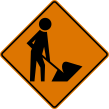
- A school patrol helping children cross between parked buses
- A crew working on or beside the roadway near your lane
- A flagger standing in the lane who will stop all traffic
- A survey crew measuring land beyond the shoulder fence
Show answer
A crew working on or beside the roadway near your lane. People working close to moving traffic have little protection beyond cones, vests, and your attention. The worker figure warns that a crew may be on the pavement or just beside it, with equipment swinging into your space. It differs from school patrol duty, a flagger stop that has its own sign, and surveying away from the road. Slow down, move as far from the crew as the lane allows, and watch for a worker stepping back without looking.
5. A passenger offers to hold a map while you eat a sandwich and sip coffee during an Alaska drive. What does the handbook direct?
- Refrain from eating, drinking, reading, and similar activities while driving
- Accept, because a passenger holding the map removes all distraction
- Eat only, because drinking and reading are the distracting parts
- Continue, provided the road ahead looks straight and empty
Show answer
Refrain from eating, drinking, reading, and similar activities while driving. Driving competes poorly with meals, drinks, and reading material, each stealing hands, eyes, or thought in turns. The handbook directs drivers to refrain from smoking, eating, drinking, reading, watching videos, and similar activity while the vehicle moves. A helpful passenger fixes only the map, and a straight empty stretch offers no promise about the next half mile. Finish food and reading while parked, then drive with both hands and your full attention available.
6. You are leaving a one way street and joining a two way street with a left turn planned in Alaska. Before the corner, which lane should your car occupy?
- In the right lane, so the turn crosses the fewest markings
- In whichever lane empties first as you reach the corner
- Start from the leftmost lane available to you
- Straddling two lanes so both turn paths stay open to you
Show answer
Start from the leftmost lane available to you. Turns begin from the lane nearest the direction of the turn, so a left turn off a one way street starts in its farthest left lane. Beginning from the right or a merely empty lane forces a sweeping path across other streams, and straddling removes predictability for everyone. Settle into the left lane early, signal the intention, and turn into the proper lane of the two way street without cutting across neighbors.
7. You sit on an Alaska shoulder after a minor slide off, ready to rejoin the pavement as traffic passes in bursts. When and how do you return?
- As soon as a single car length gap opens beside you
- Between two vehicles in a platoon, matching their speed at once
- Return slowly, and only with no vehicles anywhere nearby
- Backward, so you can watch traffic while climbing the edge
Show answer
Return slowly, and only with no vehicles anywhere nearby. Returning from a shoulder is a merge from a standstill against highway speed, so it waits for a genuinely empty road and happens slowly. Single gaps and platoon middles close faster than a shoulder start can match, and reversing into the stream adds blindness to slowness. Wait until no cars are nearby, turn back at low speed with a shallow angle, and build pace only after all wheels are on pavement and tracking straight.
Study this in the handbook: School buses, passing and railroad crossings
8. In Alaska, your lane carries a painted arrow for one movement. What must you do from that lane?
- Choose any movement because paint only suggests
- Go straight regardless of the arrow shown
- Turn opposite to the arrow when traffic is light
- Make the movement the arrow indicates
Show answer
Make the movement the arrow indicates. A pavement arrow reserves its lane for the movement it shows, and a driver in that lane must make that movement. Paint here commands rather than suggests, so going straight against a turn arrow or turning against its direction breaks the lane assignment even in light traffic. Read arrows early enough to avoid being trapped in the wrong lane, signal your intent, and if you realize the lane is wrong too late, follow its movement and reroute instead of swerving across other lanes.
Study this in the handbook: Turn signals and pavement markings
9. In Alaska, young drinking drivers crash at what blood alcohol levels compared with older drivers?
- At higher average levels than older drivers only
- At the same average levels as older drivers
- At lower average levels than middle aged or older drivers
- Only above the adult legal limit levels
Show answer
At lower average levels than middle aged or older drivers. Youth combines inexperience at driving, inexperience at drinking, and a developing judgment system, so alcohol disables the young driver package at levels an older drinker might survive by habit. That is why youthful drinking crashes cluster at lower average blood alcohol than those of middle aged and older drivers. Higher only, equal average, and adult limit readings each erase the youth penalty. For a young driver any drinking before driving stacks two inexperiences at once, and the only safe level for that combination is none at all.
Study this in the handbook: Alcohol, implied consent and under 21 rules
10. You have been holding back in a no passing stretch and the restriction finally ends on an Alaska highway. What does that ending tell you?
- Sight distance has improved, yet any pass can still be unsafe
- Passing is now required whenever a slower vehicle travels ahead
- Oncoming traffic must yield to any pass you begin there
- Speed limits rise back to the unposted rural maximum at once
Show answer
Sight distance has improved, yet any pass can still be unsafe. The end of a no passing zone means sight distance has improved enough that passing is no longer barred by the restriction, not that any particular pass is safe. Visibility ahead has increased, yet a pass may still be unsafe because of speed, weather, or a vehicle you have not seen. No one must pass, no opposing driver owes you the lane, and limits stay as posted. Rejudge the whole maneuver freshly before pulling out.
Study this in the handbook: Turn signals and pavement markings
11. In Alaska, you approach an intersection where other traffic is very close and a vehicle is already inside. What must you do?
- Yield to traffic close enough to be a hazard and to the vehicle already in the intersection
- Proceed into the intersection because your street has no stop sign posted at the corner
- Proceed after sounding the horn once before you enter the crowded intersection area
- Enter beside the vehicle already inside the intersection whenever the width seems to allow it
Show answer
Yield to traffic close enough to be a hazard and to the vehicle already in the intersection. Closeness decides the duty at the intersection mouth. Traffic near enough to become a hazard if you enter, plus any vehicle already working through the intersection, must be given the way. The absence of a stop sign on your street does not erase that duty, and a horn blast announces you without clearing the conflict. Squeezing beside a vehicle already inside narrows its escape space. Hold back, let the box clear fully, and enter only when no one needs to brake or swerve for you.
Study this in the handbook: Intersections, right of way and roundabouts
12. In Alaska, the light changes to yellow just as you enter an intersection. What may you do?
- Stop at once inside the intersection
- Proceed through with extreme caution
- Back up to the stop line and wait
- Speed up to clear before traffic moves
Show answer
Proceed through with extreme caution. When the change to yellow catches a vehicle already entering, stopping inside the intersection or backing toward the line creates fresh danger. The allowed response is to continue through while using extreme caution and watching for pedestrians and cross traffic starting to move. Speeding up to beat other traffic works against that caution. The key fact is timing: this response fits entry that has already begun, not a driver who could still stop safely before the line.
Study this in the handbook: Traffic signals and lane control signals
13. In Alaska, two drivers could collide as one leaves a parking space. Who holds the chief duty to avoid that collision?
- The driver traveling past the parking space
- Both drivers hold exactly equal chief duty
- The owner of the parked vehicle ahead
- The driver who is leaving the parking space
Show answer
The driver who is leaving the parking space. The driver entering traffic from a parked position creates the new conflict, so the main burden of avoiding the collision rests there. Passing drivers still owe care, yet their duty does not match the leaver obligation to look, signal, yield, and wait for a genuine gap. Absent owners of neighboring parked vehicles play no part in the moving decision. Before you roll, turn your head for vehicles, riders, and people on foot from both directions, and stay put until the lane is yours without forcing anyone to brake.
14. In Alaska, your vehicle kills a big game animal in a collision. Whom must you notify as soon as possible?
- A State Trooper or a Fish and Wildlife Officer
- Only your insurance company within ten days
- The nearest highway maintenance station
- No one, because road killed game may be kept by the driver who struck it
Show answer
A State Trooper or a Fish and Wildlife Officer. A big game carcass on an Alaska highway is state property and a road hazard, and the troopers or wildlife officers own the response that records the loss and clears the scene. Insurance reporting handles your claim on its own track, maintenance stations lack this duty, and keeping the animal misreads its legal status. From a safe place off the roadway, make the notification promptly, give the location plainly, and follow instructions about the carcass and your vehicle before leaving the area.
Study this in the handbook: Night driving, lighting, weather and animals
15. A green light ahead has been showing for a long stretch as you approach on a wet Alaska road. How should you approach it?
- At full speed, because a long green usually stays green
- Faster than usual, to cross before it can change on you
- By braking hard at the line whenever it finally turns yellow
- Slower than usual, ready to stop if the light changes
Show answer
Slower than usual, ready to stop if the light changes. A green that has shown for a while is stale, meaning its change to yellow is overdue and may come at your closest approach. On a wet road the stop that follows needs extra distance, so easing in slower and ready protects both options. Charging the light or braking violently at the line discards that preparation. Cover the brake early, watch cross traffic for its own start cues, and cross only when the indication and your stopping ability agree.
Study this in the handbook: Vehicle emergencies, skids and stalls on the tracks
16. In Alaska, what traffic controls must a person riding a bicycle obey while riding?
- Only signs meant for motor vehicles traveling on highways
- Signals only when a police officer is present
- No controls when riding on the right edge
- Traffic signs, signals, and all other traffic laws
Show answer
Traffic signs, signals, and all other traffic laws. A bicycle in traffic is a vehicle in the eyes of control devices, because intersections cannot sort two rulebooks arriving at once. Signs, signals, and the full body of traffic law therefore bind the rider exactly as they bind a driver beside them. Highway only, officer watched, and edge exempt readings fracture that single system into collisions of expectation. Drivers should predict rider behavior by the same signals they obey themselves, and riders earn road space by honoring the controls that protect their claim to it.
17. Headlights appear in your own lane coming straight at you on an Alaska two lane road at night. What does the manual tell you to do?
- Hold your lane and flash high beams until the driver corrects
- Horn, hard braking, and a steer toward shoulder or ditch
- Speed up to pass the vehicle before it reaches your position
- Stop in your lane so the other driver can choose a side
Show answer
Horn, hard braking, and a steer toward shoulder or ditch. A vehicle in your lane leaves seconds to act, and the prescribed response combines warning, slowing, and escape: sound the horn, brake sharply, and steer for the shoulder or even the ditch. Holding lane to flash lights, accelerating at the threat, or stopping in place each surrender the escape. Choose the right side escape early, because the wrong way driver, if they correct at all, will likely swerve toward their own right, which is your lane.
Study this in the handbook: Vehicle emergencies, skids and stalls on the tracks
18. In Alaska, an unrestrained adult holds a child in the arms during a collision. What can happen to that child?
- The adult arms gain strength equal to a child car seat in a crash
- The adult body can crush the child held in the arms
- The child is protected because adults brace well
- Nothing, because low speeds make holding safe
Show answer
The adult body can crush the child held in the arms. In a collision the adult body becomes a moving mass driven forward by forces no grip can resist, and a child held in front of that mass is crushed between the adult and the dashboard or seat ahead. Arms and good intentions cannot substitute for a restraint engineered to spread those loads. Low speed offers no rescue, because the forces multiply body weight many times even in town crashes. Place every child in the proper seat for size and age, in the rear where possible, before the vehicle moves an inch.
Study this in the handbook: Safety belts and child seats
19. An Alaska driver argues that only illegal street drugs count as driving under the influence of a controlled substance. What does the rule cover?
- Only narcotic drugs obtained without any medical prescription
- Only drugs listed on a warning label carried in the vehicle
- Only illegal drugs, because prescribed medicines are exempt
- Both narcotic and non narcotic drugs, legal source or not
Show answer
Both narcotic and non narcotic drugs, legal source or not. Influence law follows impairment, not the legality of the supply. Narcotic and non narcotic drugs both count when they affect driving, including prescribed medicines taken exactly as directed. Arguing street only coverage, demanding a label in the car, or claiming a prescription exemption misunderstands that reach. Any driver whose medicine causes drowsiness, slowed reaction, or poor judgment must not drive until the effect is gone, whatever the source of the drug.
Study this in the handbook: Alcohol, implied consent and under 21 rules
20. In Alaska city driving, what does the handbook call the safest way to turn around?
- Make a U turn at the nearest intersection always
- Drive around the block and watch for signs barring U turns
- Use a three point turn on every narrow street
- Back around the corner at the block end
Show answer
Drive around the block and watch for signs barring U turns. Circling the block trades a exposed mid street reversal for four ordinary right or left turns with traffic, each governed by signals and lanes drivers already expect. U turns at arbitrary intersections, three point turns on narrow streets, and backing around corners each place your vehicle across paths at crawl speed. The block loop costs a minute and preserves predictability, provided you still obey any signs barring U turns where they appear. Choose the loop first in town, and reserve tighter maneuvers for places and moments truly empty of traffic.
Study this in the handbook: School buses, passing and railroad crossings
Every question is written from the official Alaska Driver Manual. Need paper? Printable AK practice test with answer key.
Last verified 2026-10-05. How we check every question · Study all 500 as flashcards
Frequently asked questions
How many questions are on this Alaska practice test?
This fixed set has 20 questions. It is test 20 of 25 from the 500 question Alaska bank. The real AK exam asks 20 questions and you need 16 correct.
What is the passing score for the real Alaska test?
16 correct answers to pass (80%) That figure comes from the official Alaska source cited on the DMV facts page.
How does this fixed test relate to the full Alaska bank?
Each numbered test is a fixed set of questions in a fixed order, so you can retake the same test later and compare. Every test mixes road signs and the other topics in about the same proportion as the full bank. Tests 1 to 25 together cover every question in the Alaska bank once. The full practice page mixes the whole bank at random.
Last verified 2026-10-05. See the Alaska DMV facts page for sourced state details.