
Printable AK Permit Practice Test
20 questions in the real AK exam format, 80 percent (16 of 20) to pass. Answer key on the last page. Last verified 2026-09-05 against the official Alaska driver manual.
1. What do yellow pavement markings generally separate?
- Only bicycle lanes
- Traffic moving in the same direction
- Traffic moving in opposite directions
- Only parking spaces
2. What do Alaska warning signs alert drivers to?
- Actual or potentially dangerous conditions ahead
- Only destinations and route distances
- A required vehicle registration renewal
- A parking fee that must be paid immediately
3. What do regulatory signs tell a driver?
- An instruction that must be understood and obeyed
- Only the distance to the next town
- A possible wildlife hazard ahead
- The color of the pavement surface
4. After a lawful DUI arrest in Alaska, what can result from refusing a chemical test?
- Automatic dismissal of the DUI arrest
- A warning with no separate legal consequence
- Only a parking citation
- Separate DUI and Refusal criminal charges
5. In an Alaska roundabout, how do vehicles travel around the center island?
- Counterclockwise
- Clockwise
- Straight through without turning
- Only in reverse
6. What must a driver do before moving out of an Alaska parking place?
- Back into traffic without signaling
- Sound the horn and move immediately
- Look, signal, and yield the right-of-way
- Wait only for a larger vehicle to pass
7. How many points does Alaska assign for failing to stop for a school bus while it is loading or unloading?
- 2
- 4
- 9
- 6
8. What speed principle applies when an Alaska driver cannot stop within the clear distance ahead?
- The driver must not drive faster than allows a stop within that distance
- The driver may continue if the headlights reach the next hill
- The driver may exceed the limit until another vehicle appears
- The driver should close the gap to the vehicle ahead
9. During what hours may an Alaska provisional license holder generally not drive without a qualifying adult?
- 10:00 pm to 4:00 am
- 11:00 pm to 6:00 am
- 1:00 am to 5:00 am
- Midnight to 7:00 am
10. If the accelerator becomes jammed, which response is listed in the Alaska emergency guidance?
- Release the steering wheel so the vehicle can coast straight
- Turn the ignition key off before controlling the vehicle's direction
- Pump the accelerator until it returns to normal
- Slap the pedal, use the brakes, shift to neutral, and concentrate on steering
11. On a four lane road, what should you do when passing a stationary emergency vehicle with overhead flashing lights?
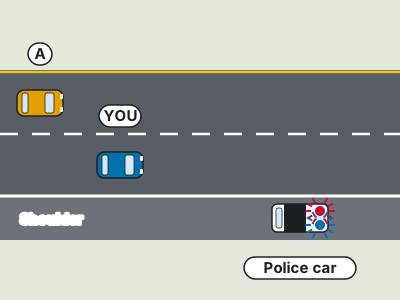
- Pass in the lane closest to it at the posted speed
- Use the lane opposite the emergency vehicle if safe
- Stop in the travel lane until the lights turn off
- Turn around before reaching the scene
12. How close must a train be for an Alaska driver to be prepared to stop at a crossbuck crossing?
- Within 100 feet
- Within one mile
- Only when the train is at the crossing
- Within 1,500 feet of the crossing
13. A 19-year-old in Alaska uses a fake driver's license to buy alcohol for the first time. What can DMV do?
- Revoke the driving privilege for 60 days
- Nothing, it is only a store matter
- Revoke for 5 years
- Issue a warning letter
14. For a driver age 21 or older operating a noncommercial vehicle in Alaska, what is the lowest BAC covered by the general alcohol per se threshold?
- .02 or more
- .08 or more
- .04 or more in every vehicle
- .12 or more
15. If every bulb in an Alaska traffic signal is out and no person directs traffic, what must a driver do?
- Yield only to traffic approaching from the left
- Treat the intersection as an uncontrolled free passage
- Stop, yield to traffic approaching from the right, and proceed only when safe
- Wait in place until a bulb begins working again
16. When parking downhill beside a curb in Alaska, which way should the front wheels point?
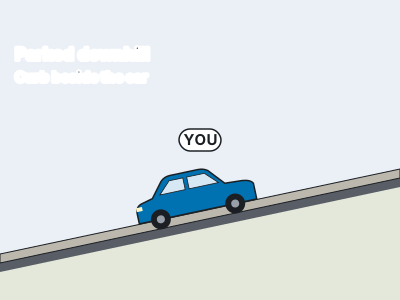
- Straight ahead regardless of the slope
- Away from the curb
- Toward the curb
- Toward the centerline
17. Under Alaska's ignition interlock chart, how long must a driver with a second DUI or Refusal conviction keep the device installed?
- 6 months
- 12 months
- 18 months
- 30 months
18. After entering an Alaska roundabout, what should a driver do while traveling inside the circle?
- Stop in the circle whenever another vehicle approaches
- Continue through without stopping and follow lane directions
- Reverse toward the previous entrance if the exit is missed
- Drive clockwise around the center island
19. What does a steady red X mean above a reversible lane?
- Do not use the lane
- Travel in the lane is permitted
- Clear the lane because a green arrow is next
- Use the lane only to pass
20. After a full stop at a red traffic signal, when may a driver make a right turn?
- Whenever the vehicle reaches the crosswalk
- When the turn is safe and no No turn on red sign restricts it
- Only after waiting for three light cycles
- Even if pedestrians or cross traffic make it unsafe
Answer key
- 1. C
- 2. A
- 3. A
- 4. D
- 5. A
- 6. C
- 7. D
- 8. A
- 9. C
- 10. D
- 11. B
- 12. D
- 13. A
- 14. B
- 15. C
- 16. C
- 17. B
- 18. B
- 19. A
- 20. B