
Test 22 of 25 · 20 questions · Free 2026
AK Permit Practice Test 22
Jump to the test ↓A fixed 20 question set from the Alaska bank with answers and plain English explanations. The real AK exam is 20 questions, 80 percent to pass; take the full length version on the main practice page.
Question 1 of 20 · 0 right so far
All 20 questions in test 22
Every question below comes from the Alaska question bank on this page. Open a question to see the correct answer and the explanation. Nothing here is hidden behind a signup.
1. In Alaska, alcohol is classified as what kind of drug, and what does it do to reflexes and alertness?
- A depressant that slows reflexes, reduces alertness, and impairs vision
- A stimulant that sharpens physical reflexes and improves fitness for driving tasks
- A neutral refreshment with no measurable effect on alertness or driving vision
- A pain relieving drink that improves the quality of driving judgment itself
Show answer
A depressant that slows reflexes, reduces alertness, and impairs vision. The lift a drinker feels is judgment loosening, not ability rising, because alcohol depresses the nervous system that driving depends on. Reflexes slow, alertness dulls, vision narrows and blurs, and judgment about all three failures fades with them. Reading alcohol as a stimulant, a neutral refreshment, or a helpful reliever reverses its pharmacology and invites driving at the moment ability collapses. Remember the class whenever a drink feels energizing: the depressant is working, and the confidence it lends is borrowed from the impairment itself.
Study this in the handbook: Alcohol, implied consent and under 21 rules
2. A crash leaves your vehicle burning with you belted inside in Alaska. How does the belt raise your survival chance?
- You stay conscious and therefore able to escape the vehicle
- The belt holds you away from every flame path inside the cabin
- The belt releases automatically when cabin heat reaches danger
- You remain asleep safely until rescuers cut the belt free
Show answer
You stay conscious and therefore able to escape the vehicle. Fire and water kill occupants who are knocked unconscious and cannot free themselves. A belt prevents the head strikes that cause that unconsciousness, leaving you awake to release the buckle and escape a burning or sinking vehicle. The belt does not deflect flames, release itself with heat, or make waiting for rescue the safer plan. Wear it on every trip, and know your buckle by touch so darkness, smoke, or water cannot delay your exit.
Study this in the handbook: Safety belts and child seats
3. In Alaska, you are ready to return from the shoulder to the pavement. When and how should you return?
- At once before following traffic notices you
- At highway speed to match the traffic flow
- Only when no cars are nearby, turning back at slow speed
- By cutting sharply across the edge at an angle
Show answer
Only when no cars are nearby, turning back at slow speed. The pavement edge is a step your tires must climb, and climbing it fast or at a sharp angle can wrench the wheel and throw the vehicle across the lane. Waiting until the nearby lane stands empty and turning back slowly lets that climb happen without an audience to strike. Hurry, highway pace, and sharp angles each convert a recovered drift into a second emergency. Signal when appropriate, confirm the gap in mirrors and by turning your head, and roll up onto the surface gently enough to correct any pull.
Study this in the handbook: School buses, passing and railroad crossings
4. No traffic opposes you on a dark rural Alaska road where animals cross at night. How should speed and beams be set?
- Keep highway speed because high beams alone reveal animals early
- Use low beams so roadside reflectors do not distract you
- Reduce speed and use high beams when possible for animal safety
- Alternate high and low beams every few seconds to scan the brush
Show answer
Reduce speed and use high beams when possible for animal safety. Darkness shortens reaction distance while animals appear first as dim shapes at the road edge. Reducing speed and using high beams when no opposing traffic suffers stretches both the view and the stopping margin. High beams at full highway speed can still outrun their own light, and low beams surrender distance you own. Set a pace you can stop within the lit area, and dip beams the moment another driver approaches.
Study this in the handbook: Night driving, lighting, weather and animals
5. A moose bolts onto the road directly ahead of your vehicle in Alaska with no room to stop gently. What does the manual direct?
- Swerve sharply toward the shoulder to miss the animal
- Aim for the ditch if the shoulder looks soft or narrow
- Leave your lane for the opposing side when it looks empty
- Brake firmly but do not swerve from your lane
Show answer
Brake firmly but do not swerve from your lane. A moose stands taller and heavier than a deer, yet swerving remains the deadlier choice because it can roll the vehicle, strike trees, or meet opposing traffic. Firm braking in your lane scrubs the most speed while keeping control for whatever contact remains. Ditches and the far lane multiply hazards instead of removing the animal. Brake hard and straight, brace for the stop you can achieve, and steer only at low speed when a clear escape truly exists.
Study this in the handbook: Night driving, lighting, weather and animals
6. Outside Alaska city limits, you park beside a roadway. Where must all four wheels rest if possible?
- On the pavement edge line
- Half on pavement and half off
- On the paved shoulder travel line
- Off the pavement
Show answer
Off the pavement. Beyond city limits traffic passes at higher speed with less street lighting, so a parked vehicle belongs fully clear of the traveled pavement whenever the ground allows it. Half measures leave tires and bodywork where a drifting or passing vehicle will travel. Edge lines and shoulder paint mark boundaries rather than parking stalls. Pull fully onto firm ground, set the vehicle parallel to the road, and check that mirrors and corners clear the lane before you leave it standing.
7. In Alaska, your vehicle breaks down beside a highway. Besides moving off the road, which warning devices should you set out if you have them?
- Only the vehicle parking lights, with no devices placed on the road at all beside it
- Headlights left on high beam to mark the vehicle to traffic
- Flares or warning triangles placed to warn traffic
- A single flashing beacon mounted on the vehicle roof
Show answer
Flares or warning triangles placed to warn traffic. A disabled vehicle beside a fast road must announce itself well before drivers reach it, and flares or warning triangles set out on the road carry that announcement farther than lamps on the vehicle alone. Place them where approaching drivers can see and react, without walking into traffic to position them. The vehicle itself should sit with all wheels off the traveled portion when possible, with parking lights or four way flashers at night and the hood raised if it cannot be moved. Warnings buy the time that help needs to arrive safely.
Study this in the handbook: Vehicle emergencies, skids and stalls on the tracks
8. In Alaska, you stop for a protected route where an unmarked crosswalk crosses your path. Where must you stop?
- On top of the unmarked crosswalk to see traffic better in both directions
- In advance of the unmarked crosswalk when a stop is needed
- Past the crosswalk once your front bumper clears it
- Anywhere in the crosswalk when no paint is visible
Show answer
In advance of the unmarked crosswalk when a stop is needed. An unmarked crosswalk still carries pedestrians across your path, even without paint to outline it. When a stop is needed before a protected route, the vehicle belongs short of that crossing space so people can pass in front without stepping around your bumper. Rolling onto the crossing for a better view uses the pedestrian space as your lookout point. Hold the earlier stopping place, scan for people on foot from both curbs, and creep forward only after the crossing is clear and the route can be entered safely.
Study this in the handbook: Intersections, right of way and roundabouts
9. You drive on an unposted street through an Alaska shopping and office area under good conditions. What legal maximum applies?
- 15 mph in that business district
- 20 mph in that business district
- 25 mph in that business district
- 55 mph in that business district
Show answer
20 mph in that business district. Unposted limits change with the kind of district the road serves, and streets lined with shops and offices form a business district where the maximum under favorable conditions is the lower urban figure. Alleys sit lower still, residential streets sit a step higher, and open roadways outside those districts carry the highway figure. Posted signs replace these defaults wherever they appear. Learn the district around you from buildings and land use, and set speed by that district before a posted sign reminds you.
Study this in the handbook: Speed laws and impact
10. Your one way street is about to end and a warning sign shows arrows passing each other in opposite directions. What changes ahead?
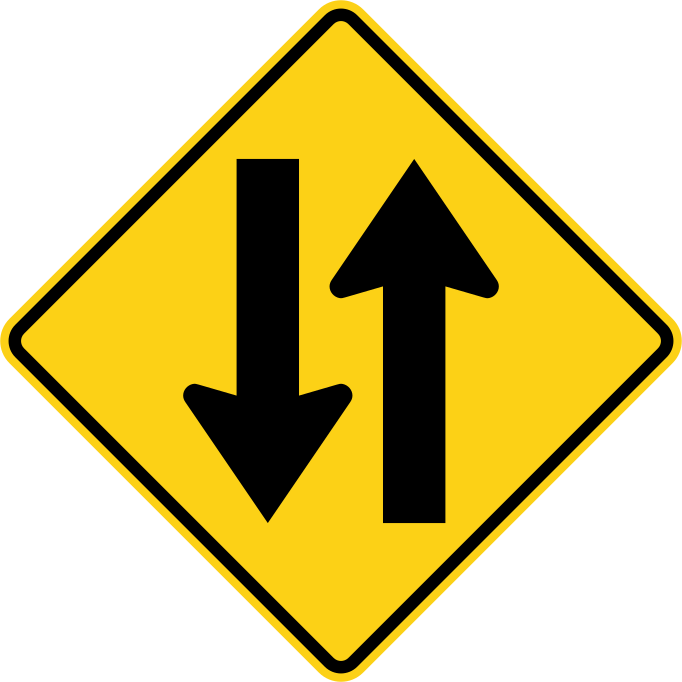
- The two way road begins, so keep right of approaching traffic
- A divided highway begins and opposing traffic moves behind a median
- Your lane becomes reversible and follows overhead lane signals
- A roundabout begins and all traffic circles in one direction
Show answer
The two way road begins, so keep right of approaching traffic. When one way operation ends, opposing vehicles suddenly share your roadway without a median. The opposing arrows warn you to settle on the right side and expect headlights in the lane that used to belong to your direction. A divided highway, a reversible lane, and a roundabout each announce themselves differently. Move right early, watch for drivers who missed the change, and give extra room at crests and curves where the opposing stream first appears.
Study this in the handbook: Road signs by color and shape
11. In Alaska, a 20 year old drinks one beer at a party. What does state law say about that drinking itself?
- It is legal when a parent bought the beer
- It is illegal for a person under 21 to consume alcohol
- It is legal below the adult driving limit
- It becomes legal inside a private home party
Show answer
It is illegal for a person under 21 to consume alcohol. The drinking age draws its line at the act of consumption, not merely at driving afterward, so a single beer at twenty breaks the law before any vehicle is approached. Parental supply, blood alcohol comparisons, and party walls do not move that line. For the young driver the rule stacks cleanly with the operating ban: any consumption is unlawful, and operating after any amount invites arrest or citation on top of it. The only compliant count for a driver under twenty one, at a party or anywhere else, is zero drinks.
Study this in the handbook: Alcohol, implied consent and under 21 rules
12. Your friend rides a bicycle through Alaska intersections beside your car on a shared evening route. What controls must the rider obey?
- Only stop signs, because signals apply solely to motor vehicles
- Traffic signs, signals, and all other traffic laws while riding
- No controls where a shoulder gives the bicycle separate space
- Driver instructions shouted from vehicles pacing the bicycle
Show answer
Traffic signs, signals, and all other traffic laws while riding. A bicycle on the road is a vehicle under traffic law, owing obedience to signs, signals, and the same rules that govern drivers. Shoulders and quiet streets do not carve out exceptions, and pacing drivers cannot direct a rider through controls. Drivers should therefore expect lawful rider behavior and still leave margin for mistakes. Riders who run controls endanger themselves most, so predictability on both sides keeps shared streets survivable.
13. In Alaska, you turn left from a two way street onto a one way street. Into which lane must you turn?
- Into the farthest lane of the one way street
- Into any lane that happens to be empty
- Sharply into the first lane of the one way street
- Across all lanes to the right curb lane
Show answer
Sharply into the first lane of the one way street. A left turn onto a one way street ends at its near edge, in the first lane your vehicle reaches, because every lane beyond that belongs to traffic already flowing on the new street. Swinging wide to a far or merely empty lane crosses those flows without need, and aiming for the right curb multiplies the crossing. Turn sharply once the crosswalk is reached and your yield is complete, settle into that first lane, and change lanes later only with the usual checks and signal.
14. You begin passing a vehicle whose driver seems unaware of you on an Alaska two lane road. What warning must you give?
- Flash your high beams repeatedly until the driver moves right
- Sound your horn only after you are fully beside that driver
- Tap your brakes so your lights warn the driver behind instead
- Honk to alert that driver before you pull out to pass
Show answer
Honk to alert that driver before you pull out to pass. A driver who does not know you are passing may drift left, speed up, or turn across your path. The horn, sounded as you begin, announces the intention while there is still time for that driver to hold course and speed. Waiting until alongside wastes the warning, flashing beams send an unclear message, and brake lights address the wrong audience. Warn early, confirm the driver holds steady, and complete the pass without lingering beside the vehicle.
Study this in the handbook: School buses, passing and railroad crossings
15. In Alaska winter driving, which surfaces turn slippery earliest and stay slippery longest?
- Sunlit straightaways in mid afternoon
- Gravel shoulders beside plowed highways in winter
- Heated parking garage ramps at noon
- Shaded areas, protected areas, and bridges
Show answer
Shaded areas, protected areas, and bridges. Sunshine thaws what it touches and leaves what it misses, so shade, sheltered pockets, and bridge decks that lose heat from below all carry ice while open pavement reads dry. Those surfaces also surrender their ice last as conditions improve. Mid afternoon sunlit road, gravel shoulders, and garage ramps do not lead the icing order. On any cold drive, treat every shaded curve and bridge as ice until your tires gently prove otherwise, and cross each with speed already shed and steering held steady.
Study this in the handbook: Vehicle emergencies, skids and stalls on the tracks
16. In Alaska, you turn left from one one way street onto another one way street. Where does the turn end?
- Sharply into the first lane on the left side of the new street
- Into the rightmost travel lane on the far side of the new one way street
- Into the very center of the intersection box to pause and reassess traffic
- Completely across the new street to rest against its far side curb line
Show answer
Sharply into the first lane on the left side of the new street. When both streets run one way, the left turn is a compact corner from the left lane of the old street to the first lane on the left side of the new one. That tight finish keeps you out of lanes that traffic on the new street is already using. Drifting to the right side, pausing in the middle, or sweeping to the far curb each expands the conflict without benefit. Signal the approach, scan the left window path for pedestrians, and turn sharply into that near left lane.
17. In Alaska, when do most collisions between vehicles and moose occur?
- At dawn and dusk when light is low and moose are most active
- At midday when moose rest beside highways
- Only during winter blizzards on rural roads
- At noon in summer on city streets
Show answer
At dawn and dusk when light is low and moose are most active. Moose stand dark against dark shoulders, and the hours when they move most are the same hours when driver eyes work worst. That overlap puts most vehicle and moose collisions at dawn and dusk in low light. Midday, blizzard only, and city noon readings each miss the pattern that should shape your schedule and speed. Keep headlights and windshields clean, use high beams where lawful at night, and treat every dim roadside shape in those hours as a moose until it proves otherwise.
Study this in the handbook: Night driving, lighting, weather and animals
18. What colors does Alaska use for regulatory signs that state an instruction drivers must obey?
- Black lettering on a yellow background
- Black or red lettering on a white background
- White lettering on a green background
- Black lettering on an orange background
Show answer
Black or red lettering on a white background. Instructions that carry the force of law appear with black or red lettering over white. Stop, yield, speed limit, and lane use orders use this family of signing. Yellow with black lettering warns, green with white lettering guides, and orange with black lettering covers work areas. When you see white behind black or red words or symbols, treat the message as an order: understand it early and follow it without waiting for traffic around you to react first.
Study this in the handbook: Road signs by color and shape
19. In Alaska, a solid white line marks the outside edge of the pavement. What should you do about your lane?
- Drive with one wheel over the edge line to see better around curves
- Leave the lane whenever the shoulder looks clear
- Drive within a lane and move from it only when it is safe
- Use the shoulder as a travel lane in heavy traffic
Show answer
Drive within a lane and move from it only when it is safe. An outside edge line shows where the traveled pavement ends and the shoulder begins. The driving duty is to stay within a lane and leave it only when that move can be made safely, such as for a proper stop clear of traffic. Riding the line for a better view wears the edge and risks a drop off, and a clear looking shoulder never becomes a travel lane for beating congestion. Keep tires inside the line and treat any exit from the lane as a deliberate, checked maneuver.
Study this in the handbook: Turn signals and pavement markings
20. In Alaska, a single flashing red beacon hangs over the roadway above a stop sign. What is its job?
- To replace the sign so no stop is required
- To mark an intersection where the stop is camera enforced
- To allow rolling stops at that sign
- To supplement the sign where special emphasis is needed
Show answer
To supplement the sign where special emphasis is needed. A flashing red beacon placed over a roadway or above a sign adds emphasis where a plain sign might be missed. It supports the sign instead of replacing it, so the stop duty at a stop sign remains in full force. Nothing in its job announces removal of the sign, and rolling through the stop is the opposite of the emphasis intended. Treat beacon and sign together: stop fully, look in all directions, and proceed only when the way is safe.
Study this in the handbook: Traffic signals and lane control signals
Every question is written from the official Alaska Driver Manual. Need paper? Printable AK practice test with answer key.
Last verified 2026-10-05. How we check every question · Study all 500 as flashcards
Frequently asked questions
How many questions are on this Alaska practice test?
This fixed set has 20 questions. It is test 22 of 25 from the 500 question Alaska bank. The real AK exam asks 20 questions and you need 16 correct.
What is the passing score for the real Alaska test?
16 correct answers to pass (80%) That figure comes from the official Alaska source cited on the DMV facts page.
How does this fixed test relate to the full Alaska bank?
Each numbered test is a fixed set of questions in a fixed order, so you can retake the same test later and compare. Every test mixes road signs and the other topics in about the same proportion as the full bank. Tests 1 to 25 together cover every question in the Alaska bank once. The full practice page mixes the whole bank at random.
Last verified 2026-10-05. See the Alaska DMV facts page for sourced state details.