
Test 4 of 10 · 20 questions · Free 2026
AK Permit Practice Test 4
Jump to the test ↓A fixed 20 question set from the Alaska bank with answers and plain English explanations. The real AK exam is 20 questions, 80 percent to pass; take the full length version on the main practice page.
Question 1 of 20 · 0 right so far
All 20 questions in test 4
Every question below comes from the Alaska question bank on this page. Open a question to see the correct answer and the explanation. Nothing here is hidden behind a signup.
1. After a lawful DUI arrest in Alaska, what can result from refusing a chemical test?
- Automatic dismissal of the DUI arrest
- A warning with no separate legal consequence
- Only a parking citation
- Separate DUI and Refusal criminal charges
Show answer
Separate DUI and Refusal criminal charges. Alaska's implied consent material warns that refusing chemical testing after a lawful DUI arrest can produce two criminal charges, DUI and Refusal, handled separately by the court. Refusal does not erase the original arrest or guarantee a warning. The state can also pursue an administrative license action apart from the court case. The practical cue is that a test refusal creates an additional legal problem, rather than serving as a way to avoid the alcohol investigation.
Study this in the handbook: Alcohol, implied consent and under 21 rules
2. For a driver age 21 or older operating a noncommercial vehicle in Alaska, what is the lowest BAC covered by the general alcohol per se threshold?
- .02 or more
- .08 or more
- .04 or more in every vehicle
- .12 or more
Show answer
.08 or more. Alaska states that a breath or blood alcohol concentration of .08 or more creates a legal presumption that the person was driving under the influence. That threshold is not .02, and the .04 figure is associated with operating a commercial motor vehicle rather than every driver. Administrative revocation can follow even if the related criminal charge is later dismissed or the person is found not guilty. Remember .08 as the adult motor vehicle threshold in this section.
Study this in the handbook: Alcohol, implied consent and under 21 rules
3. A 6-year-old Alaska child is 48 inches tall and weighs 45 pounds. How must the child be secured?
- In a seat belt only
- In a rear-facing seat
- In a booster seat secured by a seat belt system or other approved restraint
- No restraint is required after age 5
Show answer
In a booster seat secured by a seat belt system or other approved restraint. A child over four and under eight who is less than 57 inches tall and weighs 20 or more but less than 65 pounds must be secured in a booster seat held by a seat belt system, or in another restraint that meets federal standards. This child fits all those limits. Rear-facing seats are for children under one or under 20 pounds. A child over four who exceeds the height or weight limits uses a seat belt, and restraint does not stop at age 5.
Study this in the handbook: Safety belts and child seats
4. What kinds of services may be shown by white-on-blue service signs?
- School areas and school crosswalks
- Gas, phone, food, lodging, rest areas, or campgrounds
- Route restrictions backed by traffic law
- Temporary work zones and lane shifts
Show answer
Gas, phone, food, lodging, rest areas, or campgrounds. White-on-blue service signs mark conveniences such as gas, phone, food, lodging, rest areas, campgrounds, and litter barrels. The school choice belongs to school signs, legal restrictions belong to regulatory signs, and temporary lane shifts belong to construction and maintenance signs. These signs help with trip planning rather than directing an immediate maneuver. Use the service symbol and any distance information to decide where to stop, while continuing to obey the roadway controls and watching traffic instead of braking suddenly at the sign.
Study this in the handbook: Road signs by color and shape
5. What do black-on-orange construction and maintenance signs indicate?
- A school crosswalk with a reduced-speed requirement
- A permanent destination and mileage information
- A nearby fuel, food, or lodging service
- Road work or temporary conditions needing special alertness
Show answer
Road work or temporary conditions needing special alertness. Black-on-orange construction and maintenance signs identify road work and temporary conditions that require special alertness. The permanent destination choice describes guide signs, the service choice describes white-on-blue service signs, and the school choice describes a different warning shape and purpose. When orange appears, reduce speed as needed, watch for workers, equipment, lane shifts, and unusual traffic patterns, and prepare for conditions that may change quickly. The color is an advance cue to expect a temporary arrangement rather than a normal lane or shoulder.
Study this in the handbook: Road signs by color and shape
6. What point total triggers mandatory suspension or revocation under Alaska's general point rule?
- 12 points in 12 months or 18 points in 24 months
- 6 points in 12 months or 9 points in 24 months for every driver
- 10 points in 6 months or 20 points in 12 months
- 15 points in 12 months or 25 points in 24 months
Show answer
12 points in 12 months or 18 points in 24 months. Alaska's general point rule requires mandatory suspension or revocation after accumulating 12 points in 12 months or 18 points in 24 months. The 6 and 9 figures apply to a separate provisional-license driver-improvement requirement, not the general threshold for every driver. Count both the points and the time window, since a total that looks modest in one period can cross the rule in another. Keep track of convictions on the driving record and treat the halfway warning as a prompt to change behavior before the mandatory action level is reached.
Study this in the handbook: Vision, insurance and the point system
7. If a vehicle is stuck on railroad tracks and warning lights begin flashing, what should occupants do?
- Get out, move away from the tracks and vehicle toward the approaching train, then call 911
- Stay inside with the doors locked
- Drive toward the crossing gate and wait
- Run along the tracks away from the approaching train
Show answer
Get out, move away from the tracks and vehicle toward the approaching train, then call 911. When warning lights begin flashing while a vehicle is on the tracks, occupants should get out immediately. Once outside, the manual directs them to run away from both the tracks and the vehicle in the direction the train is coming, then dial 911 once clear. Staying inside or waiting at the gate leaves people in the impact area. Running along the tracks away from the train reverses the direction the manual gives. The emergency cue is immediate escape, followed by the call for help.
Study this in the handbook: Vehicle emergencies, skids and stalls on the tracks
8. How many points does an Alaska reckless driving conviction add?
- 2
- 4
- 6
- 10
Show answer
10. Alaska assigns 10 points for reckless driving, the top of the 2 to 10 point range, the same as DUI, driving while suspended, refusing a breath sample, eluding police, and racing. Six points go to offenses such as negligent driving or failing to stop for a school bus, 4 to careless driving or following too close, and 2 to other moving violations. One reckless conviction alone nearly reaches the 12 points in 12 months suspension threshold.
9. What driving experience must be certified before an Alaska minor receives a first provisional license?
- 20 total hours, including 5 at night
- 30 total hours, including 10 on highways
- 50 total hours, all after dark
- 40 total hours, including 10 in progressively challenging conditions
Show answer
40 total hours, including 10 in progressively challenging conditions. For a first license before age 18, the parent, guardian, or employer must certify at least 40 hours of driving, including at least 10 hours in progressively challenging conditions. Night driving and inclement weather are examples, not a requirement that every hour occur after dark. The 20, 30, and 50 hour figures are not the manual's threshold. Pair the total with the embedded challenging-condition minimum, and remember that a valid permit for six months and a clean recent traffic record are separate prerequisites.
Study this in the handbook: Instruction permits and provisional licenses
10. What administrative revocation period applies to a first under 21 alcohol operating offense in Alaska?
- 15 days
- 60 days
- 30 days
- 90 days
Show answer
30 days. A first under 21 offense involving operating after consuming alcohol or refusing the chemical test brings a 30 day administrative revocation. Sixty days applies when the person has previously been revoked for this offense, and 90 days applies after two previous revocations. The period is an administrative action and can occur even if the criminal citation is dismissed or the person is found not guilty in court. Track the number of prior revocations, not merely the person's age, when selecting the duration.
Study this in the handbook: Alcohol, implied consent and under 21 rules
11. What danger does the round railroad warning sign identify?

- A bicycle route crossing the next lane
- A circular intersection where entering traffic has priority
- A railroad crossing ahead where the driver should prepare to stop
- A no-passing zone that ends at the next mile marker
Show answer
A railroad crossing ahead where the driver should prepare to stop. The round railroad warning sign marks an upcoming crossing, giving the driver time to reduce speed and assess the tracks. It is not a roundabout sign, a bicycle warning, or a generic passing restriction. Approaching traffic may need to stop for a train even when the crossing equipment is not immediately visible. Treat the advance warning as an early planning cue: check the space beyond the rails, listen, and avoid entering unless the vehicle can fully clear the crossing.
Study this in the handbook: School buses, passing and railroad crossings
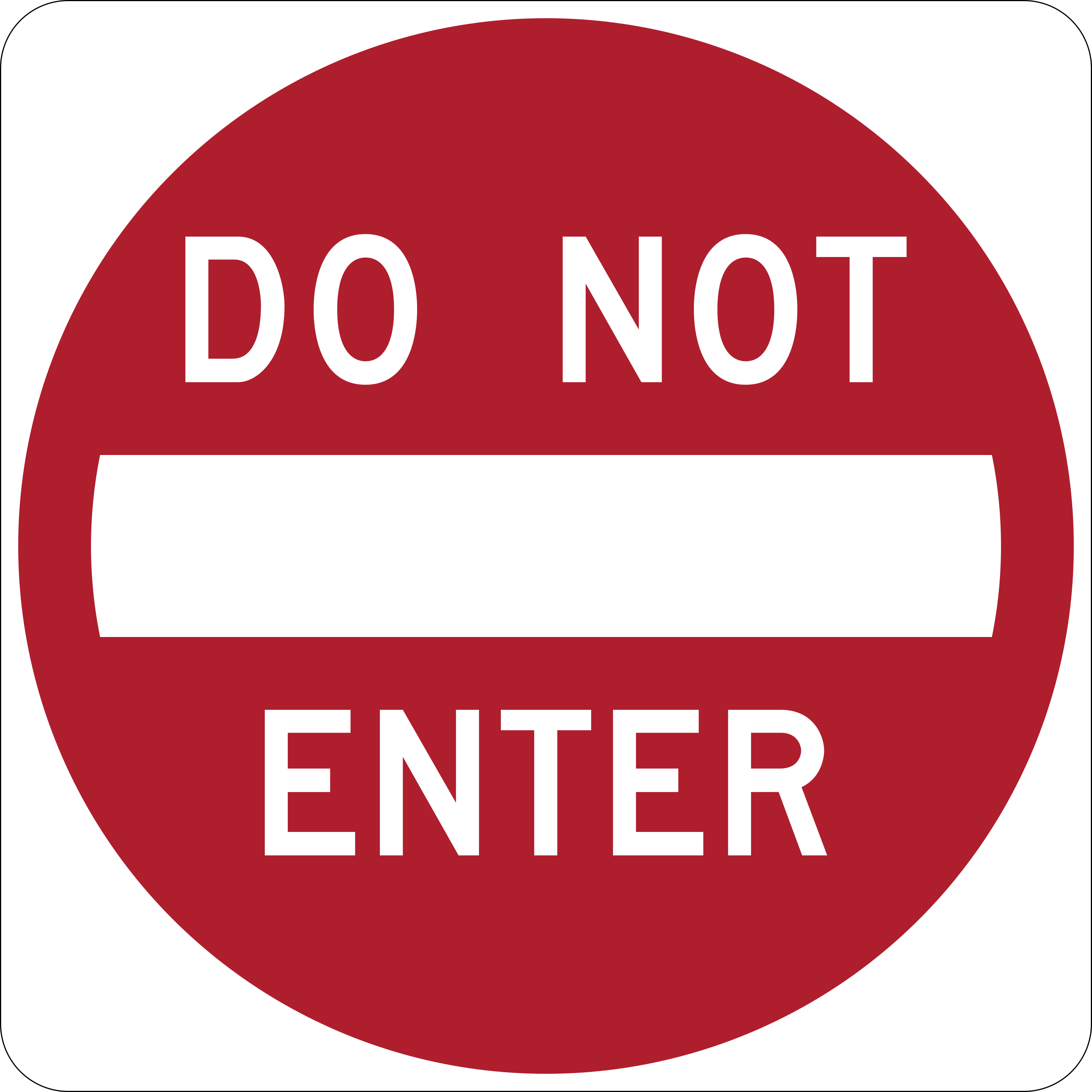
12. What action is required when a Do Not Enter sign faces your traffic?
- Turn around after passing the next intersection
- Proceed slowly after checking the shoulder
- Enter only if the roadway appears empty
- Do not proceed beyond the sign
Show answer
Do not proceed beyond the sign. A Do Not Enter sign faces traffic that is entering a roadway or ramp in the wrong direction. The driver must stop the intended movement and avoid going beyond the sign. The choice allowing entry when the road looks empty is dangerous because the sign addresses direction of travel, not whether another vehicle is visible. A wrong-way ramp can have hidden or fast-moving traffic, and an additional Wrong Way sign may appear farther along. Treat the red and white message as an immediate direction cue: do not enter, and find a legal route away from the prohibited path.
Study this in the handbook: Road signs by color and shape
13. An Alaska driver reaches the point total that requires a suspension. Can a limited work purpose license be issued?
- Yes, for work only
- Yes, if the driver takes a class
- No, no limited work purpose license is available
- Only for drivers over 21
Show answer
No, no limited work purpose license is available. Alaska's point law states that no limited work purpose license is available when a point suspension or revocation is required, and the suspension applies regardless of the hardships involved. Taking a class or being over 21 does not change that. The same no work privilege rule applies during a revocation for refusing chemical testing. Drivers get a warning letter at the halfway mark and can earn credits for violation free driving or a defensive driving course.
Study this in the handbook: Vision, insurance and the point system
14. What do dashed yellow pavement markings indicate on a two lane, two way roadway?
- Passing is permitted when it is otherwise safe
- Passing is prohibited in both directions
- Traffic travels in the same direction only
- The center lane is reserved for left turns
Show answer
Passing is permitted when it is otherwise safe. Dashed yellow lines separate opposing traffic and indicate where passing is permitted on a two lane, two way roadway. Permission to pass still depends on visibility, traffic, and the other safety rules governing a pass. Solid yellow center lines prohibit passing, while white lines separate lanes traveling in the same direction. The reserved center lane choice describes a different marking and roadway arrangement. Identify both the color and the pattern before interpreting a pavement line, because changing either changes its meaning.
Study this in the handbook: Turn signals and pavement markings
15. What should a driver do when a vehicle cannot be moved off the roadway after a breakdown?
- Leave the vehicle dark and remain in the travel lane
- Raise the hood to warn other motorists
- Stand behind the vehicle to direct traffic
- Continue driving until the vehicle repairs itself
Show answer
Raise the hood to warn other motorists. For a disabled vehicle, the manual says to park all four wheels off the traveled portion when possible and use parking lights or four-way flashers at night. If the vehicle cannot be moved off the roadway, raising the hood warns other motorists. Standing in the lane adds a person to the hazard, while continuing to drive a failed vehicle can worsen the emergency. Move clear of traffic when safe, make the vehicle conspicuous, and seek help without creating a second collision risk.
Study this in the handbook: Vehicle emergencies, skids and stalls on the tracks
16. If speed increases from 20 to 40 mph, how does Alaska's manual describe the change in impact and braking distance?
- Impact rises three times but braking distance stays the same
- Both are twice as great
- Both are four times greater
- Neither changes if the road is dry
Show answer
Both are four times greater. The manual explains that doubling speed from 20 to 40 mph makes impact and braking distance four times greater, not merely twice as great. Dry pavement does not cancel the effect of speed, and braking distance does not stay constant. The relationship becomes even more severe at higher speeds, so a small increase can have a large consequence. Use the square relationship as the study cue: double the speed, and the stated impact and braking distance multiply by four.
Study this in the handbook: Speed laws and impact
17. What minimum tread depth does the Alaska manual require, and how can a penny check it?
- At least 2/32 inch, the distance from a penny's edge to the top of Lincoln's head
- At least 6/32 inch
- At least 1/32 inch
- Any visible tread
Show answer
At least 2/32 inch, the distance from a penny's edge to the top of Lincoln's head. Tires must have at least 2/32 inch of tread depth, and the distance between the edge of a penny and the top of Lincoln's head is about 2/32 of an inch, so if you slide a penny into a groove and can see the top of his head, the tires are worn out. Proper rotation can add as much as 10,000 miles to a set of tires, and proper tire pressure is safer and extends tire life.
Study this in the handbook: Required equipment and maintenance
18. What does a 15 pound infant effectively weigh in a 30 mph collision, according to the Alaska manual?
- 30 pounds
- 450 pounds
- 15 pounds, weight does not change
- 100 pounds
Show answer
450 pounds. A 15 pound infant will suddenly weigh 450 pounds because of the forces unleashed in just a 30 mph collision, far more than any adult can hold. That is why children must ride in a properly secured child seat, rear facing as long as the seat allows, and why all children under 13 belong in the rear seat. Arms are not restraints.
Study this in the handbook: Safety belts and child seats
19. What does a dashed pavement line indicate?
- The line is permissive
- The line is always prohibitive
- The shoulder must be used for passing
- The roadway is closed ahead
Show answer
The line is permissive. The Alaska manual describes dashed pavement lines as permissive. That means a driver may cross or use the marking when the specific roadway situation and other rules allow it. A dashed line is not automatically a prohibition, and it does not direct drivers onto the shoulder or announce a closure. Read dashed and solid markings together with their color, because yellow and white lines communicate different traffic relationships.
Study this in the handbook: Turn signals and pavement markings
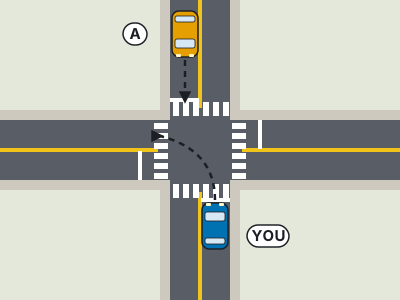
20. Before entering an intersection to make a left turn, what does the Alaska manual say to do?
- Enter immediately when the turn signal is on
- Wait for oncoming vehicles before entering the intersection
- Proceed past the center of the intersection while waiting
- Look only behind the vehicle before turning
Show answer
Wait for oncoming vehicles before entering the intersection. The left-turn guidance says to wait for oncoming vehicles before entering the intersection and not proceed past the center while waiting. A turn signal communicates the intended maneuver but does not remove the need to yield. Moving immediately or crossing the center early can place the turning vehicle in the path of oncoming traffic. Before turning, keep the vehicle positioned safely, watch the opposing approach, and check the turn path for pedestrians before completing the maneuver.
QualitySpace is expanding to Alaska
We are a California-based independent insurance brokerage working on licensing in more states. We cannot help with Alaska insurance yet. Leave your email and we will let you know when we can.
Every question is written from the official Alaska Driver Manual. Need paper? Printable AK practice test with answer key.
Last verified 2026-10-05. How we check every question · Study all 201 as flashcards
Frequently asked questions
How many questions are on this Alaska practice test?
This fixed set has 20 questions. It is test 4 of 10 from the 201 question Alaska bank. The real AK exam asks 20 questions and you need 16 correct.
What is the passing score for the real Alaska test?
16 correct answers to pass (80%) That figure comes from the official Alaska source cited on the DMV facts page.
How does this fixed test relate to the full Alaska bank?
Each numbered test is a fixed set of questions in a fixed order, so you can retake the same test later and compare. Every test mixes road signs and the other topics in about the same proportion as the full bank. Tests 1 to 10 together cover 200 of the 201 questions in the Alaska bank, each once. The full practice page mixes the whole bank at random.
Last verified 2026-10-05. See the Alaska DMV facts page for sourced state details.