
Key points
In 72 percent of fatal car and tractor trailer crashes, the car is usually at fault.
Source: Handbook p. 64
“72 percent of fatal crashes involving two or more vehicles, in which one of the vehicles is a tractor-trailer, the cause is usually attributed to a car.”
Arkansas Driver License Study Guide, Handbook p. 64A car at 55 mph stops in about 225 feet; a loaded tractor trailer may need more than 335 feet.
Source: Handbook p. 64
“The average passenger car traveling at 55 miles per hour can stop in about 225 feet. A fully loaded tractor-trailer traveling at 55 miles per hour may take more than 335 feet”
Arkansas Driver License Study Guide, Handbook p. 64A truck's blind spots reach up to 20 feet in front and up to 200 feet behind.
Source: Handbook p. 65
“A car can disappear; up to 20 feet in front of the cab, on either side of the tractor-trailer (particularly alongside the cab), and up to 200 feet in the rear of the truck.”
Arkansas Driver License Study Guide, Handbook p. 65If you cannot see the truck driver in the side mirror, the driver cannot see you.
Source: Handbook p. 66
“if you can’t see the truck driver in the tractor side mirror, the driver can’t see you.”
Arkansas Driver License Study Guide, Handbook p. 66Nearly 60% of motorcycle crashes at intersections were caused by vehicles turning left in front of the rider.
Source: Handbook p. 69
“Nearly 60% of those crashes were caused by the other vehicles turning left in front of the motorcyclist.”
Arkansas Driver License Study Guide, Handbook p. 69Follow a motorcycle by at least 4 to 6 seconds.
Source: Handbook p. 70
“Allow more following distance, at least four (4) to six (6) seconds, when following a motorcycle”
Arkansas Driver License Study Guide, Handbook p. 70Never pass between a bicyclist and oncoming vehicles on a two lane road.
Source: Handbook p. 67
“A driver should never attempt to pass between a bicyclist and oncoming vehicles on a two-lane road.”
Arkansas Driver License Study Guide, Handbook p. 67A red or orange flag on a bicycle means the rider may have impaired hearing; slow down.
Source: Handbook p. 68
“If you see a bicyclist with a red or orange pennant flag attached to the bike, slow down; this is a symbol to indicate the rider has impaired hearing.”
Arkansas Driver License Study Guide, Handbook p. 68
Numbers to know
| Number | What it means | Manual |
|---|---|---|
| 72 percent | fatal car and truck crashes usually caused by the car | Handbook p. 64 |
| 55 mph / 225 feet / 335 feet | car and loaded truck stopping distances | Handbook p. 64 |
| 20 feet / 200 feet | truck blind spots in front and behind | Handbook p. 65 |
| 60% | intersection motorcycle crashes caused by left turning vehicles (nearly) | Handbook p. 69 |
| 4 to 6 seconds | following distance behind a motorcycle | Handbook p. 70 |
Recognize these signs
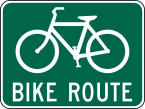
Bicycle route
3 questions from the Arkansas practice test
1. What causes nearly 60 percent of motorcycle crashes at intersections, according to the Arkansas guide?
- Other vehicles turning left in front of the motorcyclist
- Motorcycles running red lights
- Wet pavement
- Motorcycle brake failure
Show answer
Other vehicles turning left in front of the motorcyclist. Over 40 percent of all motorcycle crashes occur at intersections, and nearly 60 percent of those were caused by other vehicles turning left in front of the motorcyclist, a failure to yield right of way. Motorcycles are small and easy to miss in a quick look, and their speed is hard to judge. Before turning left, look again specifically for a motorcycle and wait.
2. In fatal crashes between a car and a tractor trailer, who is usually at fault, according to NHTSA figures in the Arkansas guide?
- The truck driver, in most cases
- Neither, usually weather
- Both equally
- The car, in 72 percent of such crashes
Show answer
The car, in 72 percent of such crashes. According to the National Highway Traffic Safety Administration, in 72 percent of fatal crashes involving two or more vehicles where one is a tractor trailer, the cause is usually attributed to a car. The guide lists common mistakes around trucks, such as cutting into the open space in front of a truck and lingering alongside one while passing. A fully loaded truck at 55 mph may need more than 335 feet to stop.
3. How far may a fully loaded tractor trailer at 55 mph need to stop, according to the Arkansas guide?
- More than 335 feet, the length of a football field
- About 100 feet
- About 225 feet
- About 50 feet
Show answer
More than 335 feet, the length of a football field. A fully loaded tractor trailer traveling at 55 mph may take more than 335 feet to come to a complete stop, the length of a football field, compared with about 225 feet for a car. That difference is why cutting in front of a truck and braking is so dangerous. Trucks also swing left before a right turn because the rear wheels follow a shorter path.
Practice this topic
Lock it in with safe driving questions from the free Arkansas practice test. Every answer comes with a plain English explanation.
Source: the Arkansas Driver License Study Guide, Chapters 6 and 7: Sharing the Road. This lesson is a plain English summary, not the law itself; where it differs, the manual and the statute govern. Last checked 2026-09-27.