
Test 7 of 10 · 20 questions · Free 2026
AR Permit Practice Test 7
Jump to the test ↓A fixed 20 question set from the Arkansas bank with answers and plain English explanations.
Question 1 of 20 · 0 right so far
All 20 questions in test 7
Every question below comes from the Arkansas question bank on this page. Open a question to see the correct answer and the explanation. Nothing here is hidden behind a signup.
1. At what age may an Arkansas applicant obtain a non-restricted Class D license?
- 21
- 14
- 16
- 18
Show answer
18. The manual sets 18 as the minimum age for a non-restricted license. Fourteen is the minimum age associated with a restricted license, while 16 describes another stage in the graduated system rather than the Class D threshold. The age 21 option is too high. When studying the stages, pair 14 with restricted eligibility and 18 with the non-restricted license to avoid swapping the two milestones.
Study this in the handbook: Who Needs a License and Vision Rules
2. What cell phone activity may an Arkansas Learner's License holder use while operating a motor vehicle?
- Talking or texting whenever the phone is hands-free
- Cell phone use only during an emergency
- Texting only at red lights
- Talking only when a licensed adult is beside the driver
Show answer
Cell phone use only during an emergency. The learner stage carries a narrow emergency exception. Ordinary conversation and text messages remain prohibited, even if the driver believes traffic is light or an adult is present. The hands-free option is not available under this learner rule, and stopping at a red light does not turn texting into permitted use. Remember the phrase emergency only, then apply it to both talking and texting. This restriction is part of the supervised period, not a general permission based on the phone method or roadway situation.
Study this in the handbook: Instruction Permits and Graduated Licenses
3. How close to a stop sign, traffic signal, or yield sign may you park in Arkansas?
- No closer than 15 feet
- No closer than 30 feet
- No closer than 50 feet
- No closer than 5 feet
Show answer
No closer than 30 feet. Arkansas prohibits parking within 30 feet of a traffic signal, stop sign, or yield sign, and the same 30 feet applies to a pedestrian safety zone. Fifteen feet is the fire hydrant distance, 50 feet is the railroad crossing distance, and 5 feet is too close. Parking near a sign can hide it from approaching drivers. You also may not park more than 18 inches from the curb.
Study this in the handbook: Parking Rules and Accessible Parking
4. An emergency vehicle approaches with flashing lights and a siren. What should you do?
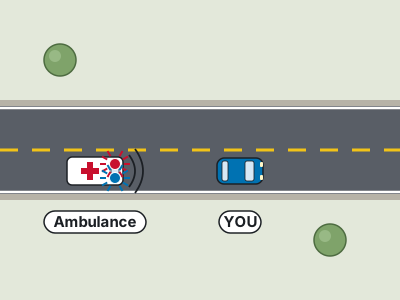
- Pull to the right edge, or as near to the right as possible
- Stop in the intersection where you first hear the siren
- Follow the emergency vehicle closely through traffic
- Move left and maintain your current speed
Show answer
Pull to the right edge, or as near to the right as possible. Arkansas directs a driver facing an approaching emergency vehicle with flashing lights and sirens to pull to the right edge of the road, or as near to the right as possible. Stopping in the intersection can block the emergency vehicle and create a second hazard. If you are already in an intersection, continue through it before pulling over. Watch and listen in every direction, because the emergency vehicle may be coming from behind, ahead, or across your path. The practical cue is siren or flashing light: make room promptly and remain stopped until it passes.
Study this in the handbook: Emergency Vehicles and the Move Over Law
5. What do signs posted in an Arkansas work zone warn drivers about?
- A permanent speed limit for the whole highway
- People working on or near the highway
- A hospital or other service nearby
- A destination on the route ahead
Show answer
People working on or near the highway. Signs in Arkansas work zones serve as a warning that people are working on or near the highway. They may be diamond or rectangular shaped, with an orange, white, or black background and white or black letters or symbols. They can warn of reduced speed, detours, slow moving construction equipment, and poor or suddenly changing road surfaces. Traffic may also be directed by a flagger holding a sign or flag, so slow down and follow every control through the area.
Study this in the handbook: Work Zones
6. On a multilane highway, you approach a stopped Arkansas DOT, utility, or towing vehicle with its lights on. What should you do?
- Keep the same lane and maintain normal speed
- Move to the farthest lane away whenever possible
- Stop beside the vehicle to offer assistance
- Pass on the shoulder without reducing speed
Show answer
Move to the farthest lane away whenever possible. Arkansas law requires a vehicle on a multilane highway to move over whenever possible to the farthest lane from a stopped law enforcement, Arkansas DOT, utility, or towing vehicle with its lights turned on. The rule creates working room and lowers the chance of striking people near the shoulder. Staying alongside at normal speed defeats that protection. Stopping beside the vehicle or using the shoulder adds danger and is not the prescribed response. Check mirrors early, signal, change lanes only when safe, and be ready to slow if moving over cannot be done safely.
Study this in the handbook: Emergency Vehicles and the Move Over Law
7. How long is an Arkansas vision test or vision referral form valid?
- 30 days
- Five years
- One year from the date the test was administered
- Until the next renewal
Show answer
One year from the date the test was administered. A vision test and a vision referral form, the ASP-90, are valid for one year from the date the test was administered. Referral forms must be completed by an Arkansas optometrist, and forms completed by out of state or virtual online optometrists will not be accepted. The requirement applies before any license or instruction permit is issued, so schedule the exam within the year you plan to apply.
Study this in the handbook: Who Needs a License and Vision Rules
8. When turning right with no signs or lane markings controlling the turn, which lane should you enter?
- Any lane, after crossing into opposing traffic
- The farthest lane across the roadway
- The lane closest to the direction of travel
- The left lane so other vehicles can pass
Show answer
The lane closest to the direction of travel. Where signs or lane markings do not control the movement, a driver should turn into the lane closest to the direction of travel. For a right turn, that means completing the turn without crossing into the opposite lane. A wide turn can make the driver behind think you are changing lanes or turning left, which can invite an unsafe pass on the right. Do not choose a far lane simply because it looks open. Begin in the proper position, make a controlled right turn, and stay within the lane nearest your intended direction.
9. When rain makes the road unsafe, how should a driver use the posted speed limit?
- Match the limit only after the road becomes dry
- Drive at the posted limit because weather never changes its meaning
- Add ten miles per hour so tires clear standing water
- Reduce speed below the posted limit as conditions require
Show answer
Reduce speed below the posted limit as conditions require. Posted speed limits are established for ideal conditions, not as a promise that the same speed is safe during rain, ice, poor visibility, or heavy traffic. When conditions become unsafe, the driver must slow to a speed that allows control and a safe stop, even if that is below the number on the sign. Adding speed increases stopping and traction problems. Waiting until the pavement dries can leave the vehicle traveling too fast while the hazard is present. A practical cue is to compare visibility, grip, and stopping room with the roadway ahead before choosing speed.
Study this in the handbook: Speed Limits and Road Conditions
10. How should you treat a traffic signal that is flashing red?
- Treat it as a flashing yellow signal
- Slow down without stopping if no car is visible
- Wait for the signal to turn solid green
- Stop completely, then proceed only when safe
Show answer
Stop completely, then proceed only when safe. A flashing red signal carries the same stopping requirement as a stop sign. Bring the vehicle to a complete stop, check the intersection, and continue only after traffic and pedestrians make movement safe. Merely reducing speed is not enough, and waiting for a solid green is unnecessary because the signal is not operating as a normal red light. The practical memory cue is simple: flashing red means stop, look, and then go when the way is clear.
Study this in the handbook: Traffic Lights and Arrows
11. What colors and shape are associated with most Arkansas warning signs?
- Yellow with black lettering or symbols, usually diamond-shaped
- White with blue lettering, always circular
- Green with red symbols, usually rectangular
- Orange with white lettering, always octagonal
Show answer
Yellow with black lettering or symbols, usually diamond-shaped. Most Arkansas warning signs use yellow with black lettering or symbols, and most have a diamond shape. This visual pattern gives advance notice that a roadway condition, hazard, or special situation may require attention. None of the other color and shape combinations matches that description; for comparison, the study guide describes regulation signs as white squares or rectangles with black or red letters, and a stop sign as a red octagon with white letters. Recognize the yellow diamond early, then read the symbol and be prepared to slow down or stop.
Study this in the handbook: Stop, Yield and Regulation Signs
12. A stopped Arkansas school bus has flashing red lights and a 20-foot median separates the opposing lanes. Who must stop?
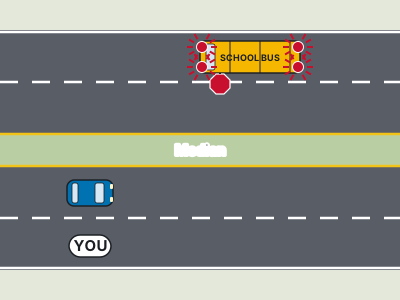
- Traffic following the bus only
- Traffic approaching from the opposite side only
- All traffic in both directions
- No traffic because the median is exactly 20 feet
Show answer
Traffic following the bus only. At a median width of twenty feet or more, the opposite lane of travel is exempt from stopping for the bus. Drivers traveling in the bus direction still must make a complete stop while the red lights flash. The word exactly matters because twenty feet meets the guide's threshold, whereas a narrower median would require every lane to stop. Do not confuse this exception with permission for following traffic to pass the bus.
Study this in the handbook: Stopping for School Buses
13. What should a driver do after seeing this round yellow railroad advance warning sign?

- Accelerate because the warning confirms no train is present
- Stop immediately in the travel lane even when the crossing is distant
- Slow down, look and listen, and be prepared to stop at the tracks
- Move onto the tracks before checking the crossing
Show answer
Slow down, look and listen, and be prepared to stop at the tracks. The round black-on-yellow sign is placed before a public highway-rail intersection. It gives advance notice, so slow down, look and listen for a train, and be prepared to stop at the tracks if one is coming. Stopping immediately in the lane may create a new hazard before the crossing, while accelerating assumes facts the sign does not provide. Never enter the rails merely because the warning is ahead. Use the extra distance to scan and prepare for a controlled stop.
Study this in the handbook: Warning and Railroad Crossing Signs
14. What condition does the skidding-car warning identify?

- A gravel surface begins at the sign
- The lane is reserved for competitive driving
- The roadway may be slippery when wet
- The road is closed whenever rain starts
Show answer
The roadway may be slippery when wet. The skidding-car symbol warns that the roadway may be slippery when wet. Reduce speed before the slick section, increase following room, and avoid abrupt braking or steering. It does not identify a racing area, guarantee gravel, or close the roadway whenever rain begins. The warning communicates a changed traction condition, so smooth inputs and a larger safety cushion help the tires maintain grip. Watch the pavement and weather together, since the hazard becomes more serious as moisture accumulates.
Study this in the handbook: Speed Limits and Road Conditions
15. About how much total stopping distance does a car need at 40 mph, according to the Arkansas guide?
- About 335 feet
- About 40 feet
- About 225 feet
- About 124 feet
Show answer
About 124 feet. Even with good tires, brakes and dry pavement, at 40 mph it can take about 124 feet of total stopping distance, and at 55 mph about 225 feet. The guide presents these figures as the time and distance to allow whenever a hazard in your path forces a stop. Traveling too fast leaves no time to stop for a sudden object in the road, and you should never drive faster than you can see ahead.
Study this in the handbook: Stopping Distance and Following
16. At what speed can tires lose all traction with the road during heavy rain?
- 50 mph
- 35 mph
- 45 mph
- 65 mph
Show answer
50 mph. During heavy rain, tires can lose all traction with the road at 50 mph. That figure is a warning about water and speed, not a target to maintain. The 35 mph choice confuses the lower traction range mentioned for ordinary wet roads with the heavy-rain threshold. Forty-five mph may still be unsafe, but it is not the figure stated for complete traction loss. Slow before standing water, keep steering gentle, and remember that worn tread can make hydroplaning begin sooner.
Study this in the handbook: Slippery Roads and Hydroplaning
17. In Arkansas, who decides which alcohol test a driver must take?
- The driver chooses
- The driver's lawyer
- A judge, before any test
- The law enforcement officer
Show answer
The law enforcement officer. The law enforcement officer chooses which test, breath, urine, or saliva, to request. If an officer instructs you to take an alcohol test, you are compelled by law to do so, and you can lose your license for refusing. The driver, a lawyer, or a judge does not pick the test in advance. Blood alcohol can also be determined by a blood or urine test.
Study this in the handbook: Drinking and Driving
18. What does an orange triangle bordered with red warn road users about?
- A vehicle traveling slower than normal traffic
- A vehicle carrying hazardous material
- A lane reserved for passing
- A railroad crossing with multiple tracks
Show answer
A vehicle traveling slower than normal traffic. The reflective orange triangle with a red border identifies a slow-moving vehicle. It warns approaching drivers to expect a large speed difference and to plan carefully before passing. The hazardous-material option describes a different concern, while the lane and railroad choices refer to roadway controls rather than a vehicle emblem. Seeing this symbol should prompt earlier awareness and a controlled approach instead of a sudden pass.
Study this in the handbook: Speed Limits and Road Conditions
19. For a driver under 18 with a learner's license, when is cell phone use permitted?
- Whenever the phone is hands-free
- Only during an emergency
- Only for navigation
- Whenever a supervising adult approves it
Show answer
Only during an emergency. The learner’s license rule prohibits talking or texting on a cell phone, with an emergency as the exception. Hands-free operation does not create a general permission for this license stage. Navigation and a supervisor’s approval likewise do not replace the statutory exception. A useful cue is to connect the learner stage with minimal distractions: leave the phone alone unless the situation is genuinely an emergency.
Study this in the handbook: Phone Laws and Distracted Driving
20. What is required when a stopped Arkansas school bus has flashing red lights and the median is less than 20 feet wide?
- Only vehicles behind the bus must stop
- Only vehicles facing the bus must stop
- All lanes of traffic must stop
- Drivers may continue if they slow below 20 mph
Show answer
All lanes of traffic must stop. A median narrower than twenty feet does not separate the stopping duty. Every lane in both directions must stop for the bus while its red lights flash. The rule is not limited to vehicles behind the bus, and slowing to a chosen speed does not replace a complete stop. This is the opposite side of the twenty-foot exception: less than twenty requires all traffic to stop, so compare the exact median measurement with the threshold.
Study this in the handbook: Stopping for School Buses
QualitySpace is expanding to Arkansas
We are a California-based independent insurance brokerage working on licensing in more states. We cannot help with Arkansas insurance yet. Leave your email and we will let you know when we can.
Every question is written from the official Arkansas Driver License Study Guide. Need paper? Printable AR practice test with answer key.
Last verified 2026-10-05. How we check every question · Study all 200 as flashcards
Frequently asked questions
How many questions are on this Arkansas practice test?
This fixed set has 20 questions. It is test 7 of 10 from the 200 question Arkansas bank.
How does this fixed test relate to the full Arkansas bank?
Each numbered test is a fixed set of questions in a fixed order, so you can retake the same test later and compare. Every test mixes road signs and the other topics in about the same proportion as the full bank. Tests 1 to 10 together cover every question in the Arkansas bank once. The full practice page mixes the whole bank at random.
Last verified 2026-10-05. See the Arkansas DMV facts page for sourced state details.
Return to the full Arkansas practice test · Study road signs